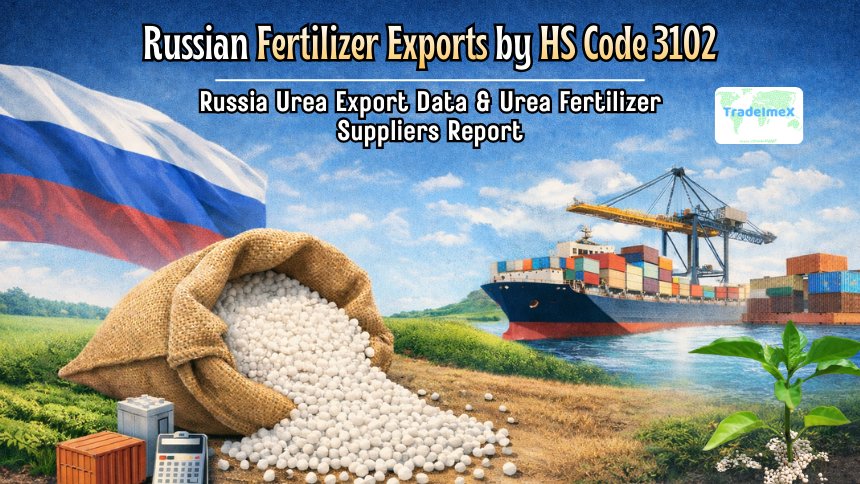
Russian Fertilizer Exports by HS Code 3102: Russia Urea Export Data & Urea Fertilizer Suppliers Report
Explore Russian fertilizer exports under HS Code 3102. Get detailed Russia urea export data, supplier insights, trade volume, & global shipment analysis.

Urea (HS Code 310210 under the broader HS 3102 category for nitrogenous fertilizers) remains one of the most strategically important agricultural commodities in global trade. Russia continues to rank among the world’s top exporters of nitrogen fertilizers, with urea forming a core segment of that export mix. According to the latest Russia export data and Russia customs export data of Urea, the total value of Russia urea exports reached around $3.65 billion in 2025, a 1% increase from the previous year.
In 2024, Russian urea exports are estimated at approximately 9.5–9.8 million metric tons (MMT). Early 2025 shipment projections suggest volumes could exceed 10.5 MMT if current trends hold. Despite geopolitical pressures, tariff shifts in Europe, and trade restructuring, Russian suppliers have maintained, & in some regions expanded, their global market share. It is the most widely used nitrogen fertilizer globally, serving as a foundational input for food production from grains to horticulture. Russia is the largest urea exporter in the world, according to global trade data.
Russia, endowed with abundant natural gas and a large chemical sector, plays a central role in the production and export of urea and related nitrogenous fertilizers. In this 2024–25 review, we examine Russian fertilizer exports performance under HS 3102, spotlighting actual shipments, major destinations, supply dynamics, supplier database, regulatory and geopolitical context, and strategic implications for global agricultural markets.
Russia’s Position in the Global Urea Export Market
Russia has long been one of the world’s largest exporters of urea and related nitrogen fertilizers. According to global trade data for solid urea exports from Russia:
-
Russia is a leading exporter of nitrogenous fertilizers, with total exports of around $4.95 billion in 2024 for the broader nitrogenous category, which includes urea products (HS 3102).
-
Historical customs data indicate that urea exported from Russia has been significant in volume in recent years, with multiple millions of tonnes directed to major agricultural markets.
-
Russia’s export of urea specifically in 2024 was reported by Metals & Mining Intelligence (MMI) as around 9.7 million tons, reflecting a modest increase compared with prior years.
-
Russia’s urea export value was estimated at nearly 3.6 billion in 2025, with continued demand growth expected in successive years.
-
Growth in export value is partially tied to broader fertilizer price trends, which have shown volatility driven by energy prices (natural gas), policy shifts, geopolitical events, and supply chain disruptions.
Russia’s fertilizer export strategy also involves quota systems, controls designed to balance domestic availability with export competitiveness. Taken together, these figures underscore the scale of Russia’s involvement in global urea trade, often accounting for double-digit percentages of total worldwide exports of nitrogen fertilizer products.
HS Code 3102 Explained: Urea in International Trade
HS Code 3102 encompasses mineral or chemical nitrogenous fertilizers, including urea and urea-based blends. Some important sub-classifications include:
-
HS 310210 – Urea, in solid form
-
HS 310220 – Other nitrogenous fertilizers (including urea, ammonium nitrate, UAN)
-
HS 310230, 310240, etc. – Other complex nitrogen formulations
In export reporting, the HS 310210 category (urea) is the most widely tracked by customs databases and international trade platforms.
Russia Urea Exports by Country: Where Does Russia Export Urea Fertilizer?

Russia is a significant player in the global urea fertilizer market, with diverse export destinations geographically spread out. The country exports urea fertilizer to a variety of countries, with key markets being Brazil, the United States, India, and Turkey. Russia's strategic positioning allows for efficient exports and distribution of urea fertilizer to meet the agricultural needs of these countries. The top 10 export destinations for Russian urea, as per the data on Russian urea exports by country and Russia shipment data for 2025, include:
1. Brazil: $836 million (17%)
Brazil stands out as one of the largest importers of urea fertilizer from Russia, accounting for 17% of Russia's urea exports. The agricultural sector in Brazil heavily relies on imported fertilizers to support its vast farmlands and boost crop yields.
2. USA: $761 million (15%)
The United States is another significant importer of urea fertilizer from Russia, making up 15% of Russia's urea exports, as per the data on Russia urea exports to the US by HS code. The demand for fertilizers in the USA is driven by its large-scale agricultural industry, which requires high-quality fertilizers to ensure optimal crop growth.
3. India: $537 million (11%)
India, with its extensive agricultural lands, also imports a substantial amount of urea fertilizer from Russia, accounting for 11% of Russia's urea exports. The Indian agricultural sector relies on imported fertilizers to enhance soil fertility and increase crop productivity.
4. Turkey: $420 million (9%)
Turkey is a key importer of urea fertilizer from Russia, making up 9% of Russia's urea exports. The Turkish agricultural industry depends on imported fertilizers to meet the needs of its diverse crop cultivation and ensure food security.
5. Netherlands: $350 million (7%)
The Netherlands is another important market for Russia's urea exports, accounting for 7% of the total exports. As a major agricultural hub in Europe, the Netherlands demands a significant amount of urea fertilizer to support its intensive farming practices.
6. Finland: $330 million (7%)
Finland imports a substantial amount of urea fertilizer from Russia, making up 7% of Russia's urea exports. The Finnish agriculture sector relies on imported fertilizers for maintaining soil fertility and increasing crop yields in its challenging climate conditions.
7. Mexico: $300 million (6%)
Mexico is a significant importer of urea fertilizer from Russia, accounting for 6% of Russia's urea exports, as per the customs data on Russia urea exports to Mexico. The Mexican agricultural industry uses imported fertilizers to enhance crop quality and achieve sustainable agricultural practices.
8. Colombia: $210 million (4%)
Colombia imports a considerable amount of urea fertilizer from Russia, making up 4% of Russia's urea exports. The Colombian agriculture sector depends on imported fertilizers to support its diverse crop cultivation and ensure food security for its population.
9. Germany: $200 million (4%)
Germany is a key market for Russia's urea exports, accounting for 4% of the total exports. The German agricultural industry relies on imported urea fertilizer to support its advanced farming practices and ensure high crop yields.
10. Belgium: $180 million (3.9%)
Belgium imports a significant amount of urea fertilizer from Russia, making up 3.9% of Russia's urea exports. The Belgian agriculture sector depends on imported fertilizers to maintain soil fertility and support sustainable farming practices.
Russia Urea Fertilizer Suppliers Database: Top Urea Exporters in Russia
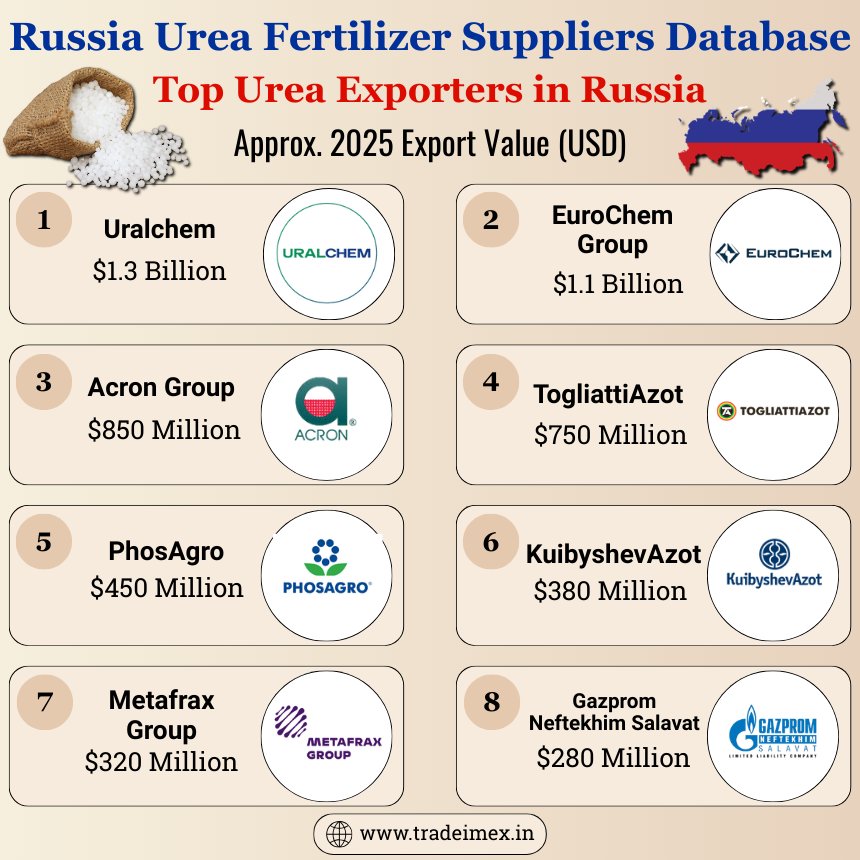
Urea export supply is anchored by a handful of large integrated producers and traders with global distribution networks. Notable contributors, according to the latest Russia urea suppliers database & exporter records for 2025, include:
1. Uralchem
-
Approx. 2025 Export Value: $1.3 Billion
-
Top Export Types (HS 3102): Granular Urea (310210), Prilled Urea, UAN (310280)
-
Top Export Destinations: India, Brazil, Turkey
2. EuroChem Group
-
Approx. 2025 Export Value: $1.1 Billion
-
Top Export Types (HS 3102): Granular Urea, UAN, Ammonium Nitrate (310230)
-
Top Export Destinations: Brazil, EU, US
3. Acron Group
-
Approx. 2025 Export Value: $850 Million
-
Top Export Types (HS 3102): Granular Urea, Ammonium Nitrate, NPK blends
-
Top Export Destinations: EU, Brazil, Africa
4. TogliattiAzot
-
Approx. 2025 Export Value: $750 Million
-
Top Export Types (HS 3102): Urea (industrial & agricultural), Ammonia derivatives
-
Top Export Destinations: Turkey, EU, India
5. PhosAgro
-
Approx. 2025 Export Value: $450 Million
-
Top Export Types (HS 3102): Nitrogen blends, UAN, specialty nitrogen
-
Top Export Destinations: EU, Latin America
6. KuibyshevAzot
-
Approx. 2025 Export Value: $380 Million
-
Top Export Types (HS 3102): Industrial Urea, Caprolactam-linked nitrogen products
-
Top Export Destinations: Brazil, USA
7. Metafrax Group
-
Approx. 2025 Export Value: $320 Million
-
Top Export Types (HS 3102): Industrial Urea, Formaldehyde-linked urea
-
Top Export Destinations: Asia, Turkey
8. Gazprom Neftekhim Salavat
-
Approx. 2025 Export Value: $280 Million
-
Top Export Types (HS 3102): Urea, Ammonia, Nitrogen solutions
-
Top Export Destinations: Turkey, India
9. Shchekinoazot
-
Approx. 2025 Export Value: $220 Million
-
Top Export Types (HS 3102): Urea, Methanol-linked nitrogen
-
Top Export Destinations: EU, CIS countries
10. Minudobreniya Rossii
-
Approx. 2025 Export Value: $120 Million
-
Top Export Types (HS 3102): Bulk Urea shipments (310210)
-
Top Export Destinations: Africa, South Asia
Integrated Fertilizer Producers
-
Uralchem – Leading nitrogen fertilizer manufacturer with substantial urea production capacity.
-
Acron Group – Major producer of nitrogen and complex fertilizers with trade infrastructure.
-
TogliattiAzot – One of the world’s largest ammonia producers, linked to urea production capacity.
-
Beyond these, trade register exports reveal dozens of export-registered entities capable of shipping urea in bulk for international buyers. Export registries indicate that around 80–90 firms are actively involved in urea exports.
Export Trading Houses
Export intermediaries & traders like EuroChem trading subsidiaries & global commodity brokers also act as distribution arms, helping Russian urea reach markets such as the US, South America, and Asia.
For importers and supply chain managers, understanding the specific capabilities and certifications of these suppliers is vital, particularly in managing quality, trade (CFR/FOB), and payment compliance.
Russia Urea Export Data For The Last 10 Years
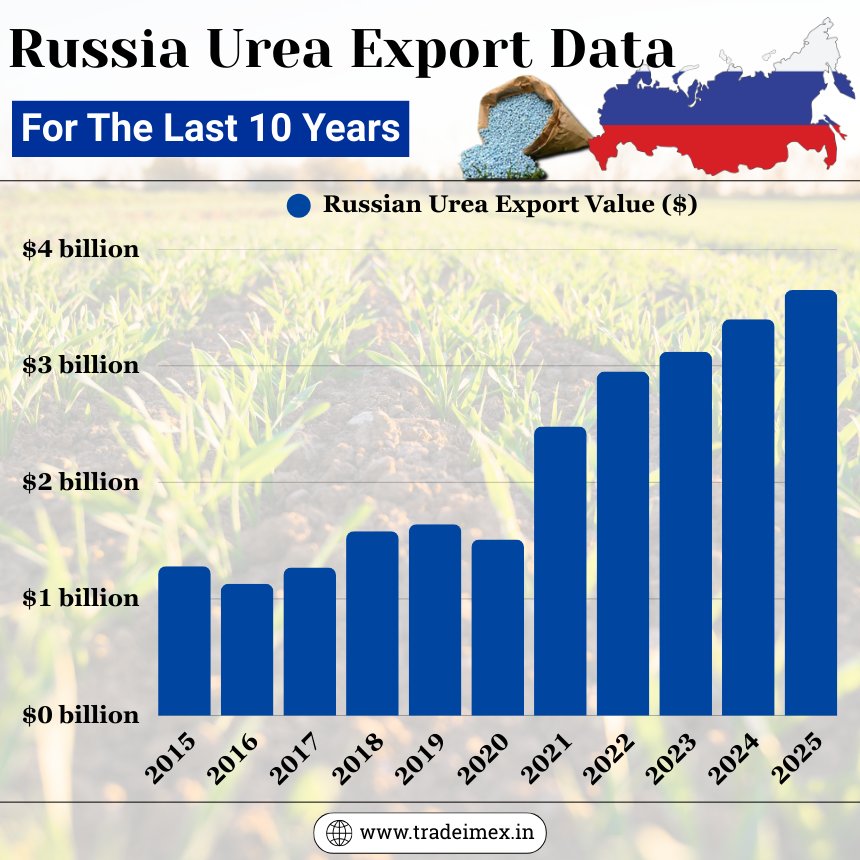
|
Year of Exports |
Russian Urea Export Value ($) |
|
2015 |
$1.28 billion |
|
2016 |
$1.13 billion |
|
2017 |
$1.27 billion |
|
2018 |
$1.58 billion |
|
2019 |
$1.64 billion |
|
2020 |
$1.51 billion |
|
2021 |
$2.48 billion |
|
2022 |
$2.95 billion |
|
2023 |
$3.12 billion |
|
2024 |
$3.40 billion |
|
2025 |
$3.65 billion |
Regulatory, Sanctions & Tariff Factors Impacting Exports
Russian fertilizer exports have unfolded against shifting geopolitical and policy landscapes:
Sanctions & Trade Barriers
-
While most Western sanctions do not explicitly target fertilizer products, tariff barriers and anti-dumping duties, especially in the EU, have complicated the trade environment.
-
Despite these measures, imports into Europe did not collapse but rather persisted at elevated levels before tariffs, showing market inertia due to agricultural dependency.
Export Quotas & Domestic Policy
-
The Russian government has periodically implemented export quotas on nitrogen and compound fertilizers, extending them to manage domestic supply and global pricing.
-
These quota systems can affect the timing, volume, and predictability of export supply, a key consideration for global buyers.
Energy Cost Linkages
Natural gas prices, a critical input for urea manufacture, influence Russian fertilizer economics. Lower domestic gas prices and a depreciated ruble have preserved export competitiveness compared with Western producers.
Russian Urea Demand Drivers in Key Import Markets
India
India’s fertilizer import dynamics shifted substantially toward Russia:
-
Agricultural import data shows a strong presence of Russian fertilizers in Indian imports, mostly nitrogen, phosphate, and potash products.
-
Long-term collaborations, including joint ventures between Russian producers and Indian firms to boost domestic capacities, signal deeper integration.
India’s demand is propelled by the need to maintain yield stability, support food security, and diversify away from traditional Middle Eastern/Asian suppliers.
United States
In the US market, Russia has emerged as a leading urea supplier, accounting for nearly a quarter of total imports per recent trade data.
Europe
Despite tariffs and political pressures, European urea import demand has remained significant, underlining structural reliance on imported nitrogen fertilizers as domestic production capacity declined.
Latin America & Africa
These regions are strategic growth foci, where pricing advantage and trade efficiencies make Russian urea an appealing option to offset local production constraints.
Market Outlook & Strategic Implications
Expansion Expectations
Industry analysts project continued growth in Russian urea export volumes into 2026 and beyond, underpinned by resilient global fertilizer demand, production capacity expansions, and market diversification.
Russian fertilizer producers have also publicly targeted increased global market share, aiming for around 25% of the global mineral fertilizer trade by 2030.
Price and Competitiveness
Global fertilizer prices are influenced by Russian export pricing strategies, often offering competitive CIF/CFR terms to attract buyers outside traditional markets.
However, potential policy shifts (e.g., escalation of tariffs or broader sanctions) could reposition export flows and prompt buyers to diversify sources.
Supply Chain Considerations
For importers, whether agricultural conglomerates, national procurement agencies, or commodity traders, key considerations include:
-
Supplier reliability: contractual certainty in the context of quotas and regulatory shifts.
-
Trade planning: port handling, transshipment hubs, and seasonal demand cycles.
-
Compliance risks: navigating tariffs, sanctions screening, and documentation requirements.
Practical Takeaways for Fertilizer Buyers & Market Stakeholders
Whether securing urea for agricultural programs or planning long-term sourcing strategies, stakeholders should consider:
-
Russia remains a core global exporter of urea (HS 3102), with growing volumes and diverse destination reach.
-
Top supply markets include India, the EU, and the United States, each with distinct regulatory and tariff profiles.
-
Supplier profiles range from vertically integrated chemical majors to smaller export houses, offering varying terms, volumes, and export arrangements.
-
Regulatory landscapes are evolving, with tariffs and geopolitical risks impacting trade costs and supply certainty.
-
Demand drivers in Asia and the Americas are underpinning robust global urea import needs.
Conclusion and Final Thoughts
Russia’s fertilizer export landscape, particularly for urea under HS Code 3102, reflects a combination of large production capacity, global market integration, shifting demand centers, and dynamic policy environments. From 2024 through 2025, data reveals rising volumes and expanding ties with agricultural markets across Asia, the Americas, and Europe.
For global agribusinesses, policymakers, and supply chain planners, understanding these patterns is essential, not just for efficient procurement but for managing geopolitical risk, price volatility, and long-term food security strategies. As Russia adjusts its export priorities and partner markets, the fertilizer sector will remain a strategic component of global agricultural trade.
Note for Our Readers
We hope you found this detailed report on Russian Urea Exports under HS Code 3102 informative and actionable. If you’re looking for deeper insights into Russia urea exports by country, HS code–wise shipment breakdowns (310210, 310230, 310280, etc.), monthly trade trends, or a verified database of Russian urea suppliers & exporters, TradeImeX can support your analysis.
Access detailed Russia import-export shipment data, company-level trade intelligence, port-wise movement analysis, pricing benchmarks, and supplier verification tools tailored to your procurement or market expansion strategy.
Turn real trade data into real fertilizer market opportunities with our specialized global trade database solutions. For inquiries, partnerships, or to request a sample dataset, feel free to reach out at info@tradeimex.in and discover how data-driven decisions can strengthen your position in the global urea and nitrogen fertilizer market.
Also read:
Share
What's Your Reaction?
 Like
0
Like
0
 Dislike
0
Dislike
0
 Love
0
Love
0
 Funny
0
Funny
0
 Angry
0
Angry
0
 Sad
0
Sad
0
 Wow
0
Wow
0