Exploring the Top Iran Trade Partners: Iran Exports & Imports by Country (2025–26)
Explore Iran’s top trade partners in 2025–26 with detailed insights into Iran exports & imports by country. Analyze key markets to support smarter business decisions.

Iran’s trade landscape in 2025–26 is a story of resilience under pressure. Despite years of economic sanctions, shifting geopolitical alliances, and disruptions in global energy markets, Iran continues to maintain a functioning and strategically adaptive trade network. What makes Iran’s trade profile unique is not just what it trades, but how and with whom it trades. Iran's imports totaled $69.4 billion in 2025, up 4.5% from the year before, according to Iran import data. According to the Iran export data, the total value of Iran exports reached $113.2 billion in 2025, a 2% increase from the previous year. As per the data on Iran's trade partners, China remains the largest trading partner of Iran.
Iran's total trade accounted for $182.6 billion in 2025, according to Iran customs data and global trade data. This blog takes a data-driven deep dive into Iran’s top trade partners, its export-import structure, and the evolving dynamics shaping its global trade in 2025–26.
Iran’s Trade Overview: A Snapshot
Iran’s external trade remains heavily influenced by its energy sector and geopolitical constraints. Recent figures show:
-
Total exports (2025): $113 billion
-
Total imports (2025): $69 billion
-
Trade deficit: $44 billion
This persistent trade deficit reflects Iran’s dependence on imported machinery, pharmaceuticals, & industrial inputs. The Iranian economy is also dependent on the leading Iran trade partners.
Key Characteristics of Iran’s Trade Structure
1. Heavy Reliance on Oil Exports
Oil and gas dominate Iran’s exports, accounting for over 80% of export revenues.
2. Regional and Sanctions-Driven Trade
Due to sanctions:
-
Trade is concentrated in Asia and neighboring countries
-
Western markets are accessed indirectly via intermediaries
3. Barter and Alternative Payment Systems
Iran uses:
-
Local currency swaps (e.g., rupee-rial with India)
-
Barter trade (e.g., oil for goods with Russia or Venezuela)
Top Import Partners of Iran: Iran Imports by Country
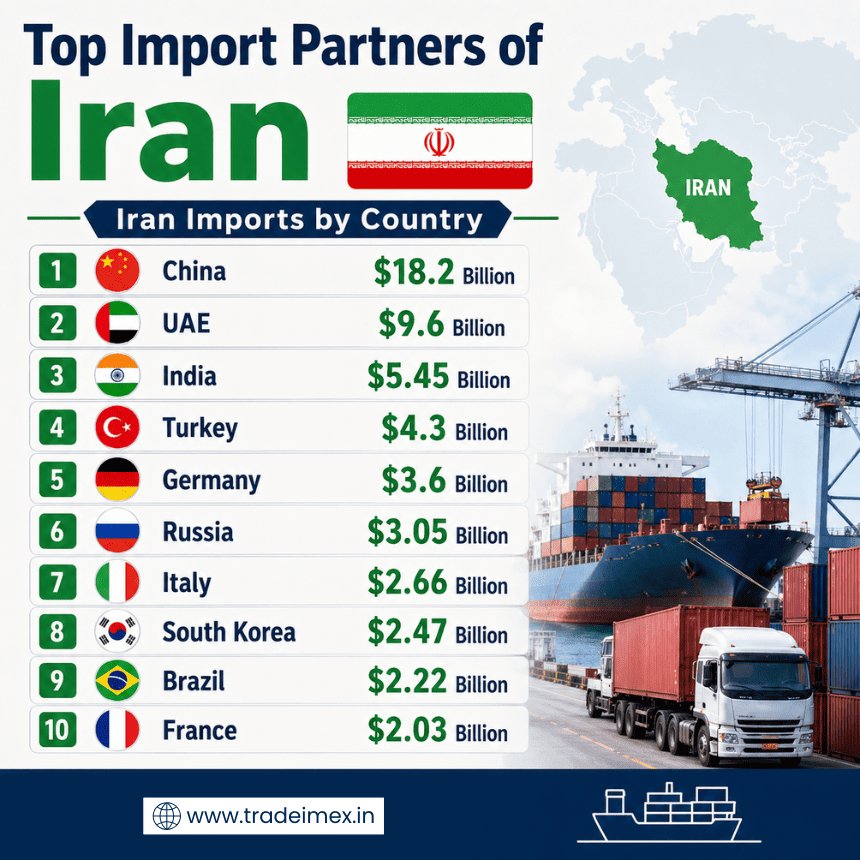
Iran's economy heavily relies on imports to meet its domestic demands and sustain its industries, as per the data on Iran imports. Iran's top import partners play a crucial role in shaping the country's import landscape. Currently, China stands out as one of Iran's major import partners, contributing significantly to the country's import activity. Additionally, the United Arab Emirates, India, and Turkey hold prominent positions as key import partners, fueling Iran's economy through critical trade. The top import partners of Iran, as per the Iran trade data & Iran imports by country for 2025, include:
1. China: $18.2 billion (28.7%)
China stands as Iran's top import partner, contributing significantly to Iran's import market. With a trade value of $18.2 billion, China holds a substantial share of Iran's imports, reflecting the strong trade ties between the two nations. Iran imports a wide range of products from China, including machinery, electronics, and consumer goods.
2. UAE: $9.6 billion (15.1%)
The United Arab Emirates (UAE) is another key import partner of Iran, accounting for $9.6 billion in trade value. The close geographical proximity between Iran and the UAE facilitates smooth trade relations, with a focus on oil, gas, and petrochemical products. The UAE serves as a vital gateway for Iran's imports and plays a crucial role in Iran's trade network.
3. India: $5.45 billion (8.6%)
India emerges as a significant import partner for Iran, with trade valued at $5.45 billion. Iran imports various goods from India, including agricultural products, pharmaceuticals, and textiles. The strong historical ties between Iran and India foster a robust trading relationship, driving economic cooperation between the two nations.
4. Turkey: $4.3 billion (6.8%)
Turkey holds a notable position as one of Iran's top import partners, with trade amounting to $4.3 billion. Iran imports a diverse range of products from Turkey, such as machinery, iron, and steel. The strategic location of Turkey as a bridge between Europe and the Middle East enhances trade connectivity and promotes bilateral trade between Iran and Turkey.
5. Germany: $3.6 billion (5.7%)
Germany plays a crucial role in Iran's import market, with trade worth $3.6 billion. Iran imports high-tech products, machinery, & automotive parts from Germany, showcasing the depth of economic cooperation between the two countries, as per the data on Germany exports to Iran. The quality and reliability of German products contribute to Germany's prominence as an import partner for Iran.
6. Russia: $3.05 billion (4.8%)
Russia serves as a key import partner for Iran, with trade valued at $3.05 billion. Iran imports energy products, machinery, and agricultural goods from Russia, strengthening bilateral trade relations. The strategic partnership between Iran and Russia drives economic collaboration and promotes mutual growth in trade and investment.
7. Italy: $2.66 billion (4.2%)
Italy is one of Iran's top import partners, with trade totaling $2.66 billion. Iran imports machinery, textiles, and chemicals from Italy, reflecting the diversification of Iran's import sources. The cultural and historical ties between Iran and Italy foster trade cooperation and stimulate economic exchanges between the two countries.
8. South Korea: $2.47 billion (3.9%)
South Korea emerges as a significant import partner for Iran, with trade valued at $2.47 billion. Iran imports electronics, automotive parts, and machinery from South Korea, highlighting the technological expertise of South Korean products. The growing trade relations between Iran and South Korea underscore the potential for further collaboration in various sectors.
9. Brazil: $2.22 billion (3.5%)
Brazil occupies a notable position as one of Iran's top import partners, with trade worth $2.22 billion. Iran imports agricultural products, livestock, and food items from Brazil, showcasing the diversity of goods exchanged between the two countries. The strengthening economic ties between Iran and Brazil open up new opportunities for trade expansion and economic growth.
10. France: $2.03 billion (3.2%)
France plays a significant role in Iran's import market, with trade amounting to $2.03 billion. Iran imports luxury goods, cosmetics, & pharmaceuticals from France, reflecting the high-quality products sourced from France. The cultural & commercial ties between Iran and France promote mutual understanding and foster trade relations in various sectors.
Top Export Partners of Iran: Iran Exports by Country
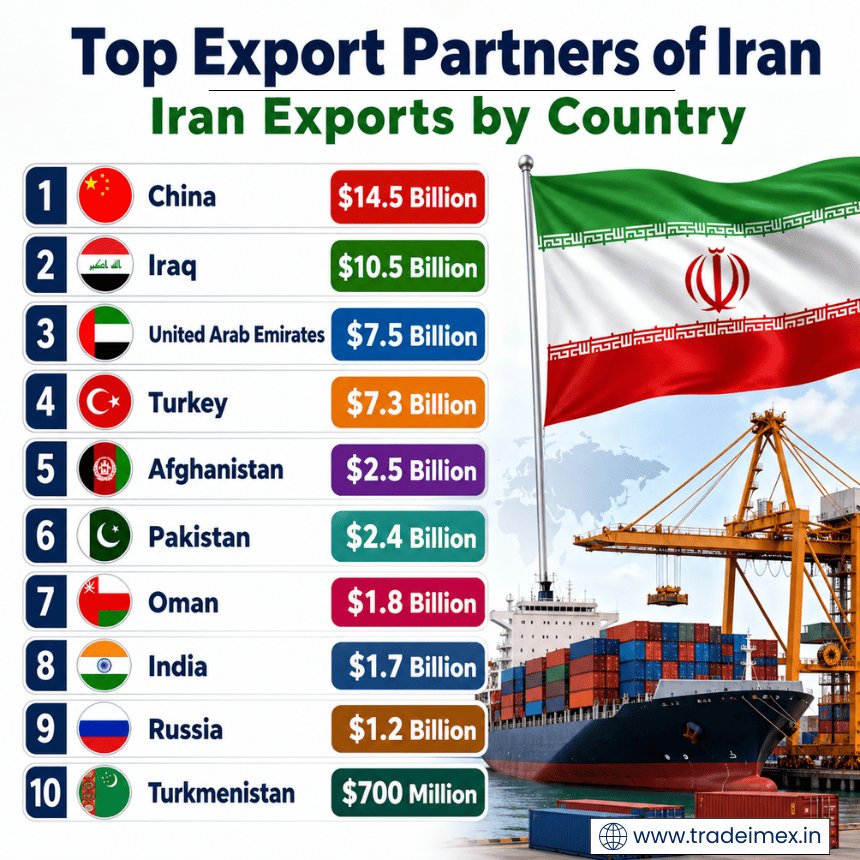
Iran's top export partners play a crucial role in shaping the country's economy. In terms of Iran's exports by country, China stands out as the leading destination, absorbing a significant portion of Iranian goods. Following closely behind, the United Arab Emirates and Iraq also hold key positions as major export partners of Iran. These partnerships not only contribute to Iran's trade growth but also reflect the interconnected nature of the global economy. The top 10 export partners of Iran, as per the data on Iran exports by country and Iran shipment data for 2025, include:
1. China: $14.5 Billion (12.8%)
China stands out as Iran's top export partner, with exports amounting to $14.5 billion, accounting for 12.8% of Iran's total exports. The strong trade relationship between Iran and China is fueled by mutual interests in various industries, including oil, gas, and technology. With China's growing economy and demand for energy resources, Iran's oil exports play a crucial role in strengthening this partnership.
2. Iraq: $10.5 Billion (9.2%)
Iraq is another key export partner for Iran, with trade between the two countries reaching $10.5 billion. As neighboring countries, Iran and Iraq share a long history of economic cooperation, particularly in the energy sector. Iran's exports to Iraq include oil, gas, and agricultural products, contributing significantly to the bilateral trade volume.
3. United Arab Emirates: $7.5 Billion (6.6%)
The United Arab Emirates (UAE) holds a vital position as one of Iran's top export partners, with exports valued at $7.5 billion. The strategic location of the UAE as a major hub for global trade makes it an essential partner for Iran. The two countries engage in trade across various sectors, with Iran exporting oil, gas, and petrochemical products to the UAE.
4. Turkey: $7.3 Billion (6.4%)
Turkey emerges as another significant export partner for Iran, with trade reaching $7.3 billion. The geographical proximity between Iran and Turkey facilitates trade relations, with both countries benefiting from the exchange of goods and services. Iran exports a diverse range of products to Turkey, including minerals, textiles, and agricultural goods.
5. Afghanistan: $2.5 Billion (2.2%)
Afghanistan holds a notable position among Iran's export partners, with trade amounting to $2.5 billion. The proximity and historical ties between Iran and Afghanistan have created a conducive environment for trade relations. Iran exports a variety of goods to Afghanistan, such as food products, construction materials, and machinery.
6. Pakistan: $2.4 Billion (2.1%)
Pakistan is also a significant export partner for Iran, with trade valued at $2.4 billion. The two countries share a long border and cultural connections, fostering robust trade relations. Iran's exports to Pakistan include petroleum products, chemicals, and machinery, contributing to the bilateral trade volume.
7. Oman: $1.8 Billion (1.5%)
Oman features prominently as one of Iran's key export partners, with trade reaching $1.8 billion. The geographical proximity between Iran and Oman facilitates trade relations, with both countries engaging in the exchange of goods and services. Iran exports oil, gas, and petrochemical products to Oman, enhancing the bilateral trade volume.
8. India: $1.7 Billion (1.5%)
India holds a significant position as one of Iran's top export partners, with trade valued at $1.7 billion. The historical ties and cultural connections between Iran and India have laid the foundation for strong trade relations. Iran exports a range of products to India, including oil, textiles, and agricultural goods.
9. Russia: $1.2 Billion (1.1%)
Russia emerges as an important export partner for Iran, with trade amounting to $1.2 billion. The strategic partnership between Iran and Russia spans various industries, including energy, agriculture, and technology. Iran exports oil, gas, and minerals to Russia, contributing to the bilateral trade volume.
10. Turkmenistan: $700 Million (0.6%)
Turkmenistan holds a noteworthy position among Iran's export partners, with trade reaching $700 million. The geographical proximity and shared interests between Iran and Turkmenistan have fostered strong trade relations. Iran exports natural gas, chemicals, and construction materials to Turkmenistan, enhancing the bilateral trade volume.
Iran’s Major Export Commodities
1. Oil and Gas
-
Largest export category
-
80%+ of export revenue
2. Petrochemicals
-
Methanol, urea, polyethylene
-
Major buyers: China, India, Southeast Asia
3. Agricultural Products
-
Saffron (90% of global supply)
-
Pistachios, dates
4. Industrial and Traditional Goods
-
Carpets and handicrafts
-
Metals and ceramics
Iran’s Major Import Commodities
1. Machinery and Equipment
-
17% of imports
2. Metals and Industrial Inputs
-
Iron and steel (14%)
3. Chemicals and Pharmaceuticals
-
11% of imports
4. Vehicles and Transport Equipment
-
9%
5. Electronics
-
7%
Iran Trade in The Last 10 Years: Historical Import-Export Data
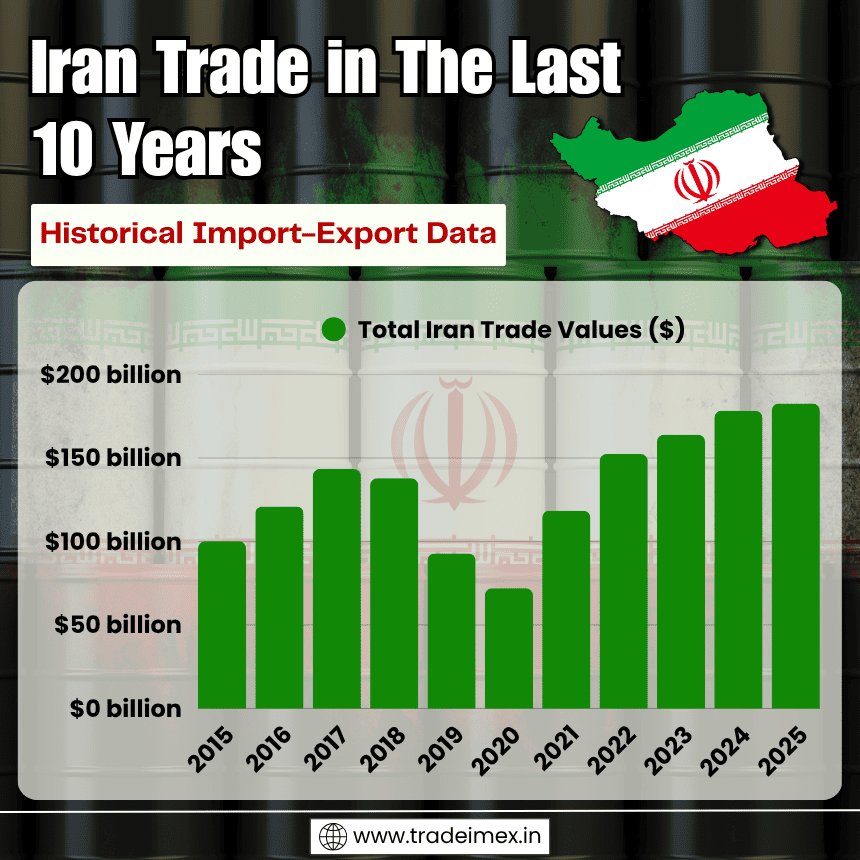
|
Year of Trade |
Total Iran Trade Values ($) |
|
2015 |
$100.08 billion |
|
2016 |
$120.96 billion |
|
2017 |
$143.34 billion |
|
2018 |
$137.84 billion |
|
2019 |
$92.87 billion |
|
2020 |
$71.94 billion |
|
2021 |
$118.47 billion |
|
2022 |
$152.37 billion |
|
2023 |
$163.98 billion |
|
2024 |
$178.25 billion |
|
2025 |
$182.60 billion |

Iran Trade Balance and Economic Implications
Iran consistently runs a trade deficit, driven by:
-
Heavy import needs for industrial development
-
Limited export diversification beyond oil
However:
-
Non-oil exports reached $43+ billion in recent estimates
-
Suggests gradual diversification
Trade Agreements Shaping Iran’s Global Trade
Iran’s trade relationships are not only driven by bilateral exchanges but also supported by a growing network of regional and strategic trade agreements. These agreements play a critical role in helping Iran bypass sanctions, reduce tariffs, and strengthen economic ties with non-Western partners.
1. Eurasian Economic Union (EAEU) Free Trade Agreement
One of the most significant developments in recent years is Iran’s Free Trade Agreement with the Eurasian Economic Union (EAEU), which officially came into force in May 2025.
-
Covers Russia, Kazakhstan, Belarus, Armenia, and Kyrgyzstan
-
Provides preferential or zero tariffs on nearly 87–90% of goods
-
Reduces average customs duties from around 20% to ~4.5%
-
Expected to significantly boost trade volumes, potentially reaching $10–12 billion in the medium term
This agreement is particularly important because it marks Iran’s first comprehensive multilateral FTA, strengthening its integration with Eurasian markets and providing new export opportunities in sectors like petrochemicals, steel, and agriculture.
2. Economic Cooperation Organization Trade Agreement (ECOTA)
Iran is also a founding member of the Economic Cooperation Organization (ECO), which includes countries such as Pakistan, Turkey, Afghanistan, and the Central Asian states.
-
ECOTA promotes preferential tariffs and regional trade integration.
-
ECO Vision 2025 aims to establish a free trade area among key member nations.
-
Iran’s trade with ECO countries reached $27.6 billion in 2025, showing strong regional growth.
This agreement supports Iran’s strategy of regionalizing trade, especially with neighboring and land-connected economies.
3. Iran–Russia Strategic Economic Partnership (2025)
In 2025, Iran and Russia signed a Comprehensive Strategic Partnership Treaty, deepening economic cooperation alongside political and military ties.
-
Focuses on trade expansion, banking cooperation, and sanctions mitigation
-
Encourages the use of national currencies and alternative financial systems
-
Complements the EAEU trade framework, strengthening bilateral trade flows
This partnership reflects Iran’s pivot toward sanction-resistant economic alliances.
4. Preferential and Bilateral Trade Agreements
Beyond major frameworks, Iran has:
-
20+ preferential and bilateral trade agreements with various countries
-
Ongoing negotiations to expand trade corridors, especially through:
-
The International North–South Transport Corridor (INSTC)
-
Regional trade and customs cooperation initiatives
These agreements help Iran maintain trade continuity despite global restrictions.
Impact of Sanctions on Iran’s Trade Patterns
Sanctions have reshaped Iran’s trade in several ways:
1. Shift Toward Asia
-
China dominates oil imports
-
Regional trade replaces Western markets
2. Shadow Trade Networks
-
Use of intermediaries and “ghost shipping.”
-
Oil traded at discounted prices
3. Reduced Diversification
-
Heavy reliance on a few countries (especially China)
Emerging Trends in 2025–26
1. Increasing Dependence on China
China’s share in Iran’s exports and imports continues to grow, making Iran economically tied to Chinese demand.
2. Regionalization of Trade
Trade is becoming more:
-
Border-based (Pakistan, Iraq)
-
Regional (Turkey, UAE)
3. Geopolitical Disruptions
Recent tensions affecting oil routes (e.g., Strait of Hormuz disruptions) have:
-
Reduced shipments temporarily
-
Forced countries to diversify suppliers
4. Sanctions Tightening
New sanctions targeting oil shipments and shipping networks continue to pressure Iran’s trade flows
Opportunities and Challenges
Opportunities
-
Strong energy reserves
-
Strategic geographic location
-
Growing regional trade
Challenges
-
Overdependence on oil exports
-
Limited access to global financial systems
-
Trade concentration risk (China-heavy)
Future Outlook: Iran Trade Beyond 2026
Iran’s trade future depends on three key factors:
1. Sanctions Environment
-
Easing sanctions for diversification and growth
-
Tightening sanctions due to deeper reliance on Asia
2. Energy Market Trends
-
Oil demand will continue to shape export revenues
3. Regional Integration
-
Trade corridors with Central Asia and the Middle East could expand
Conclusion and Final Thoughts
In conclusion, Iran’s trade ecosystem in 2025–26 is a mix of constraints and adaptation. While sanctions have limited its global reach, they have also forced Iran to innovate through alternative trade mechanisms and stronger regional ties. China stands firmly at the center of Iran’s trade network, followed by key regional partners like Iraq, Turkey, and the UAE. On the import side, Iran remains dependent on foreign machinery, technology, and consumer goods, sustaining a structural trade deficit.
The country’s long-term trade success will depend on its ability to diversify exports beyond oil, expand trade partnerships, & navigate the complex geopolitical environment shaping global trade. In many ways, Iran’s trade story is not just about numbers. It’s about survival, strategy, and adaptation in one of the most challenging economic environments in the world.
Note For Our Readers
We hope this blog has given you a clear, data-driven view of Iran’s trade landscape in 2025–26, from its key export and import partners to the structural role of oil, regional trade dependencies, and the growing influence of countries like China, the UAE, and neighboring markets. As global trade continues to shift under the weight of geopolitical tensions, sanctions, and evolving energy dynamics, understanding Iran’s trade patterns is essential for businesses, analysts, and policymakers tracking opportunities and risks in the region.
If you’re looking to go beyond high-level insights and need more detailed, actionable trade intelligence, TradeImeX can support your business needs. With access to comprehensive global import-export data, including country-wise trade flows, HS code-level analysis, and real-time shipment tracking, you can gain a deeper understanding of Iran’s trading ecosystem & search live import-export data by country or HS code. Reach out to us at info@tradeimex.in to strengthen your strategy in the evolving global trade environment.
Share
What's Your Reaction?
 Like
2
Like
2
 Dislike
0
Dislike
0
 Love
0
Love
0
 Funny
0
Funny
0
 Angry
0
Angry
0
 Sad
0
Sad
0
 Wow
0
Wow
0