Top Spice Importers & Global Spice Imports Data 2024-25: Spices Imports by Country
Discover the latest global spice import data for 2024-25, including the top spice-importing countries, leading spice varieties, & top spice importers.

In today's global market, the spice trade plays a significant role in shaping world economies and culinary cultures. As the demand for exotic and flavorful spices continues to grow, countries around the world engage in importing various spices to satisfy consumer preferences. According to the global trade data and spices import data, the total value of global spice imports reached $4.05 billion in 2024, a 4% increase from the previous year. The spice industry is a multi-billion-dollar market that involves the trade of a wide variety of spices, including pepper, cinnamon, cloves, turmeric, and more.
According to recent data, global spice imports are projected to increase significantly in the coming years, with a forecasted growth rate of over 5% by 2025. Countries in Asia, Europe, North America, and beyond are expected to ramp up their spice imports to cater to the growing demand for exotic flavors in the food industry, as per the World Spice Organization report. The global spice trade has entered a new phase of maturity and complexity in 2024–25. After two years of volatility driven by supply chain disruptions and inflationary pressures, the spice import market has regained momentum. In this article, we will explore the key players in the spice import market and how different countries are contributing to the spice trade. Let's dive in and uncover the exciting world of spice imports!
Exploring the Spice Import Market
Spices have been an integral part of global trade for centuries, adding flavor and aroma to cuisines around the world. With globalization and the demand for diverse culinary experiences on the rise, the spice import market is thriving. From exotic spices like saffron and cardamom to everyday essentials like pepper and cinnamon, there is a wide variety of spices being imported across borders every day. The top spice importers in the world play a crucial role in sourcing high-quality spices from different regions and making them available to consumers globally. Countries like the United States, Germany, and the United Kingdom are known for their significant imports of spices from various countries. Here are some Global Spice Import Trends in 2024-25:
-
Global spice imports reached over $4 billion in 2024, with pepper, chili, and turmeric being the most traded spices.
-
The United States remained the largest importer, followed by China, Germany, and India.
-
Pepper alone accounted for over $2.5 billion in global trade value.
-
Rising demand for organic and traceable spices is driving imports by companies like Frontier Co‑op and Olam.
-
Spice price trends varied: cardamom and pepper saw price drops, while turmeric and cinnamon prices increased due to lower yields.
Top 10 Spices Importing Countries in 2024-25: Spices Imports by Country

In the 2024-25 report on spice-importing countries, the top 10 nations leading in spice imports were revealed. These countries play a key role in the global spice market, with their imports shaping industry trends. The list sheds light on the significant contributors in the spice trade, showcasing their reliance on imported spices to meet market demands and cater to diverse consumer preferences. The top spice importers, such as the US, Saudi Arabia, and Germany, led the spice import market in 2024. The leading top 10 spices importing countries in 2024-25, as per the data on spices imports by country and global spice import shipment data, include:
1. USA: $466.08 million (11.5%)
The United States tops the list as the largest importer of spices, with a total import value of $466.08 million, accounting for 11.5% of the global spice trade, as per the US spices import data. The country's diverse culinary landscape and multicultural population drive the demand for a wide variety of spices from around the world, as per the American Spice Trade Association.
Top Spices Imported:
-
Black Pepper
-
Turmeric
-
Cumin Seeds
-
Chili Powder
-
Cinnamon
2. Saudi Arabia: $295.29 million (7.3%)
Saudi Arabia holds the second position in the list of top spice-importing countries, with an import value of $295.29 million, making up 7.3% of the global spice market. The country's rich culinary traditions, particularly in Middle Eastern and Arabic cuisine, fuel the demand for an array of spices.
Top Spices Imported:
-
Cardamom
-
Black Pepper
-
Cloves
-
Saffron
-
Cumin
3. Netherlands: $253.03 million (6.2%)
The Netherlands ranks third among the top spice-importing countries, with imports totaling $253.03 million, representing 6.2% of the global spice trade, as per the Netherlands spices import data by HS code. The country's strategic location as a transshipment hub and its well-established trading networks contribute to its significant spice imports.
Top Spices Imported:
-
Black Pepper
-
Nutmeg
-
Ginger
-
Turmeric
-
Paprika
4. Germany: $232.26 million (5.7%)
Germany is another key player in the global spice trade, with imports amounting to $232.26 million, accounting for 5.7% of the total spice market. The country's strong culinary culture and preference for a wide range of spices drive its substantial imports.
Top Spices Imported:
-
Black Pepper
-
Mustard Seeds
-
Paprika
-
Coriander
-
Nutmeg
5. United Arab Emirates: $186.75 million (4.6%)
The United Arab Emirates secures the fifth spot on the list, with spice imports valued at $186.75 million, representing 4.6% of the global spice trade. The country's vibrant food scene and its role as a crossroads for international trade contribute to its significant spice imports.
Top Spices Imported:
-
Cardamom
-
Black Pepper
-
Cloves
-
Cinnamon
-
Saffron
6. Bangladesh: $165.68 million (4.1%)
Bangladesh emerges as a major importer of spices, with a total import value of $165.68 million, making up 4.1% of the global spice market. The country's rich culinary heritage and spice-centric dishes drive the demand for various spices from around the globe.
Top Spices Imported:
-
Chili Powder
-
Turmeric
-
Cumin Seeds
-
Coriander
-
Black Pepper
7. United Kingdom: $163.17 million (4%)
The United Kingdom features prominently in the global spice trade, with imports amounting to $163.17 million, accounting for 4% of the total spice market. The country's diverse population and growing interest in international cuisines contribute to its significant spice imports.
Top Spices Imported:
-
Curry Powder
-
Black Pepper
-
Turmeric
-
Paprika
-
Ginger
8. Japan: $151.61 million (3.7%)
Japan holds a key position in the global spice trade, with imports totaling $151.61 million, representing 3.7% of the global spice market. The country's culinary traditions, including its use of spices in various dishes, drive its substantial imports.
Top Spices Imported:
-
Black Pepper
-
Chili Powder
-
Turmeric
-
Ginger
-
Wasabi
9. Spain: $120.86 million (3%)
Spain is a notable importer of spices, with imports valued at $120.86 million, making up 3% of the global spice trade. The country's vibrant food culture, which includes the use of an array of spices in traditional dishes, contributes to its significant spice imports.
Top Spices Imported:
-
Paprika
-
Saffron
-
Black Pepper
-
Oregano
-
Garlic Powder
10. France: $118.96 million (2.9%)
France rounds out the list of the top spice-importing countries, with a total import value of $118.96 million, accounting for 2.9% of the global spice market. The country's gourmet cuisine and culinary excellence drive the demand for high-quality spices from around the world.
Top Spices Imported:
-
Black Pepper
-
Mustard Seeds
-
Nutmeg
-
Cinnamon
-
Cloves
List of Top Spice Importers: Global Spices Importers Database 2025
Global Spices Importers Database is a comprehensive resource that provides valuable information on key players in the global spice import industry and spice importers directory. This meticulously curated database offers insights into the top spice importers worldwide, assisting businesses in identifying potential partners and expanding their reach in the market. Top spice importers or spice import companies such as McCormick & Company, Kerry Group, Olam International, & Everest Spices lead the global spices import market, as per the spice importers list. The top 10 leading spice importers in the world, as per the spices importers data and spices buyers list for 2024-25, include:
|
Rank |
Company Name |
Origin Country |
Approx. Import value (2024) |
Top Imported Spices |
|
1 |
McCormick & Company |
USA |
$5 billion |
Pepper, Cinnamon, Ginger, Vanilla, Spice Blends |
|
2 |
Kerry Group |
Ireland |
$2.8 billion |
Curry, Turmeric, Pepper, Spice Extracts |
|
3 |
Olam International |
Singapore |
$1.2 billion |
Black Pepper, Cardamom, Cumin |
|
4 |
Ajinomoto Co., Inc. |
Japan |
$1 billion |
Ginger, Pepper, Seasoning Blends |
|
5 |
Everest Spices |
India |
$900 million |
Pepper, Chili, Cumin, Coriander |
|
6 |
George Weston Foods |
Australia |
$800 million |
Cinnamon, Vanilla, Pepper |
|
7 |
DS Group |
India |
$700 million |
Cumin, Turmeric, Cardamom, Chili |
|
8 |
Unilever |
UK |
$600 million |
Pepper, Cinnamon, Spice Extracts |
|
9 |
Frontier Co‑op |
USA |
$500 million |
Organic Pepper, Cinnamon, Herbs |
|
10 |
Baria Pepper |
Vietnam |
$400 million |
Black Pepper, White Pepper |
Top 10 Spices Imported in 2024-25: Spice Imports by Variety
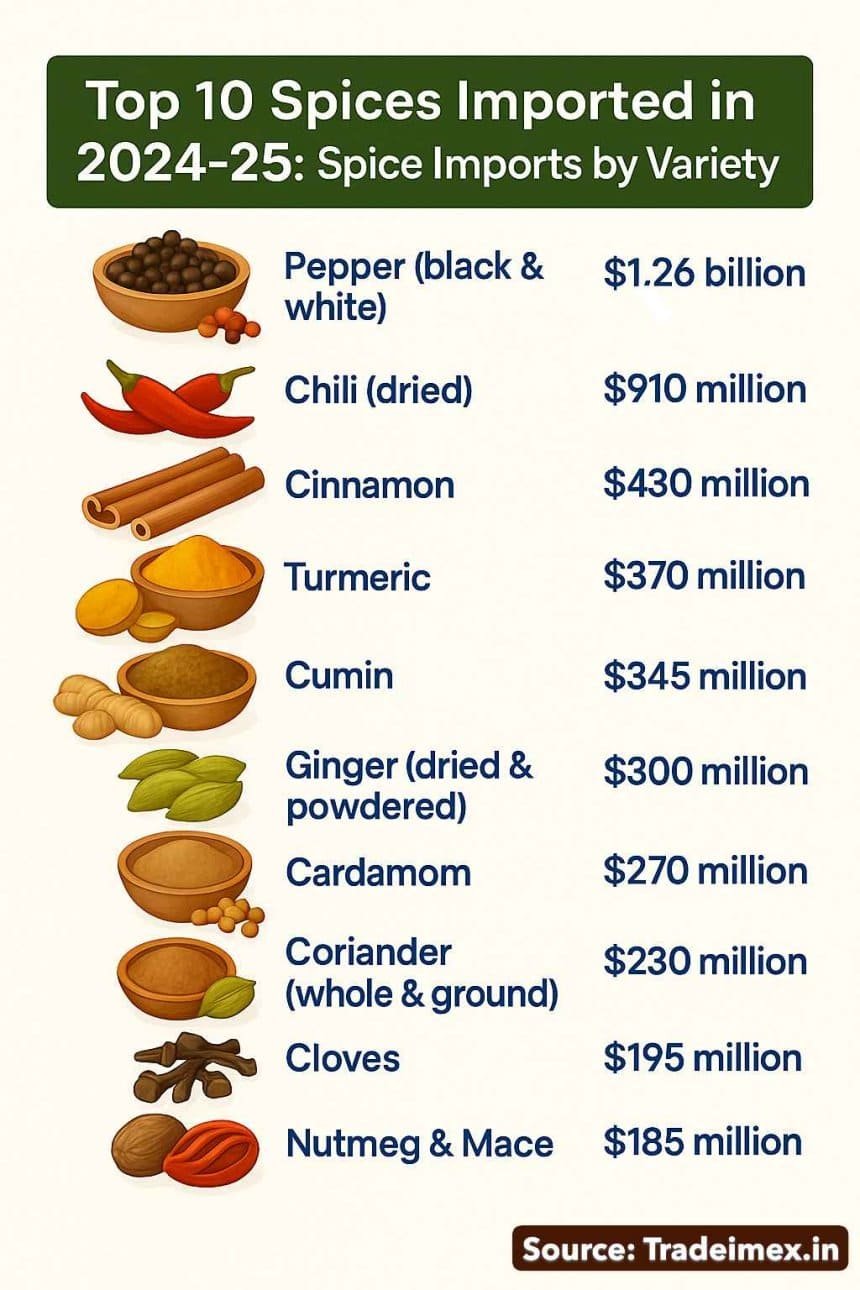
In the year 2024-25, the top 10 spices imported by variety highlighted significant trends in spice imports. The data shed light on the diverse range of flavors making their way into international markets. Among the top imports were familiar favorites such as cinnamon, pepper, and turmeric, alongside emerging contenders like sumac and za'atar. The top 10 imported spice varieties, as per the data on spice imports by type and spices import statistics for 2024-25, include:
-
Pepper (black & white): $1.26 billion
-
Chili (dried): $910 million
-
Cinnamon: $430 million
-
Turmeric: $370 million
-
Cumin: $345 million
-
Ginger (dried & powdered): $300 million
-
Cardamom: $270 million
-
Coriander (whole & ground): $230 million
-
Cloves: $195 million
-
Nutmeg & Mace: $185 million
Global Spice Imports in the Last 10 Years: Yearly Spice Import Data

|
Year of Imports |
Spice Import Value ($) |
|
2014 |
$2.45 billion |
|
2015 |
$2.40 billion |
|
2016 |
$2.40 billion |
|
2017 |
$2.59 billion |
|
2018 |
$2.81 billion |
|
2019 |
$2.87 billion |
|
2020 |
$3.59 billion |
|
2021 |
$3.71 billion |
|
2022 |
$3.33 billion |
|
2023 |
$3.63 billion |
|
2024 |
$4.05 billion |
|
2025 quarter 1 |
$0.8 billion |
Global Spice Imports: 2024 in Numbers
Import Volume and Value
-
Total global spice imports in 2024 reached approximately 4.2 million metric tons, marking a recovery from the post-pandemic dip and nearing the pre-COVID peak of 4.4 million metric tons recorded in 2021.
-
Import value rose to approximately USD 4.5 billion, reflecting a modest year-on-year growth of 4%. The compound annual growth rate (CAGR) between 2013 and 2024 stands at around 5.2%.
Average Import Price
-
The average global import price for spices remained stable at approximately USD 3,351 per metric ton in 2024. Prices have seen minimal fluctuation since 2017, suggesting a mature pricing environment with limited speculative volatility.
Commodity-Specific Trends
Black Pepper
-
Global production: Approx. 855,000 metric tons in 2024.
-
Major producers: Vietnam, Brazil, Indonesia, and India.
-
Share of global spice trade: 20%.
Cardamom
-
Production (2024): Approx. 139,000 metric tons.
-
Top producers: India, Guatemala, Indonesia.
-
High-value niche: Cardamom remains one of the most expensive traded spices due to labor-intensive harvesting and volatile yields.
Processed Spices
-
The value of ground and crushed spice imports globally crossed USD 4.4 billion in 2024, representing a 5.5% increase year-on-year and 25% growth compared to 2020. This indicates growing consumer demand for ready-to-use, value-added spice products.
Spices Market Dynamics and Import Pricing
-
Import prices globally remained flat in 2024, signaling price stabilization in a sector previously rocked by pandemic-era volatility and weather-induced supply shocks.
-
Export prices for spices averaged USD 3,150 per metric ton in 2024—a 5.9% decline from 2023, likely due to improved harvests in key growing regions and increased competition in bulk commodities like chili and cumin, as per the data on Spices exporters 2024-25.
Forward Outlook: 2025–2030
Market Size Projections
-
The global spice market is projected to reach between USD 26.6 billion and USD 41.8 billion by 2033, depending on the data source, with a CAGR ranging from 4.9% to 5.5%.
-
Growth is being driven by:
-
Rising consumer demand for global cuisine
-
Increased consumption of health-promoting spices (e.g., turmeric, cinnamon)
-
Growth in ready-to-eat and convenience foods
-
Expansion of online grocery and direct-to-consumer spice brands
Key Risks and Opportunities
-
Climate disruption (e.g., El Niño, erratic monsoons) remains a significant risk to yields in major growing regions.
-
Trade policy changes, particularly tariffs and phytosanitary regulations, could impact export competitiveness.
-
E-commerce and branding of origin-specific, organic, or sustainably sourced spices present new opportunities for value creation.
Strategic Takeaways for Global Spice Import Data
-
Recovery and stabilization: After two turbulent years, the global spice market is stabilizing, with moderate growth in both value and volume.
-
India’s leadership: India remains the key player globally, with strong export growth and rising investments in agri-infrastructure and processing.
-
Processed spice growth: The shift toward ground and value-added spices continues to gain traction across importing countries.
-
Regional diversification: Non-traditional importers and exporters are emerging, especially in Africa and Southeast Asia.
-
Market readiness: Stakeholders should prepare for sustained demand growth, but remain alert to supply-side shocks and evolving trade barriers.
Conclusion: The Flavorful World of Spice Imports
In conclusion, the global spice import market is a vibrant and diverse industry that caters to the ever-growing demand for exotic and everyday spices. The global spice trade in 2024–25 reflects a mature but evolving ecosystem. Demand is steady, pricing is stable, and both production and processing are undergoing modernization. From the top importers like the United States and Germany to the variety of spices being traded worldwide, the spice import market offers a world of flavors to explore. Whether you're a spice enthusiast or a culinary connoisseur, keep an eye on the latest trends in spice imports to spice up your next meal!
For more such insights into the global trade trends or to search live spice import data by country, visit TradeImeX. Contact us at info@tradeimex.in and get a customized database report, along with a verified list of the top spice importers, as per your business needs.
Share
What's Your Reaction?
 Like
2
Like
2
 Dislike
0
Dislike
0
 Love
1
Love
1
 Funny
0
Funny
0
 Angry
1
Angry
1
 Sad
1
Sad
1
 Wow
3
Wow
3