India-UAE LPG Deal 2026: How Strategic Oil Reserves Are Reshaping Asia’s Energy Security Amid Oil Market Volatility
Explore the India-UAE LPG Deal 2026, strategic oil reserve expansion amid energy crisis, ADNOC partnership, LPG trade, & long-term fuel resilience.

The global energy market entered a new phase of instability in 2026. Escalating geopolitical tensions in West Asia, disruptions around the Strait of Hormuz, rising crude oil prices, and renewed fears of supply shortages forced major Asian economies to rethink their energy security strategies. Against this backdrop, India and the United Arab Emirates signed one of the most strategically important energy agreements of 2026. The deal includes long-term Liquefied Petroleum Gas (LPG) supply arrangements and expanded cooperation on strategic petroleum reserves (SPR), signaling a deeper energy partnership between one of the world’s largest energy importers and one of the world’s leading hydrocarbon producers. As far as the LPG trade is concerned, the UAE exported LPG worth $1.80 billion to India in 2025, according to the UAE export data.
The agreement was finalized during Prime Minister Narendra Modi’s May 2026 visit to the UAE and involves collaboration between Indian energy companies and the Abu Dhabi National Oil Company (ADNOC). The timing is significant because global oil markets are facing severe volatility linked to the Iran conflict and shipping disruptions in the Strait of Hormuz. The India-UAE deal is more than a bilateral fuel supply agreement. It reflects a broader shift in Asia’s energy security architecture, where countries are increasingly prioritizing strategic reserves, diversified supply chains, long-term contracts, and geopolitical energy partnerships.
Why the India-UAE Energy Deal Matters in 2026
India is the world’s third-largest oil consumer and second-largest LPG importer. The country imports nearly 90% of its crude oil requirements, making it highly vulnerable to geopolitical disruptions and shipping bottlenecks. About 40% of India's total imports of LPG came from the UAE, making it the country's biggest single-source supplier of LPG in 2025. To accommodate the rising domestic demand for cooking and fuel for vehicles, the nation imported a sizable amount of its yearly LPG supply, which totaled over 22 million metric tons, from the United Arab Emirates.
The latest India-UAE agreements focus on two major areas:
-
Long-term LPG supply security
-
Expansion of strategic petroleum reserves
These trade agreements come at a critical moment when:
-
Crude oil prices are surging
-
Hormuz shipping routes face disruptions
-
Global LPG supplies remain tight
-
Asian economies are competing for secure energy access
According to reports from global trade data, India recently experienced its first fuel price hike in four years, with petrol and diesel prices rising by more than 3% due to global crude price increases. The UAE deal is designed to reduce India’s exposure to sudden supply shocks while ensuring stable access to essential fuels.
Understanding the LPG Component of the UAE-India Deal
The LPG agreement was signed between Indian Oil Corporation (IOC) and ADNOC Global Trading. The arrangement expands long-term LPG shipments from the UAE to India and strengthens bilateral supply cooperation. This matters because LPG is central to India’s household energy ecosystem.
India’s LPG Dependency by the Numbers
|
Metric |
Value |
|
India’s global LPG import rank |
2nd largest importer |
|
Share of LPG demand met via imports |
60% |
|
Share of LPG imports from the Middle East |
90% |
|
UAE's share in India’s LPG imports |
40% |
|
India’s LPG reserve coverage |
45 days |
India’s domestic LPG consumption has risen sharply over the past decade due to:
-
Expansion of household LPG connections
-
Urbanization
-
Government clean cooking fuel programs
-
Industrial demand growth
The government’s Ujjwala Yojana and similar initiatives significantly expanded LPG penetration across rural India, increasing import dependence.
India-UAE LPG Trade in The Last 10 Years: Historical Trade Data
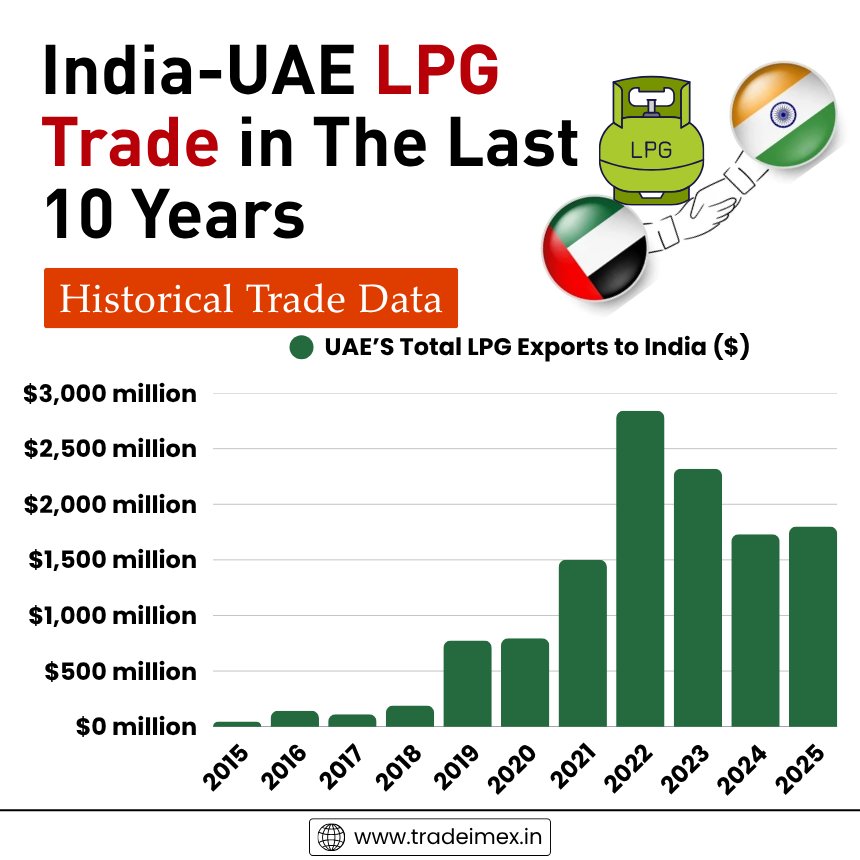
|
Year of Trade |
UAE’S Total LPG Exports to India ($) |
|
2015 |
$46.73 million |
|
2016 |
$142.09 million |
|
2017 |
$111.32 million |
|
2018 |
$189.53 million |
|
2019 |
$774.08 million |
|
2020 |
$794.23 million |
|
2021 |
$1.50 billion |
|
2022 |
$2.84 billion |
|
2023 |
$2.32 billion |
|
2024 |
$1.73 billion |
|
2025 |
$1.80 billion |

The Strategic Petroleum Reserve (SPR) Agreement
The second pillar of the India-UAE partnership focuses on strategic oil storage cooperation. The new Memorandum of Understanding between ADNOC and Indian Strategic Petroleum Reserves Limited (ISPRL) expands crude storage arrangements inside India. This agreement builds upon an earlier 2018 partnership where ADNOC stored crude oil at India’s underground Mangaluru SPR facility.
India’s Strategic Oil Reserve Expansion
According to recent reports, India’s strategic crude storage capacity may increase significantly under the new UAE-India framework.
|
Strategic Reserve Metric |
Value |
|
Existing Indian SPR capacity |
5.3 million tons |
|
Proposed ADNOC crude storage expansion |
Up to 30 million barrels |
|
Current ADNOC storage in India |
5 million barrels |
|
Estimated increase in reserve capacity |
70% |
This expansion is critical because strategic reserves act as emergency buffers during supply disruptions.
Why Strategic Oil Reserves Are Becoming Essential
The 2026 energy crisis exposed how vulnerable global oil markets remain to geopolitical shocks. The Strait of Hormuz handles nearly 20% of global oil shipments, making it one of the world’s most important energy chokepoints. When tensions escalated in the region due to the Strait of Hormuz disruptions, energy-importing countries faced:
-
Higher crude prices
-
Shipping delays
-
Insurance cost spikes
-
LPG shortages
-
Currency pressure
Strategic petroleum reserves help countries absorb temporary disruptions without immediate economic panic.
Key Benefits of Strategic Oil Reserves
1. Emergency Supply Buffer
SPR facilities allow governments to release stored crude during emergencies. This prevents sudden shortages in:
-
Transportation fuels
-
Aviation fuel
-
Industrial feedstocks
-
LPG supply chains
2. Price Stabilization
Countries with reserves can avoid panic buying during temporary disruptions. This reduces exposure to short-term price spikes.
3. Supply Chain Flexibility
Oil stored domestically becomes immediately accessible compared to waiting weeks for tanker deliveries.
4. National Security
Strategic reserves support:
-
Military shipments
-
Power generation
-
Critical infrastructure
-
Emergency response systems
How the Hormuz Crisis Changed Asian Energy Thinking
The Strait of Hormuz crisis accelerated a major shift in Asian energy strategy. Countries are now moving beyond traditional spot-market purchases toward:
-
Long-term bilateral energy agreements
-
Reserve-sharing partnerships
-
Diversified import sources
-
Domestic storage expansion
India is not alone. China, Japan, and South Korea have also expanded strategic petroleum stockpiles over the past decade. The difference is that India’s reserves remain relatively smaller compared to its consumption scale.
India’s Oil Consumption Reality
|
Metric |
Value |
|
Daily crude oil consumption |
5 million barrels/day |
|
Import dependency |
90% |
|
Current crude + fuel reserve coverage |
69 days |
|
LPG stock coverage |
45 days |
This explains why India is aggressively strengthening reserve infrastructure.
UAE’s Growing Strategic Importance for India
The UAE has become one of India’s most important energy partners. The bilateral trade relationship now extends beyond crude oil into:
-
LPG
-
LNG
-
Strategic storage
-
Energy trading
-
Infrastructure investment
Bilateral trade between India and the UAE crossed $101 billion in FY 2025-26 for the first time, according to the UAE import data. Both countries are targeting $200 billion in bilateral trade by 2032, strengthening the India-UAE trade. The UAE is also India’s seventh-largest investor.
ADNOC’s Expanding Role in Asia
ADNOC is rapidly positioning itself as a long-term strategic supplier to Asian economies. The company is investing heavily in:
-
Storage infrastructure
-
LNG exports
-
LPG trading
-
Downstream partnerships
-
Global energy trade
The UAE’s decision to increase production capacity and expand export routes is particularly important. Reports indicate the UAE plans to increase oil export flexibility by developing additional infrastructure linked to Fujairah, helping bypass the Strait of Hormuz if necessary. This could significantly improve supply reliability for Asian buyers like India.
Oil Market Volatility in 2026
Global oil markets remain highly unstable in 2026. Several factors are driving volatility:
|
Major Risk Factor |
Impact on Oil Market |
|
Iran conflict |
Supply disruptions |
|
Hormuz tensions |
Shipping risk |
|
OPEC policy shifts |
Production uncertainty |
|
Rising insurance costs |
Higher import costs |
|
Freight volatility |
Delayed cargo movement |
|
Currency fluctuations |
Import inflation |
The UAE agreement helps India partially hedge against these risks.
India’s Diversification Strategy
India is increasingly pursuing diversified energy sourcing. In addition to Middle Eastern imports, India recently signed structured LPG agreements with suppliers linked to the US Gulf Coast. Reports indicate these contracts cover approximately 2.2 million tonnes of LPG imports in 2026. However, Middle Eastern LPG remains strategically superior for India because:
-
Shipping time is shorter
-
Freight costs are lower
-
Product composition suits Indian cooking requirements
-
Supply chains are well established
For example:
|
Source Region |
Average Shipping Time to India |
|
UAE/Middle East |
5 days |
|
US Gulf Coast |
25–30 days |
This makes the UAE partnership particularly valuable during emergencies.
Asia’s Broader Energy Security Transformation
The India-UAE agreement on LPG reflects a wider transformation across Asia, as per the Asia trade data. Countries are no longer treating energy purely as a commercial commodity. It is increasingly viewed as:
-
Strategic infrastructure
-
National security protection
-
Geopolitical leverage
-
Economic resilience
The new energy model includes:
-
Long-term government-backed contracts
-
Reserve partnerships
-
Domestic storage expansion
-
LNG and LPG diversification
-
Reduced dependence on vulnerable chokepoints
Economic Impact on India
Stable energy access is essential for India’s economic growth. Oil price spikes directly affect:
-
Inflation
-
Manufacturing costs
-
Transportation
-
Consumer spending
-
Fiscal stability
India’s energy import bill rises sharply when crude prices surge. The UAE deal helps mitigate these risks by improving supply reliability and reducing emergency procurement exposure.
The Role of Strategic Reserves in Future Crises
Energy analysts increasingly view strategic reserves as essential infrastructure. Recent research on maritime energy resilience during the 2026 Hormuz crisis found that LPG was among the most vulnerable commodities during supply disruptions. This reinforces why governments are focusing heavily on:
-
LPG stockpiling
-
Reserve diversification
-
Supply route resilience
-
Bilateral storage agreements
The India-UAE partnership directly addresses these concerns.
Geopolitical Implications
The agreement also strengthens India’s geopolitical positioning in West Asia. India is balancing relationships with:
-
UAE
-
Saudi Arabia
-
United States
-
Russia
-
Iran
Maintaining diversified partnerships is critical because India cannot rely on a single energy corridor or geopolitical bloc. The UAE’s relatively stable diplomatic & economic environment makes it an attractive long-term partner.
Future Outlook for UAE-India Trade
The India-UAE energy partnership is expected to deepen further over the next decade. Potential future areas of cooperation include:
-
LNG expansion
-
Hydrogen trade
-
Petrochemical investments
-
Renewable energy collaboration
-
Carbon capture technologies
-
Maritime energy infrastructure
India is expected to continue expanding its strategic reserves while also improving refinery flexibility and domestic storage infrastructure.
Conclusion and Final Verdict
In conclusion, the India-UAE LPG and strategic petroleum reserve agreements mark a major turning point in Asia’s evolving energy security framework. The deal is not simply about importing more LPG or storing additional crude oil. It represents a strategic response to a world where energy markets are increasingly shaped by geopolitical conflict, shipping vulnerabilities, and supply chain uncertainty. For India, the agreement provides:
-
More secure LPG supplies
-
Expanded strategic oil storage
-
Faster emergency access to crude
-
Reduced exposure to market shocks
-
Stronger long-term energy resilience
For the UAE, the partnership strengthens its role as a trusted long-term energy supplier to one of the world’s fastest-growing major economies. As oil market volatility continues through 2026, strategic reserves, bilateral supply agreements, and diversified energy partnerships are becoming central pillars of Asia’s energy security architecture. The India-UAE agreement may ultimately serve as a model for how emerging economies secure energy stability in an increasingly uncertain global market.
Note For Our Readers
We hope this blog has helped you gain a clearer, data-driven understanding of the India-UAE LPG Deal 2026, the growing importance of strategic petroleum reserves, and how evolving geopolitical tensions and oil market volatility are reshaping Asia’s energy security landscape. As global crude oil prices remain unstable, supply chain disruptions intensify around critical trade routes like the Strait of Hormuz, and countries increasingly prioritize long-term energy resilience, strategic fuel partnerships & reserve infrastructure are becoming more important than ever before.
If you’re looking for customized energy trade reports, live crude oil and LPG import-export data by country, strategic petroleum reserve insights, HS code-level trade intelligence, shipment records, importer-exporter databases, country-wise oil and gas trade statistics, or energy market competitor analysis, TradeImeX can help you make faster and smarter business decisions with accurate global trade intelligence. To learn more, connect with us at info@tradeimex.in and explore how we can support your international trade and energy market growth strategy.
Read also about:
Share
What's Your Reaction?
 Like
0
Like
0
 Dislike
0
Dislike
0
 Love
0
Love
0
 Funny
0
Funny
0
 Angry
0
Angry
0
 Sad
0
Sad
0
 Wow
0
Wow
0