Semiconductor Export Data 2025: Exports by Country & Semiconductor Suppliers Database
Explore Semiconductor Export Data 2025 with semiconductor exports by country, semiconductor suppliers database, HS code 8541 insights, & top semiconductor manufacturers worldwide.

The semiconductor industry has become the backbone of the global economy. From artificial intelligence and cloud computing to electric vehicles and smartphones, nearly every modern technology depends on chips. In 2025, the semiconductor market entered another major growth cycle driven by AI infrastructure, high-performance computing, automotive electronics, and geopolitical supply chain shifts. According to the latest global trade data and semiconductor export data under HS code 8541, the total value of global semiconductor exports reached $143.77 billion in 2025, a 5% increase from the previous year. Semiconductors are the 22nd largest exported commodity globally.
Global semiconductor market sales were $298.5 billion in the first quarter of 2026, up 25% from Q4 of 2025, according to the Semiconductor Industry Association (SIA) report. Global sales reached $99.5 billion in March 2026, up 79.2% from $55.5 billion in March 2025 & 11.5% over February 2026. By revenue, SIA accounts for around two-thirds of chip companies outside of the United States & 99% of the semiconductor sector in the United States. At the same time, semiconductor foundry revenue reached a record $320 billion, with advanced-node manufacturing and AI accelerators dominating growth.
This article breaks down:
-
The top semiconductor exporting countries in 2025
-
Global semiconductor trade trends
-
Major semiconductor suppliers and manufacturers
-
Semiconductor assembly and testing ecosystems
-
The growing importance of supplier databases and trade intelligence
-
Future export opportunities and risks
Global Semiconductor Industry Overview in 2025
In 2025, global semiconductor sales hit USD 795.6 billion, one of the biggest annual increases in the industry's history and a 26.2 percent year-over-year gain. The World Semiconductor Trade Statistics (WSTS) organization reports that the total growth accelerated throughout the year, ultimately resulting in Q4 2025 revenues of USD 238.9 billion, up 38.4 percent from Q4 2024. This indicates strong demand across many key use cases, especially in data center infrastructure and AI-related systems. The semiconductor industry in 2025 is defined by three major forces:
-
AI-driven demand
-
Supply chain localization
-
Geopolitical competition
AI infrastructure alone has reshaped semiconductor demand patterns. GPU suppliers, memory manufacturers, and advanced foundries have experienced unprecedented order growth due to large-scale AI model training and inference workloads. The semiconductor market is becoming increasingly concentrated around advanced manufacturing hubs. Taiwan, South Korea, China, the USA, Singapore, and Malaysia continue to dominate global semiconductor exports because they control key segments of the supply chain, as per the semiconductor production by country, including:
-
Wafer fabrication
-
Memory production
-
Assembly and testing
-
Chip packaging
-
Equipment manufacturing
-
Design ecosystems
Meanwhile, governments worldwide are investing billions into domestic semiconductor manufacturing through initiatives such as:
-
The U.S. CHIPS Act
-
Europe’s Chips Act
-
China’s localization strategy
-
India’s semiconductor mission
-
Japan’s advanced packaging investments
Semiconductor Exports by Country: Top 10 Semiconductor Exporting Countries
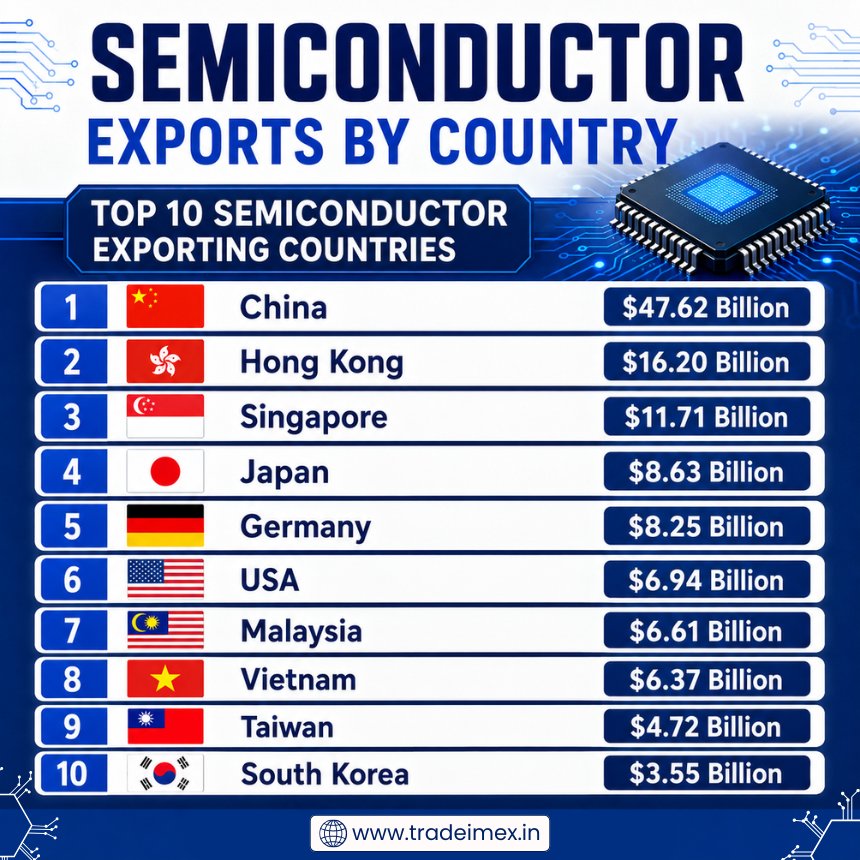
In the global semiconductor export landscape, the top 10 exporters play a crucial role in driving technological advancement & innovation. These countries exhibit a remarkable prowess in semiconductor production and exportation, contributing significantly to the worldwide electronics industry.
Their strategic investments in research & development, coupled with a skilled workforce and cutting-edge manufacturing facilities, position them as key players in the semiconductor market. In the fast-paced world of technology, semiconductors play a crucial role in powering devices that we use daily. From smartphones to laptops, these tiny chips are the backbone of modern electronics. The leading semiconductor-exporting countries, according to the global semiconductor shipment data for 2025, include:
1. China: $47.62 billion (33.5%)
China takes the lead as the top semiconductor exporting country, with a whopping $47.62 billion in exports, accounting for 33.5% of the global market share. The country's robust manufacturing capabilities and investment in cutting-edge technology have solidified its position as a dominant player in the semiconductor industry.
2. Hong Kong: $16.20 billion (11.2%)
Coming in second is Hong Kong, with $16.20 billion in semiconductor exports, representing 11.2% of the market share. The region's strategic location, strong business environment, and advanced infrastructure have made it a key hub for semiconductor production and distribution.
3. Singapore: $11.71 billion (7.9%)
Singapore follows closely behind, with $11.71 billion in semiconductor exports, making up 7.9% of the global market. The country's skilled workforce, efficient trade network, and favorable business policies have attracted major semiconductor companies to set up operations in Singapore.
4. Japan: $8.63 billion (5.2%)
Japan ranks sixth with $8.63 billion in semiconductor exports, representing 5.2% of the global market, as per Japan semiconductor export data by HS code. The country's long history of semiconductor manufacturing, technological expertise, and focus on research and development have made it a powerhouse in the industry.
5. Germany: $8.25 billion (5.7%)
Germany is not far behind, with $8.25 billion in semiconductor exports, also claiming 5.7% of the market share. The country's reputation for precision engineering, innovation, and quality manufacturing has established it as a leading semiconductor exporter in Europe.
6. USA: $6.94 billion (4.8%)
The United States comes in seventh place, with $6.94 billion in semiconductor exports, accounting for 4.8% of the market share, as per the US export data under HS code 8541. Despite facing stiff competition from other countries, the US remains a major player in semiconductor exports, thanks to its strong innovation ecosystem and advanced technology infrastructure.
7. Malaysia: $6.61 billion (5.7%)
With $6.61 billion in semiconductor exports, Malaysia holds the fourth position, accounting for 5.7% of the market share. The country's well-developed semiconductor industry, government support, and investment in research and development have contributed to its success in the global market, as per the data on Malaysia semiconductor and chipset exports.
8. Vietnam: $6.37 billion (4.4%)
Vietnam is steadily climbing the ranks, with $6.37 billion in semiconductor exports, making up 4.4% of the global market, as per Vietnam semiconductor export data. The country's low-cost labor, favorable trade agreements, and growing electronics industry have attracted semiconductor manufacturers looking to diversify their supply chain.
9. Taiwan: $4.72 billion (3.1%)
Taiwan holds the ninth position with $4.72 billion in semiconductor exports, representing 3.1% of the market share. The country's expertise in semiconductor design, manufacturing, and packaging has earned it a reputation as a key player in the global semiconductor market.
10. South Korea: $3.55 billion (2.6%)
Rounding out the top 10 is South Korea, with $3.55 billion in semiconductor exports, accounting for 2.6% of the global market. The country's focus on technological innovation, research and development, and investment in semiconductor production facilities has positioned it as a major semiconductor exporter.
Detailed Analysis of The Leading Semiconductor Exporters
1. China: Rapid Expansion Despite Restrictions
China remains one of the fastest-growing semiconductor exporters despite ongoing U.S. export restrictions. China’s semiconductor exports were estimated at $95 billion in 2025 with double-digit growth rates. China dominates many parts of the semiconductor ecosystem:
-
Assembly and testing
-
Mid-range chip manufacturing
-
Consumer electronics ICs
-
Power semiconductors
-
Packaging operations
The country is also aggressively localizing semiconductor production. Beijing aims to significantly reduce dependence on foreign suppliers, especially in wafer manufacturing and AI infrastructure. Chinese semiconductor companies expanding rapidly include:
-
Semiconductor Manufacturing International Corporation
-
Huawei
-
Yangtze Memory Technologies
China’s export ecosystem benefits from:
-
Massive electronics manufacturing scale
-
Government subsidies
-
Large domestic demand
-
Regional supply chain integration
However, advanced lithography access remains a major constraint.
2. Singapore: Advanced Packaging and Trade Hub
Singapore plays a crucial role in the semiconductor trade, packaging, and advanced manufacturing. The country hosts operations from major suppliers, including:
-
GlobalFoundries
-
Micron Technology
-
Infineon Technologies
Singapore’s strengths include:
-
Advanced packaging
-
High-value semiconductor exports
-
Supply chain infrastructure
-
Stable regulatory environment
The country also functions as a key re-export hub for semiconductor products across Asia.
3. Malaysia and Vietnam: OSAT and Electronics Manufacturing Growth
Malaysia & Vietnam have become increasingly important for semiconductor assembly, testing, & outsourced manufacturing. Malaysia especially dominates OSAT operations:
-
Outsourced Semiconductor Assembly and Test (OSAT)
-
Packaging
-
Backend manufacturing
Major semiconductor firms continue expanding in Southeast Asia to diversify supply chains away from concentrated production regions.
4. United States: Design and IP Dominance
The United States remains the global leader in semiconductor design and intellectual property. While much manufacturing occurs overseas, American companies dominate:
-
GPU design
-
CPU architecture
-
AI accelerators
-
EDA software
-
Semiconductor equipment
Key U.S. semiconductor suppliers include:
-
NVIDIA
-
Intel
-
Advanced Micro Devices
-
Qualcomm
-
Broadcom
AI demand has significantly boosted U.S. semiconductor revenues. NVIDIA in particular became one of the most strategically important chip suppliers due to AI accelerator demand. Despite strong design leadership, the U.S. remains dependent on Asian fabrication ecosystems for advanced production.
5. Taiwan: The Global Foundry Leader
Taiwan remains one of the world’s largest semiconductor export economies in 2025. Taiwan’s dominance comes primarily from advanced chip manufacturing led by Taiwan Semiconductor Manufacturing Company (TSMC), which produces chips for companies including Apple, NVIDIA, AMD, Qualcomm, and Broadcom. Industry estimates suggest Taiwan’s semiconductor exports exceeded $180 billion in 2025. Taiwan’s competitive advantages include:
-
Leadership in 3nm and 5nm fabrication
-
Advanced packaging technologies
-
Strong engineering ecosystem
-
Deep integration with global fabless chip companies
TSMC alone accounted for roughly 38% of global foundry revenue in 2025. The country’s exports primarily flow to:
-
China
-
United States
-
European Union
-
Southeast Asia
Taiwan remains central to AI chip production because advanced GPUs and AI accelerators rely heavily on its cutting-edge fabrication capabilities.
6. South Korea: The Memory Semiconductor Powerhouse
South Korea is the world leader in memory semiconductor exports. The country’s semiconductor export market is dominated by:
-
Samsung Electronics
-
SK hynix
South Korea’s semiconductor exports reached approximately $145 billion in 2025, driven by strong demand for:
-
DRAM
-
NAND flash
-
High-Bandwidth Memory (HBM)
HBM has become particularly important because AI servers require massive memory bandwidth. As AI workloads expand, Korean memory suppliers have seen rapid growth in both pricing & shipment volumes. Recent Korean export data showed semiconductor shipments rising more than 130% year-over-year during peak AI demand periods. South Korea’s strengths include:
-
Advanced memory manufacturing
-
Vertical integration
-
Strong export trade
-
Deep relationships with hyperscale cloud providers
Semiconductor Suppliers Database: Top Semiconductor Exporters with Shipment Records
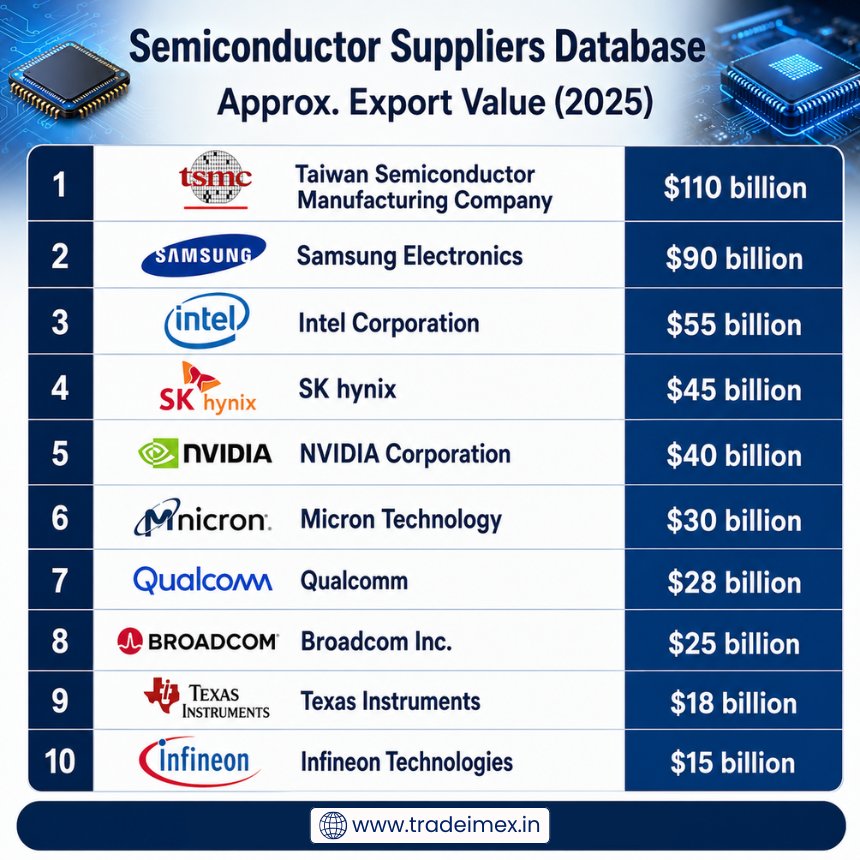
As supply chains become more complex, semiconductor supplier databases have become critical business tools. The leading semiconductor suppliers, according to the global semiconductor exporters database for 2025, include:
1. Taiwan Semiconductor Manufacturing Company
-
Origin Country: Taiwan
-
Approx. Export Value (2025): $110 billion
-
Top Exported Types: Advanced logic chips, AI GPUs, 3nm and 5nm wafers, Foundry manufacturing services
2. Samsung Electronics
-
Origin Country: South Korea
-
Approx. Export Value (2025): $90 billion
-
Top Exported Types: DRAM, NAND flash, High-Bandwidth Memory (HBM), Mobile processors
3. Intel Corporation
-
Origin Country: United States
-
Approx. Export Value (2025): $55 billion
-
Top Exported Types: CPUs, Server processors, AI accelerators, Networking semiconductors
4. SK Hynix
-
Origin Country: South Korea
-
Approx. Export Value (2025): $45 billion
-
Top Exported Types: HBM memory, DRAM, Enterprise SSD NAND chips
5. NVIDIA Corporation
-
Origin Country: United States
-
Approx. Export Value (2025): $40 billion
-
Top Exported Types: AI GPUs, Data center accelerators, Networking processors
6. Micron Technology
-
Origin Country: United States
-
Approx. Export Value (2025): $30 billion
-
Top Exported Types: DRAM, NAND flash, Automotive memory semiconductors
7. Qualcomm
-
Origin Country: United States
-
Approx. Export Value (2025): $28 billion
-
Top Exported Types: Smartphone SoCs, 5G modems, RF chips
8. Broadcom Inc.
-
Origin Country: United States
-
Approx. Export Value (2025): $25 billion
-
Top Exported Types: Networking chips, Broadband ICs, AI connectivity semiconductors
9. Texas Instruments
-
Origin Country: United States
-
Approx. Export Value (2025): $18 billion
-
Top Exported Types: Analog ICs, Power management chips, Automotive semiconductors
10. Infineon Technologies
-
Origin Country: Germany
-
Approx. Export Value (2025): $15 billion
-
Top Exported Types: Automotive semiconductors, Power chips, Industrial microcontrollers (MCUs)
Companies now require real-time intelligence on:
-
Supplier locations
-
Manufacturing capabilities
-
Packaging facilities
-
Testing operations
-
Export dependencies
-
Geopolitical exposure
Organizations such as SEMI and TechSearch International released semiconductor assembly & testing reports in 2025 to help businesses map global supply chains more accurately. These databases typically include:
-
Fab locations
-
OSAT facilities
-
Capacity expansion data
-
Process technology nodes
-
Equipment suppliers
-
Regional manufacturing trends
The need for supplier databases increased sharply after recent semiconductor shortages exposed vulnerabilities in global sourcing networks.
Key Semiconductor Manufacturers in 2025
The following are the top semiconductor manufacturing companies:
Leading Foundries
1. Taiwan Semiconductor Manufacturing Company
-
Global foundry leader
-
Advanced AI chip manufacturing
-
Dominates sub-5nm production
2. Samsung Electronics
-
Advanced logic and memory production
-
Expanding the foundry business
-
Strong HBM market position
3. Semiconductor Manufacturing International Corporation
-
China’s largest foundry
-
Expanding mature-node capacity
-
Beneficiary of localization efforts
Leading AI Chip Suppliers
1. NVIDIA
The dominant AI GPU supplier globally.
2. Advanced Micro Devices
Growing presence in AI accelerators and data center processors.
3. Intel
Continuing investments in foundry and AI infrastructure.
Leading Memory Suppliers
1. SK hynix
Leader in HBM memory for AI systems.
2. Micron Technology
Major supplier of DRAM and NAND products.
Leading Equipment Suppliers
Semiconductor equipment companies remain essential because advanced fabrication depends on extremely sophisticated manufacturing systems.
Key players include:
-
ASML
-
Applied Materials
-
Lam Research
ASML remains especially important because EUV lithography systems are necessary for advanced-node chip production.
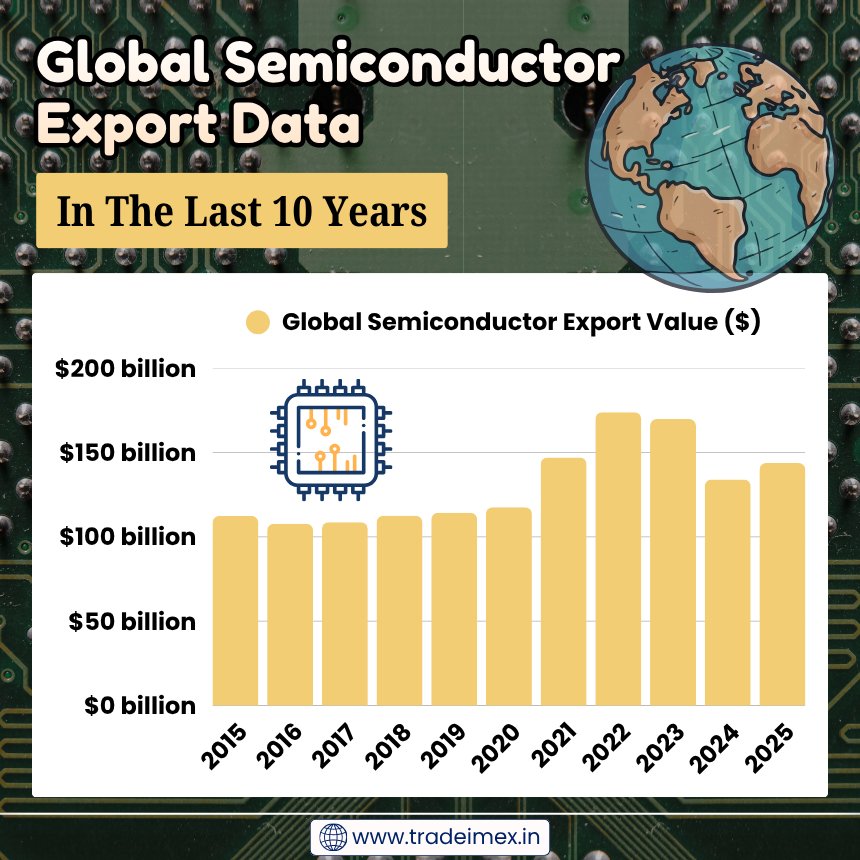
Global Semiconductor Export Data in The Last 10 Years
|
Year of Exports |
Global Semiconductor Export Value ($) |
|
2015 |
$112.41 billion |
|
2016 |
$107.70 billion |
|
2017 |
$108.70 billion |
|
2018 |
$112.51 billion |
|
2019 |
$114.33 billion |
|
2020 |
$117.60 billion |
|
2021 |
$147.08 billion |
|
2022 |
$173.86 billion |
|
2023 |
$169.81 billion |
|
2024 |
$134.01 billion |
|
2025 |
$143.77 billion |
Semiconductor Production by Country: Which Country Produces the Most Semiconductors
Global semiconductor production in 2025 remains highly concentrated in a few key economies that dominate chip fabrication, memory manufacturing, packaging, and assembly operations. Countries with advanced semiconductor ecosystems continue to benefit from rising demand for AI chips, automotive semiconductors, high-performance computing processors, and memory devices. The following are the top semiconductor producing countries in 2025, as per the semiconductor production by country:
-
Taiwan remains the world’s leading semiconductor manufacturing hub, producing a major share of the world’s advanced logic chips through companies like Taiwan Semiconductor Manufacturing Company. Taiwan dominates advanced-node production, including 3nm and 5nm chip fabrication used in AI processors and premium consumer electronics.
-
South Korea continues to lead global memory semiconductor production through Samsung Electronics and SK Hynix. The country is a major producer of DRAM, NAND flash, and High-Bandwidth Memory (HBM) chips essential for AI data centers.
-
China has significantly expanded domestic semiconductor production capacity in 2025, especially in mature-node chips, power semiconductors, and chip packaging. Government-backed investments continue driving growth in local manufacturing and semiconductor self-sufficiency initiatives.
-
The USA remains a global leader in semiconductor design, AI processors, and high-performance computing chips. Companies such as Intel Corporation, NVIDIA Corporation, and Qualcomm continue expanding production and R&D investments supported by the CHIPS Act.
-
Japan plays a critical role in semiconductor materials, manufacturing equipment, sensors, and specialty chip production. Japan remains an important supplier of semiconductor chemicals and fabrication equipment globally.
-
Germany leads Europe’s semiconductor production, especially in automotive semiconductors, industrial chips, and power electronics through companies like Infineon Technologies.
-
Emerging semiconductor production hubs such as India, Vietnam, and Malaysia are increasingly attracting investments in semiconductor assembly, testing, packaging, and electronics manufacturing as companies diversify global supply chains.
As global semiconductor demand continues growing in AI, cloud computing, automotive electronics, and smart devices, semiconductor production capacity expansion is expected to remain one of the top industrial priorities worldwide through the rest of the decade.
AI Is Reshaping Semiconductor Export Patterns
AI has become the single biggest driver of semiconductor export growth. Several major changes emerged in 2025:
1. HBM Demand Explosion
High-Bandwidth Memory demand surged because AI training clusters require enormous memory bandwidth.
This benefited:
-
South Korea
-
Advanced memory suppliers
-
Packaging companies
2. Advanced Packaging Became Strategic
Advanced packaging technologies such as chiplets and 3D stacking are now critical for AI systems. Countries investing heavily in advanced packaging include:
-
Taiwan
-
Singapore
-
Malaysia
-
United States
3. AI Infrastructure Increased Chip Concentration
Large AI systems increasingly depend on a small group of suppliers:
-
NVIDIA
-
TSMC
-
SK hynix
-
Samsung
This concentration creates both opportunities and risks across global trade networks.
Geopolitical Risks in Semiconductor Trade
Semiconductors are now deeply tied to national security and industrial policy. Major geopolitical risks include:
1. U.S.-China Technology Restrictions
Export controls continue to limit China’s access to advanced semiconductor technologies.
Restrictions affect:
-
AI GPUs
-
EUV lithography
-
Advanced manufacturing tools
2. Taiwan Strait Risks
Because Taiwan produces much of the world’s advanced chips, geopolitical instability could severely disrupt global technology supply chains.
Supply Chain Localization
Countries are increasingly attempting to localize semiconductor production to reduce dependency on foreign suppliers. China’s push for domestic silicon wafer sourcing illustrates this broader trend.
Semiconductor Export Trends to Watch Through 2030
Several trends are likely to shape semiconductor exports over the next five years.
1. AI Will Continue Driving Growth
AI infrastructure investment remains extremely strong. Semiconductor sales could exceed $1 trillion annually within the next few years.
2. Advanced Packaging Will Gain Importance
Packaging is becoming as strategically important as fabrication itself. Countries with strong OSAT ecosystems may gain larger export shares.
3. Regionalization Will Increase
Instead of a single global supply chain, semiconductor production is gradually becoming more regionalized:
-
North America
-
East Asia
-
Europe
-
Southeast Asia
4. India Could Become a Larger Player
India is investing aggressively in semiconductor manufacturing and assembly infrastructure. While India is not yet a major semiconductor exporter, its role in packaging, testing, and electronics manufacturing may expand significantly over the next decade.
Conclusion and Final Thoughts
The semiconductor industry in 2025 sits at the center of the global economy. Semiconductor exports now influence everything from AI development & cloud computing to national security and industrial competitiveness. China continues dominating advanced semiconductor exports, while Singapore and Hong Kong expand aggressively despite geopolitical restrictions. The United States remains the leader in chip design and AI processors, and Southeast Asia is strengthening its position in packaging and assembly.
At the same time, semiconductor supplier databases have become essential tools for businesses seeking supply chain visibility, sourcing resilience, and geopolitical risk management. The next decade will likely bring:
-
More AI-driven semiconductor demand
-
Greater localization of production
-
Increased investment in advanced packaging
-
Stronger competition for semiconductor leadership
One thing is clear: semiconductors are no longer just components inside electronic devices. They are now strategic assets shaping the future of the global economy.
Final Note For Our Readers
We hope this blog has helped you gain a clearer, data-driven understanding of the global semiconductor industry in 2025, including semiconductor exports by country, semiconductor suppliers database, AI-driven chip demand, memory semiconductor trends, and the evolving global semiconductor supply chain. If you are looking for customized semiconductor trade reports, live country-wise semiconductor import-export data, HS code-level chip trade data, live shipment records, semiconductor supplier databases, or competitor analysis, TradeImeX can help you access valuable global trade intelligence and actionable market insights.
Using advanced trade databases and real-time import-export analytics, businesses can more effectively identify new semiconductor sourcing opportunities, track shifting trade patterns, analyze supplier networks, and stay ahead in the rapidly evolving global technology market. To learn more, connect with us at info@tradeimex.in and discover how we can support your semiconductor trade and global sourcing strategy.
Share
What's Your Reaction?
 Like
0
Like
0
 Dislike
0
Dislike
0
 Love
0
Love
0
 Funny
0
Funny
0
 Angry
0
Angry
0
 Sad
0
Sad
0
 Wow
0
Wow
0