Malaysia Chipset Exports: Malaysia Tightens Semiconductor Regulations Amid US Pressure
Discover the latest insights on Malaysia's chipset exports and its tightening semiconductor regulations amid US pressure. Learn about Malaysia's top trade partners, export trends, regulatory changes, semiconductor exports, and the impact on the global semiconductor industry.

In recent years, Malaysia has emerged as a key player in the global semiconductor industry, particularly in the production and export of chipsets or chip exports. However, the country's position in the market is now facing significant challenges as it grapples with increasing pressure from the United States to tighten its semiconductor regulations. This has led to a series of measures being implemented by the Malaysian government to ensure compliance with international standards and to protect its semiconductor industry from potential disruptions.
According to the Malaysia export data and customs data on Malaysia exports, Malaysia's chipset exports accounted for $36.94 billion in 2024, a 1% decline from the previous year. Malaysia is the 4th largest chipset exporter in the world, as per the global trade data. In this article, we will gain insights into the Malaysia exports data for chipset exports, with a key focus on Malaysia semiconductor regulations amid the US pressure.
The Rise of Malaysia as a Semiconductor Powerhouse
Malaysia has been steadily growing its semiconductor industry over the past few decades, becoming a major player in the global market. The country is home to several semiconductor manufacturers, including well-known companies such as Intel, Qualcomm, and Texas Instruments. With a skilled workforce, pro-business policies, and strong infrastructure, Malaysia has been able to attract foreign investment and establish itself as a key hub in Asia for semiconductor production, as per Asia trade data.
Malaysia to Tighten Chip and Semiconductor Regulations Amid US Pressure
The Trump administration is investigating the illegal export of prohibited Nvidia graphics processing units to China. Following a request from the US to closely monitor cutting-edge semiconductors that might be headed to China closely, Malaysia proposes to impose stricter controls over the movement of Nvidia Corp.'s chips.
Following pressure from the United States to stop Malaysia from being used to enable the illegal movement of banned Nvidia chips used to build artificial intelligence (AI) to China, Malaysia's government has announced that it will strengthen its semiconductor restrictions.
Malaysia Chipset Exports by Country: Top Malaysia Trade Partners for Chipset Exports
Malaysia is a key player in the global chipset export market, with top trade partners for chipset exports including countries like the United States, China, Japan, and Singapore. The Malaysian chipset industry has demonstrated significant growth and competitiveness, fostering strong trade relationships with these prominent nations. The top 10 countries where Malaysia exports the most chipsets and processors, as per Malaysia customs export data and shipment data for Malaysia exports by country in 2024, include:
- China: $7.60 billion (20.6%)
China emerges as the top trade partner for Malaysia's chipset exports, accounting for a significant 20.6% of the total exports. The strong economic relationship between Malaysia and China has played a pivotal role in this partnership, with China's demand for Malaysian chipsets driving this substantial export number.
- Hong Kong: $5.71 billion (15.5%)
Hong Kong ranks second among Malaysia's trade partners for chipset exports, with $5.71 billion worth of chipsets being exported to the region. The strategic location of Hong Kong as a global trade hub and its strong technological sector make it a key player in Malaysia's chipset export market.
- Singapore: $4.15 billion (11.3%)
Singapore follows closely behind Hong Kong, with $4.15 billion worth of chipset exports from Malaysia. The symbiotic relationship between the two countries in terms of technology, innovation, and trade has cemented Singapore's position as a top trade partner for Malaysia in the chipset industry.
- Vietnam: $4.09 billion (11.1%)
Vietnam has emerged as a significant trade partner for Malaysia in chipset exports, with $4.09 billion worth of chipsets imported by Vietnam from Malaysia, as per the data on Vietnam chipset imports from Malaysia by HS code. The burgeoning tech industry in Vietnam and its proximity to Malaysia have contributed to the growth of this trade partnership.
- USA: $3.89 billion (10.5%)
The United States holds a strong position as a trade partner for Malaysia in chipset exports, with $3.89 billion worth of chipsets being exported to the country, as per US import data. The advanced technology sector in the USA and its high demand for Malaysian chipsets have solidified this trade relationship.
- Taiwan: $2.85 billion (7.7%)
Taiwan ranks sixth among Malaysia's trade partners for chipset exports, with $2.85 billion worth of chipsets being exported to the country. The thriving semiconductor industry in Taiwan and its close ties with Malaysia have contributed to the growth of this trade partnership.
- South Korea: $2.13 billion (5.8%)
South Korea is another important trade partner for Malaysia in chipset exports, with $2.13 billion worth of chipsets being exported to the country. The strong technological advancements in South Korea and its demand for Malaysian chipsets have strengthened this trade relationship.
- Netherlands: $1.07 billion (2.9%)
The Netherlands holds a significant position as a trade partner for Malaysia in chipset exports, with $1.07 billion worth of chipsets being exported to the country. The strategic location of the Netherlands in Europe and its strong technology sector make it a key player in Malaysia's chipset export market.
- Mexico: $993.11 million (2.7%)
Mexico has emerged as a growing trade partner for Malaysia in chipset exports, with $993.11 million worth of chipsets being exported to the country. The increasing demand for Malaysian chipsets in Mexico and the country's focus on technological advancements have contributed to this trade relationship.
- Thailand: $790.68 million (2.1%)
Thailand rounds out the top 10 Malaysian trade partners for chipset exports, with $790.68 million worth of chipsets being exported to the country. The collaborative efforts between Malaysia and Thailand in the technology sector have paved the way for growth in this trade partnership.
Malaysia Exports of Chipsets in the Last 10 Years: Yearly Malaysia Export Data
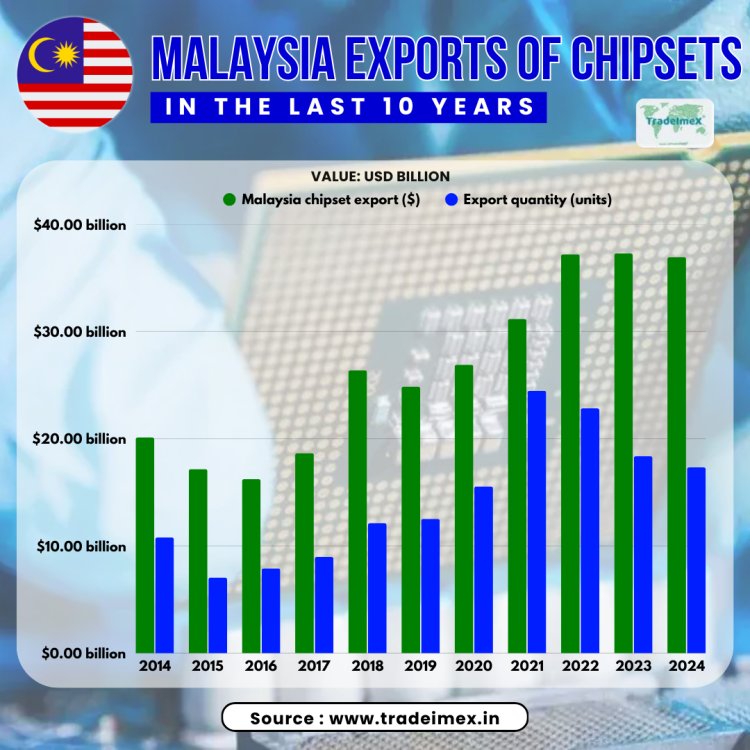
|
Year of Trade |
Malaysia chipset export ($) |
Export quantity (units) |
|
2014 |
$20.11 billion |
10.78 billion units |
|
2015 |
$17.16 billion |
7.04 billion units |
|
2016 |
$16.23 billion |
7.90 billion units |
|
2017 |
$18.66 billion |
8.97 billion units |
|
2018 |
$26.37 billion |
12.13 billion units |
|
2019 |
$24.86 billion |
12.51 billion units |
|
2020 |
$26.90 billion |
15.54 billion units |
|
2021 |
$31.17 billion |
24.46 billion units |
|
2022 |
$37.19 billion |
22.83 billion units |
|
2023 |
$37.28 billion |
18.36 billion units |
|
2024 |
$36.94 billion |
17.32 billion units |
US Pressure on Malaysia's Semiconductor Industry
Despite its success in the semiconductor market, Malaysia has recently come under pressure from the United States to tighten its semiconductor regulations. The US government has raised concerns about the potential misuse of Malaysian-made chipsets in products that could compromise national security. In response to these concerns, Malaysia has taken steps to strengthen its semiconductor regulations and enhance the oversight of the industry for the betterment of Malaysia semiconductor exports.
Malaysia's Response to US Pressure
To address the concerns raised by the United States, the Malaysian government has introduced a series of measures to tighten its semiconductor regulations. These measures include increased monitoring of semiconductor production facilities, enhanced security protocols, and greater cooperation with international partners to ensure compliance with global standards. Additionally, Malaysia has imposed stricter export controls on semiconductor products to prevent the unauthorized transfer of technology to countries of concern.
Overview of Malaysia’s Semiconductor Industry
- Malaysia is a key player in the global semiconductor supply chain, particularly in the assembly, testing, and packaging of semiconductor components.
- The industry contributes significantly to the Malaysian economy, with semiconductor exports accounting for a substantial portion of total export revenues.
Malaysia Export Trends and Shipments
|
Key Metric |
Details |
|
2024 Export Value to U.S. |
$16.2 billion, constituting 20% of U.S. semiconductor imports. |
|
Annual Growth Forecast (2025) |
4.5% growth in semiconductor exports projected. |
|
Challenges |
Semiconductor market downcycle, potential global slowdown impacting demand. |
|
Top Export Destination |
United States, followed by China and other global markets. |
|
Key Export Products |
Chipsets, integrated circuits, processors, memory chips, and microcontrollers. |
|
Primary Export Sector |
Electrical and Electronic (E&E) industry. |
Export Pricing Dynamics and Factors Impacting Pricing:
- Global semiconductor supply-demand balance.
- Technological advancements and production capacity.
- Trade policies and tariffs.
- Demand from the automotive, telecommunications, and consumer electronics sectors.
|
Factor |
Impact on Pricing |
|
Global Supply/Demand |
Fluctuates based on technological advancements and market needs. |
|
US Tariffs on Semiconductor Imports |
Potential to drive up costs of exports to the U.S. |
|
Technological Innovation |
New generation chips and higher production costs may increase prices. |
Impact of U.S. Tariffs on Malaysia
- The U.S. has proposed tariffs of up to 25% on semiconductor imports.
- Malaysia is discussing the ramifications of these tariffs with key semiconductor companies.
- Key companies affected: Intel, GlobalFoundries, and other major U.S. chip manufacturers.
|
Impact Area |
Details |
|
Proposed Tariffs |
Up to 25% on semiconductor imports from Malaysia to the U.S. |
|
Affected Companies |
U.S. multinationals (Intel, GlobalFoundries, etc.) |
|
Government Response |
Malaysia is engaging with industry stakeholders to mitigate the impact. |
|
Potential Outcomes |
Price increases for consumers or absorption of costs by companies. |
Regulatory Developments Amid US Pressure
- New Regulations: Malaysia is tightening regulations on semiconductor exports, particularly high-end chips like Nvidia chips, to comply with U.S. demands.
- Goal: Prevent the diversion of sensitive technology to China or unauthorized destinations.
- Regulatory Oversight: A government task force has been set up to monitor and control semiconductor shipments to ensure compliance.
|
Regulatory Changes |
Details |
|
Focus on High-End Chips |
Special emphasis on Nvidia chips used in AI and data centers. |
|
Export Restrictions |
Increased scrutiny on exports to China and other restricted regions. |
|
Task Force |
Malaysia has formed a task force to monitor exports and prevent unauthorized trade. |
|
Government Involvement |
Led by Trade Minister Zafrul Aziz and Digital Minister Gobind Singh Deo. |
Strategic Responses and Future Outlook
- Ongoing engagement with the US semiconductor companies to navigate the tariff situation.
- Strengthening relationships with other trade partners, diversifying export destinations beyond the US
- Malaysia’s semiconductor industry shows resilience with continued export growth and robust demand.
- New technological advancements and R&D investments will help Malaysia stay competitive in the global market.
|
Strategic Focus |
Details |
|
Engagement with Industry |
Malaysia is working with U.S. companies to minimize tariff impact. |
|
Export Diversification |
Expanding semiconductor exports to new markets like Europe and Asia. |
|
Technological Advancements |
Investing in the next generation of chipsets, AI, and 5G technology. |
List of Top Chipset and Processor Exporters in Malaysia: Malaysia Semiconductor Exporters
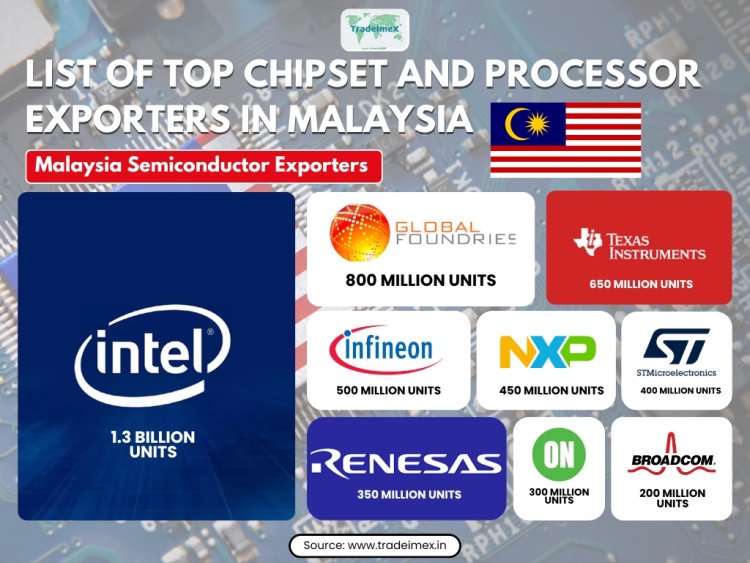
|
Company Name |
Export Shipments in 2024 (Units) |
|
Intel Corporation |
1.3 billion units |
|
GlobalFoundries |
800 million units |
|
Texas Instruments |
650 million units |
|
Infineon Technologies |
500 million units |
|
NXP Semiconductors |
450 million units |
|
STMicroelectronics |
400 million units |
|
Renesas Electronics |
350 million units |
|
ON Semiconductor |
300 million units |
|
Micron Technology |
250 million units |
|
Broadcom Inc. |
200 million units |
Impact on Malaysia's Semiconductor Industry
While Malaysia's efforts to tighten its semiconductor regulations are aimed at safeguarding national security and maintaining its position in the global market, these measures could have a significant impact on Malaysia’s semiconductor industry. The increased regulatory scrutiny and export controls may lead to higher production costs, delays in product launches, and a decline in competitiveness for Malaysian semiconductor manufacturers. Additionally, the uncertainty surrounding Malaysia's semiconductor regulations could deter foreign investment and potentially harm the country's reputation as a reliable supplier of chipsets, processors, and motherboards.
Conclusion
To conclude with final thoughts, it is fair to say that Malaysia's efforts to tighten its semiconductor regulations amid US pressure reflect the increasingly complex dynamics of the global semiconductor industry. By proactively addressing concerns about the misuse of chipsets and enhancing oversight of semiconductor production, Malaysia can maintain its competitive edge in the market while upholding international standards. It remains to be seen how these regulatory changes will impact Malaysia's semiconductor industry in the long run, but proactive measures and adherence to best practices will be crucial for the country's continued success in this vital sector.
----------
We hope that you liked our insightful and interactive blog report on Malaysia's chipset exports and how Malaysia tightened semiconductor regulations under US pressure. Visit TradeImeX for more such market reports and Malaysia import-export data. Contact us at info@tradeimex.in for subscription & other details, and get a list of the top chipset exporting companies in Malaysia.
Share
What's Your Reaction?
 Like
1
Like
1
 Dislike
0
Dislike
0
 Love
0
Love
0
 Funny
0
Funny
0
 Angry
0
Angry
0
 Sad
0
Sad
0
 Wow
0
Wow
0