
USA vs China: Which Country is the World’s Biggest Trading Hub?
Compare the USA vs China trade data in 2025. Discover which country leads global imports, exports, trade volume, manufacturing, & economic influence with the latest trade statistics.


The USA and China are the leading trading countries in the world, but both countries are competing with each other to become the world’s largest trading hub, and the competition between both of them was so intense in 2025, but they do it in different areas. The USA is the world’s largest importer and consumer market for goods, as per the US import data, whereas China is the world’s largest exporter and manufacturing hub in the world, according to China export data.
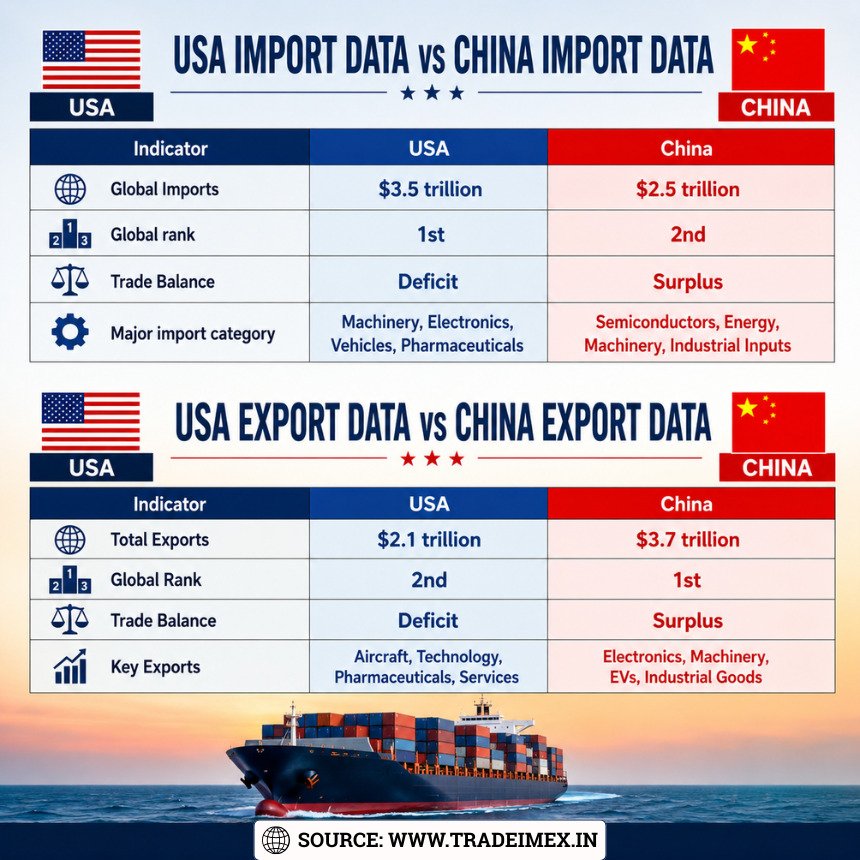
According to the 2025 trade data & statistics, the USA's total import is $3.5 trillion, and the total export is $2.1 trillion, with a trade deficit of $1.4 trillion. Meanwhile, China’s total merchandise trade in 2025 is $6.2 trillion, in which the total import is $2.5 trillion, and the total export is $3.7 trillion, with a trade surplus of $1.2 trillion. After all this, which country is the world's largest trading hub in 2025? This article analyzes the comparison between the world’ top 2 largest economies in the world.
USA Import Data vs China Import Data
|
Indicator |
USA |
China |
|
Global Imports |
$3.5 trillion |
$2.5 trillion |
|
Global rank |
1st |
2nd |
|
Trade Balance |
Deficit |
Surplus |
|
Major import category |
Machinery, Electronics, Vehicles, Pharmaceuticals |
Semiconductors, Energy, Machinery, Industrial Inputs |
This data shows a massive consumer market in the USA compared to China. According to the China import data, it indicates that China generally imports goods for manufacturing or industrial purposes. China focuses more on exports, and the USA is more focused on imports. In terms of importing goods or products, the USA is far better than China.
USA Export Data vs China Export Data
|
Indicator |
USA |
China |
|
Total Exports |
$2.1 |
$3.7 |
|
Global Rank |
2nd |
1st |
|
Trade Balance |
Deficit |
Surplus |
|
Key Exports |
Aircraft, Technology, Pharmaceuticals, Services |
Electronics, Machinery, EVs, Industrial Goods |
According to the USA export data, the total trade deficit of the USA is $1.4 trillion, and according to the China export data, China's total export was $3.7 trillion in 2025, with a trade surplus of $1.2 trillion. In terms of export performance, China significantly outpaces the United States, maintaining a stronger position in global export markets.

US-China Import-Export Comparison 2025

|
Indicator |
USA |
China |
|
Imports |
$3.5 trillion |
$2.5 trillion |
|
Exports |
$2.1 trillion |
$3.7 trillion |
|
Total trade |
$5.6 trillion |
$6.2 trillion |
|
Trade Balance |
Deficit ($1.4 trillion) |
Surplus ($1.2 trillion) |
|
Largest Strength |
Consumption Market |
Manufacturing Hub |
According to the USA-China import-export data, China slightly exceeds the USA. USA imports are higher than China's, but the USA has a massive trade deficit.
US-China Trade Relations in 2025
The two most significant economic relationships in the world are the US-China trade relations. According to the import-export data, China exports worth $420 billion and imports $141 billion, with the trade balance of +$279 billion. According to import data, the USA generally imports electrical machinery and equipment, nuclear reactors, and boilers from China. According to recent export statistics, the United States primarily ships electrical machinery and equipment, nuclear reactors, and boilers to China.
China continues to be a critical supplier of electronics, machinery, batteries, consumer goods, and industrial components to the United States. Even as companies diversify sourcing toward Vietnam, Mexico, and other countries, China remains deeply integrated into global supply chains.
US-China Trade War and Its Effect
The US-China trade war continues to influence trade patterns in 2025. Since the initial tariff rounds, many multinational companies have diversified manufacturing locations. Despite predictions that China's dominance in global exports would weaken, the country continued to strengthen its position, recording an unprecedented trade surplus of nearly $1.2 trillion in 2025. As a result, the US-China trade relationship has shifted from simple trade competition to broader competition involving technology, supply chains, manufacturing leadership, and geopolitical influence.
Top Trading Partners of the US and China in 2025
Although the United States and China are economic rivals, both countries maintain extensive trade networks with dozens of nations. Their respective trading partners highlight the differences in their economic structures and global influence.
Top Trading Partners of the USA
According to the latest US trade statistics, America's largest trading partners in 2025 include:
-
Mexico
-
Canada
-
China
-
Germany
-
Japan
-
South Korea
-
Vietnam
-
Taiwan
-
India
-
United Kingdom
North America continues to dominate US trade thanks to the USMCA agreement, while Asian economies remain important suppliers of electronics, machinery, automobiles, and consumer products.
Top Trading Partners of China
China's trade relationships are centered around Asia and Europe. Major Chinese trading partners include:
-
United States
-
ASEAN countries
-
European Union
-
South Korea
-
Japan
-
Taiwan
-
Australia
-
Russia
-
India
-
Brazil
China's Belt and Road Initiative and regional trade agreements have strengthened its commercial influence across Asia, Africa, and Latin America.
Manufacturing Powerhouse vs Consumer Superpower
One of the biggest differences between the two economies lies in their economic models.
China: The World's Factory
China has spent decades building one of the largest manufacturing ecosystems in history. The country dominates global production in:
-
Electronics
-
Solar panels
-
Batteries
-
Electric vehicles
-
Machinery
-
Steel products
-
Consumer goods
-
Textiles
Massive industrial clusters, efficient infrastructure, and integrated supply chains have enabled China to maintain its position as the world's leading exporter.
USA: The World's Largest Consumer Market
The United States possesses unparalleled purchasing power and remains the most attractive consumer market globally. High household spending and strong domestic demand make the country heavily dependent on imports.
The United States leads the world in:
-
Services trade
-
Technology innovation
-
Aerospace
-
Pharmaceuticals
-
Artificial intelligence
-
Financial services
-
Entertainment and media
This unique combination allows the USA to maintain its status as the world's largest importing nation.
Role of Services Trade
While merchandise trade often receives most attention, services exports are a major strength of the United States.
The US dominates global exports in:
-
Software and IT services
-
Financial services
-
Intellectual property
-
Digital services
-
Education
-
Tourism
-
Entertainment
American companies such as Microsoft, Apple, Google, Amazon, Meta, and Netflix generate billions of dollars through international service revenues. China, meanwhile, derives a larger proportion of its trade strength from physical goods manufacturing and industrial exports.
Emerging Competition in High-Tech Industries
Trade competition between the USA and China is increasingly shifting toward advanced technologies.
Electric Vehicles
China has become the world's largest EV producer and exporter, with companies like BYD rapidly expanding their international presence. Meanwhile, Tesla remains one of the leading electric vehicle manufacturers in the United States.
Artificial Intelligence
The United States currently enjoys an advantage in AI innovation and semiconductor design, supported by companies such as Nvidia, Microsoft, OpenAI, and AMD. China is investing heavily to reduce dependence on foreign technologies and strengthen domestic chip manufacturing.
Renewable Energy
China dominates the production of:
-
Solar panels
-
Lithium-ion batteries
-
Rare earth elements
-
Wind turbines
The United States is accelerating investments in clean energy manufacturing through incentives and industrial policies aimed at strengthening domestic supply chains.
Supply Chain Diversification in 2025
Following years of geopolitical tensions and tariff disputes, many multinational corporations have adopted a "China Plus One" strategy.
Countries benefiting from supply chain diversification include:
-
Vietnam
-
Mexico
-
India
-
Thailand
-
Malaysia
-
Indonesia
However, despite this shift, China remains deeply embedded in global manufacturing networks. Complete decoupling between the United States and China appears unlikely because of the enormous scale of economic interdependence.
Future Outlook for Global Trade
The rivalry between the United States and China will continue to shape global trade over the next decade.
Several trends are expected to define future competition:
-
Expansion of artificial intelligence and digital trade.
-
Increased investment in semiconductor manufacturing.
-
Growth of electric vehicle supply chains.
-
Rising importance of renewable energy technologies.
-
Diversification of manufacturing toward Southeast Asia and India.
-
Strengthening of regional trade agreements.
-
Continued competition for technological leadership.
Despite ongoing tensions, the world's two largest economies remain highly interconnected. Their trade policies, industrial strategies, and economic performance influence virtually every country and industry worldwide.
As global trade continues evolving, both the USA and China are expected to remain indispensable pillars of the international economy, each excelling in different areas and continuing their competition for economic leadership.
USA vs China: Who Holds Greater Influence in Global Trade?
Beyond trade volumes and export values, the influence of the United States and China extends to global supply chains, investment flows, and international economic policies. Both countries have developed different forms of economic power that shape world trade.
The United States continues to dominate the global financial system. The US dollar remains the world's primary reserve currency and is used in most international trade transactions. American financial institutions, technology companies, and multinational corporations have a significant presence in virtually every region. This gives the United States substantial leverage over global commerce and investment flows.
China, on the other hand, has expanded its influence through manufacturing capabilities and infrastructure investments. Through initiatives such as the Belt and Road Initiative (BRI), China has strengthened trade relationships with developing economies across Asia, Africa, the Middle East, and Latin America. Chinese companies have become increasingly important suppliers of industrial goods, renewable energy equipment, and consumer products.
Another major difference lies in foreign direct investment. American firms continue to invest heavily in advanced technologies, pharmaceuticals, aerospace, and services, while Chinese companies have increased investments in infrastructure, mining, logistics, and manufacturing projects around the world. Furthermore, both countries are competing to secure leadership in strategic industries of the future, including:
-
Artificial intelligence (AI)
-
Semiconductor manufacturing
-
Electric vehicles (EVs)
-
Battery technologies
-
Renewable energy equipment
-
Robotics and automation
-
Quantum computing
The outcome of this competition will likely determine the next phase of global economic leadership. While China currently enjoys an advantage in manufacturing and merchandise exports, the United States remains stronger in services, finance, innovation, and high-value technologies.
Therefore, determining the world's biggest trading hub depends on the metric being considered. China leads in exports and manufacturing strength, whereas the United States dominates imports, consumer demand, services trade, and financial influence. Together, these two economic giants account for a significant share of global trade and will continue to shape international commerce for decades to come.
Which country is the world's biggest trading hub?
-
Largest Importing Hub: USA ($3.5 trillion)
-
Largest Exporting Hub: China ($3.7 trillion)
-
Largest Consumer Market: USA
-
Largest Manufacturing Hub: China
-
Highest Trade Surplus: +$1.2 trillion
-
Highest Total Trade Volume: USA
Both countries are dominant in different sectors: in total import, highest market demand, and highest total trade volume, the USA is dominant, and China is dominant in total export, largest manufacturing hub, and highest trade surplus.
Conclusion
The comparison between the USA import-export data and China import-export data demonstrates that both countries occupy unique positions in global commerce. The United States leads global imports and overall trade turnover, while China dominates exports and manufacturing output. Despite ongoing tensions surrounding US-China trade relations, the USA-China bilateral trade remains one of the most influential economic relationships in the world. As global supply chains evolve, both nations will continue shaping international trade patterns for years to come.
FAQs (Frequently Asked Questions)
-
What are the major products in the USA-China bilateral trade?
Aircraft, electronics, machinery, pharmaceuticals, batteries, and industrial equipment dominate bilateral trade.
-
US-China trade war still affecting trade?
Yes, tariffs, supply chain diversification, and technology restrictions continue to influence trade flows.
-
Why is the USA considered a global trading hub?
The USA's enormous import demand, consumer market size, trade infrastructure, and total trade volume make it a leading global trading hub.
-
Which country is the largest trading hub in 2025?
The United States of America (USA) is the third-largest trading hub in 2025.
-
Which one exports more in 2025?
China exports more than the USA in 2025, with total exports of $3.7 trillion.
For the latest update of USA import-export data or China import-export data by country or HS code, you can contact info@tradeimex.in & get customized trade data for businesses. You can also search for exclusive trade databases by country, HS codes, or company with TradeImeX.
Share
What's Your Reaction?
 Like
0
Like
0
 Dislike
0
Dislike
0
 Love
0
Love
0
 Funny
0
Funny
0
 Angry
0
Angry
0
 Sad
0
Sad
0
 Wow
0
Wow
0