Malaysia vs Indonesia: Palm Oil Export Showdown 2024–25
Discover the 2024–25 battle in Malaysia vs Indonesia palm oil exports. Get key stats, export values, top destinations, and leading companies driving the global palm oil market.


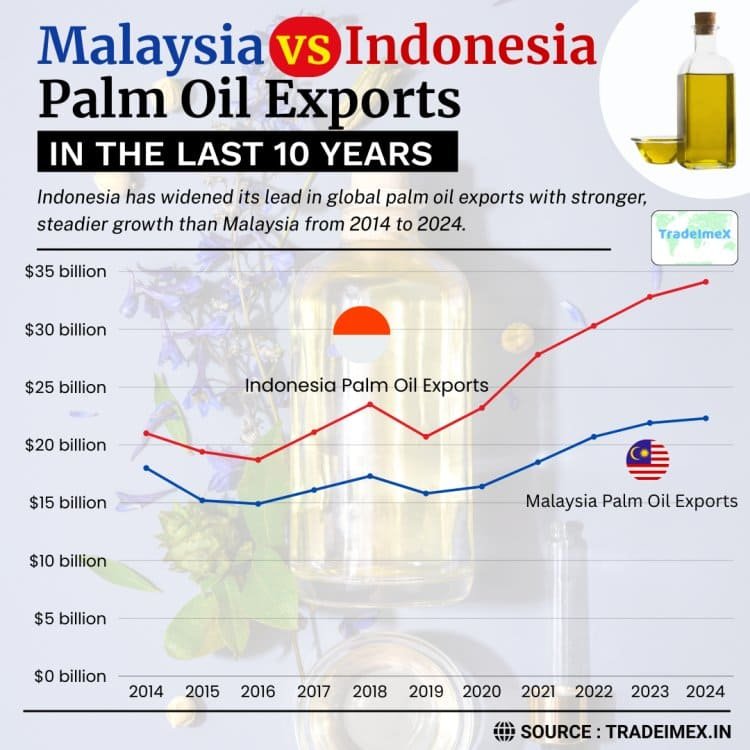
In the global palm oil industry, Malaysia and Indonesia stand as dominant forces. As of 2024, Indonesia leads as the world's largest producer and exporter of palm oil, while Malaysia holds a significant position as the second-largest. Both nations are navigating challenges such as shifting trade policies, environmental regulations, and evolving market demands. This analysis delves into their export data, trends, and the broader implications shaping the palm oil industry. According to Malaysia export data and Malaysia palm oil export data, the total value of Malaysia palm oil exports reached $22.3 billion in 2024. While Indonesia palm oil exports accounted for $34.1 billion in 2024, as per the Indonesia export data and Indonesia palm oil export data.
In recent years, Malaysia and Indonesia have been at the forefront of the palm oil industry, with both countries being major exporters of this valuable commodity. As we look ahead to the year 2024–25, all eyes are on these two Southeast Asian nations as they gear up for a fierce showdown in the global palm oil market. Let's take a closer look at the key factors that will shape this competition and determine which country will come out on top as the largest exporter of palm oil.
The Rise of Palm Oil in Malaysia and Indonesia
Palm oil has become a key driver of economic growth in both Malaysia and Indonesia, thanks to the high demand for this versatile product in various industries such as food, cosmetics, and biofuels. Over the years, both countries have significantly expanded their palm oil plantations to meet this growing demand, with Indonesia currently being the world's largest producer and largest exporter of palm oil, followed closely by Malaysia, as per the Asia trade data.
Indonesia, with 55.5%, is the largest exporter of palm oil, followed by Malaysia at 29%. Synopsis of the Dominance of Indonesia and Malaysia in Palm Oil Production. Indonesia and Malaysia are the dominant forces in the global palm oil sector, together controlling more than 80% of the market. These Southeast Asian countries, celebrated for their fertile tropical climates that are perfect for growing palms, have established themselves as the top producers and exporters of this multipurpose commodity.
Statistical Comparison of Malaysia vs Indonesia Palm Oil Exports in the Last 10 Years
|
Year |
Malaysia Palm Oil Exports ($) |
Indonesia Palm Oil Exports ($) |
|
2014 |
$18 billion |
$21 billion |
|
2015 |
$15.2 billion |
$19.4 billion |
|
2016 |
$14.9 billion |
$18.7 billion |
|
2017 |
$16.1 billion |
$21.1 billion |
|
2018 |
$17.3 billion |
$23.5 billion |
|
2019 |
$15.8 billion |
$20.7 billion |
|
2020 |
$16.4 billion |
$23.2 billion |
|
2021 |
$18.5 billion |
$27.8 billion |
|
2022 |
$20.7 billion |
$30.3 billion |
|
2023 |
$21.9 billion |
$32.8 billion |
|
2024 |
$22.3 billion |
$34.1 billion |
Key Observations:
- Indonesia's exports have consistently outpaced Malaysia’s, growing from $21 billion in 2014 to $34.1 billion in 2024.
- Malaysia has shown steady growth with some fluctuations, reaching $22.3 billion in 2024, a modest increase from $18 billion in 2014.
- Both countries benefited from rising global demand and pricing from 2021 onwards, partly due to pandemic-related supply chain disruptions and renewed industrial demand.
Export Performance: Malaysia vs Indonesia
Malaysia’s Palm Oil Exports (2024)
In 2024, Malaysia exported approximately 19.3 million metric tons of palm oil, valued at $22.3 billion, as per Malaysia palm oil export statistics.
Top 10 Export Destinations: Malaysia Palm Oil Exports by Country
Analysis of the top 10 export destinations for Malaysia's palm oil exports by country reveals key insights into the country's trade patterns. The data provides a comprehensive overview of the countries that are major buyers of Malaysia's palm oil exports. Now the question arises, that Malaysia export palm oil to which country? Malaysia exports the most palm oil to India, Kenya, and the Philippines, as per the customs data on Philippines palm oil imports from Malaysia. The top Malaysia export partners for palm oil exports, as per Malaysia customs data and Malaysia export shipment data for Malaysia palm oil exports by country in 2024, include:
|
Rank |
Country |
Export Value (USD) |
|
1 |
India |
$2.09 billion |
|
2 |
Kenya |
$470 million |
|
3 |
Netherlands |
$272 million |
|
4 |
Philippines |
$45 million |
|
5 |
Germany |
$34 million |
|
6 |
Mozambique |
$26 million |
|
7 |
Tanzania |
$21 million |
|
8 |
Morocco |
$14 million |
|
9 |
Italy |
$11 million |
|
10 |
Spain |
$9 million |
Key Insights:
- India remains Malaysia's largest market, accounting for over 69% of its CPO exports.
- Kenya and the Netherlands are significant importers, reflecting Malaysia's diversified export strategy.
Indonesia’s Palm Oil Exports (2024)
In 2024, Indonesia exported over 24.2 million metric tons of palm oil, with refined palm oil and its fractions contributing significantly to the export value.
Top 10 Export Destinations: Indonesia Palm Oil Exports by Country
Indonesia's palm oil industry stands out on the global stage, with its top 10 export destinations significantly impacting the market. These countries play a crucial role in Indonesia palm oil export data, shaping the industry's growth and influence worldwide. Indonesia exports the most palm oil to India, as per the customs data on Indonesia palm oil exports to India. The top 10 Indonesia export partners for Indonesia palm oil exports by country, as per Indonesia customs data and Indonesia export shipment data for 2024, include:
|
Rank |
Country |
Export Value (USD) |
|
1 |
India |
$4.5 billion |
|
2 |
China |
$3.6 billion |
|
3 |
Pakistan |
$2.17 billion |
|
4 |
USA |
$1.51 billion |
|
5 |
Bangladesh |
$1.16 billion |
|
6 |
Egypt |
$798 million |
|
7 |
Vietnam |
$577 million |
|
8 |
Myanmar |
$521 million |
|
9 |
Russia |
$444 million |
|
10 |
Philippines |
$403 million |
Key Insights:
- India is also Indonesia's top market, highlighting its central role in global palm oil trade.
- The USA imported palm oil worth $1.51 billion, underscoring Indonesia's reach into Western markets.
Palm Oil Export Trends and Developments
Malaysia:
- China's Market Dynamics: In 2024, Malaysia's palm oil exports to China totaled 1.39 million tons, a 5.3% decrease from the previous year, valued at $2.39 billion. This decline is attributed to competition from cheaper soybean oil and changing consumer preferences.
- Production Outlook: Sime Darby Plantation, Malaysia's largest palm oil producer, anticipates a 5% increase in production for 2024, driven by improved labor conditions and automation efforts.
Indonesia:
- Biodiesel Demand Surge: Indonesia has increased the mandatory palm oil content in biodiesel to 40% in 2024, with potential plans for further increases. This policy shift is expected to reduce palm oil exports to 20 million metric tons by 2030, down from 29.5 million in 2024.
- Production Constraints: Challenges such as limited land availability, replanting delays, and environmental concerns have slowed production growth, contributing to higher global palm oil prices.
Top Palm Oil Exporting Companies in Malaysia & Indonesia
The top palm oil exporting companies of Malaysia and Indonesia play a crucial role in the global palm oil industry with their significant market share and high-quality products. Companies like Sime Darby Berhad, IOI Corporation Berhad, and Wilmar International Limited have established themselves as leaders in the sector due to their exceptional production capabilities and sustainable practices. The top 10 palm oil exporters in Malaysia & Indonesia are mentioned in the tables below, based on the Malaysia palm oil exporters database and Indonesia palm oil exporters database for 2024-25:
Malaysia Palm Oil Exporters
|
Rank |
Company Name |
Approx. Export Value ($) |
Top Export Markets |
|
1 |
Wilmar International Limited |
$67 billion |
India, China, Netherlands |
|
2 |
Sime Darby Plantations Berhad |
$4.7 billion |
India, China |
|
3 |
Felda Global Ventures Holdings Berhad (FGV) |
$4.4 billion |
India, Netherlands |
|
4 |
Kuala Lumpur Kepong Berhad (KLK) |
$3.8 billion |
India, China, Netherlands |
|
5 |
IOI Corporation Berhad |
$3.2 billion |
India, China, Netherlands |
|
6 |
Gentings Plantations Berhad |
$1.1 billion |
India, China, Netherlands |
|
7 |
Hap Seng Plantations Holdings Berhad |
$780 million |
India, China, Netherlands |
|
8 |
United Plantations Berhad |
$602 million |
India, China, Netherlands |
|
9 |
Rajawali Corp. |
$552.3 million |
India, China, Netherlands |
|
10 |
Sarawak Oil Palms Berhad (SOPB) |
$550 million |
India, China, Netherlands |
Indonesia Palm Oil Exporters
|
Rank |
Company Name |
Approx. Export Value ($) |
Top Export Markets |
|
1 |
Sinar Mas Agro Resources and Technology (SMART) |
$40 billion |
India, China |
|
2 |
Wilmar International |
$32.19 billion |
India, China |
|
3 |
Golden Agri-Resources |
$9.8 billion |
India, China |
|
4 |
Astra Agro Lestari |
$1.36 billion |
India, China |
|
5 |
First Resources |
$981 million |
India, China |
|
6 |
Bumitama Agri Ltd |
$695.81 million |
India, China |
|
7 |
Salim Ivomas Pratama |
$348 million |
India, China |
|
8 |
Rajawali Nusantara Indonesia |
$65 million |
India, China |
|
9 |
Provident Agro |
$53.2 million |
India, China |
|
10 |
Asian Agri |
$6.7 million |
India, China |
Palm Oil Production Volumes: Comparative Analysis & Growth Trends
A comparative analysis of the palm oil production volumes in Indonesia and Malaysia unveils fascinating insights into the development path of these two industry leaders. Recent data from reputable industry sources like the Indonesian Palm Oil Association (GAPKI) and the Malaysian Palm Oil Board (MPOB) indicates that Indonesia has retained its status as the world’s largest palm oil producer, consistently exceeding Malaysia's output. Nonetheless, the production volumes of both nations have shown consistent growth over the years, propelled by factors like rising global demand, enlarging cultivation areas, and improvements in farming methods.
Indonesia Bans Palm Oil Exports
In 2022, Indonesia, which is the biggest producer and exporter of palm oil globally, imposed a temporary ban on palm oil exports to tackle the rise in the country's cooking oil prices. To ensure a sufficient supply of cooking oil and to reduce its prices domestically, a ban lasting approximately four weeks was enacted. In May 2022, the ban was lifted, and further regulations were implemented to guarantee that domestic supplies would be adequate.
US Tariffs and Impact on Palm Oil Exports from Malaysia & Indonesia
Tariff Overview:
- Indonesia: In April 2025, the US imposed a 32% tariff on Indonesian palm oil imports, prompting Indonesian producers to explore alternative markets in Africa, Central Asia, and the Middle East.
- Malaysia: Subject to a 24% US tariff, leading to concerns about export volumes and the need for market diversification.
Impact Analysis:
- The US accounts for a relatively small portion of global palm oil consumption (approximately 2.4%).
- In 2024, Malaysia exported 191,000 tons of palm oil to the US, representing about 1.1% of its total exports.
- The tariff differential may provide Malaysian producers with a slight competitive advantage over Indonesian counterparts in the US market.
Palm Oil Shipment Records and Export Data
- Malaysia: Exported 3.54 million metric tons of crude palm oil in 2024, with India being the primary destination.
- Indonesia: Exported over 2 million metric tons of crude palm oil in 2024, with significant volumes directed to India and China.
Environmental Regulations and Market Shifts
- EU Deforestation Regulation (EUDR): Set to take effect on December 30, 2024, the EUDR aims to curb imports of agricultural goods linked to deforestation, including palm oil.
- Industry Response: Indonesia and Malaysia have expressed concerns over the regulation, citing potential economic impacts and challenges in compliance.
- Market Diversification: In response to regulatory pressures, both countries are exploring new markets and investing in sustainable practices to meet global standards.
Palm Oil Export Market Overview: Indonesia & Malaysia
- Global Share:
- Indonesia: 55.5% of global exports
- Malaysia: 29%
- Combined: Over 80% of the global palm oil supply
- Industry Foundations:
- Decades of government support, agriculture R&D, and infrastructure investment
- Export applications span food, cosmetics, biofuels, and pharmaceuticals
Production Volumes & Growth Trends
- Indonesia:
- The world's largest producer of palm oil
- Continued expansion due to high global demand, improved agriculture techniques, and increased land utilization
- Malaysia:
- Second-largest palm oil exporter and producer globally
- Steady growth driven by modernization and export demand
Export Destinations & Pricing Influence
- Top Buyers (2024):
- China: Major importer due to demand for edible oils; impacts global prices
- India: High consumption, but vulnerable to policy changes (e.g., tariffs)
- EU: Critical but cautious buyer; high focus on sustainability standards
- Market Dynamics:
- Demand from top markets directly affects price volatility
- Geopolitical shifts and import restrictions (e.g., India, EU) influence trade flow and profitability
Sustainability: RSPO Certification
- RSPO = Roundtable on Sustainable Palm Oil
- Ensures compliance with environmental and social standards
- Impact:
- Certified producers can charge premium prices
- Access to high-standard markets (especially in Europe and North America)
- Challenges:
- Smallholder farmers struggle with certification due to cost and training gaps
- Ongoing initiatives aim to support the inclusion of smallholders in sustainability frameworks
Regulatory Landscape & Government Policies
Indonesia
- Biofuel Mandates:
- B30 biodiesel blending mandated to stimulate local demand and cut fossil fuel use
- Policy Goals:
- Improve smallholder yields
- Combat deforestation and regulate land use
Malaysia
- MSPO Certification:
- Promotes sustainable practices aligned with global standards
- Diversification Strategy:
- Expanding exports to Africa, the Middle East, and Latin America
- Reducing dependence on traditional markets (China, India, EU)
- Regulatory Challenges:
- International pressure on labor rights, deforestation, and land disputes
- Push for better enforcement and supply chain transparency
Palm Oil Export Forecast for 2024-25
- Indonesia & Malaysia will remain dominant despite global scrutiny of palm oil exports.
- Sustainability investment and value-added processing will define competitiveness
- New market exploration (Africa, Latin America) to buffer against volatility in traditional markets
- Certification and ESG alignment are increasingly critical for long-term success
Conclusion and Final Thoughts
In conclusion, the palm oil export landscape in 2024–25 is marked by shifting trade dynamics, regulatory challenges, and evolving market demands. Indonesia continues to lead in production and exports, while Malaysia leverages its strategic partnerships and sustainable practices to maintain its market position. As Malaysia and Indonesia gear up for the palm oil export showdown in 2025, it is clear that several factors will determine the outcome of this competition. It remains to be seen which country will emerge as the ultimate victor in this high-stakes battle for palm oil export supremacy.
We hope that you liked our insightful and comparative analysis blog on Malaysia vs Indonesia Palm Oil Exports. Visit TradeImeX for exclusive Malaysia import-export data and Indonesia import-export data, and get our customized database reports for the first quarter of 2025! Contact us at info@tradeimex.in and get a list of the top palm oil exporters in Malaysia and the leading Indonesian palm oil exporters.
Share
What's Your Reaction?
 Like
0
Like
0
 Dislike
0
Dislike
0
 Love
0
Love
0
 Funny
0
Funny
0
 Angry
0
Angry
0
 Sad
0
Sad
0
 Wow
0
Wow
0