
US-Russia Trade Relations: Top US Imports From Russia, US-Russia Trade Balance, & Bilateral Trade Data 2025
Explore US-Russia trade relations in 2025 with insights on top US imports from Russia, bilateral trade data, US-Russia trade balance, & key market trends.

Trade relations between the United States and Russia have changed dramatically over the past decade. Before 2022, Russia was an important supplier of energy products, metals, fertilizers, and industrial raw materials to the U.S. market. But after the Russia–Ukraine war and the wave of Western sanctions that followed, bilateral trade collapsed to historic lows. According to the latest US import data and Russia export data, the total value of US imports from Russia reached $4.05 billion in 2025, a 3% increase from the previous year. The total value of US-Russia trade accounted for $4.64 billion in 2025 and $1.10 billion in the first quarter of 2026, as per the US export data and Russia customs import data.
Russia is the 60th largest trading partner of the USA, according to global trade data. Due to sanctions, the US-Russia trade was still severely constrained in 2025, but there was a small uptick in some industries. By 2025, the economic relationship between the two countries had become highly restricted, politically sensitive, and concentrated in a narrow group of strategic commodities. While trade has not stopped entirely, it now operates under heavy sanctions, export controls, financial restrictions, and geopolitical uncertainty.
Despite those constraints, the United States still imports several critical products from Russia, especially uranium, fertilizers, palladium, and select industrial materials. At the same time, U.S. exports to Russia have fallen sharply compared to pre-war levels. This article examines the latest available US–Russia trade data for 2025, including:
-
Total bilateral trade volumes
-
Top U.S. imports from Russia
-
Major U.S. exports to Russia
-
The U.S.–Russia trade balance
-
Key sectors driving trade
-
The impact of sanctions and tariffs
-
Future outlook for trade relations
Overview of US–Russia Trade Relations in 2025
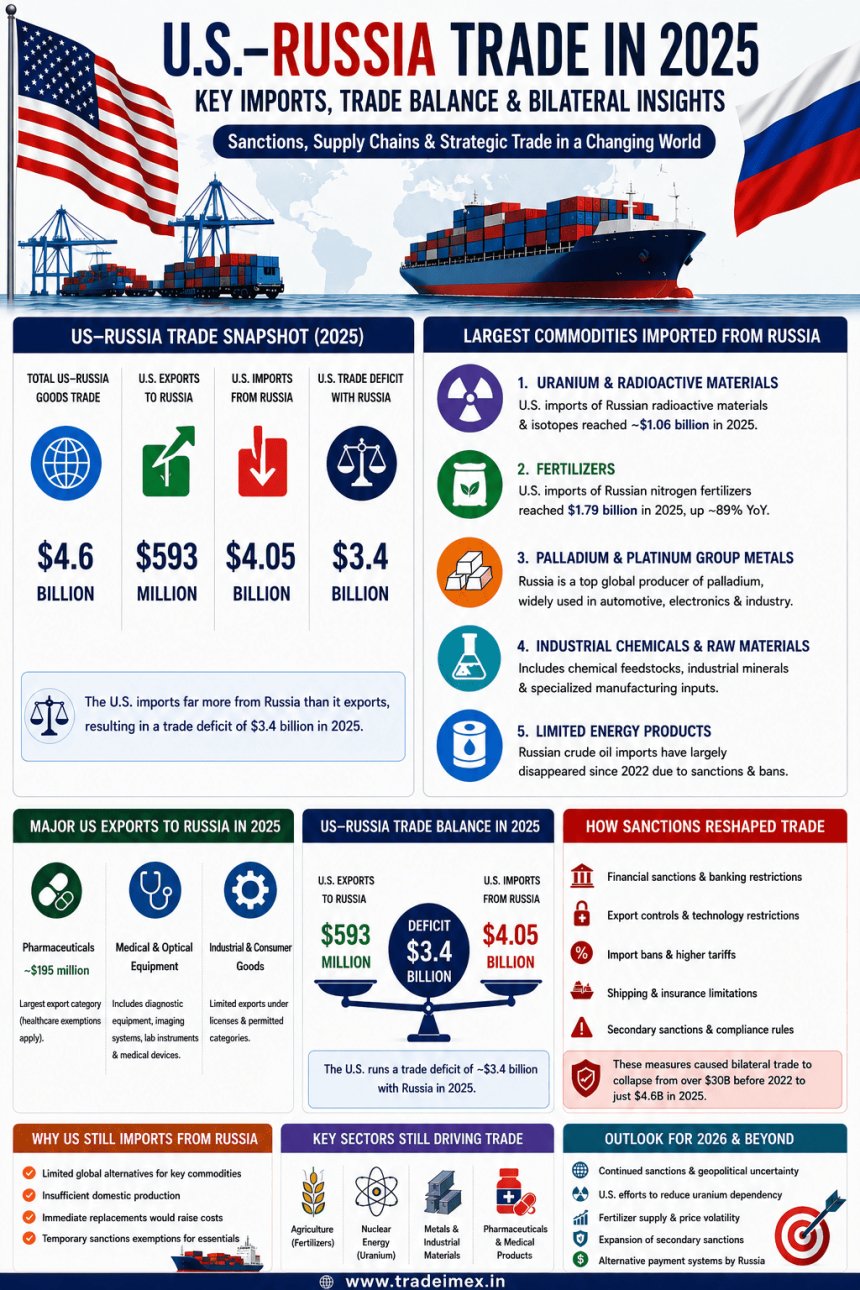
According to the Office of the United States Trade Representative (USTR), total U.S. goods trade with Russia in 2025 was around $4.6 billion. U.S. exports to Russia totaled around $593 million, while imports from Russia reached $4.05 billion. The resulting U.S. goods trade deficit with Russia stood at approximately $3.4 billion.
These figures are tiny compared to the scale of trade before 2022. Before sanctions intensified, annual bilateral goods trade between the two countries regularly exceeded $30 billion. Russia was once a major supplier of crude oil, petroleum products, aluminum, steel, and industrial minerals to the U.S. economy. Most of those flows have either disappeared or been heavily reduced. The remaining trade relationship is now concentrated in a few strategic sectors where the United States still depends on Russian supply chains, as per the US-Russia bilateral trade data.
US–Russia Trade Data Snapshot (2025)
|
Trade Indicator |
2025 Value |
|
Total US–Russia Goods Trade |
$4.6 billion |
|
U.S. Exports to Russia |
$593 million |
|
U.S. Imports from Russia |
$4.05 billion |
|
U.S. Trade Deficit with Russia |
$3.4 billion |
The data shows a major imbalance in trade. The U.S. imports far more from Russia than it exports, largely because the remaining imports involve essential commodities that are difficult to replace immediately.
Top Goods US Imports from Russia: What Does the USA Import from Russia?
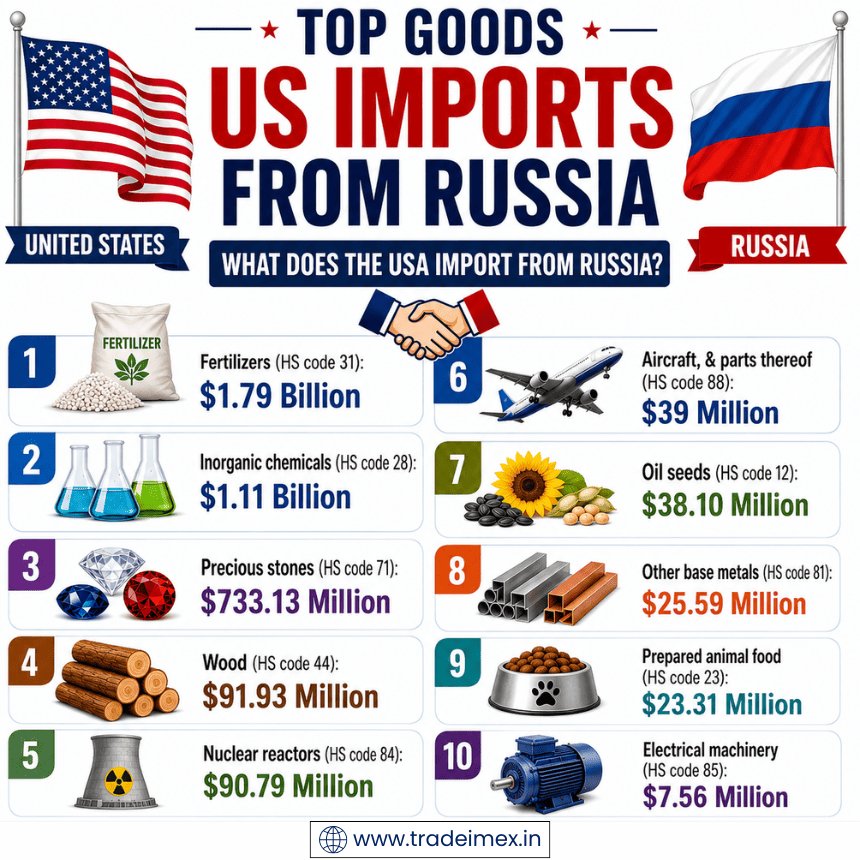
The major goods the USA imports from Russia span a diverse range, highlighting the strong trade relations between the two countries. Major imports from Russia to the United States include petroleum and petroleum products, precious metals, gems, and industrial machinery. These imports play a significant role in supporting various industries and contributing to the American economy. The top 10 commodities that the US imports from Russia, as per the US import data and Russia-US trade shipment data for 2025, include:
1. Fertilizers (HS code 31): $1.79 billion
Fertilizers are essential for agriculture and are widely used in the United States for crop production. Russia is a major exporter of fertilizers, supplying a significant share of the US market, as per the data on Russia exports to US by HS code. The import value of fertilizers from Russia is $1.79 billion, making them among the top goods the US imports from Russia.
2. Inorganic chemicals (HS code 28): $1.11 billion
Inorganic chemicals are another key import from Russia to the United States. These chemicals are used in various industries, including manufacturing, pharmaceuticals, and agriculture. The US imports a substantial amount of inorganic chemicals from Russia, with an import value of $1.11 billion.
3. Precious stones & metals (HS code 71): $733.13 million
Russia is known for its production of precious stones and metals such as diamonds, gold, and platinum. These valuable materials are in demand in the United States for jewelry and industrial purposes. The US imports precious stones and metals from Russia with an import value of $733.13 million.
4. Wood & articles thereof (HS code 44): $91.93 million
Wood and wood products are also among the goods that the US imports from Russia. Russia has vast forest resources, making it a major exporter of wood products to the United States. The import value of wood and articles thereof from Russia is $91.93 million, as per the data on US imports from Russia under HS code 44.
5. Nuclear reactors & machinery (HS code 84): $90.79 million
Nuclear reactors and machinery are crucial for various industrial applications, including energy production and manufacturing. The US imports nuclear reactors and machinery from Russia with an import value of $90.79 million, highlighting the importance of this category of goods in trade between the two countries.
6. Aircraft, spacecraft, & parts thereof (HS code 88): $39 million
Russia has a strong aerospace industry, producing aircraft, spacecraft, and related parts. The United States imports aircraft, spacecraft, and parts thereof from Russia with an import value of $39 million, reflecting the cooperation between the two countries in the aerospace sector.
7. Oil seeds & oleaginous fruits (HS code 12): $38.10 million
Oilseeds and oleaginous fruits are important for producing edible oils and food products. Russia is a significant exporter of oil seeds and oleaginous fruits to the United States, with an import value of $38.10 million.
8. Other base metals (HS code 81): $25.59 million
In addition to precious metals, Russia also exports base metals such as copper, lead, and zinc to the United States. The import value of other base metals from Russia is $25.59 million, contributing to the US industrial and manufacturing sectors.
9. Prepared animal food (HS code 23): $23.31 million
Prepared animal food is another category of goods that the US imports from Russia. This includes pet food and animal feed, which are essential for the domestic animal industry in the United States. The import value of prepared animal food from Russia is $23.31 million.
10. Electrical machinery & equipment (HS code 85): $7.56 million
Electrical machinery and equipment are crucial for various industries, including electronics, telecommunications, and manufacturing. The US imports electrical machinery and equipment from Russia with an import value of $7.56 million, highlighting the technological cooperation between the two countries.
Why US Imports from Russia Still Continue
A common question in 2025 is why the United States still imports anything from Russia at all. The answer lies in supply chain realities.
Certain Russian products remain important to American industries because:
-
Global supply alternatives are limited
-
Domestic U.S. production is insufficient
-
Immediate replacement would raise costs significantly
-
Some products received temporary sanctions exemptions
This is particularly true in the nuclear energy and agriculture sectors. For example, Russian uranium products remain important for U.S. nuclear reactors. Similarly, Russian fertilizers continue to support American agriculture, especially nitrogen-based fertilizer production.
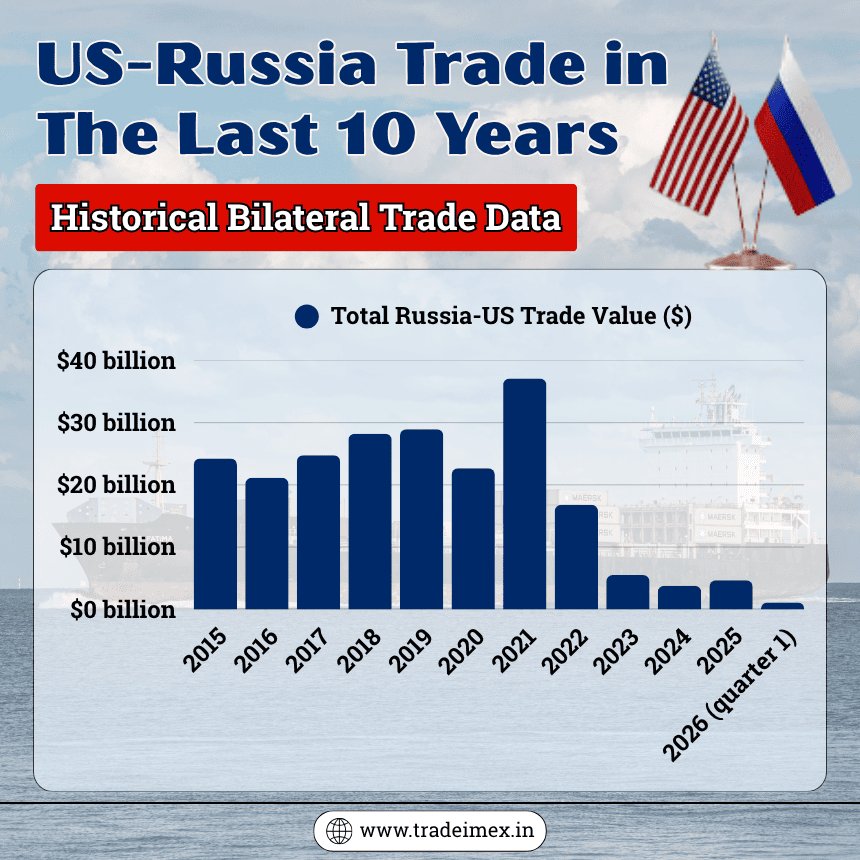
US-Russia Trade in The Last 10 Years: Historical Bilateral Trade Data
|
Year of Trade |
Total Russia-US Trade Value ($) |
|
2015 |
$24.24 billion |
|
2016 |
$21.12 billion |
|
2017 |
$24.77 billion |
|
2018 |
$28.22 billion |
|
2019 |
$28.95 billion |
|
2020 |
$22.65 billion |
|
2021 |
$37.08 billion |
|
2022 |
$16.78 billion |
|
2023 |
$5.49 billion |
|
2024 |
$3.79 billion |
|
2025 |
$4.64 billion |
|
2026 (quarter 1) |
$1.10 billion |

Largest Commodities Imported From Russia into the US
Although overall imports have declined sharply, several categories still dominate U.S. purchases from Russia.
1. Uranium and Radioactive Materials
One of the largest remaining import categories is enriched uranium and related nuclear materials. According to trade analyses cited by the Gaidar Institute, U.S. imports of Russian radioactive materials and isotopes reached approximately $1.06 billion in 2025, representing significant year-over-year growth.
Russia remains one of the world’s leading suppliers of enriched uranium. Many American nuclear power plants were designed around fuel supply arrangements involving Russian enrichment services. Even as the USA pushed to reduce its dependence on Russian energy, replacing uranium imports has proven far more difficult than replacing crude oil imports.
2. Fertilizers
Fertilizers are another major import category. Russian nitrogen fertilizers remain highly competitive globally because of Russia’s large natural gas reserves, which provide a cost advantage in fertilizer production.
Research cited by the Gaidar Institute found that U.S. imports of Russian nitrogen fertilizers increased substantially in 2025, reaching $1.79 billion, up nearly 89% year over year. American farmers continue to rely on fertilizer imports to stabilize prices and maintain agricultural output.
3. Palladium and Platinum Group Metals
Russia is one of the world’s largest producers of palladium, a metal used heavily in:
-
Automotive catalytic converters
-
Electronics
-
Aerospace components
-
Industrial manufacturing
Even under sanctions, some Russian palladium exports continued reaching global markets because of strong industrial demand and limited global supply alternatives.
4. Industrial Chemicals and Raw Materials
The U.S. still imports select industrial chemicals and raw materials from Russia, where supply chains remain difficult to diversify quickly.
These include:
-
Chemical feedstocks
-
Industrial minerals
-
Certain metal products
-
Specialized manufacturing inputs
However, volumes are far lower than before 2022.
5. Limited Energy Products
Russian crude oil imports into the United States largely disappeared after sanctions and import bans were implemented in 2022. Before the war, Russia had been one of the top foreign suppliers of petroleum products to the United States. That trade relationship effectively collapsed following sanctions.
Major US Exports to Russia in 2025
U.S. exports to Russia have fallen dramatically due to sanctions, export controls, payment restrictions, and the withdrawal of many Western companies from the Russian market. Still, several categories remain active.
Pharmaceuticals
Pharmaceutical products are among the largest U.S. exports, still reaching Russia. According to trade analyses referenced by the Gaidar Institute, U.S. pharmaceutical exports to Russia reached approximately $195 million in 2025. Many medical products were exempted from the harshest sanctions for humanitarian reasons.
Medical and Optical Equipment
Medical devices and optical equipment also continue to be exported. These include:
-
Diagnostic equipment
-
Medical imaging technologies
-
Specialized healthcare devices
-
Laboratory instruments
Consumer Goods and Industrial Equipment
Some limited exports of industrial and consumer products continue under licensing exemptions and permitted trade categories. However, most high-tech exports remain heavily restricted under U.S. export control rules.
US–Russia Trade Balance in 2025
The United States continues to run a trade deficit with Russia. In 2025, the U.S. goods trade deficit with Russia was around $3.4 billion, according to the latest data. This deficit exists because:
-
Russia exports high-value commodities to the U.S.
-
U.S. exports to Russia have collapsed
-
Sanctions disproportionately target American exports
-
Essential commodity imports continue
The deficit is much smaller than before 2022 because total trade volumes have shrunk dramatically.
How Sanctions Reshaped The Russia-US Bilateral Trade
The most important factor shaping U.S.–Russia trade relations is sanctions policy. Since 2022, the U.S. government has imposed several sanctions and export controls on Russia, such as:
-
Financial sanctions
-
Export controls
-
Import bans
-
Technology restrictions
-
Banking limitations
-
Shipping restrictions
-
Tariffs and secondary sanctions
These measures were designed to weaken Russia’s access to Western technology, finance, and export markets. The result has been a historic collapse in bilateral trade. The U.S. imports from Russia dropped sharply after 2022, though strategic commodities remain in circulation.
The Role of Tariffs and Trade Restrictions
Tariffs have become an increasingly important part of U.S. trade policy toward Russia. Following the Ukraine conflict, the U.S. revoked Russia’s “Most Favored Nation” trade status, allowing higher tariffs on Russian goods. Additional restrictions included:
-
Expanded customs duties
-
Bans on specific imports
-
Restrictions on industrial products
-
Enhanced compliance requirements
However, many trade experts note that sanctions have had a larger impact than tariffs alone because financial restrictions severely disrupted payment systems and trade.
Sector-by-Sector Impact
1. Energy
The energy relationship between the two countries has largely collapsed. Russian oil exports to the U.S. have fallen dramatically compared to pre-war levels.
2. Agriculture
Agriculture remains one of the few sectors where trade continues relatively actively because of fertilizer demand.
3. Nuclear Energy
The nuclear sector remains strategically important. Russian uranium imports continue despite political pressure to reduce dependency.
4. Manufacturing
Manufacturing trade has declined sharply because industrial supply chains were disrupted by sanctions and export controls.
How Russia’s Global Trade Strategy Has Changed
As trade with the U.S. and Europe declined, Russia increasingly redirected exports toward:
-
China
-
India
-
Turkey
-
Middle Eastern markets
-
Southeast Asia
China became Russia’s dominant trading partner after 2022. Russian companies also increased efforts to use alternative currencies and bypass Western financial systems.
Impact on American Businesses
The collapse in bilateral trade affected several U.S. industries.
1. Higher Input Costs
Industries dependent on Russian raw materials faced rising costs and supply disruptions.
2. Supply Chain Diversification
Many companies accelerated diversification away from Russian suppliers.
3. Energy Market Volatility
The disruption of global energy markets contributed to inflationary pressures worldwide.
Public Debate Around Remaining Trade
Remaining U.S.–Russia trade flows continue to generate political debate. Critics argue that continuing imports undermine sanctions pressure. Supporters of exemptions argue that abrupt cutoffs would hurt American industries more than Russia in certain sectors. Online discussions frequently focus on fertilizer and uranium imports as examples of ongoing economic dependence.
Future Outlook for US–Russia Trade Relations
The outlook for Russia-US trade relations remains highly uncertain.
Several factors will determine future trade levels:
-
The trajectory of the Ukraine conflict
-
Future sanctions policy
-
U.S. domestic politics
-
Global commodity markets
-
Energy security concerns
-
Nuclear fuel supply diversification
In the short term, trade is likely to remain limited and concentrated in essential commodities. Long-term normalization appears unlikely unless there is a major geopolitical shift.
Key Trends to Watch in 2026 and Beyond
1. Uranium Dependency Reduction
The U.S. government continues efforts to reduce dependence on Russian nuclear fuel.
2. Fertilizer Supply Chains
Agricultural markets will continue monitoring fertilizer supply risks and pricing.
3. Expanded Secondary Sanctions
Washington may increase pressure on third countries facilitating Russian trade.
4. Alternative Payment Systems
Russia continues exploring non-dollar trade settlement mechanisms.
5. Commodity Price Volatility
Global commodity markets remain sensitive to sanctions and geopolitical developments.
Conclusion and Final Verdict
In conclusion, the U.S.–Russia trade relations in 2025 are a fraction of what they once were. What was previously a broad commercial relationship has become a narrowly focused exchange centered on strategic commodities and essential industrial inputs. The United States imported around $4 billion worth of Russian goods in 2025 while exporting only about $593 million to Russia, resulting in a trade deficit of roughly $3.4 billion.
The largest remaining imports include:
-
Uranium and nuclear materials
-
Fertilizers
-
Palladium and industrial metals
-
Specialized chemicals and raw materials
Meanwhile, U.S. exports to Russia are now dominated by pharmaceuticals and medical equipment. Sanctions, tariffs, and geopolitical tensions have fundamentally reshaped the relationship. Although trade has not disappeared entirely, it now reflects strategic necessity more than economic partnership. Going forward, bilateral trade will remain closely tied to global politics, sanctions policy, & the evolving balance between economic security and supply chain dependence.
Frequently Asked Questions (FAQs)
1. What are the top US imports from Russia in 2025?
The top US imports from Russia in 2025 include fertilizers, uranium and radioactive materials, inorganic chemicals, precious metals, palladium, wood products, machinery, and industrial raw materials. Fertilizers remained the largest import category, valued at around $1.79 billion.
2. Why does the United States still import goods from Russia despite sanctions?
The United States still imports certain Russian products because some commodities are difficult to replace immediately. Critical sectors such as agriculture and nuclear energy continue relying on Russian fertilizers and uranium supplies due to limited global alternatives and supply chain dependencies.
3. What is the US–Russia trade balance in 2025?
In 2025, the total US–Russia goods trade was approximately $4.6 billion. US imports from Russia reached around $4.05 billion, while US exports to Russia were about $593 million, resulting in a US trade deficit of nearly $3.4 billion.
4. How have sanctions affected US–Russia trade relations?
Sanctions significantly reduced bilateral trade between the two countries after 2022. The United States imposed import bans, export controls, financial restrictions, and higher tariffs on Russian goods, causing trade volumes to fall from over $30 billion annually before 2022 to less than $5 billion in 2025.
5. What products does the US export to Russia?
The main US exports to Russia in 2025 include pharmaceuticals, medical devices, optical instruments, laboratory equipment, and limited industrial products. Most high-tech exports remain heavily restricted under US sanctions and export control regulations.
Final Note For Our Readers
We hope this blog has helped you gain a clearer, data-backed understanding of US–Russia trade relations in 2025, including the latest bilateral trade figures, top U.S. imports from Russia, trade balance trends, and the broader geopolitical and economic factors influencing this relationship. As sanctions, supply chain diversification, energy security concerns, and global market shifts continue to reshape international commerce, the future of U.S.–Russia trade remains one of the most closely watched developments in the global economy.
If you’re looking for detailed, customized trade reports or search live import-export data, HS code-level insights, live shipment records, country-wise trade statistics, or competitor analysis, TradeImeX can help you make smarter and faster business decisions.
With access to global trade databases and actionable market intelligence, you can better track changing trade flows, identify new sourcing opportunities, and stay ahead in an increasingly dynamic international trade environment. To learn more, connect with us at info@tradeimex.in and explore how TradeImeX can support your global trade strategy.
Share
What's Your Reaction?
 Like
0
Like
0
 Dislike
0
Dislike
0
 Love
0
Love
0
 Funny
0
Funny
0
 Angry
0
Angry
0
 Sad
0
Sad
0
 Wow
0
Wow
0