India-UAE Sign $3 Billion LNG Trade Deal: India & UAE Set Ambitious $200 Billion Trade Target by 2032
India and the UAE strengthen ties with a $3 billion LNG trade deal, aiming to boost bilateral trade to $200 billion by 2032. Read full trade insights.


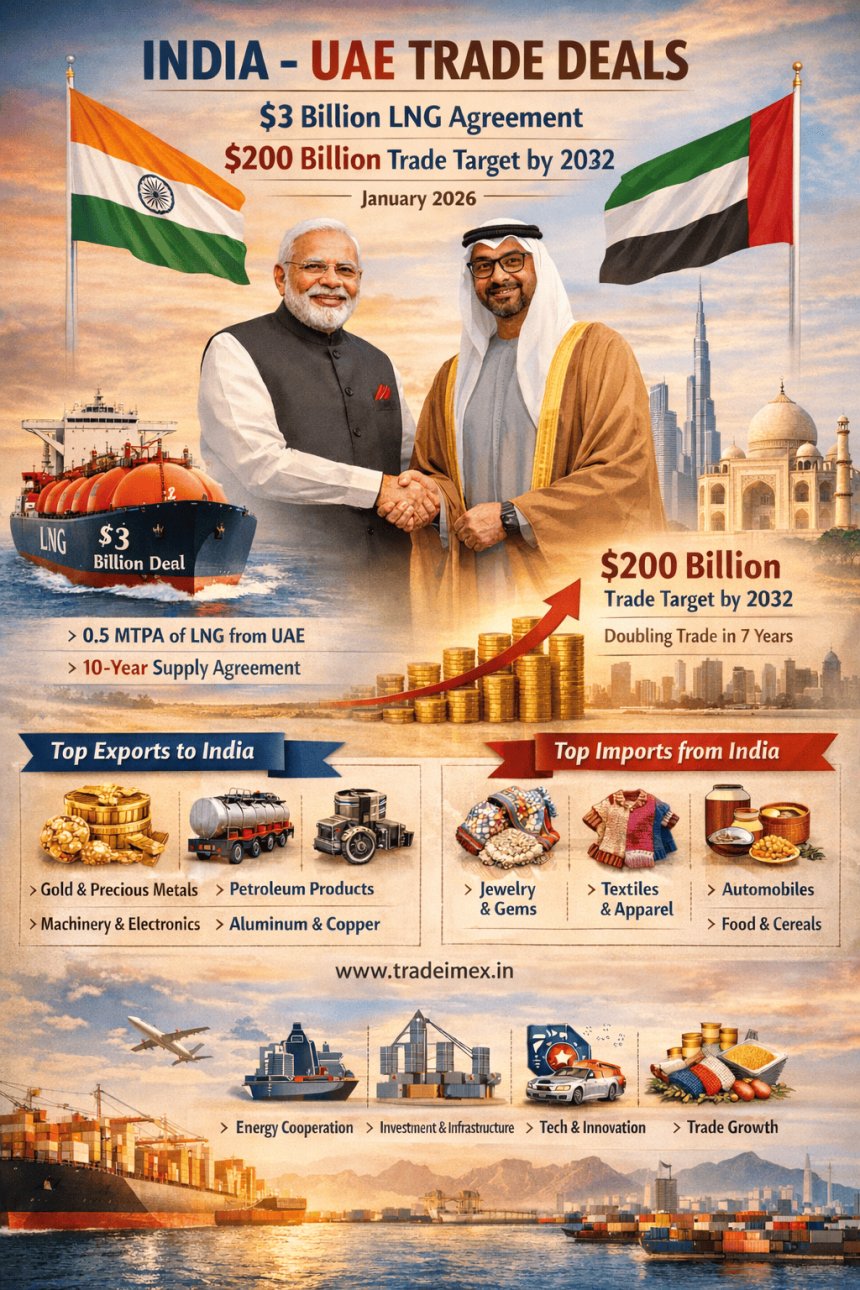
On January 19, 2026, India and the United Arab Emirates (UAE) took a major step forward in deepening their strategic and economic partnership. The India–UAE relationship entered a decisive new phase with the signing of a $3 billion long-term liquefied natural gas (LNG) trade agreement and the announcement of a $200 billion annual bilateral trade target by 2032, reinforcing energy cooperation and marking India as the UAE’s largest LNG customer. According to the latest UAE export data & India-UAE trade data, the total value of the UAE-India trade reached over $100 billion in 2024-25.
These developments signal not just an expansion of commerce but a structural deepening of economic, energy, and strategic cooperation between two increasingly aligned economies. At a time when global trade is being reshaped by supply-chain disruptions, geopolitical uncertainty, and energy transitions, the India–UAE partnership stands out for its clarity of direction and long-term ambition, as per the Asia trade data. The agreements reflect confidence in each other’s economic resilience and underline a shared vision for growth, stability, and strategic autonomy.
This blog examines the LNG deal in detail, places it within India’s broader energy strategy, analyses the feasibility of the $200 billion trade target, and explores the wider economic and geopolitical implications of this evolving partnership.
India–UAE Trade Relations: From Energy Dependence to Strategic Interdependence
India and the UAE share one of the most dynamic bilateral relationships in Asia and the Middle East. What began decades ago as a largely oil-based trading relationship has steadily diversified into a multi-sector partnership covering infrastructure, finance, technology, defence, food security, and renewable energy.
Over the last decade, bilateral trade has grown rapidly:
-
Total India-UAE trade crossed $100 billion annually in the mid-2020s.
-
The UAE consistently ranks among India’s top three global trading partners.
-
India is one of the UAE’s largest export destinations and a major source of imports, services, and skilled labour.
The signing of the Comprehensive Economic Partnership Agreement (CEPA) in 2022 accelerated this momentum by reducing tariffs on thousands of goods, simplifying customs procedures, and encouraging investment flows in both directions. The new $200 billion trade target by 2032 builds directly on this foundation.
The $3 Billion LNG Deal: Structure and Key Details
At the heart of the latest announcements is a long-term LNG supply agreement valued at around $3 billion.
Core Features of the LNG Agreement
-
India will import 0.5 million metric tonnes per annum (mtpa) of LNG from the UAE.
-
Hindustan Petroleum Corporation Ltd (HPCL) will buy 0.5 million metric tons per annum (mtpa) of LNG from ADNOC Gas, the UAE’s national gas company.
-
The deal spans 10 years, beginning in 2028, and is valued at approximately $2.5-3 billion.
-
The supply will come from the UAE’s established LNG infrastructure, ensuring reliability and delivery certainty.
-
An Indian public-sector oil company will act as the buyer, while the UAE’s national gas producer will supply the LNG.
This contract converts an earlier framework into a firm Sales and Purchase Agreement (SPA) and reinforces the UAE’s role as a reliable energy partner for India.
Top Traded Goods Between the UAE and India
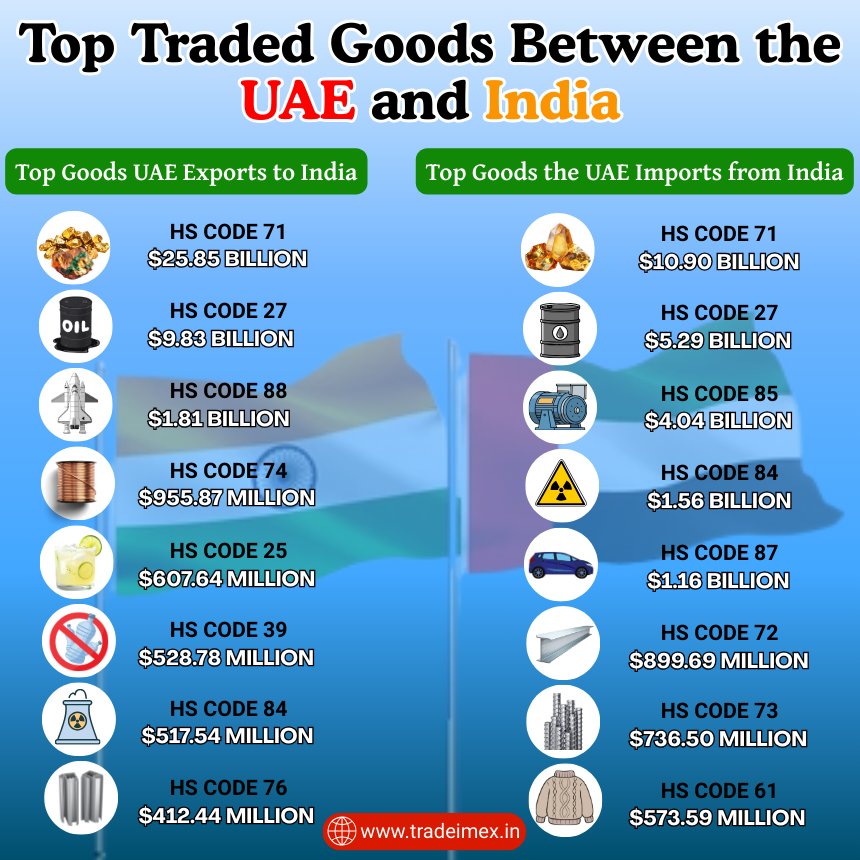
The top traded goods between the UAE and India encompass a diverse range of products, fostering a robust economic partnership between the two countries. Key commodities include petroleum products, gems and jewelry, precious metals, machinery, and textiles. The UAE-India bilateral trade relationship is characterized by mutual benefits and a strong commitment to enhancing trade ties through strategic collaborations and investments. The following are the top traded goods between India & the UAE in 2025:
Top Goods UAE Exports to India
The total value of goods that the UAE exported to India reached $42.79 billion in 2024-25, as per the UAE trade data. The top products that the UAE exports to India, as per the UAE shipment data for 2024-25, include:
1. Precious stones & metals (HS code 71): $25.85 billion
2. Mineral fuels & oils (HS code 27): $9.83 billion
3. Aircraft, spacecraft, & parts thereof (HS code 88): $1.81 billion
4. Copper & articles thereof (HS code 74): $955.87 million
5. Salt, sulphur, lime, & cement (HS code 25): $607.64 million
6. Plastics & articles thereof (HS code 39): $528.78 million
7. Nuclear reactors & machinery (HS code 84): $517.54 million
8. Aluminum & articles thereof (HS code 76): $412.44 million
9. Electrical machinery & equipment (HS code 85): $399.70
10. Articles of iron or steel (HS code 73): $252.37 million
Top Goods the UAE Imports from India
The total value of goods that the US imports from India reached $33.11 billion in the 2024-25 fiscal year. The major products that the UAE imports from India, as per the UAE import data for 2024-25, include:
1. Precious stones & metals (HS code 71): $10.90 billion
2. Mineral fuels & oils (HS code 27): $5.29 billion
3. Electrical machinery & equipment (HS code 85): $4.04 billion
4. Nuclear reactors & machinery (HS code 84): $1.56 billion
5. Vehicles (HS code 87): $1.16 billion
6. Iron & steel (HS code 72): $899.69 million
7. Articles of iron or steel (HS code 73): $736.50 million
8. Articles of apparel, knitted (HS code 61): $573.59 million
9. Cereals (HS code 10): $485.83 million
10. Articles of apparel, not knitted (HS code 62): $458.79 million
India-UAE Trade in the Last 10 Years: Historical Bilateral Trade Data
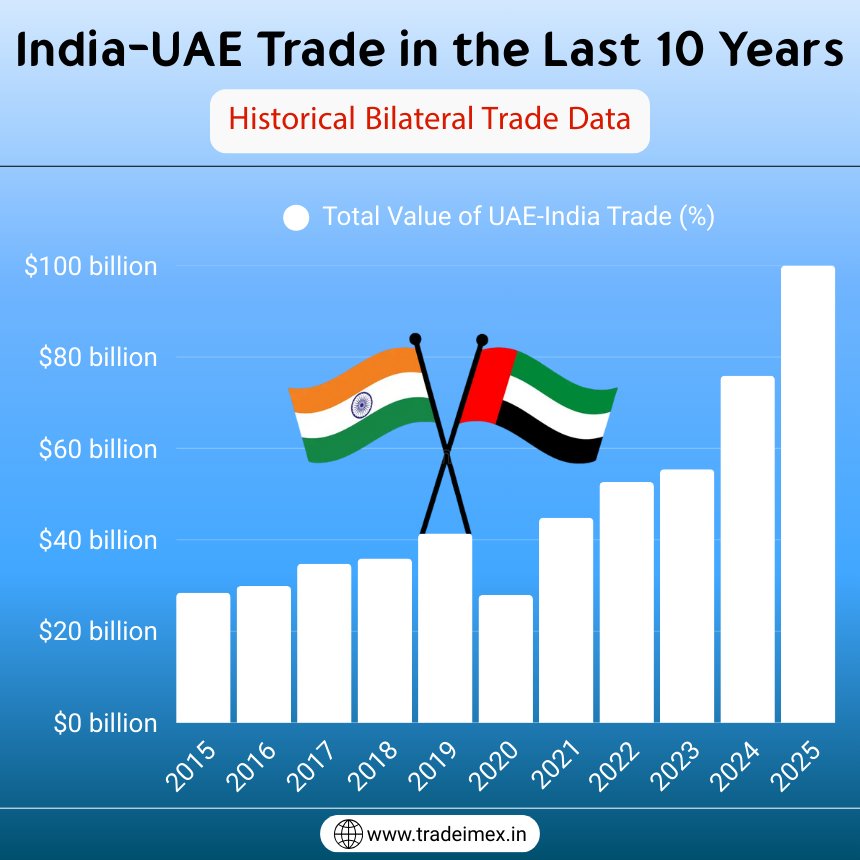
|
Year of Trade |
Total Value of UAE-India Trade (%) |
|
2015 |
$28.41 billion |
|
2016 |
$29.91 billion |
|
2017 |
$34.76 billion |
|
2018 |
$35.91 billion |
|
2019 |
$41.39 billion |
|
2020 |
$27.96 billion |
|
2021 |
$44.84 billion |
|
2022 |
$52.66 billion |
|
2023 |
$55.45 billion |
|
2024 |
$75.90 billion |
|
2025 |
$100 billion |
Why LNG Matters to India’s Energy Strategy
India’s energy demand is among the fastest-growing in the world. As the economy expands, urbanization increases, and manufacturing capacity scales up, energy security has become a strategic priority.
India’s Natural Gas Transition
India aims to increase the share of natural gas in its energy mix from around 6–7% today to 15% by 2030. Several factors drive this transition:
-
Natural gas emits significantly less carbon dioxide than coal and oil.
-
LNG supports cleaner urban transport, industrial fuel switching, and power generation.
-
Gas-based fertilizer production is critical for food security.
However, domestic gas production remains insufficient to meet rising demand. As a result, India depends heavily on LNG imports, making long-term supply agreements essential for price stability and planning certainty.
Why the UAE Is a Strategic LNG Partner
The UAE offers several advantages as an LNG supplier:
-
Political stability and strong diplomatic ties with India.
-
Advanced LNG production and export infrastructure.
-
A proven track record as a reliable energy supplier.
-
Geographic proximity compared to Atlantic basin suppliers reduces transportation risks.
By securing LNG from the UAE, India reduces over-reliance on spot markets and volatile suppliers, particularly during periods of global energy disruption.
What the LNG Deal Means for the UAE
For the UAE, the LNG agreement strengthens its position as a major energy exporter during a time of global energy transition.
Key benefits include:
-
Long-term demand security from one of the world’s fastest-growing energy markets.
-
Reinforcement of the UAE’s role as a preferred energy partner for Asia.
-
Better utilization of existing LNG assets while investing in cleaner gas-based exports alongside renewables.
The deal also fits into the UAE’s strategy of balancing traditional hydrocarbon exports with forward-looking energy diplomacy.
The $200 Billion Trade Target: Ambition Meets Strategy
The announcement of a $200 billion annual trade target by 2032 represents a doubling of current trade levels in less than a decade.
Is the Target Realistic?
From a purely numerical standpoint, doubling trade over seven to eight years requires sustained annual growth of around 9–10%, which is ambitious but achievable given recent trends. To evaluate the $200 billion target, it helps to consider:
|
Indicator |
Latest Value |
Target |
Growth Required |
|
Bilateral Trade (2024-25) |
>$100 billion |
$200 billion by 2032 |
Double in 7 years |
Maintaining this level of growth will depend on:
-
Continued tariff reductions and trade facilitation.
-
Expansion into non-oil sectors such as services, technology, and manufacturing.
-
Strengthening investment flows and business linkages.
Several factors support this target:
-
Strong post-CEPA trade growth.
-
Complementary economic structures.
-
Rising investment flows.
-
Expanding cooperation in non-oil sectors.
The key challenge will be ensuring diversification beyond petroleum products, which still account for a large share of bilateral trade.
Key Sectors Driving the Next Phase of Growth
1. Energy and Green Transition
Beyond LNG, India and the UAE are expanding cooperation in:
-
Renewable energy projects, including solar and green hydrogen.
-
Strategic oil storage and energy infrastructure.
-
Joint investments in clean energy technologies.
Energy trade will remain the backbone of the relationship, but its composition will evolve.
2. Infrastructure and Capital Investment
The UAE is one of the largest sources of foreign direct investment into India, particularly in:
-
Ports and trade hubs
-
Airports
-
Roads and industrial corridors
-
Smart cities and urban infrastructure
Large-scale infrastructure projects offer long-term returns for UAE sovereign wealth funds while supporting India’s domestic growth objectives.
3. Manufacturing and Industrial Collaboration
India’s push to become a global manufacturing hub aligns well with UAE investment and trade strengths.
Priority areas include:
-
Pharmaceuticals
-
Electronics
-
Automotive components
-
Food processing
-
Defence manufacturing
Manufacturing partnerships will be critical to boosting non-oil trade volumes.
4. Technology, AI, and Digital Economy
Digital cooperation is emerging as a new pillar of India–UAE relations:
-
Joint work in artificial intelligence and data infrastructure.
-
Semiconductor and high-performance computing collaboration.
-
Fintech integration, including digital payment linkages.
These sectors offer high-value trade growth and position both countries at the forefront of technological change.
5. Financial Services and Trade Facilitation
Efforts are underway to simplify cross-border payments, improve trade finance access, and integrate financial systems. Enhanced financial connectivity reduces transaction costs and encourages MSMEs to participate in bilateral trade, broadening the base of economic engagement.
Strategic and Geopolitical Dimensions
The India–UAE relationship has increasingly strategic overtones.
Defence and Security Cooperation
Alongside economic agreements, the two countries have expanded cooperation in:
-
Defence manufacturing and technology sharing.
-
Maritime security and counter-terrorism.
-
Cybersecurity and intelligence coordination.
This reflects mutual concerns over regional stability and the security of trade routes.
Geopolitical Alignment
The partnership demonstrates a pragmatic alignment in a multipolar world:
-
India strengthens its footprint in the Gulf without entanglement in regional rivalries.
-
The UAE diversifies strategic partnerships beyond traditional Western allies.
-
Both countries emphasize economic diplomacy over ideological alignment.
This balance has helped insulate the relationship from regional volatility.
People-to-People Ties: An Often Overlooked Advantage
Over three million Indians live and work in the UAE, forming one of the largest expatriate communities in the country.
This diaspora:
-
Contributes significantly to the UAE economy.
-
Supports remittance flows to India.
-
Acts as a cultural and commercial bridge between the two nations.
Education, tourism, and professional mobility agreements further strengthen these human connections, which underpin economic cooperation.
Challenges That Could Slow Momentum
Despite strong fundamentals, several risks must be managed:
-
The global economic slowdown is affecting trade volumes.
-
Energy price volatility is impacting LNG economics.
-
Regulatory complexity that may slow investment execution.
-
Regional instability in West Asia is affecting trade and confidence.
Sustained political commitment and policy coordination will be essential to overcoming these challenges.
Conclusion: A Partnership Built for the Next Decade
In conclusion, the $3 billion LNG agreement and the $200 billion trade target by 2032 mark a decisive moment in India–UAE trade relations. The January 2026 summit between Prime Minister Narendra Modi and UAE President Sheikh Mohamed bin Zayed Al Nahyan marked a watershed moment in India-UAE relations. Together, they represent a shift from transactional engagement to long-term strategic partnership. For India, the deals strengthen energy security, attract investment, and accelerate integration into global value chains. For the UAE, they secure access to a vast growth market and reinforce its role as a strategic economic hub between Asia, Africa, and Europe.
If current momentum is maintained and diversification continues, the India–UAE partnership could become one of the most consequential bilateral economic relationships of the next decade, not just in volume, but in depth, resilience, and strategic impact.
We hope that you liked our data-driven & insightful blog report on the UAE-India LNG trade agreement & ambitious trade goals. To access the latest global trade data, or to search live import-export data by country, visit TradeImeX. Contact us at info@tradeimex.in for customized trade reports and market insights.
Share
What's Your Reaction?
 Like
0
Like
0
 Dislike
0
Dislike
0
 Love
1
Love
1
 Funny
0
Funny
0
 Angry
0
Angry
0
 Sad
0
Sad
0
 Wow
0
Wow
0