
Breaking Down the Canada–China Tariff Agreement: EVs, Canola, and Canada–China Trade Insights
Breaking down the Canada–China tariff agreement covering EVs and canola, with key trade impacts, policy insights, & the future Canada–China trade outlook.


Canada–China trade relations have entered a complex and highly strategic phase. After years of tension marked by tariffs, import restrictions, and diplomatic disputes, both countries are reassessing their economic relationship under shifting global conditions. Rising geopolitical fragmentation, supply chain reconfiguration, and climate-driven industrial policy, particularly in electric vehicles (EVs) and clean technology, have pushed tariffs and market access back to the center of bilateral trade discussions.
In early 2026, Canada and China announced a major reset of their economic relationship, one that Canadian Prime Minister Mark Carney described as offering “historic gains” for both nations by leveraging mutual strengths across agriculture, energy, technology, and finance. This diplomatic milestone, marked by Carney’s first official visit to China since 2017, signals a deliberate effort to rebuild bilateral trade ties after years of tension and tariff escalations, and comes at a moment of global economic fragmentation and shifting trade alliances. According to the latest Canada export data and China import data, the total value of Canada-China trade reached $85.75 billion in 2024 and $65.40 billion in the first three quarters of 2025.
China is still one of Canada’s largest trading partners, while Canada remains an important supplier of agricultural commodities, natural resources, and increasingly, upstream inputs for clean energy and advanced manufacturing. At the same time, both governments are using tariffs and trade controls more actively to protect domestic industries and advance strategic objectives. This article breaks down the evolving Canada–China tariff landscape with a focus on three critical areas: electric vehicles (EVs), canola and agricultural trade, and broader structural trade dynamics shaping the bilateral relationship for Canada and China trade.
The EV–Canola Tariff Deal Reshaping Canada–China Trade Relations
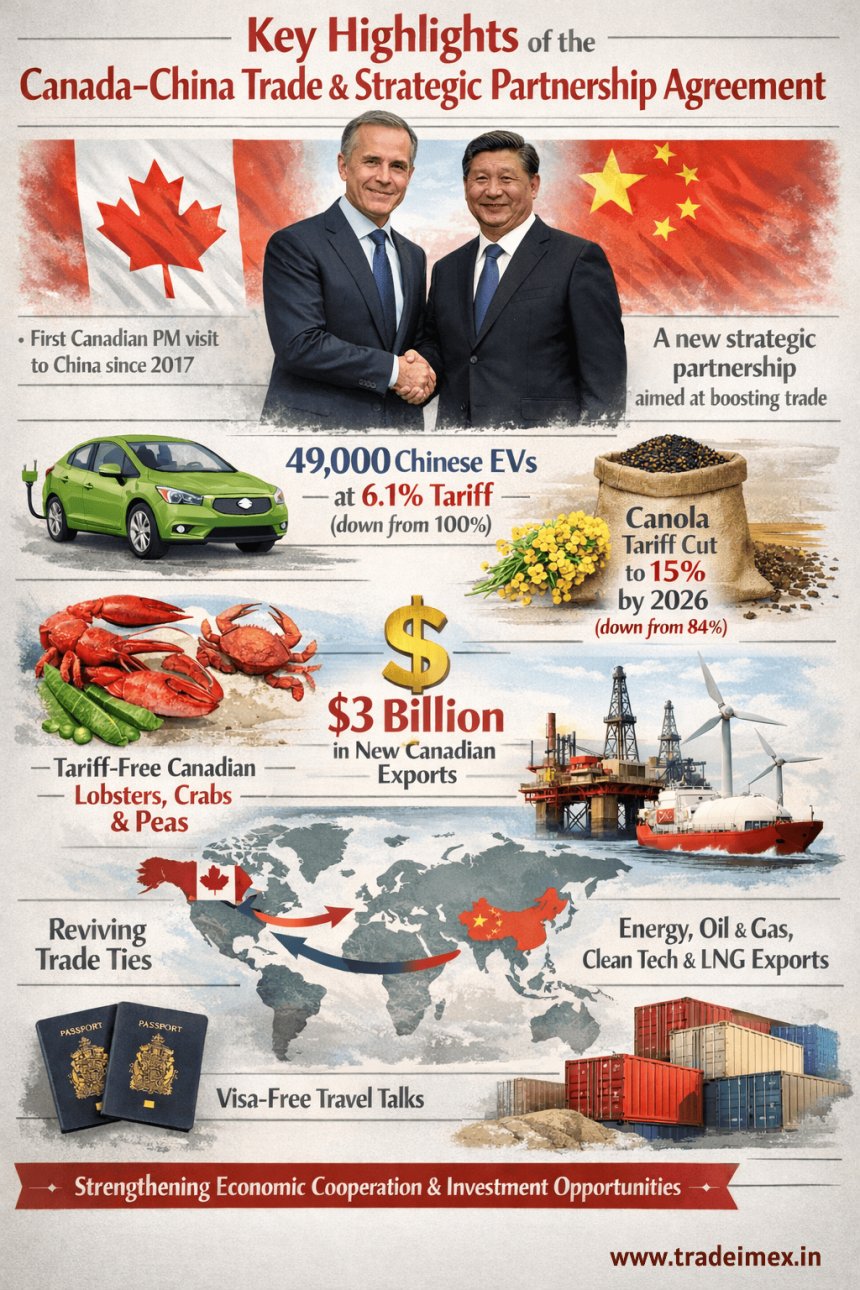
At the heart of this renewed engagement is a preliminary tariff agreement focused on two previously contentious sectors, electric vehicles (EVs) and canola, with implications that go well beyond those industries. Canada agreed to slash tariffs on Chinese-made EVs, allowing up to 49,000 vehicles to enter at a most-favored-nation rate of 6.1 percent, a dramatic change from the punitive 100 percent tariffs imposed as recently as 2024 under the previous Canadian government. In exchange, China committed to reducing tariffs on Canadian canola seeds and related agricultural goods, including canola meal, lobsters, crabs, and peas. This shift in policy is expected to unlock billions of dollars in export opportunities for Canadian farmers and processors after prolonged market disruptions.
These breakthroughs are positioned by both governments as part of a strategic partnership aimed at sustainable economic cooperation, even as broader geopolitical tensions persist. Canada, long economically intertwined with both the United States and China, now appears intent on diversifying trade relationships and reducing dependency on any single market, a pragmatic response to unpredictable tariff environments and a fracturing global trading system. China, in turn, sees value in stabilizing and expanding trade with a major Western economy at a time when global supply chains and geopolitical alliances are shifting rapidly. This Canada-China tariff deal does not represent a full free trade deal in the conventional sense, but it positions trade policy as a core pillar of a deeper bilateral relationship.
By focusing on sectors central to both countries’ industrial strategies, EV manufacturing for Canada’s clean energy ambitions and canola agriculture for China’s food and industrial demand, the agreement reflects a pragmatic recalibration of Canada–China trade relations. In the sections that follow, we’ll break down this evolving tariff landscape, examine the ramifications for Canada’s EV and agricultural sectors, and explore broader trade implications as both nations navigate a complex global economy.
Canada–China Trade in Context: Size, Structure, & Imbalance
Trade Volume and Direction
Canada–China trade remains large but structurally imbalanced. As of the mid-2020s:
-
Annual two-way merchandise trade exceeds CAD 100 billion or USD 80 billion.
-
Canada consistently runs a significant trade deficit, importing far more from China than it exports.
-
Manufactured goods dominate Chinese exports to Canada.
-
Primary commodities dominate Canadian exports to China.
China is Canada’s second-largest trading partner after the United States, while Canada is a mid-tier partner for China, reflecting asymmetrical dependence.
What Canada Imports from China
Canada imports from China are heavily concentrated in:
-
Consumer electronics
-
Machinery and electrical equipment
-
Furniture and household goods
-
Textiles and apparel
-
Batteries and battery components
These imports are price-competitive and deeply embedded in Canadian retail and manufacturing supply chains.
What Canada Exports to China
Canada exports to China are narrower and more volatile, dominated by:
-
Canola and canola products
-
Wheat and barley
-
Pork and seafood
-
Wood pulp and lumber
-
Minerals and energy-related inputs
This structural asymmetry makes tariffs and non-tariff barriers particularly impactful for Canadian exporters.
Canada-China Trade in the Last 10 Years: Yearly Bilateral Trade Data
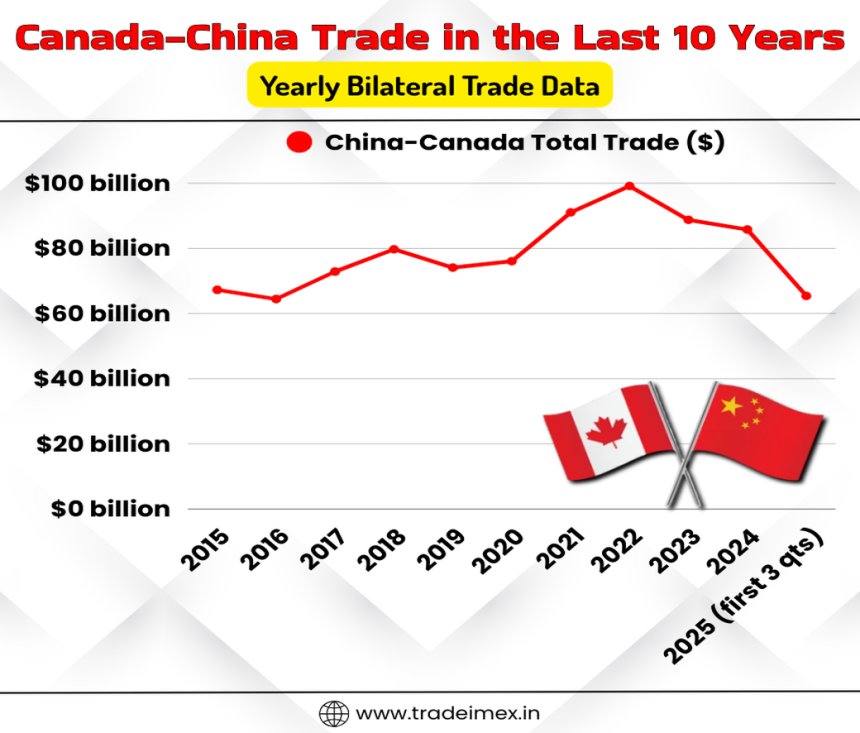
|
Year of Trade |
China-Canada Total Trade ($) |
|
2015 |
$67.26 billion |
|
2016 |
$64.44 billion |
|
2017 |
$72.88 billion |
|
2018 |
$79.71 billion |
|
2019 |
$74.07 billion |
|
2020 |
$76.04 billion |
|
2021 |
$91.01 billion |
|
2022 |
$99.11 billion |
|
2023 |
$88.72 billion |
|
2024 |
$85.75 billion |
|
2025 (first 3 quarters) |
$65.40 billion |
Tariffs as Policy Tools in Canada–China Relations
Unlike traditional free trade agreements, Canada–China tariff arrangements are selective, reactive, and politically sensitive. Tariffs are often accompanied, or replaced by, regulatory barriers, licensing requirements, and administrative controls. China imposed tariffs on about $2.6 billion worth of Canadian farm and food items, including canola oil and meal, in March in retaliation for Trudeau's tariffs. In August, the country imposed tariffs on canola seed. As a result, China's imports of Canadian commodities fell by 10.4% in 2025. According to Carney, Canada anticipates that China would reduce its canola seed tariffs from the current 84% to a combined rate of roughly 15% by March 1 as part of the new agreement. Canada anticipates the removal of anti-discrimination duties on canola meal, lobsters, crabs, and peas starting on March 1 and continuing until at least the end of the year.
Key characteristics of the Canada–China tariff environment include:
-
Limited tariff liberalization
-
High use of non-tariff measures
-
Sector-specific restrictions rather than economy-wide agreements
-
Strong linkage between trade actions and political developments
This context is critical when analyzing EVs and canola, where tariffs intersect with strategic and security concerns.
Electric Vehicles: Tariffs, Subsidies, & Strategic Competition
China’s Dominance in the EV Supply Chain
China is the world’s largest producer and exporter of electric vehicles and EV components. It controls significant portions of:
-
Battery cell manufacturing
-
Rare earth processing
-
Cathode and anode materials
-
EV platform manufacturing
Chinese EV exports have surged globally, raising concerns in importing countries about market distortion driven by state subsidies and scale advantages.
Canada’s EV Strategy
Canada has positioned itself as a clean automotive and battery manufacturing hub, supported by:
-
Large-scale investment incentives
-
Domestic battery plants
-
Critical mineral development
-
Industrial policy aligned with North American partners
Protecting this emerging ecosystem is a key priority for Canadian trade and tariff policy.
EV Tariffs Between Canada and China
Canada’s Approach to Chinese EV Imports
Canada does not have a comprehensive tariff agreement with China covering EVs. Instead, the EV trade is shaped by:
-
Existing Most-Favored-Nation tariff rates
-
Enhanced scrutiny of subsidies and state support
-
Alignment with broader industrial and national security policies
Canada has signaled a willingness to use:
-
Anti-dumping investigations
-
Countervailing duties
-
Investment screening
These tools function as de facto trade barriers even when formal tariffs remain unchanged.
Why EV Tariffs Matter More Than Volume
Currently, Chinese EVs represent a small share of Canada’s total vehicle market. However, their potential impact is significant due to:
-
Lower production costs
-
Rapid technological improvement
-
Aggressive export pricing
Tariff policy is therefore preemptive, aimed at shaping future market structure rather than reacting to existing volumes.
China’s Tariff and Market Access Policy on EV-Related Inputs
While China exports finished EVs, it imports upstream inputs where Canada is strategically positioned.
Canadian exports relevant to EV supply chains include:
-
Nickel
-
Cobalt
-
Copper
-
Lithium-related materials
-
Potash for battery-related chemical processing
China has generally maintained low tariff barriers on these inputs, prioritizing supply security. However, access is increasingly managed through:
-
Licensing
-
Long-term contracts
-
State-linked procurement
Tariffs are less important than strategic control mechanisms, which shape Canada’s export opportunities.
Canola: The Most Politically Sensitive Trade Issue
Importance of Canola to Canada
Canola is one of Canada’s most valuable agricultural exports:
-
Annual production exceeds 20 million tons
-
China has historically absorbed 30–40 percent of Canada’s canola exports
-
The sector supports tens of thousands of farmers and processors
Few Canadian exports are as exposed to China-specific trade policy risk.
China’s Restrictions on Canadian Canola
China’s actions on canola have rarely taken the form of straightforward tariffs. Instead, they have included:
-
Import suspensions
-
Tightened quality inspections
-
Revocation of exporter licenses
-
Delays at ports
While nominal tariff rates may remain unchanged, these measures function as effective trade barriers.
Economic Impact
During periods of restricted access:
-
Canadian canola prices have declined domestically
-
Export volumes have shifted to alternative markets at lower margins
-
Processing capacity utilization has fluctuated
These impacts demonstrate how non-tariff barriers can be more disruptive than tariffs.
Tariff Agreements vs. Managed Trade in Agriculture
Why Canola Is Treated Differently
Agricultural trade between Canada and China is shaped by:
-
Food security concerns
-
Domestic price stabilization
-
Political leverage
-
Consumer safety narratives
As a result, China prefers managed trade mechanisms over transparent tariff reductions. Even when tariffs are low, market access is conditional, unpredictable, and highly sensitive to bilateral relations.
Canada’s Response: Diversification and Domestic Processing
Canada has responded to canola trade volatility by:
-
Expanding domestic crushing capacity
-
Diversifying export markets in Asia and Europe
-
Promoting value-added exports such as canola oil and meal
While China remains important, its share of Canadian canola exports has become less dominant than a decade ago. This reduces vulnerability but does not eliminate exposure.
Beyond EVs and Canola: Other Tariff-Sensitive Sectors
Pork and Beef
Canadian meat exports to China are sensitive to:
-
Health certifications
-
Disease outbreaks
-
Inspection regimes
Tariffs are typically low, but access can be quickly curtailed through administrative action.
Seafood
Seafood exports face:
-
Seasonal demand volatility
-
Inspection delays
-
Changing consumer preferences
Tariffs are secondary to regulatory approvals.
Wood Products and Pulp
These products face cyclical demand and are influenced by China’s construction sector. Tariffs remain moderate, but demand swings drive trade volumes more than policy.
The Role of Tariffs in a Fragmenting Global Trade System
Canada and China trade illustrates a broader global trend:
-
Tariffs are no longer the primary barrier
-
Strategic controls and industrial policy matter more
-
Trade agreements are increasingly selective and sector-specific
EVs represent the future of industrial competition, while canola represents legacy commodity dependence. Both are shaped by policy rather than pure market forces.
Strategic Implications for Canadian Businesses
Risk Management Is Essential
Companies engaged in Canada–China trade must plan for:
-
Policy-driven disruptions
-
Sudden market access changes
-
Long-term uncertainty rather than short-term volatility
Sectoral Strategy Matters
-
EV-related firms should focus on upstream integration and trusted supply chain positioning.
-
Agricultural exporters should prioritize diversification and value-added processing.
-
Resource exporters should secure long-term contracts rather than rely on spot markets.
Outlook: What the Canada-China Trade Landscape Looks Like Ahead
What Is Unlikely
-
A comprehensive free trade agreement
-
Broad-based tariff elimination
-
Fully depoliticized trade relations
What Is Likely
-
Continued selective tariff use
-
Increased reliance on non-tariff measures
-
Strategic trade management in sensitive sectors
-
Deeper scrutiny of EVs, batteries, and clean technology
Trade will remain large but increasingly conditional.
Key Highlights of the Canada–China Trade & Strategic Partnership Agreement
-
Canada and China have agreed to forge a new strategic partnership aimed at delivering “historic gains” for both countries by leveraging strengths in areas such as agriculture, energy, agri-food, and finance.
-
This marked the first official visit to China by a Canadian prime minister since 2017, reflecting a reset in bilateral ties after years of diplomatic strain.
-
A preliminary trade deal was announced that includes tariff reductions on key products:
-
Canada will allow up to 49,000 Chinese electric vehicles (EVs) to enter at a 6.1% tariff, down from the previous 100% tariffs.
-
China is expected to lower canola seed tariffs to about 15% by March 1, 2026 (down from 84%).
-
Additional Canadian agricultural products like canola meal, lobsters, crabs, & peas are expected to be free of discriminatory tariffs at least through the end of the year.
-
The changes are projected to unlock nearly $3 billion in Canadian export orders, benefiting farmers, fish harvesters, and processors.
-
China remains Canada’s second-largest export market, and these tariff reductions aim to rejuvenate trade that had been constrained by prior tariff disputes.
-
The deal also includes commitments to restart high-level economic and financial dialogue, boost two-way trade and investment, and expand cooperation in sectors like green energy, oil, gas, and clean technologies.
-
Part of the wider partnership includes discussions on visa-free travel for Canadians to China and enhancements in energy grid cooperation and LNG exports to Asia.
-
The agreement comes amid broader geopolitical dynamics as Canada seeks to diversify trade away from heavy reliance on the U.S. market, especially in the context of recent U.S. tariffs.
Conclusion and Final Verdict
In conclusion, the Canada–China trade relationship is not defined by sweeping agreements but by strategic calibration. Electric vehicles represent the future of industrial competition, where tariffs function as defensive tools. Canola represents legacy dependence, where market access is shaped more by politics and regulation than by tariff schedules. Understanding this dynamic is critical for policymakers, businesses, and investors. Canada and China trade is no longer about maximizing volume; it is about managing risk, protecting strategic sectors, and navigating an increasingly fragmented global trade system.
In this environment, tariffs are only one piece of the puzzle. The real story lies in how trade policy, industrial strategy, and geopolitics intersect to shape who trades, what they trade, and on what terms.
We hope that you liked our interactive & insightful blog report on the latest Canada and China trade agreement & bilateral trade data. For more insights into the latest global trade data, or to search live import-export data by country, visit TradeImeX. Contact us at info@tradeimex.in for customized trade reports and market insights.
Share
What's Your Reaction?
 Like
0
Like
0
 Dislike
0
Dislike
0
 Love
0
Love
0
 Funny
0
Funny
0
 Angry
0
Angry
0
 Sad
0
Sad
0
 Wow
0
Wow
0