Global Cocoa Import Data 2025: Top Cocoa Beans Buyers & Importers Database
Discover top cocoa beans buyers & importers with Global Cocoa Import Data 2025. Get detailed shipment data, import volumes, market trends, & cocoa trade insights.

The global cocoa trade entered a new phase in 2025. After two years of supply disruptions, record-breaking cocoa prices, and tightening sustainability regulations, importers across Asia, Europe, and the Americas reshaped their sourcing strategies. According to the latest global trade data and cocoa import data, the total value of global cocoa imports reached $125.47 billion in 2025, a 15% increase from the previous year. For exporters, traders, and cocoa processors, understanding who is buying cocoa beans in 2025 is no longer optional. It is a competitive advantage.
In 2025, global cocoa imports were supported by nearly 380,000 trade transactions and more than 16,000 active importing companies worldwide, as per the cocoa import statistics under HS code 18. At the same time, the market became more concentrated. Large multinational processors and chocolate manufacturers increased their market share, while emerging Asian importers accelerated purchases to support growing domestic chocolate consumption and processing capacity. This article breaks down the latest global cocoa import data for 2025, including:
-
Top cocoa-importing countries
-
Largest cocoa bean buyers and importers
-
Market trends driving import growth
-
Emerging sourcing destinations
-
Supply chain and compliance challenges
-
How exporters can build a cocoa importers database for B2B sales
Global Cocoa Import Market Overview 2025
The cocoa industry experienced extraordinary volatility between 2023 and 2025. Poor harvests in West Africa, climate disruptions, swollen shoot disease in Ghana, and rising processing demand pushed cocoa futures to historic highs. According to the International Cocoa Organization (ICCO), the global cocoa market remains highly active despite supply concerns, with sustained demand from confectionery, beverage, bakery, and food processing industries. Recent cocoa market data shows:
|
Metric |
2025 Data |
|
Global Cocoa Import Value |
USD 125+ Billion |
|
Active Cocoa Importers |
16,000+ |
|
Total Trade Shipments |
380,000+ |
|
Major Demand Regions |
Asia, Europe, North America |
|
Largest Processing Hubs |
Indonesia, Malaysia, Brazil, the Netherlands |
The cocoa trade is increasingly driven by processing economies rather than traditional chocolate-consuming countries alone. Importers are purchasing raw cocoa beans for grinding, cocoa butter extraction, powder manufacturing, and re-export.
Cocoa Imports by Country: Who Are the Largest Cocoa Importing Countries?
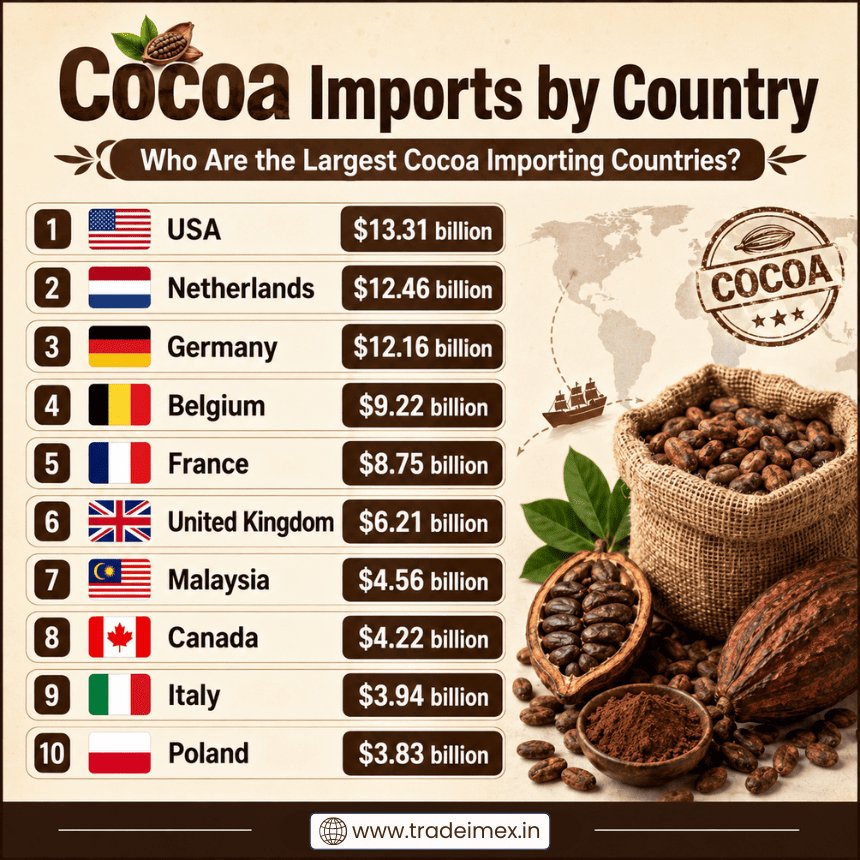
When it comes to cocoa imports, several countries stand out as the largest importers of cocoa in the world. These countries play a crucial role in the global cocoa trade, not only in terms of consumption but also in terms of processing and re-exporting cocoa to other parts of the world. The leading cocoa-importing countries include the Netherlands, the United States, Germany, Belgium, and France. These countries play a crucial role in the global cocoa trade, with a significant share of the world's cocoa beans passing through their borders. The top 10 cocoa importer countries, as per the global cocoa shipment data for 2025, include:
1. USA: $13.31 billion (10.6%)
The United States is the largest importer of cocoa in the world, with annual cocoa imports totaling $13.31 billion, as per the US cocoa import data. The demand for cocoa in the US is driven by its thriving chocolate industry, with American consumers having a strong appetite for chocolate products. The US is also a major player in cocoa processing, with many chocolate manufacturers sourcing cocoa beans from around the world to meet the high demand for chocolate products.
2. Netherlands: $12.46 billion (9.9%)
The Netherlands is another major player in the global cocoa trade, with annual cocoa imports amounting to $12.46 billion. The country is home to the largest cocoa processing industry in the world, with several cocoa buyers in Netherlands based in the port city of Amsterdam. The Netherlands acts as a hub for the cocoa trade, with cocoa beans arriving from cocoa-producing countries and being processed before being re-exported to other parts of the world, as per the Netherlands import data under HS code 1801.
3. Germany: $12.16 billion (9.7%)
Germany is the third-largest importer of cocoa in the world, with annual cocoa imports reaching $12.16 billion. The country has a strong chocolate industry, with German consumers having a sweet tooth for chocolate products. Germany also has a significant cocoa processing industry, with several chocolate manufacturers sourcing cocoa beans from different parts of the world to meet the demand for chocolate confectionery.
4. Belgium: $9.22 billion (7.4%)
Belgium is renowned for its high-quality chocolates, and it is no surprise that the country is one of the largest importers of cocoa in the world. With annual cocoa imports amounting to $9.22 billion, Belgium plays a significant role in the global cocoa trade. Belgian chocolate manufacturers source cocoa beans from various cocoa-producing countries to create premium chocolate products that are enjoyed by consumers around the world.
5. France: $8.75 billion (7%)
France is another major importer of cocoa, with annual cocoa imports totaling $8.75 billion. The country has a rich tradition of chocolate making, with French chocolatiers known for their expertise in creating exquisite chocolate confections. France imports cocoa beans from cocoa-producing countries to fuel its chocolate industry, producing a wide range of chocolate products that are cherished by consumers both in France and abroad.
6. United Kingdom: $6.21 billion (5%)
The United Kingdom is a significant importer of cocoa, with annual cocoa imports amounting to $6.21 billion. The UK has a vibrant chocolate industry, with British consumers having a strong affinity for chocolate products. British chocolate manufacturers source cocoa beans from different parts of the world to create a diverse range of chocolate treats that cater to the tastes of their consumers.
7. Malaysia: $4.56 billion (3.6%)
Malaysia is a prominent importer of cocoa, with annual cocoa imports reaching $4.56 billion. The country has a growing chocolate industry, with Malaysian consumers developing a taste for chocolate products. Malaysia imports cocoa beans from various cocoa-producing countries to meet the demand for chocolate confectionery in the country.
8. Canada: $4.22 billion (3.4%)
Canada is a significant importer of cocoa, with annual cocoa imports totaling $4.22 billion. The country has a thriving chocolate industry, with Canadian consumers enjoying a wide variety of chocolate products. Canadian chocolate manufacturers import cocoa beans from different parts of the world to create delicious chocolate treats that are popular among consumers in Canada.
9. Italy: $3.94 billion (3.1%)
Italy is known for its world-class chocolates and is a major importer of cocoa, with annual cocoa imports totaling $3.94 billion. Italian chocolatiers have a long history of crafting exquisite chocolate confections, with Italian chocolate products renowned for their quality and taste. Italy imports cocoa beans from cocoa-producing countries to create premium chocolate treats that are beloved by consumers worldwide.
10. Poland: $3.83 billion (3.1%)
Poland is a significant importer of cocoa, with annual cocoa imports reaching $3.83 billion. The country has a growing chocolate industry, with Polish consumers developing a taste for chocolate products. Polish chocolate manufacturers import cocoa beans from around the world to produce a wide range of chocolate confections that cater to consumers' preferences.
Top Cocoa Beans Buyers & Importers Database
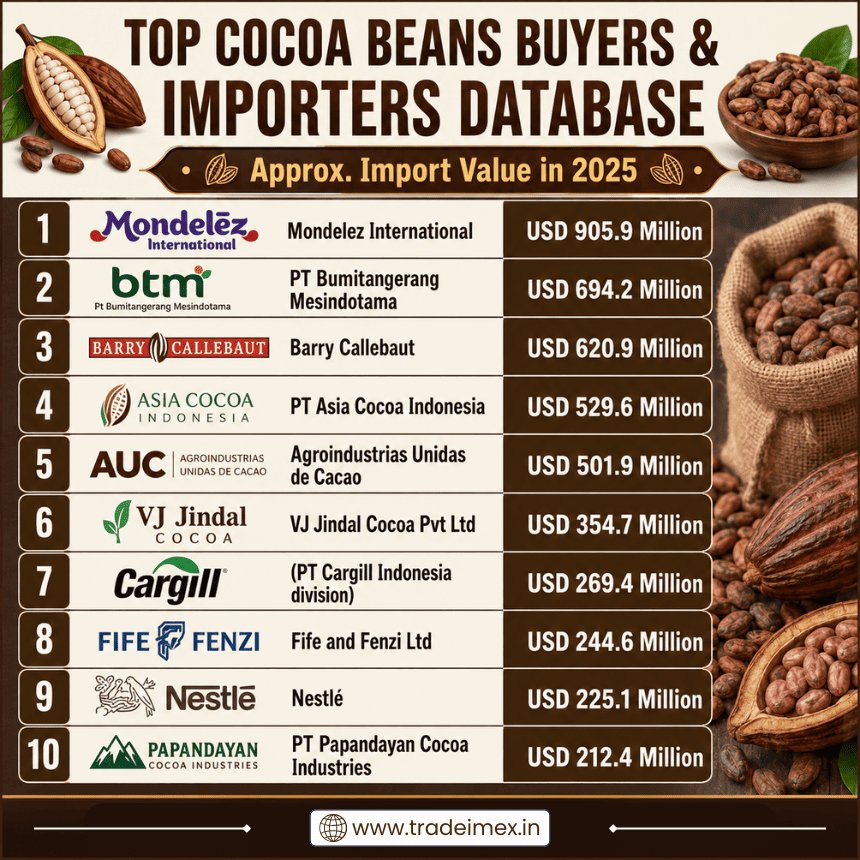
The cocoa import market is highly concentrated among multinational processors, industrial manufacturers, and global chocolate brands. The top cocoa buyers accounted for more than 44% of the total global import value in 2025. Below are some of the leading cocoa importers globally, as per the cocoa buyers & importers database for 2025:
1. Mondelez International
-
Origin Country: USA/India Operations
-
Approx. Import Value in 2025: USD 905.9 Million
-
Top Import Types: Cocoa beans, cocoa liquor, cocoa butter, cocoa powder
2. PT Bumitangerang Mesindotama
-
Origin Country: Indonesia
-
Approx. Import Value in 2025: USD 694.2 Million
-
Top Import Types: Raw cocoa beans, fermented cocoa beans, industrial cocoa inputs
3. Barry Callebaut
-
Origin Country: Switzerland
-
Approx. Import Value in 2025: USD 620.9 Million
-
Top Import Types: Premium cocoa beans, cocoa liquor, cocoa butter, specialty cocoa ingredients
4. PT Asia Cocoa Indonesia
-
Origin Country: Indonesia
-
Approx. Import Value in 2025: USD 529.6 Million
-
Top Import Types: Cocoa beans, cocoa cake, cocoa liquor
5. Agroindustrias Unidas de Cacao
-
Origin Country: Peru
-
Approx. Import Value in 2025: USD 501.9 Million
-
Top Import Types: Fine-flavor cocoa beans, organic cocoa, cocoa paste
6. VJ Jindal Cocoa Pvt Ltd
-
Origin Country: India
-
Approx. Import Value in 2025: USD 354.7 Million
-
Top Import Types: Cocoa beans, cocoa nibs, cocoa powder
7. Cargill (PT Cargill Indonesia division)
-
Origin Country: United States / Indonesia Operations
-
Approx. Import Value in 2025: USD 269.4 Million
-
Top Import Types: Cocoa beans, cocoa butter, industrial cocoa ingredients
8. Fife and Fenzi Ltd
-
Origin Country: United Kingdom
-
Approx. Import Value in 2025: USD 244.6 Million
-
Top Import Types: Cocoa beans, cocoa shells, cocoa derivatives
9. Nestlé
-
Origin Country: Switzerland
-
Approx. Import Value in 2025: USD 225.1 Million
-
Top Import Types: Cocoa liquor, cocoa butter, certified sustainable cocoa
10. PT Papandayan Cocoa Industries
-
Origin Country: Indonesia
-
Approx. Import Value in 2025: USD 212.4 Million
-
Top Import Types: Fermented cocoa beans, cocoa cake, cocoa powder
These companies dominate global procurement because they operate integrated supply chains that include:
-
Bean sourcing
-
Grinding facilities
-
Ingredient processing
-
Chocolate manufacturing
-
Export distribution
For exporters, these firms represent high-volume buyers with long-term purchasing contracts.
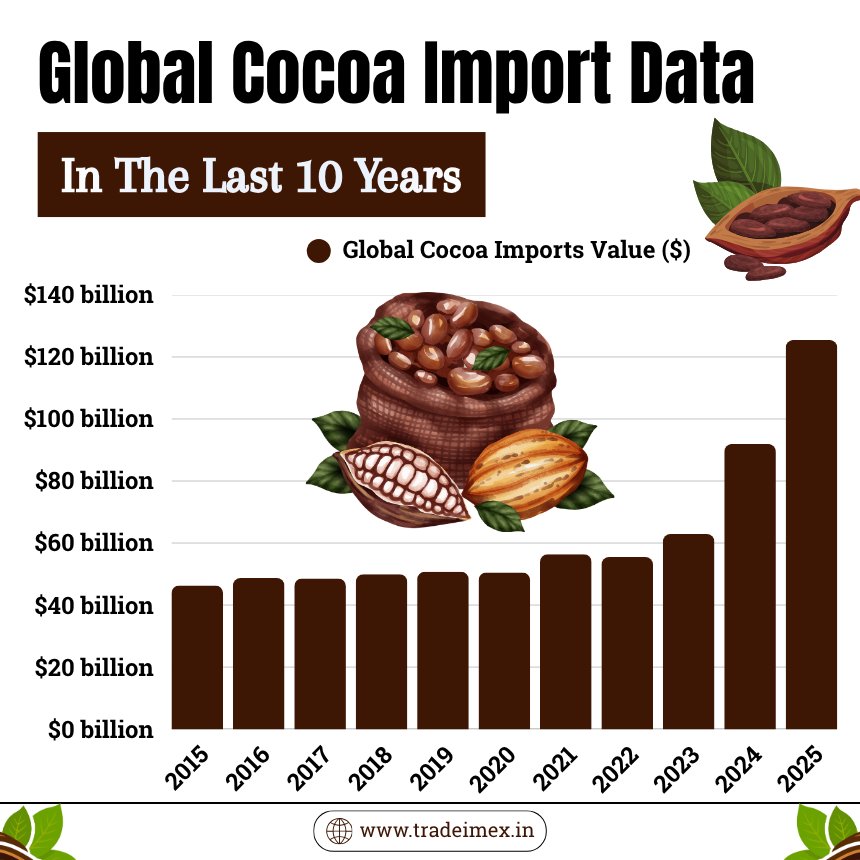
Global Cocoa Import Data in The Last 10 Years
|
Year of Imports |
Global Cocoa Imports Value ($) |
|
2015 |
$46.31 billion |
|
2016 |
$48.70 billion |
|
2017 |
$48.59 billion |
|
2018 |
$49.94 billion |
|
2019 |
$50.74 billion |
|
2020 |
$50.51 billion |
|
2021 |
$56.42 billion |
|
2022 |
$55.49 billion |
|
2023 |
$62.91 billion |
|
2024 |
$91.94 billion |
|
2025 |
$125.47 billion |

Top Cocoa Products Imported Under HS Code 18
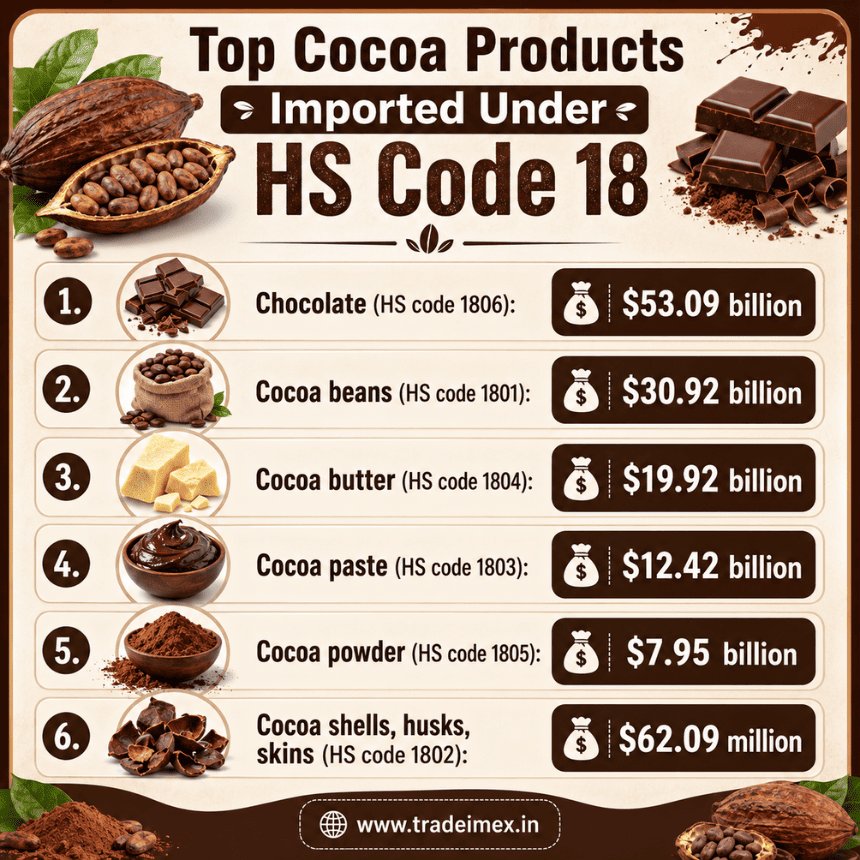
Among the top Cocoa Products imported under HS Code 18 are chocolates, cocoa powder, cocoa butter, and cocoa beans. These products are essential in the food and beverage industry, adding rich flavors and textures to a wide range of foods and beverages. Cocoa powder is commonly used in baking and desserts, while cocoa butter is valued for its smooth texture in chocolate production. Cocoa beans, on the other hand, serve as the raw material for various cocoa products and are sourced from regions known for their quality produce. The major cocoa imports by HS code, as per the cocoa shipment data for 2025, include:
-
Chocolate (HS code 1806): $53.09 billion
-
Cocoa beans (HS code 1801): $30.92 billion
-
Cocoa butter (HS code 1804): $19.92 billion
-
Cocoa paste (HS code 1803): $12.42 billion
-
Cocoa powder (HS code 1805): $7.95 billion
-
Cocoa shells, husks, skins (HS code 1802): $62.09 million
Understanding Asia’s Rise in Cocoa Imports
One of the biggest structural shifts in the cocoa trade is the rise of Asia as a cocoa processing powerhouse, as per the Asia trade data. Historically, Europe controlled most cocoa bean imports and chocolate manufacturing. While Europe still accounts for roughly 60% of global cocoa imports collectively, Asian processors are growing faster. Several factors are driving this transition:
1. Growing Chocolate Consumption
Countries like India, Indonesia, Vietnam, and the Philippines are witnessing double-digit growth in chocolate demand. Urbanization, premium confectionery trends, and rising disposable income are pushing multinational brands to localize production.
2. Expansion of Grinding Capacity
Asian processors increasingly import raw beans directly from West Africa and Latin America for domestic grinding. This allows companies to produce:
-
Cocoa butter
-
Cocoa powder
-
Cocoa liquor
-
Industrial chocolate ingredients
at lower operational costs compared to Europe.
3. Supply Chain Diversification
Importers are reducing dependence on traditional European supply chains by sourcing directly from producing nations such as:
-
Côte d’Ivoire
-
Ghana
-
Ecuador
-
Nigeria
-
Cameroon
4. Export-Oriented Manufacturing
Countries like Indonesia and Malaysia process cocoa products for export to China, the Middle East, and regional Asian markets.
Europe Remains the Largest Cocoa Consumption Hub
Despite Asia’s rapid rise, Europe still controls the largest share of global cocoa imports overall, according to Europe trade data.
Countries such as:
-
Netherlands
-
Germany
-
Belgium
-
France
These remain critical entry points for cocoa beans into the European Union. The Netherlands alone serves as one of the world’s largest cocoa processing centers due to the Port of Amsterdam and advanced grinding infrastructure. European countries collectively import around 25% of the world’s cocoa beans, while the EU overall accounts for nearly 60% of global cocoa imports. European demand remains strong because of:
-
Premium chocolate manufacturing
-
Industrial food production
-
Private-label confectionery
-
Specialty cocoa ingredients
However, the region also faces growing regulatory pressure.
EUDR and Sustainability Compliance Challenges
One of the biggest issues impacting cocoa imports in 2025 is compliance with the European Union Deforestation Regulation (EUDR). The regulation requires importers to prove cocoa products are not linked to deforestation. Although implementation timelines have been delayed, importers are already investing heavily in traceability systems and supplier verification. This is changing how cocoa importers choose suppliers. Importers increasingly prefer exporters who can provide:
-
Farm-level traceability
-
GPS mapping
-
Sustainability certifications
-
Child labor compliance
-
Deforestation-free sourcing records
Data shows that only about 40% of cocoa beans were fully traceable during the 2024–2025 season, highlighting the scale of the challenge. For exporters, compliance is becoming a sales requirement rather than a premium advantage.
Cocoa Price Volatility and Its Impact on Imports
The cocoa market experienced exceptional price swings throughout 2024 and 2025. Supply shortages in West Africa pushed futures above USD 12,000 per metric ton at peak levels before markets corrected later in 2025.
Major factors behind volatility included:
-
Poor harvests in Ghana
-
Weather disruptions
-
Aging cocoa plantations
-
Disease outbreaks
-
Reduced grindings in Asia and Europe
-
Shipment bottlenecks
Importers responded by:
-
Diversifying sourcing regions
-
Increasing inventory buffers
-
Expanding direct procurement
-
Locking long-term contracts
This created opportunities for emerging exporters from Latin America and Southeast Asia.
Ecuador’s Rising Importance in Cocoa Trade
Ecuador is rapidly becoming one of the most strategic suppliers in the global cocoa industry, as per the Ecuador cocoa export data and the cocoa suppliers database. Industry projections suggest Ecuador could soon become the world’s second-largest cocoa producer, overtaking Ghana.
Several factors explain Ecuador’s rise:
-
Higher farm productivity
-
Premium fine-flavor cocoa
-
Agroforestry cultivation methods
-
Better farmer pricing systems
-
Strong sustainability positioning
Many importers now view Ecuador as a more reliable sourcing alternative amid instability in West African supply chains. This trend is expected to continue through 2026 and beyond.
How Exporters Use Cocoa Importers Databases
A verified cocoa buyers database helps exporters identify:
-
Active importers
-
Shipment frequency
-
Buying volume
-
Product specifications
-
Destination markets
-
Seasonal procurement patterns
Our import databases typically include:
|
Data Point |
Importance |
|
Importer Name |
Lead generation |
|
Country |
Market targeting |
|
Shipment Volume |
Buyer qualification |
|
HS Code |
Product matching |
|
Port of Entry |
Shipment planning |
|
Supplier Relationships |
Competitor analysis |
|
Purchase Frequency |
Sales forecasting |
Exporters use this information for:
-
B2B lead generation
-
Distributor outreach
-
Trade fair targeting
-
Pricing strategy
-
Market expansion
The most successful exporters combine trade data with direct outreach and compliance documentation.
Fastest Growing Cocoa Import Markets
Several emerging markets are showing rapid cocoa import growth.
1. India
India’s chocolate market continues to expand due to rising disposable income and changing consumer habits. Multinational brands are increasing local manufacturing investments, making India one of the most attractive cocoa import destinations.
2. Indonesia
Indonesia has evolved into a major cocoa processing and re-export hub. Its strategic location and lower processing costs continue to attract global cocoa companies.
3. Mexico
Mexico’s confectionery and bakery industries are boosting cocoa bean demand. The country also benefits from proximity to North American markets.
4. Philippines
The Philippines is becoming an emerging cocoa processing market with growing domestic chocolate production.
Key Trends Shaping the Cocoa Import Market
Several long-term trends are reshaping the industry.
1. Traceability and Transparency
Importers now prioritize transparent supply chains over lowest-cost sourcing.
2. Shift Toward Origin Processing
More producing countries are investing in local grinding instead of exporting raw beans.
3. Sustainability Premiums
Certified cocoa products command stronger demand from European and premium chocolate manufacturers.
4. Consolidation Among Buyers
Large multinational processors continue gaining market share through integrated procurement networks.
Conclusion and Final Thoughts
In conclusion, the global cocoa import market in 2025 reflects a major transformation in the international food commodity trade. Asia is rapidly expanding its role as a cocoa processing center. Europe remains the dominant consumption region. Sustainability regulations are reshaping sourcing decisions, & multinational buyers are consolidating procurement power. For cocoa exporters, traders, and suppliers, access to accurate cocoa importers data is now essential for business growth.
The most successful exporters in 2025 are not simply selling cocoa beans. They are building transparent, traceable, data-driven supply relationships with the world’s leading cocoa buyers. As cocoa demand continues evolving, companies that understand import trends, buyer behavior, and compliance requirements will be best positioned to capture opportunities in the global cocoa trade market.
Final Note For Our Readers
We hope this blog has helped you gain a clearer, data-backed understanding of the global cocoa import market in 2025, including the top cocoa-importing countries, cocoa beans buyers and importers database, emerging trade trends, sustainability challenges, and the shifting dynamics of global cocoa supply chains. As cocoa prices remain volatile, demand continues rising across Asia and Europe, and stricter sustainability regulations reshape sourcing decisions, the global cocoa trade is becoming more competitive and data-driven than ever before.
If you’re looking for customized cocoa trade reports, live cocoa import-export data by country, HS code-level insights, shipment records, importer databases, country-wise cocoa trade statistics, or competitor analysis, TradeImeX can help you make smarter and faster business decisions.
With access to global trade databases and actionable market intelligence, you can better understand changing cocoa trade flows, discover new sourcing and sales opportunities, and stay ahead in the evolving international commodity market. To learn more, connect with us at info@tradeimex.in and explore how we can support your global trade growth strategy.
Share
What's Your Reaction?
 Like
0
Like
0
 Dislike
0
Dislike
0
 Love
0
Love
0
 Funny
0
Funny
0
 Angry
0
Angry
0
 Sad
0
Sad
0
 Wow
0
Wow
0