Global Smartphone Exports Data 2025: Top 10 Smartphone Manufacturers & Suppliers Database
Discover global smartphone export data 2025, with top smartphone manufacturers, export trends, & smartphone exports by country for market analysis.

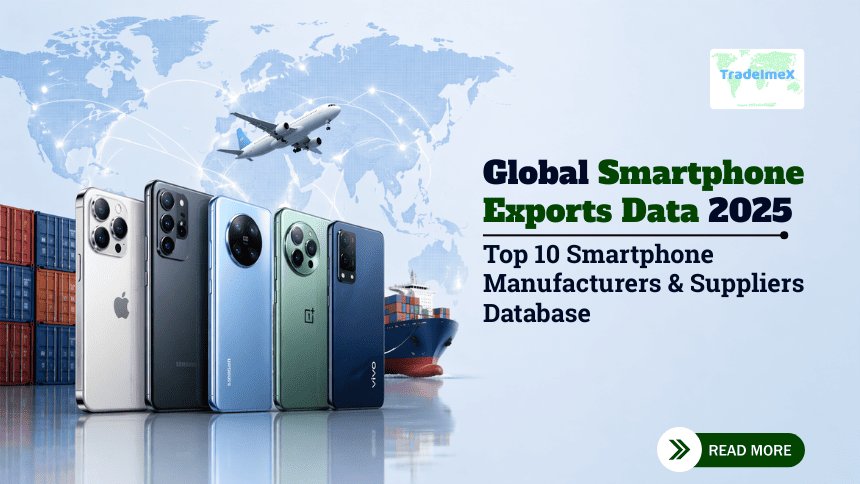
The global smartphone industry in 2025 sits at an interesting crossroads. After years of volatility driven by pandemic disruptions, inflation, and supply chain shocks, the market has stabilized and returned to modest growth. Shipments increased by roughly 2% year-on-year, signaling recovery but not explosive expansion. According to the latest global trade data and smartphone export data, the total value of global smartphone exports reached $293.91 billion in 2025, a 2% increase from the previous year.
Due to the robust demand for the iPhone 17 and the expansion of emerging markets, global smartphone shipments in 2025 increased by 2% year over year to over 1.25 billion units, with Apple holding a 20% market share. Vietnam became a significant production center, exporting mobile phones valued at $33.45 billion. At the same time, the export landscape is shifting rapidly. Manufacturing hubs are diversifying beyond China, premium devices are driving value growth, and emerging markets are reshaping demand patterns. This blog takes a data-driven look at global smartphone exports in 2025, with a detailed analysis of the top 10 manufacturers and suppliers, along with trends, regional dynamics, and future outlook.
Global Smartphone Market Overview 2025
Production and Shipment Volume
Global smartphone production reached approximately 1.254 billion units in 2025, reflecting a 2.5% annual increase.
Quarterly trends of global smartphone shipments show similar stability:
-
Q2 2025 shipments: 292.5 million units (+5.1% YoY)
-
Q3 2025 shipments: 322.7 million units (+2.6% YoY)
This moderate growth highlights a mature market where:
-
Replacement cycles are longer
-
Innovation is incremental (AI features, foldables)
-
Demand is shifting toward premium devices
Revenue vs Volume Dynamics
While unit growth is modest, revenue performance is stronger due to:
-
Higher average selling prices (ASPs)
-
Premium device adoption
-
Strong brand ecosystems
Apple, Samsung, and Xiaomi collectively dominate global revenue share, accounting for a significant portion of industry profits.
Smartphone Exports by Country: Top 10 Smartphone Exporting Countries
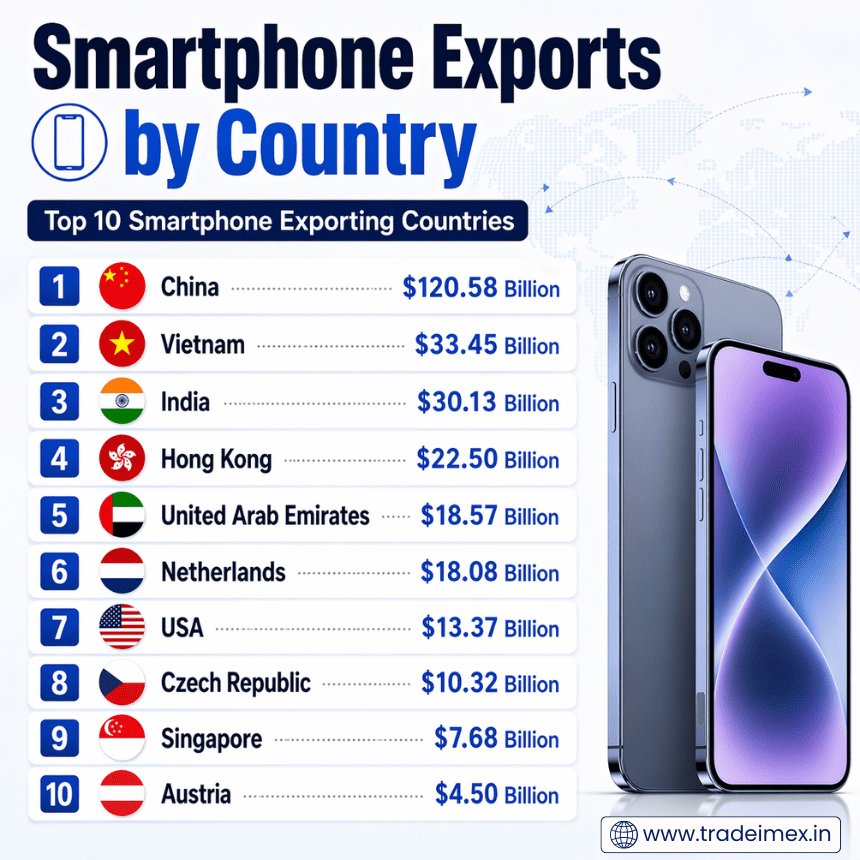
As the demand for smartphones continues to rise, more and more countries are entering the market as key players in smartphone manufacturing and exporting. According to the latest database on Smartphone Exports by Country, the top 10 smartphone-exporting countries demonstrate diverse levels of dominance in the global tech industry. Countries like China, India, and Vietnam lead the pack in smartphone exports. With ongoing technological advancements, these countries leverage innovation and manufacturing capabilities to maintain their strong positions in the global smartphone market. The leading smartphone exporter countries, according to the smartphone shipment data for 2025, include:
1. China: $120.58 billion (41.03%)
China has long been known as the world's largest exporter of smartphones. With major manufacturers like Huawei, Xiaomi, and Oppo leading the way, China has solidified its position as a global powerhouse in the smartphone industry. The country's efficient manufacturing processes and competitive pricing have made Chinese smartphones popular among consumers worldwide.
2. Vietnam: $33.45 billion (11.38%)
Vietnam has emerged as a key player in the smartphone exporting market in recent years, as per the Vietnam customs export data of Smartphones. With companies like Samsung and Apple setting up production facilities in the country, Vietnam has become a hub for smartphone manufacturing. The country's skilled workforce and favorable business environment have attracted investment from major tech companies, contributing significantly to its smartphone export numbers, as per the Vietnam smartphone export data 2025.
3. India: $30.13 billion (10.26%)
India is another rising star in the smartphone exporting industry. With a growing middle class and increasing smartphone penetration, the country has seen a surge in domestic demand for smartphones. Companies like Samsung, Xiaomi, and Vivo have established a strong presence in the Indian market, further boosting the country's smartphone export numbers.
4. Hong Kong: $22.50 billion (7.66%)
Hong Kong has long been a key player in the global electronics market, & smartphones are no exception. The region's strategic location, advanced infrastructure, and business-friendly environment have made it a preferred destination for smartphone manufacturers looking to tap into international markets. Hong Kong's strong ties with China also play a significant role in its smartphone export numbers.
5. United Arab Emirates: $18.57 billion (6.32%)
The United Arab Emirates has emerged as a major player in the smartphone exporting market, thanks to its well-developed trade infrastructure. Companies like Apple and Samsung have established a strong presence in the country, tapping into the region's affluent consumer base. The UAE's strategic location between Europe, Asia, and Africa also makes it an ideal hub for smartphone exports.
6. Netherlands: $18.08 billion (6.15%)
The Netherlands may not be the first country that comes to mind when you think of smartphone exports, but it has quietly established itself as a key player in the industry, as per the Netherlands smartphone export data by HS code. The country's advanced technology sector, skilled workforce, and business-friendly policies have attracted major tech companies like Samsung and Huawei. The Netherlands' strong commitment to innovation and sustainability also sets it apart in the smartphone exporting market.
7. USA: $13.37 billion (4.55%)
While the US may not be the top smartphone exporter, it still holds a significant share of the market. Companies like Apple and Google have a strong presence in the global smartphone industry, with their innovative products and cutting-edge technology driving demand worldwide. The US's strong intellectual property rights and research capabilities also give it a competitive edge in the smartphone exporting market.
8. Czech Republic: $10.32 billion (3.51%)
The Czech Republic may be a small country, but it has made a big impact in the smartphone exporting market. The country's skilled workforce, high-quality manufacturing standards, and strategic location in Europe have attracted major tech companies like Huawei and LG. The Czech Republic's reputation for precision engineering and technological expertise has helped it establish itself as a key player in the industry.
9. Singapore: $7.68 billion (2.61%)
Singapore is another small but mighty player in the smartphone exporting market. The country's advanced infrastructure, business-friendly policies, and skilled workforce have made it a preferred destination for tech companies looking to expand their global footprint. Singapore's reputation for innovation and efficiency has helped it carve out a niche in the competitive smartphone industry.
10. Austria: $4.50 billion (1.53%)
Rounding out the top 10 smartphone exporting countries is Austria. While it may not have the same volume of exports as some of the larger players on this list, Austria's high-quality manufacturing standards and reputation for reliability have made it a sought-after destination for smartphone production. The country's skilled workforce and commitment to sustainability also set it apart in the smartphone exporting market.
Global Smartphone Export Landscape
Key Export Trends
Smartphone exports in 2025 are defined by three major structural shifts:
1. Supply Chain Diversification
India emerged as a major export hub, becoming the largest supplier of smartphones to the US in Q2 2025, with a 44% export share, up from 13% a year earlier.
This reflects:
-
US–China trade tensions
-
“China+1” manufacturing strategy
-
Government incentives in India and Vietnam
2. Asia-Pacific Dominance
Asia-Pacific continues to dominate both:
-
Manufacturing output
-
Export volumes
China, India, Vietnam, and South Korea remain core production bases, as per the smartphone export statistics of Asia.
3. Premiumization of Exports
Export value is increasingly driven by:
-
Flagship smartphones
-
AI-enabled devices
-
Foldable phones
This benefits companies like Apple and Samsung, which focus on high-margin exports.
Top 10 Smartphone Manufacturers & Suppliers Database (2025)
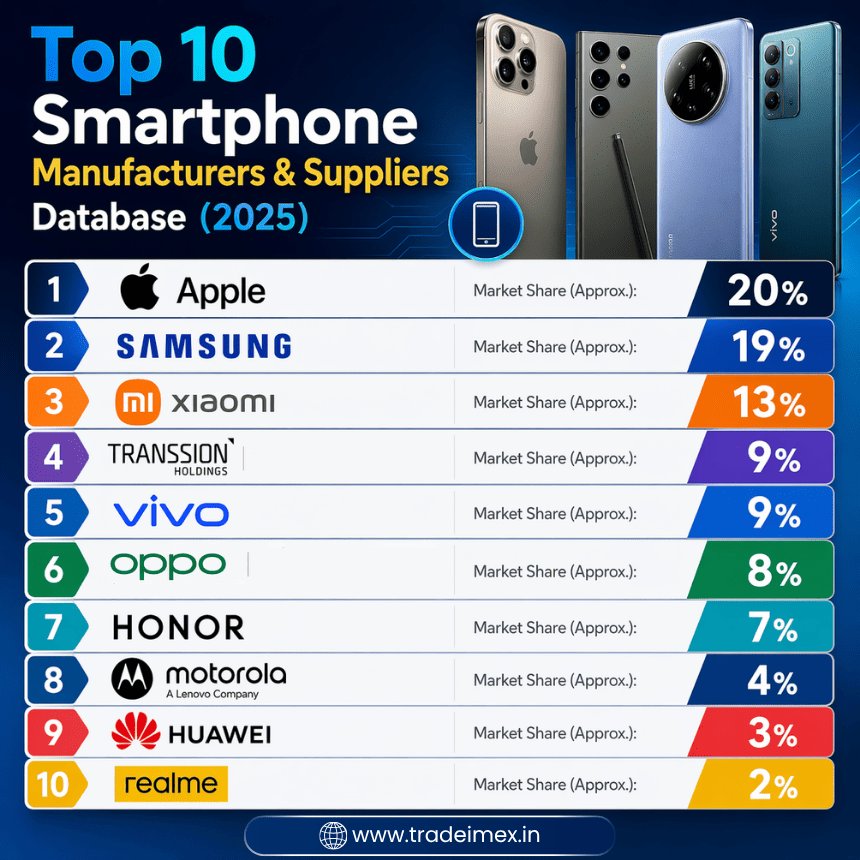
Based on shipment volumes, market share, and production data, the global top 10 smartphone manufacturers in 2025 are:
1. Apple
-
Market share: 20%
-
Production: 240 million units
-
Strength: Premium segment dominance
Apple led the global smartphone market in 2025, driven by strong demand for its flagship iPhone lineup and expansion into emerging markets.
Export Insight: Apple’s export strategy focuses on high-value devices, with increasing production shifting to India.
2. Samsung
-
Market share: 19%
-
Production: 240 million units
-
Strength: Diverse product portfolio
Samsung maintains a balanced approach across:
-
Budget devices (Galaxy A series)
-
Premium foldables
Export Insight: Heavy reliance on Vietnam and India as export manufacturing hubs.
3. Xiaomi
-
Market share: 13%
-
Strength: Competitive pricing, strong emerging market presence
Xiaomi continues to rank among the top three globally, with strong performance in Latin America, Southeast Asia, and Europe.
Export Insight: Focus on high-volume exports in mid-range and budget segments.
4. Transsion Holdings (TECNO, Infinix, itel)
-
Market share: 9%
-
Strength: Dominance in Africa
Transsion’s localized strategy (language support, battery optimization) has made it a leader in emerging markets.
Export Insight: Strong export growth into Africa and South Asia.
5. Vivo
-
Market share: 8–9%
-
Strength: Camera innovation, offline retail
Vivo regained momentum in 2025 through:
-
AI imaging features
-
Expansion in emerging markets
6. OPPO (including OnePlus, Realme ecosystem links)
-
Strength: Mid-range segment dominance
OPPO leverages strong offline distribution networks and brand positioning in Asia and Europe.
7. HONOR
-
Fastest-growing major brand in 2025
-
Strength: Premium innovation and global expansion
HONOR’s growth reflects aggressive international expansion and product innovation.
8. Motorola
-
Strength: Growth in the Americas and India
Motorola is experiencing a revival due to:
-
Strong mid-range offerings
-
Competitive pricing
9. Huawei
-
Strength: Strong domestic Chinese market
Despite global restrictions, Huawei remains a key player due to:
-
Domestic demand
-
Technological resilience
10. Realme
-
Strength: Youth-focused branding and affordability
Realme plays a critical role in budget smartphone exports, especially in Asia.
Market Share Snapshot (2025)
|
Rank |
Company |
Market Share (Approx.) |
|
1 |
Apple |
20% |
|
2 |
Samsung |
19% |
|
3 |
Xiaomi |
13% |
|
4 |
Transsion |
9% |
|
5 |
Vivo |
9% |
|
6 |
OPPO |
8% |
|
7 |
HONOR |
7% |
|
8 |
Motorola |
4% |
|
9 |
Huawei |
3% |
|
10 |
Realme |
2% |
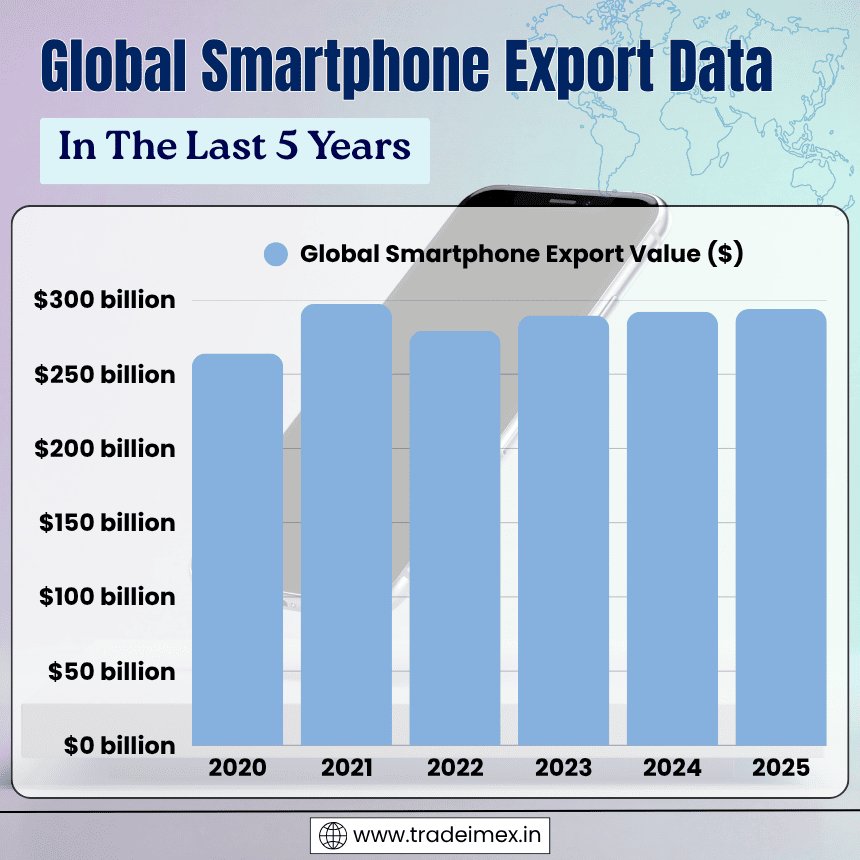
Global Smartphone Export Data in The Last 5 Years
|
Year of Exports |
Global Smartphone Export Value ($) |
|
2020 |
$263.91 billion |
|
2021 |
$297.30 billion |
|
2022 |
$279.20 billion |
|
2023 |
$289.62 billion |
|
2024 |
$292.01 billion |
|
2025 |
$293.91 billion |

Regional Export Analysis
Asia-Pacific
-
Largest production and export region
-
Key countries: China, India, Vietnam
North America
-
High-value import market
-
Dominated by Apple and Samsung
Europe
-
Strong demand for premium and mid-range devices
Africa
-
Fastest-growing market
-
Dominated by Transsion brands
Latin America
-
Rapid growth in Xiaomi and Samsung exports
Key Industry Drivers
1. Emerging Market Growth
Emerging economies are the primary growth engine, with rising smartphone penetration and increasing affordability.
2. AI Integration
AI features (camera, battery optimization, assistants) are becoming a major selling point.
3. Premiumization Trend
Consumers are:
-
Upgrading less frequently
-
Spending more per device
4. Supply Chain Realignment
Manufacturing is shifting toward:
-
India
-
Vietnam
-
Southeast Asia
Challenges in the Smartphone Export Market
1. Rising Component Costs
Memory prices and semiconductor costs are increasing production expenses.
2. Geopolitical Risks
Trade tensions are reshaping export routes and manufacturing decisions.
3. Market Saturation
Developed markets show:
-
Slower replacement cycles
-
Limited new user growth
4. Inventory Corrections
Brands are adjusting production to avoid oversupply.
Opportunities for Manufacturers & Suppliers
1. India as a Global Export Hub
India’s rapid rise offers:
-
Cost advantages
-
Government incentives
-
Export scalability
2. Foldable and AI Smartphones
Premium innovation is unlocking new revenue streams.
3. Refurbished and Secondary Markets
Growing demand for affordable alternatives.
4. Vertical Integration
Companies are investing in:
-
Chip design
-
Software ecosystems
Future Outlook (2026 and Beyond)
Despite a stable 2025, the outlook for 2026 is more cautious:
-
Production expected to decline by ~10% due to rising costs
-
Continued shift toward premium devices
-
Increased competition in emerging markets
However, long-term growth remains intact due to:
-
5G expansion
-
AI integration
-
Digital transformation in developing economies
Global Smartphone Exports 2025 – Executive Summary
In 2026, the global smartphone export market is dominated by a few large companies and production hubs. Industry data indicate total smartphone exports on the order of $285–290 billion in 2025, roughly 2% higher than 2024, with about 1.25 billion units shipped worldwide. China-based OEMs, whether Chinese-headquartered brands or Asia-based factories, account for by far the largest share of this trade. Four of the top five global exporters of smartphones are in Asia: mainland China (47% of export value), Hong Kong (9%), Vietnam (8%), and India (7%). Asia overall supplies about 78.6% of all exported smartphones by value; Europe and North America together account for only about 20% (with 16% from Europe, 5% from North America).
Among companies, Apple Inc. (USA) has emerged as the leading exporter, with roughly 240–247 million iPhones shipped in 2025 (20% global market share) and an estimated export value above $260 billion. Samsung Electronics (South Korea) follows closely (235 million units, 19% share). Chinese brands Xiaomi, vivo, OPPO (including realme), and Transsion together make up much of the remainder of the top-5, each shipping on the order of 100–170 million units.
Among components, contract assemblers like Foxconn/Hon Hai (Taiwan), Luxshare (China), and Pegatron (Taiwan) underpin much of the output. For example, Foxconn alone builds 60% of Apple’s iPhones (144 million units) in its Chinese and Vietnamese factories, making it arguably the largest single smartphone exporter by volume. Export hubs include Shenzhen, Guangzhou, and Zhengzhou (China); Hanoi and Ho Chi Minh City (Vietnam); and Chennai, Bengaluru, and Sriperumbudur (India). The US, China, and EU nations (Germany, UK, France) are the top markets for these exports.
Over 2020–2025, global smartphone exports grew modestly: from about $264B in 2020 to roughly $293B in 2025, and are forecast slightly higher in 2026. Unit volumes saw a dip in 2022–23, followed by a rebound (annual growth +2% in 2025). Asia’s export surplus in smartphones continued to climb (China, Vietnam, and India trade surpluses), while Europe and North America remain net importers (with deficits roughly balanced by intra-Asia/Asia‑America imports). The 2020–2025 CAGR is low‑single-digit (roughly 2% per year) by value. Strategic risks include US–China trade tensions and tariff policies, semiconductor supply bottlenecks, and regional regulations (e.g. EU data/EC endorsement rules), which could disrupt this Asia‑centric supply chain.
Regional Export Flows and Trade Balances
Smartphone export flows are highly skewed toward Asia as the production hub. In 2025, about $225.2 billion worth of phones (78.6% of the global total) were exported from Asia. Most of this flows into other regions: for example, Asia to Europe ($46 B, 16% of world) and Asia to North America ($13 B, 5%). Africa, Latin America, and Oceania import only a few percent combined (0.5% of value). In effect, Asia runs a large trade surplus in smartphones while Europe and the Americas run deficits. For instance, Europe’s exports ($46B) cover only part of its imports (the US, Hong Kong, and China send most smartphones into Europe), giving Europe a net deficit of roughly $200–220B in phone trade. North America (chiefly the US) similarly imports $13B but exports only $0.5B (mostly Apple parts to Canada), yielding a $12.5B deficit. Latin America and Africa are also net importers (0.15% and 0.05% of world exports, respectively).
These flows reflect production/assembly hubs versus consumer demand. For example, China and Vietnam manufacture vast quantities that are shipped to end markets in Europe and North America. Conversely, Europe (Czech, Slovakia, etc.) and North America (Mexico/US) have small re-export or OEM sectors, but mainly import finished smartphones. The chart above illustrates these approximate trade flows in 2024–25.
Year-on-Year Trends (2020–2025) and CAGR
Global smartphone trade saw slow growth over 2020–2024. Export value rose from roughly $264B in 2020 to about $287B in 2024 (CAGR 2% per year). Unit shipments peaked pre-COVID (1.38B in 2019), dipped in 2020–23 (down to 1.2B in 2023), then rebounded to 1.25B in 2025. Sources attribute the 2023 downturn to component shortages and waning demand, but see a recovery by late 2024 (with Q4 2025 shipments up 5% YoY). Our conservative estimate for 2025 exports is 1.25B units ($290B), roughly 2% above 2024. This implies a five-year 2020–2025 CAGR of only 1–3% in volume and value.
Risk Factors and Strategic Implications
1. Geopolitical/Regulatory Risks
The smartphone export market is sensitive to trade policies and geopolitics. US-China trade tensions and export controls (e.g., on semiconductors) pose risks: many Chinese manufacturers rely on US/Japanese chipmakers. Similarly, export incentives (India’s PLI scheme) & trade agreements (e.g., Vietnam’s CPTPP/EVFTA) have shifted production.
For instance, rising tariffs could divert Samsung or Apple output away from China to Vietnam/India. Our sources note that Samsung’s Vietnam factories alone once accounted for 20–25% of Vietnam’s entire export revenue; if geopolitical shifts occur, Vietnam’s phone exports could fall as dramatically as they rose.
2. Supply-Chain Risks
Key component shortages (especially memory chips and advanced SoCs) are acute. Industry analysts warn that 2026 growth may slow due to semiconductor constraints. Vendors with limited component access (e.g., smaller Chinese brands) face a higher risk. Conversely, Apple and Samsung (with large-scale procurement and in-house chip fabrication) are better insulated. COVID-era disruptions (trade delays, factory closures) have also periodically impacted smartphone exports, particularly in China and Southeast Asia.
3. Market Saturation & Competition
In mature markets (the US, Europe, and China), saturation and carrier timing dominate. Vendors increasingly rely on emerging markets (India, Africa, Latin America) for growth. The shifting market shares (e.g., vivo surpassing OPPO in 2025) reflect aggressive competition. Exporters must also navigate currency fluctuations and regulatory demands (e.g., environmental standards for electronics).
4. Strategic Response
Firms and countries are diversifying supply chains. India aims to capture more export share (it is already the world’s 3rd-largest mobile exporter with $24.1B in 2024). Vietnam continues to attract assembly investment (Samsung’s biggest plant), while Mexico serves the North American market. Companies are also investing in higher-value segments (foldables, AI phones) to boost unit value even if volumes plateau.
Overall, global smartphone exports in 2025 remain highly concentrated by geography & company. China (and Hong Kong) plus Vietnam & India accounted for over 75% of the value. Apple and Samsung together shipped 40% of devices, illustrating the duopoly at the high end.
Conclusion and Final Thoughts
In conclusion, the global smartphone export market in 2026 reflects a mature yet evolving industry. While shipment growth remains modest, structural shifts are reshaping the competitive landscape.
Key takeaways:
-
Apple and Samsung dominate global exports in value terms
-
Chinese and emerging-market brands drive volume growth
-
India is emerging as a critical export hub
-
Premiumization and AI are defining future demand
For manufacturers, suppliers, and investors, success in this market depends on:
-
Adapting to supply chain shifts
-
Targeting emerging markets
-
Balancing volume with profitability
The smartphone industry is no longer just about selling devices. It is about ecosystems, innovation, and strategic positioning in a rapidly changing global trade environment.
Note For Our Readers
We hope this blog has given you a clear, data-driven understanding of the global smartphone export landscape in 2025, from shifting manufacturing hubs and the dominance of leading smartphone brands to the growing role of emerging markets, premium devices, and supply chain diversification. As the smartphone industry continues to evolve, shaped by technological innovation, geopolitical developments, and changing consumer demand, access to accurate and timely global trade data is becoming increasingly important for strategic decision-making.
If you’re looking to move beyond surface-level insights and need deeper, actionable intelligence, TradeImeX can support your business. With access to detailed global smartphone exporters, suppliers, and buyers data, you can explore and analyze live smartphone import-export data by country and HS codes, along with real-time updates that reflect current market dynamics. Whether your goal is to identify reliable suppliers, track competitor activity, evaluate new markets, or understand demand trends, our customized data solutions can help you act faster and make informed decisions. Reach out at info@tradeimex.in to strengthen your position in the global smartphone trade ecosystem.
Share
What's Your Reaction?
 Like
0
Like
0
 Dislike
0
Dislike
0
 Love
0
Love
0
 Funny
0
Funny
0
 Angry
0
Angry
0
 Sad
0
Sad
0
 Wow
0
Wow
0