
Indian Union Budget 2026–27 Explained: Fiscal Discipline or Growth Push?
Indian Union Budget 2026–27 explained with key highlights on fiscal discipline vs growth push. Explore tax changes, spending priorities, reforms, and economic impact.


On February 1, 2026, India’s Finance Minister Nirmala Sitharaman presented the Union Budget 2026–27 in Parliament, a highly anticipated fiscal roadmap that has triggered varied responses from economists, industry leaders, markets, & policymakers across sectors. This year’s Budget sits at the intersection of two major policy imperatives: maintaining fiscal discipline while accelerating economic growth, especially in an environment of global uncertainties, trade disruptions, and rising structural challenges. This article will examine India's union budget for 2026-27 and consider how it may affect companies, taxpayers, and global trade data.
In this detailed analysis, we break down the Budget’s intent, key measures, sectoral effects, macroeconomic implications, stakeholder reactions, and what it means for you, the taxpayer, consumer, investor, job seeker, traders, and business owners. Below are the revised points from Hon. Finance Minister Nirmala Sitharaman's budget address from India.
Overview: A Budget Built Around “Growth with Discipline”
At its core, the Union Budget 2026–27 and its accompanying policy narrative emphasize:
-
A continued capital expenditure push to drive economic activity and infrastructure development.
-
Fiscal consolidation, with both deficit and debt metrics trending toward medium-term targets.
-
Strategic support to manufacturing, technology, and services sectors to position India as a global production and innovation hub.
-
Enhancements in social infrastructure, such as healthcare, skills, and employment programs.
-
Tax and regulatory reforms aimed at simplifying compliance and boosting investment attractiveness.
Let’s unpack these themes in detail.
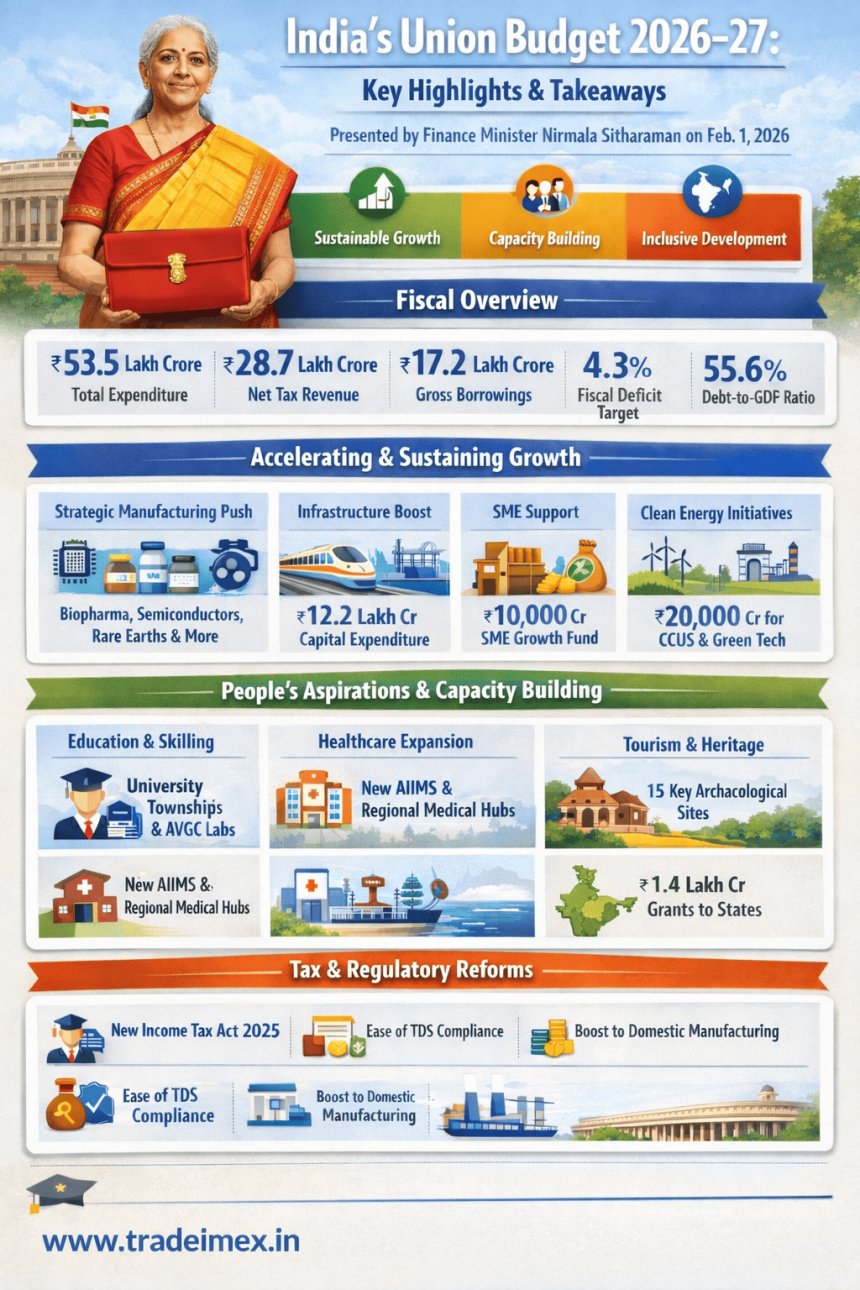
India’s Union Budget 2026–27: Key Highlights & Takeaways
Presented by Finance Minister Nirmala Sitharaman in Parliament on 1 Feb 2026, this Budget is guided by three foundational duties (kartavyas): sustainable economic growth, people’s capacity building, and inclusive development for all regions and communities.
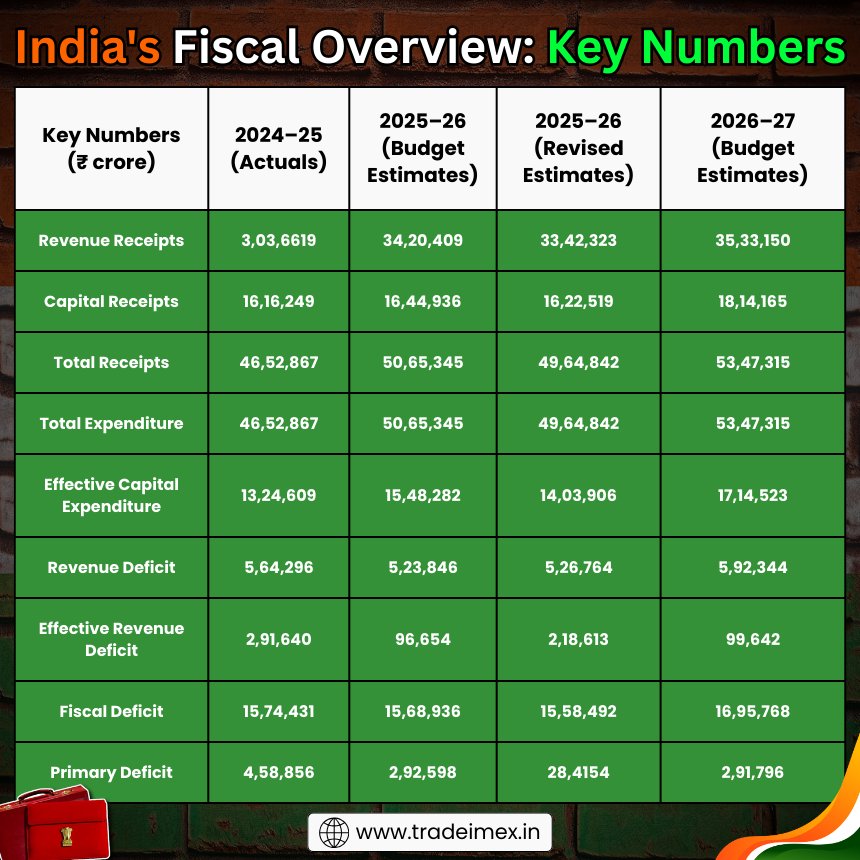
Fiscal Overview
-
Total expenditure: ₹53.5 lakh crore.
-
Non-debt receipts: ₹36.5 lakh crore.
-
Centre’s net tax receipts: ₹28.7 lakh crore.
-
Gross market borrowings: ₹17.2 lakh crore; net borrowings: ₹11.7 lakh crore.
-
Fiscal deficit target: 4.3% of GDP.
-
Debt-to-GDP ratio: estimated at 55.6% (slightly lower than the revised estimate for 2025-26).
This reflects a continued drive toward a balanced fiscal approach while maintaining strong investment in development priorities.
First Kartavya: Accelerating and Sustaining Growth
1. Strategic Manufacturing Push
To reduce import dependency and boost domestic capability, the Budget sets ambitious targets across seven strategic and frontier sectors:
-
Biopharma SHAKTI: ₹10,000 crore over 5 years to make India a global biopharmaceutical manufacturing hub. Includes new institutes and 1,000+ accredited clinical trial sites.
-
India Semiconductor Mission (ISM) 2.0: support for equipment, materials, design IP, supply-chain training, and industry-led R&D.
-
Electronics Components Manufacturing Scheme: enlarged outlay of ₹40,000 crore.
-
Dedicated Rare Earth Corridors: boost mining, processing, research and manufacturing in Odisha, Kerala, Andhra Pradesh, and Tamil Nadu.
-
Chemical Parks Support Scheme: assists states to establish 3 world-class chemical manufacturing clusters.
-
Capital Goods Ecosystem:
-
Hi-Tech Tool Rooms by CPSEs to support precision component manufacturing.
-
Construction & Infrastructure Equipment (CIE) scheme to strengthen domestic production of advanced equipment.
-
Container manufacturing initiative with ₹10,000 crore over 5 years.
2. Textile & Traditional Sectors
-
Integrated Textile Programme:
-
National Fibre Scheme for self-reliant natural and new-age fibres.
-
Textile Expansion & Employment Scheme for modernization of clusters.
-
Mega Textile Parks for value addition in technical textiles.
-
Mahatma Gandhi Gram Swaraj initiative to boost khadi, handloom, and handicrafts.
3. Legacy Sector Revival
-
Scheme to rejuvenate 200 legacy industrial clusters through infrastructure upgrades and technology infusion.
4. Championing SMEs and Micro Enterprises
-
Dedicated ₹10,000 crore SME Growth Fund to nurture future “Champion SMEs.”
-
Self-Reliant India Fund allocated an additional ₹2,000 crore to support micro businesses.
-
Professional institutions to help build local entrepreneur support systems (e.g., corporate mentors).
5. Infrastructure Overhaul
-
Public capital expenditure increased to ₹12.2 lakh crore.
-
The Infrastructure Risk Guarantee Fund is to increase private developer confidence.
-
REITs for CPSE Real Estate are aimed at recycling assets for new investment.
-
Transport & logistics expansion:
-
New Dedicated Freight Corridor (East–West).
-
20 new National Waterways to enhance cargo movement and connectivity.
-
Inland waterway ship repair hubs planned in Varanasi and Patna.
-
Coastal Cargo Promotion Scheme to shift freight from road/rail to waterways.
-
Incentives for seaplane manufacturing and operations to improve remote connectivity and tourism.
6. Energy & Urban Development
-
Carbon Capture, Utilization & Storage (CCUS): ₹20,000 crore over 5 years for advanced energy technologies.
-
City Economic Regions (CER): ₹5,000 crore per region to support localized growth via challenge-mode financing.
-
Seven High-Speed Rail Corridors announced to link major cities with faster, eco-friendly transport systems.
7. Finance & Regulatory Reforms
-
High-level committee on banking to align the sector with growth goals.
-
Restructuring of Power Finance Corporation and Rural Electrification Corporation to scale operations.
-
Review of foreign investment rules (FEMA) for easier compliance and modernisation.
-
Incentives for municipal bonds (₹100 crore for issues of ₹1,000 crore+).
Second Kartavya: People’s Aspirations & Capacity Building
Education and Skilling
-
Education-to-Employment & Enterprise Standing Committee to recommend reforms focusing on service-sector skills.
-
5 University Townships near industrial and logistics corridors.
-
Girls’ Hostels: one in every district via VGF/capital support.
-
AVGC Labs (Animation, Visual Effects, Gaming, Comics) in schools and colleges to spur creative tech skill growth.
Healthcare & Allied Professions
-
100,000 Allied Health Professionals to be trained over 5 years.
-
5 Regional Medical Hubs to boost medical value tourism.
-
Three new All-India Institutes of Ayurveda.
-
Veterinary expansion: over 20,000 professionals plus new support for private sector facilities.
Tourism, Culture & Sports
-
Heritage tourism development: 15 key archaeological sites to become experiential destinations.
-
National Destination Digital Knowledge Grid to document cultural and heritage assets.
-
Khelo India Mission launched to transform sports over the next decade.
-
Upskilling the workforce at major tourist locations with hybrid training programs.
Third Kartavya: Inclusive, Regional, and Sustainable Development
Agriculture & Rural Economy
-
Integrated development of 500 reservoirs and Amrit Sarovars.
-
Push for high-value crops like coconut, sandalwood, cocoa, and cashew in coastal regions.
-
Bharat-VISTAAR: AI-enabled multilingual agricultural knowledge and advisory platform combining AgriStack and ICAR resources.
Empowerment Schemes
-
Divyangjan Kaushal Yojana to provide skills and job roles in IT, hospitality and allied sectors.
-
Expanded mental health infrastructure: NIMHANS-2 and upgraded apex institutions.
Connectivity & Regional Growth
-
East Coast Industrial Corridor with nodes at key industrial towns.
-
Tourism schemes for Buddhist circuits in multiple North-East states.
-
Deployment of 4,000 e-buses for sustainable public transport.
State Funding
-
₹1.4 lakh crore allocated as grants to states per the 16th Finance Commission recommendations.
Direct Tax Reforms & Ease of Compliance
-
New Income Tax Act, 2025, effective from April 2026 with simplified forms and rules.
-
Motor accident claim interest is now tax-exempt with no TDS.
-
TCS (Tax Collected at Source) rationalised:
-
Overseas travel packages cut to 2%.
-
LRS education and medical remittances are capped at 2%.
-
Simplified TDS provisions for labour-intensive businesses.
-
Automated certificates for lower/nil TDS without manual applications.
Customs, Trade & Duty Changes
-
Customs duty rationalised on various goods to support manufacturing and reduce costs for consumers.
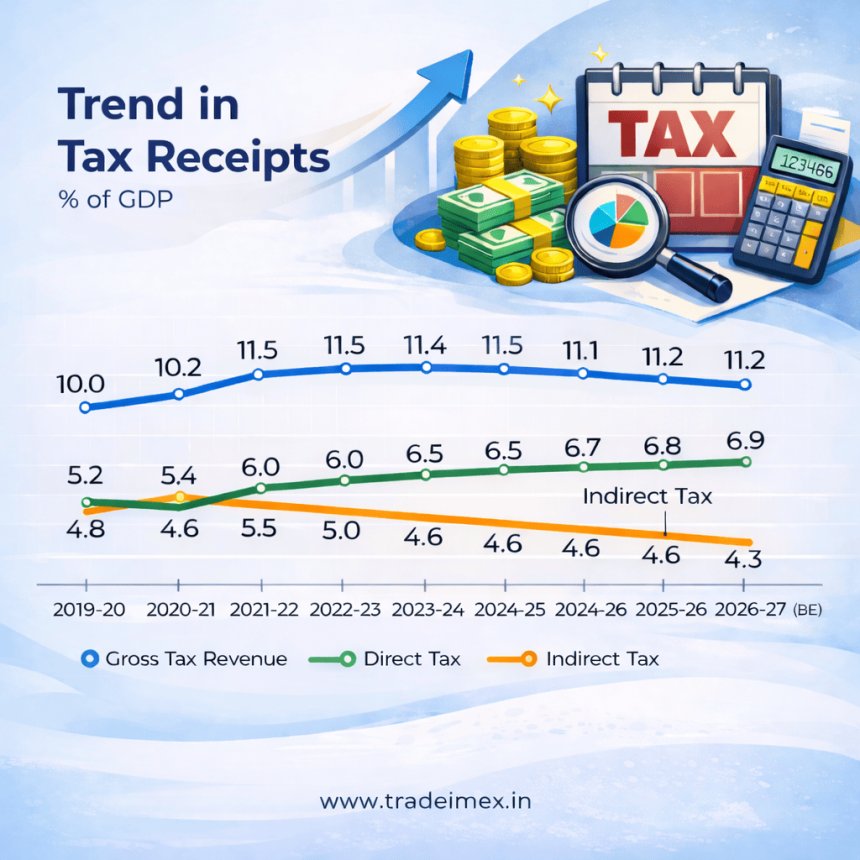
Tax Slabs: Income Tax (FY 2026-27 / AY 2027-28)
In the Union Budget 2026-27, the Finance Minister kept the income tax slabs unchanged, continuing the structure introduced previously under the new tax regime. This means many taxpayers, especially in the middle class, will benefit from predictable and simplified taxation.
New Tax Regime
Under the new regime (without most exemptions and deductions), the tax rates for individual taxpayers are:
|
Taxable Income (₹) |
Tax Rate |
|
Up to 4,00,000 |
Nil |
|
4,00,001–8,00,000 |
5% |
|
8,00,001–12,00,000 |
10% |
|
12,00,001–16,00,000 |
15% |
|
16,00,001–20,00,000 |
20% |
|
20,00,001–24,00,000 |
25% |
|
Above 24,00,000 |
30% |
Under Section 87A, a rebate makes tax zero for individuals with taxable income up to ₹12 lakh, effectively giving many taxpayers a larger tax-free threshold when combined with standard deductions and rebates.
Old Tax Regime
Taxpayers can still choose the old regime to claim exemptions like House Rent Allowance (HRA), Section 80C deductions, etc. Slabs remain:
-
Below 60 years:
-
Up to ₹2.5 lakh — Nil
-
₹2.5 lakh–₹5 lakh — 5%
-
₹5 lakh–₹10 lakh — 20%
-
Above ₹10 lakh — 30%
-
Senior Citizens (60–79):
-
Up to ₹3 lakh — Nil
-
₹3 lakh–₹5 lakh — 5%
-
₹5 lakh–₹10 lakh — 20%
-
Above ₹10 lakh — 30%
-
Super Senior Citizens (80+):
-
Up to ₹5 lakh — Nil
-
₹5 lakh–₹10 lakh — 20%
-
Above ₹10 lakh — 30%
Note: A standard deduction of ₹75,000 remains under the new regime for salaried taxpayers, reducing taxable income further.
Key Points
-
No change to income tax slabs in Budget 2026-27, continuity helps taxpayers plan finances.
-
New tax regime offers a broad tax-free threshold up to ₹12 lakh with rebate and deductions.
-
The old regime is still available for deduction-friendly taxpayers.
-
GST reforms streamline indirect taxes by focusing on 0%, 5%, 18%, and 40% slabs, making daily life simpler and often cheaper.
Macro Framework: Growth, Deficit, and Debt
GDP Growth Outlook
India’s economy continues to project robust growth despite global headwinds. Pre-Budget estimates and policy outlook signal a maintained growth trajectory of around 7%, powered by investment, consumption, and structural reforms.
Fiscal Deficit and Debt
Fiscal discipline remains central:
-
The fiscal deficit for FY 2026–27 is targeted at 4.3% of GDP, down from an estimated 4.4% in the current year, aligning with a phased consolidation strategy.
-
The debt-to-GDP ratio is expected to decline gradually, from 56.1% to 55.6%, reinforcing medium-term fiscal credibility.
Reducing deficit and debt metrics is imperative for macroeconomic stability. It signals to investors that India is committed to maintaining sustainable public finances even while investing ambitiously in growth sectors.
Capital Expenditure: The Backbone of “Growth Push”
One of the most striking features of the 2026–27 Budget is the consistency and scale of capital expenditure (CapEx), a tool the government is using to build demand, create jobs, and lay physical and digital infrastructure.
CapEx Allocation
-
Public capital expenditure has been set at ₹12.2 lakh crore for FY27, an increase of nearly 9–11% year-on-year.
This sustained capex emphasis is aimed at reducing logistic bottlenecks, boosting manufacturing productivity, stimulating private sector investment, and enhancing connectivity across regions.
Key Infrastructure Measures
High-Speed Rail and Connectivity
The government outlined seven new high-speed rail corridors, envisioned as “growth connectors” linking major urban and industrial hubs across regions.
National Waterways & Coastal Shipping
Plans include:
-
20 new National Waterways, expanding the inland waterways network.
-
Scheme initiatives to double the share of inland shipping in freight transport by 2047.
These investments target lower logistic costs, greater export competitiveness, and balanced regional development.
Infrastructure Risk Guarantee Fund
To crowd in private participation, the Budget proposes a partial credit guarantee mechanism that reduces construction phase risks for private investors.
Manufacturing and Strategic Sector Push
A hallmark of this Budget is its focus on manufacturing competitiveness, not just in traditional areas, but across several strategic and frontier sectors.
New and Expanded Missions
Key initiatives include:
-
Biopharma SHAKTI: A ₹10,000 crore, five-year initiative to build India into a global biologics and biosimilars production hub.
-
India Semiconductor Mission (ISM) 2.0: To strengthen semiconductor supply chains, expand materials and equipment capabilities, and boost indigenous IP.
-
Electronics Components Manufacturing Scheme: Increased outlay to ₹40,000 crore.
Other Manufacturing Initiatives
-
Rare Earth Corridors in Odisha, Kerala, Andhra Pradesh, and Tamil Nadu to develop upstream minerals and critical inputs.
-
Chemical Parks, container manufacturing, and capital goods schemes to scale high-value production.
-
Mega Textile Parks and upliftment of the textile ecosystem.
These reflect a concerted shift toward import substitution, value chain integration, and global competitiveness in both traditional manufacturing sectors and emerging high-tech arenas.
Services Sector: Jobs, Skills, and New Economies
Beyond manufacturing, the Budget aims for jobs and human capital:
Employment Generation and Skill Development
Efforts to create jobs for India’s large youth workforce include:
-
Sector-specific skilling and training programs tailored to high-growth services such as care, tourism, and digital services.
-
Committees aimed at boosting India’s share in services exports to 10% by 2047.
Creative and Digital Economy Support
Investment in creative industries and digital skills reflects an understanding that future jobs will span new domains:
-
Support for Animation, Visual Effects, Gaming & Comics (AVGC) labs in schools and colleges, part of backing the so-called “Orange Economy”.
-
Digital infrastructure pushes that integrate emerging tech with governance and services.
These measures aim to link education with employability in sectors where India has latent global advantages.
Taxation and Compliance: Simplification with Targeted Relief
Income Tax and TCS Changes
While there was no change in the basic income tax slabs, the Budget proposes:
-
Reduced Tax Collected at Source (TCS) rates for foreign education, medical remittances, and overseas tour packages, from 5–20% down to 2%.
These adjustments are designed to ease compliance and reduce costs for Indian taxpayers engaged in international transactions.
Corporate and Investment-Related Tax Measures
Some noteworthy tax changes include:
-
Reduction of Minimum Alternate Tax (MAT) from 15% to 14% for certain companies.
-
Tax holiday until 2047 for foreign cloud service providers operating through Indian data centres, subject to Indian customer service criteria.
These changes aim to make the business environment more attractive to both domestic startups and global investors, especially in key technology sectors.
Agriculture and Rural Development
The Budget dedicates attention to rural economies through:
-
Integrated agriculture development initiatives and reservoirs.
-
Support for fisheries value chains and women-led farmer-producer organisations (FPOs).
These interventions aim to modernize production, improve market access, and support diversified agricultural incomes.
State Finances and Federal Fiscal Architecture
A noteworthy fiscal decision is the retention of the states’ share of federal taxes at 41% for 2026–31, consistent with the previous formula. While this decision provides continuity, it drew criticism from several states that had sought an increased share to manage rising expenditures.
Importantly, the Budget also increases interest-free, long-term loans to states to support capital investments, a move aimed at reducing state borrowing pressures and stabilizing bond markets.
Trade, Exports, and External Sector Strategy: Re-Engineering India’s Global Footprint
One of the most strategically important yet understated aspects of the Union Budget 2026–27 is its renewed focus on trade competitiveness and export-led growth. At a time when global trade is fragmenting due to geopolitics, protectionism, and supply chain realignment, India’s budget signals a shift from passive integration to an active trade positioning. India’s total trade reached $884.62 billion in the first three quarters of 2025, as per the latest Asia trade data.
Export Growth Targets and Trade Vision
The government reiterated its medium-term ambition of achieving USD 2 trillion in exports by 2030, with a strong emphasis on:
-
High-value manufacturing exports
-
Services exports (IT, business services, healthcare, education)
-
New-age sectors like electronics, defence, green technologies, and semiconductors
To support this, the Budget aligns trade policy with domestic manufacturing incentives, logistics reform, and skilling initiatives, an important structural change compared to earlier, siloed approaches.
Trade Facilitation and Customs Reforms
Several trade-related administrative reforms were announced to reduce transaction costs:
-
Further rationalisation of customs duties to eliminate inverted duty structures in electronics, chemicals, and engineering goods
-
Expansion of faceless customs assessment to additional ports
-
Digitisation of trade documentation under a unified trade portal
These steps aim to reduce export clearance times, which remain significantly higher in India compared to ASEAN peers.
India’s Trade in the Last 10 Years

|
Year of Trade |
India’s Total Imports ($) |
India’s Total Exports ($) |
|
2015 |
$390.79 billion |
$263.88 billion |
|
2016 |
$356.68 billion |
$260.96 billion |
|
2017 |
$443.85 billion |
$295.86 billion |
|
2018 |
$509.27 billion |
$323.99 billion |
|
2019 |
$478.88 billion |
$323.25 billion |
|
2020 |
$367.98 billion |
$275.48 billion |
|
2021 |
$570.40 billion |
$394.81 billion |
|
2022 |
$732.56 billion |
$452.68 billion |
|
2023 |
$671.99 billion |
$431.41 billion |
|
2024 |
$682.15 billion |
$441.50 billion |
|
2025 (first 3 quarters) |
$548.99 billion |
$335.63 billion |
Sector-Wise Reaction and Market Response
Equity Markets
Financial markets responded with volatility after the Budget, largely due to:
-
Increases in Securities Transaction Tax (STT), especially on derivatives, triggered sharp equity indices declines.
Investors interpreted this as a cost for market participation, even as other measures signal long-term structural support.
Industry and CEO Reactions
Top industry leaders broadly view the Budget as capex-led, growth-oriented, and reform-driven, especially in areas such as manufacturing, technology, and infrastructure, but some caution that the private sector investment response will be critical.
Political and Social Commentary
Opposition leaders argued that the Budget offered “little for the middle class,” while economic policymakers highlighted its balanced approach between growth stimulus and fiscal prudence.
For Citizens and Households: What Changes?
Here’s how the Budget affects ordinary people:
Disposable Income
-
No changes in core tax slabs, but TCS cuts help reduce costs related to travel, education, and medical expenses abroad.
Cost of Living Adjustments
Budget provisions affect consumption patterns: some goods and services may get cheaper or costlier depending on duty adjustments, ranging from coffee to manufactured items.
Critical Assessment: Discipline vs. Growth
The 2026–27 Budget attempts an intricate balancing act, and its success will ultimately hinge on execution and private sector response.
Fiscal Discipline
Proponents of the fiscal consolidation path argue that lowering deficits and debt ratios enhances macroeconomic resilience, keeps borrowing costs manageable, and safeguards India’s credit profile.
Growth Push
On the other hand, sustained capex, manufacturing incentives, and strategic industry support underline a clear growth thrust. Investment in infrastructure and technology sectors is a bet on India’s long-run competitive advantage.
Analysts see this as a budget that chooses neither austerity nor populism, but targeted investment with an eye on long-term sustainability.
Conclusion & Final Thoughts: Turning Point or Continuity Statement?
In conclusion, the Indian Union Budget 2026–27 is less of a one-off transfer and more of a strategic blueprint. It prioritizes:
-
Big-ticket infrastructure and connectivity
-
Manufacturing and technological self-reliance
-
Job creation and services exports
-
Fiscal prudence to reassure investors
Whether this budget from the Modi Government will translate into accelerated private investment, higher job growth, and tangible gains for households will be visible only in the coming quarters, when spending begins to materialize on the ground, the investor response unfolds, & macro indicators reflect the policy mix.
Bottom Line for Readers
This Union Budget 2026-27 blends strong public investment with fiscal discipline, deep structural reforms, and targeted support for strategic industries, people-centred capacity building, and inclusive development. It’s a growth-oriented roadmap that aims to make India a global manufacturing hub, boost competitiveness, strengthen health and education systems, and ensure that development benefits reach every region and sector. In sum, this Budget blends fiscal discipline with a decisive growth push, a nuanced approach that aligns India’s current economic strengths with its aspirations of becoming a Viksit Bharat 2047.
For more information on the latest global trade data, or to search live import-export data by country, visit TradeImeX. Contact us at info@tradeimex.in for customized trade reports and market insights.
Share
What's Your Reaction?
 Like
0
Like
0
 Dislike
0
Dislike
0
 Love
0
Love
0
 Funny
0
Funny
0
 Angry
0
Angry
0
 Sad
0
Sad
0
 Wow
0
Wow
0