US Tariffs on India's Rubber Goods Slashed from 50% to 18%: Implications & Trade Data Insights
The US cuts tariffs on India’s rubber goods from 50% to 18%, reshaping bilateral trade dynamics. Explore key implications, export opportunities, market impact, and detailed trade data insights.

Introduction: A Major Shift in Trade Policy
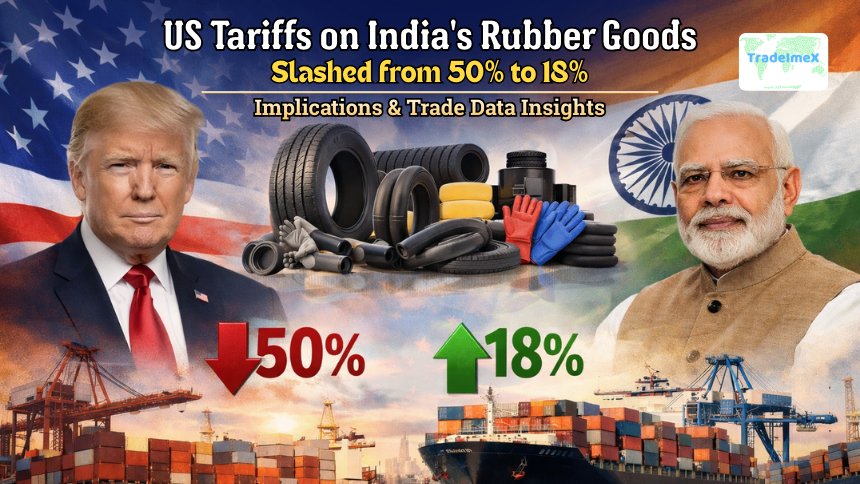
In early 2026, the United States and India announced a landmark interim trade framework that dramatically reconfigures their economic relationship. At its heart, the U.S. has agreed to slash reciprocal tariffs it imposed on Indian goods, including rubber products, from punitive levels of roughly 50% to 18%. This change comes after prolonged trade tensions triggered by U.S. tariff hikes in 2025 and prolonged negotiations to reset access conditions for both countries. According to the latest US export data, the total value of the US-India rubber trade reached $1.30 billion in 2024-25. India is the 11th largest rubber exporter to the USA, according to the US rubber import data.
For India, one of the world’s largest producers and exporters of rubber-based goods, this represents not just tariff relief but a strategic gateway back into competitiveness in the U.S. market. For the U.S., it signals a partial recalibration of “America First” trade policies in favour of more balanced economic engagement.
This blog unpacks the background of the US-India tariff deal on India’s rubber products tariff reduction, why rubber matters in bilateral trade, the latest trade data, sector-level implications, market and industry responses, and longer-term strategic considerations.
Background: How We Got Here
Tariff Escalation in 2025
In mid-2025, the U.S. government broadly applied high reciprocal tariffs on Indian exports, escalating duty levels from typical base rates of 25% to around 50% in many categories, including rubber goods. These punitive duties were framed as a response to concerns about India’s trade barriers on US products and geopolitical disagreements, including oil purchases from Russia.
At 50%, Indian exports faced one of the highest tariff burdens seen in recent U.S. trade policy, a level that sharply undercut competitiveness and disrupted key export sectors.
Rubber Within the Broader Tariff Landscape
Rubber was one among several industrial and manufactured goods that saw tariffs jump to these punitive levels. While base rates for rubber products were traditionally modest under standard MFN (Most Favoured Nation) schedules, the reciprocal tariff escalation meant Indian rubber exporters suddenly faced effective duties in excess of 50%, a level that effectively priced many products out of the U.S. market.
The tariff shock triggered urgent policy engagement, export slowdowns, and industry pushback, especially from the Automotive Tyre Manufacturers’ Association (ATMA) and rubber processors who stated that such duties severely constrained their market momentum in the U.S. and handed an edge to competitors like Turkey and Vietnam.
Negotiating a Turnaround
Months of high-level diplomacy culminated in the February 2026 interim trade framework between India and the U.S. Part of this deal was a decision to reset reciprocal tariffs at 18% for a wide range of goods, including plastic and rubber products, under the new India-US trade deal.
US Rubber Imports from India by HS Code: India-US Rubber Trade Insights & Top Traded Goods

According to the latest U.S. import data, India’s exports of rubber and rubber products to the U.S. exceeded $1.06 billion in 2024, with a 6% increase from the previous year, an important yet relatively modest slice of India’s total exports to the world. US rubber imports from India by HS code reveal an interesting trend in the USA's top imported rubber products from India.
US rubber & articles imports from India reached $1.02 billion in the first 11 months of 2025. The data showcases that products such as rubber tyres, tubes, and belts are among the most prominent imports. Additionally, items like rubber hoses, sheets, and plates are also prevalent in the rubber import trade. The top 10 rubber goods that the US imports from India, as per the US-India trade data by HS code 40 and US shipment data for 2025, include:
1. New pneumatic tyres of rubber (HS code 4011): $551.85 million
2. Articles of vulcanised rubber (HS code 4016): $202.77 million
3. Tubes, pipes and hoses of vulcanised rubber (HS code 4009): $108.17 million
4. Conveyor or transmission belts (HS code 4010): $89.91 million
5. Plates, sheets, strips, & shapes of vulcanised rubber (HS code 4008): $46.35 million
6. Synthetic rubber derived from oils (HS code 4002): $14.53 million
7. Reclaimed rubber in primary forms (HS code 4003): $13.17 million
8. Hygienic or pharmaceutical articles (HS code 4014): $12.41 million
9. Retreaded or used pneumatic tyres of rubber (HS code 4012): $10.21 million
10. Natural rubber (4001): $5.11 million
The dominance of tyres and industrial rubber products speaks to India’s comparative strength in these segments. The U.S. is a key market for tyres, with India ranking among the top exporters globally. But under 50% tariffs in 2025, many of these segments became severely uncompetitive, driving buyers to alternative suppliers with better trade terms.
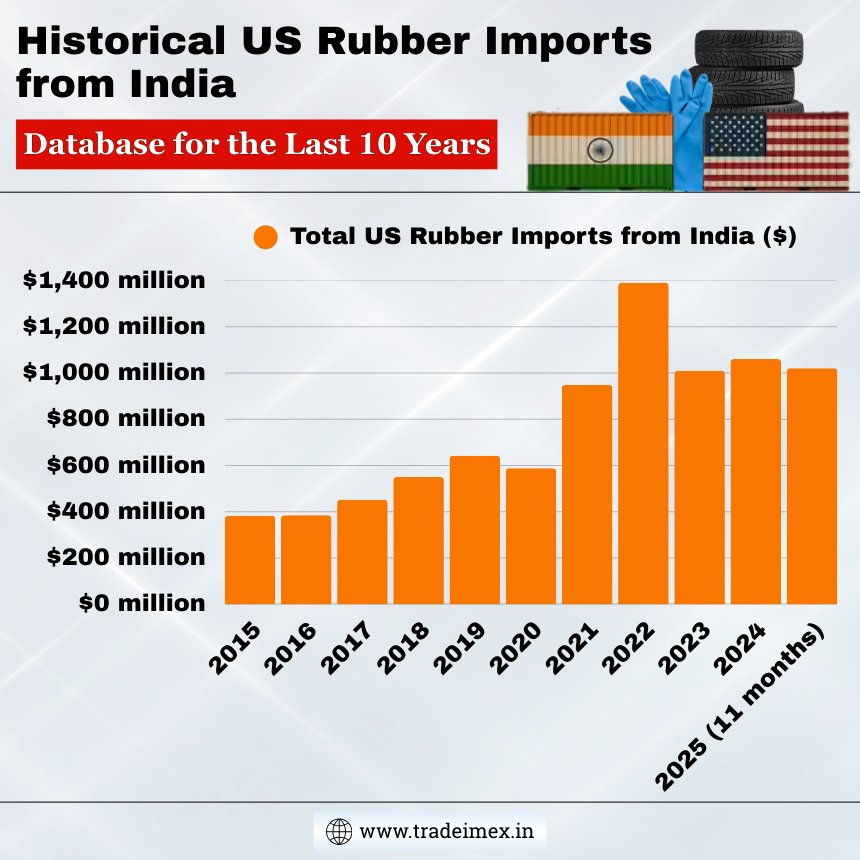
Historical US Rubber Imports from India: Database for the Last 10 Years
|
Year of Imports |
Total US Rubber Imports from India ($) |
|
2015 |
$382.81 million |
|
2016 |
$385.40 million |
|
2017 |
$451.44 million |
|
2018 |
$550.50 million |
|
2019 |
$641.86 million |
|
2020 |
$587.67 million |
|
2021 |
$948.54 million |
|
2022 |
$1.39 billion |
|
2023 |
$1.01 billion |
|
2024 |
$1.06 billion |
|
2025 (11 months) |
$1.02 billion |
Why the Tariff Cut Matters for Rubber
1. Renewed Competitiveness in the U.S. Market
With the tariff rate now at 18%, Indian rubber products (classified under HS code 40), especially tyres, become materially more competitive compared to the prohibitive 50% rate and against competitors from other countries.
For perspective:
-
At a 50% tariff, a product with a factory price of $100 would attract $50 in duty, meaning landed costs jumped sharply.
-
At 18%, that same product is hit with only $18 in duty, restoring much of the price differential needed to compete in procurement bids.
This translates to meaningfully lower landed costs for U.S. importers and higher order volumes for Indian firms.
2. Volume and Market Access Gains
Tariff changes affect not just prices, but order flows and volume commitments. At 50% tariffs, many buyers paused new contracts or switched to alternative sources like Southeast Asian manufacturers. The reset to 18% lowers barriers to re-entry and supports reviving long-term commercial relationships.
3. Tyres as a Strategic Case Study
Tyre exports illustrate the lift that tariff reductions can provide. Before the 2025 hikes, India was exporting tyres worth over Rs 25,000 crore to the U.S., with the U.S. accounting for about 17% of tyre exports.
Under high tariffs, export growth stalled, and buyers relented. With an 18% tariff, Indian tyres become competitive again, especially in applications where cost differentials matter, such as off-the-road (OTR), conventional automotive tyres, and speciality industrial products.
4. Spillover Across the Rubber Value Chain
Tariffs also affect upstream and downstream industries:
-
Synthetic rubber producers benefit if demand from exporters rises.
-
Rubber chemical suppliers see renewed orders.
-
Equipment and capital goods used in rubber manufacturing may see more investment.
This interplay highlights how tariff changes can cascade through the supply chain beyond headline export figures.
Broader Trade Data Effects and Sector Dynamics
Export Performance and Tariff Shock
Overall, after tariffs peaked in 2025, India’s exports to the U.S. softened, with some sectors showing contractions. Official trade data reported a mixed picture: exports declined in some months and grew in others as markets adjusted to tariff realities.
But export sentiment improved once tariff relief was announced, export engagement resumed across sectors, and buyers began revisiting pending contracts.
Sectoral Winners Beyond Rubber
Though rubber is the focal point here, the tariff reset applies to a broad set of products impacting Indian exporters:
-
Textiles and apparel
-
Leather and footwear
-
Organic chemicals
-
Home décor and artisanal goods
-
Select machinery and industrial products
These sectors were previously also constrained by punitive duties, and the reset provides a structural boost to exports and pricing power.
Industry and Market Reactions
Rubber and Tyre Producers
Industry associations like ATMA have welcomed the tariff cut as essential for regaining competitiveness. Previously, high tariffs allowed cheaper suppliers with lower duties to grab market share. The reset to 18% helps level the playing field.
Exporters and MSMEs
Indian MSME exporters, many of whom operate in rubber downstream segments such as hoses and ancillary products, view the tariff reduction as a pathway back to scale and profitability. This comes at a time when export orders had been disrupted and buyer confidence shaken.
Market Response
The broader trade deal also included commitments from India to import more U.S. goods, including energy products, drawing scepticism from some analysts about trade balance impacts. A latest report noted that India’s intention to import $500 billion of U.S. goods could draw resources away from domestic production and narrow India’s trade surplus with the U.S. if not executed efficiently.
Strategic Implications Beyond Rubber
1. Trade Relations Reset
The tariff change reflects a broader diplomatic recalibration between the US and India. While high tariffs reflected friction and policy standoffs, the reset indicates a turn toward cooperation in trade and strategic areas.
2. Energy and Geopolitics Intersect Trade
The deal is tied to larger geopolitical shifts, including commitments by India on energy procurement, showing how trade policy now intersects with defence, energy, & broader diplomacy.
3. Future Negotiations: Toward a Full Trade Agreement
The interim relief is seen as a step toward a comprehensive bilateral trade agreement. Full negotiations could yield deeper tariff cuts or zero duties in targeted sectors, further expanding access and economic integration.
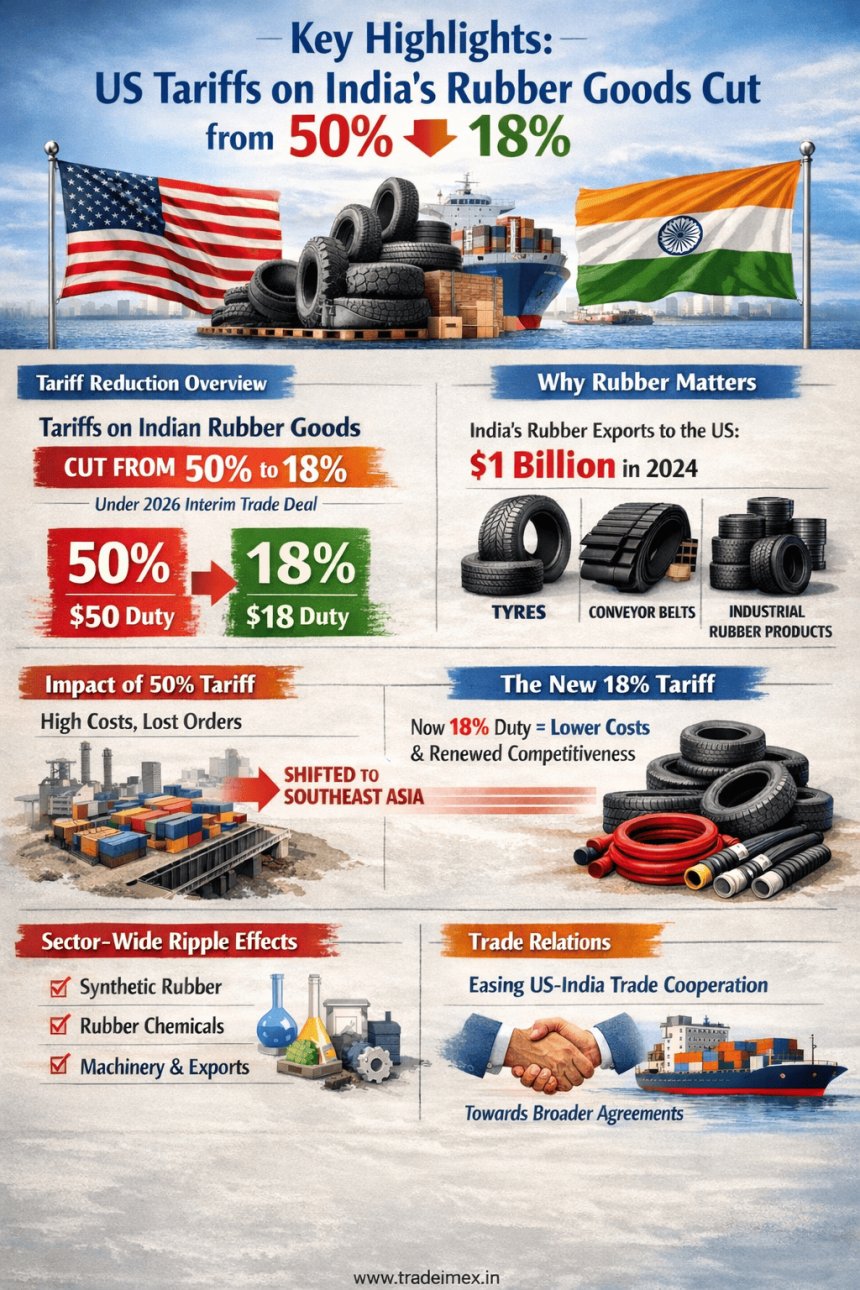
Key Highlights: US Tariffs on India’s Rubber Goods Cut from 50% to 18%
Trade Policy Shift
-
The United States reduced tariffs on Indian rubber goods from punitive levels of 50% to 18% under a 2026 interim trade framework.
-
The tariff reset marks a major de-escalation in trade tensions that intensified in 2025.
-
The new 18% rate restores partial competitiveness for Indian exporters in the US market.
Why Rubber Matters
-
India exported over $1 billion worth of rubber and rubber products to the US in 2024.
-
Tyres account for the largest share of rubber exports to the US, followed by industrial rubber products like hoses, conveyor belts, and vulcanized rubber articles.
-
The US is a key export destination for India’s tyre industry, historically accounting for a significant share of overseas sales.
Impact of the Earlier 50% Tariff
-
At 50% duty, Indian rubber goods became significantly more expensive in the US market.
-
Many US buyers shifted orders to alternative suppliers in Southeast Asia and other regions.
-
Export growth stalled, and pricing power weakened across tyre and industrial rubber segments.
What the 18% Tariff Means Now
-
A product priced at $100 now faces $18 in duty instead of $50, sharply lowering landed costs.
-
Indian exporters regain meaningful price competitiveness.
-
Long-term buyer contracts that were paused are likely to resume.
-
Market re-entry becomes viable for MSMEs in hoses, tubes, belts, and speciality rubber components.
Sector-Wide Ripple Effects
-
Increased export orders can benefit upstream industries such as:
-
Synthetic rubber manufacturers
-
Rubber chemical suppliers
-
Machinery and capital goods producers
-
Production capacity utilization in the rubber sector is expected to improve.
Broader Trade Context
-
The tariff cut applies to multiple sectors beyond rubber, including textiles, leather, chemicals, and select industrial goods.
-
The agreement forms part of a broader US–India trade recalibration.
-
India has signaled increased imports of US goods as part of balancing trade relations.
Strategic Implications
-
The move signals renewed economic cooperation between the US and India.
-
Rubber and tyres serve as a case study of how tariff policy directly affects supply chains and competitiveness.
-
The interim framework could pave the way for a broader bilateral trade agreement.
What to Watch
-
Recovery speed of India’s rubber export volumes to the US.
-
Whether Indian firms regain lost market share from competitors.
-
Future negotiations could potentially reduce tariffs further.
-
Long-term impact on India’s trade balance with the US.
Conclusion: What to Watch Next
In conclusion, the reduction of U.S. tariffs from roughly 50% to 18% on Indian rubber and other goods is a significant trade policy shift. While 18% still represents a cost for exporters, it is far more manageable and allows Indian products to regain pricing competitiveness in the U.S. market. For the rubber industry, particularly tyre makers and rubber goods producers, this opens the door to resumed market penetration, volume growth, and competitive pricing after a period of trade disruption.
However, the broader impact will depend on how quickly exporters rebuild market share, how the industry ramps up production, and how the bilateral trade relationship evolves in a more integrated and strategic economic framework. Overall, the tariff reset represents not just a reversal of punitive trade barriers but a turning point in US–India economic engagement, one that promises new opportunities for exporters, supply chain integration, and deeper commercial ties between the world’s two large democracies.
Note For Our Readers
We hope that you liked our insightful blog report on the US tariff slash on Indian rubber products to 18% under the India-US trade deal. Want to access the latest global trade data and search live import-export data by country, product, or HS code and skyrocket your business? Visit TradeImeX and contact us at info@tradeimex.in for customized trade database reports and market insights.
Read more:
Trump Imposes 25% Tariffs on South Korean Imports
US-Bangladesh Reciprocal Trade Agreement 19% Tariff Cuts & Duty-Free Benefits
Share
What's Your Reaction?
 Like
1
Like
1
 Dislike
0
Dislike
0
 Love
0
Love
0
 Funny
0
Funny
0
 Angry
0
Angry
0
 Sad
0
Sad
0
 Wow
0
Wow
0