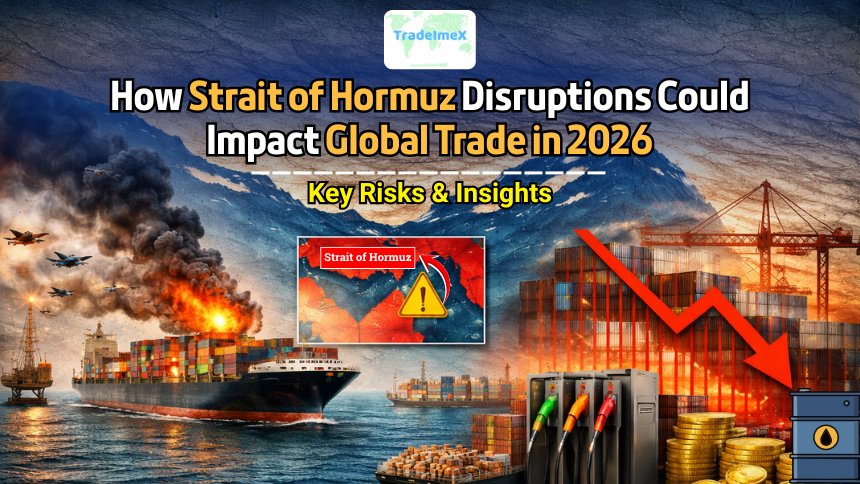
How Strait of Hormuz Disruptions Could Impact Global Trade in 2026: Key Risks & Insights
Explore how Strait of Hormuz disruptions could impact global trade in 2026. Learn key risks, oil supply threats, & strategic insights shaping international markets.

Introduction
The Strait of Hormuz has always been a geopolitical flashpoint. In 2026, it's something more serious: a direct threat to global trade stability. At its narrowest point, this 33-kilometer-wide waterway handles a disproportionate share of the world’s energy and commodity flows. When disruptions occur here, the effects are not isolated. They surge across shipping, manufacturing, agriculture, and financial markets, impacting the global trade data. The Strait of Hormuz is one of the most critical shipping routes in the world. When disruptions happen here, the effects are immediate and global.
Recent tensions in the region have shown just how fragile this system is. Ships are delayed, costs rise quickly, and the impact spreads far beyond energy markets into food, transport, and everyday living expenses due to the US-Iran-Israel war. The key question is no longer whether disruptions matter. It is how deep and how fast the impact spreads through the global economy. This blog breaks down the Strait of Hormuz global trade risks using data, system-level analysis, and real economic linkages.
The Strait of Hormuz: A Critical Global Chokepoint
The Strait of Hormuz connects the Persian Gulf to the Arabian Sea. Despite its narrow geography, it is one of the most important arteries of global trade.
Key Trade Flows (Approximate 2025–2026 Data)
-
Oil: 20–21 million barrels per day (20–25% of global consumption)
-
Liquefied Natural Gas (LNG): 20% of global trade
-
Petrochemicals and refined fuels: Significant share of global exports
-
Fertilizers and industrial chemicals: Critical for agriculture and manufacturing
Major exporters relying on the route include:
-
Saudi Arabia
-
Iraq
-
United Arab Emirates
-
Kuwait
-
Qatar (especially LNG)
Major importers:
-
China
-
India
-
Japan
-
South Korea
-
European Union
This concentration creates a structural vulnerability: a single disruption point affects multiple continents simultaneously.
Energy Markets: The First and Fastest Shock
Supply Disruption Dynamics
When flows through Hormuz are restricted, the immediate effect is a supply shock. Even partial disruptions can remove millions of barrels per day from global markets, as per an UNCTAD report.
In early 2026 scenarios:
-
Flows reportedly dropped sharply during peak tensions
-
Oil prices crossed $100 per barrel in volatile trading windows
-
Spot LNG prices surged due to uncertainty around Qatari exports
Why the Market Reacts So Quickly
Energy markets are highly sensitive because:
-
Demand is relatively inelastic in the short term
-
Spare production capacity is limited
-
Strategic reserves are finite and politically managed
Secondary Energy Effects
-
Refining bottlenecks: Crude supply disruptions affect fuel production
-
Electricity costs rise: Gas shortages impact power generation
-
Industrial slowdown: Energy-intensive sectors (steel, cement, chemicals) face cost pressures
Key Insight: Even if physical supply is only partially disrupted, price volatility alone can trigger economic consequences. Markets price in risk before shortages fully materialize.
Why the Strait of Hormuz Matters
This narrow waterway connects major oil and gas producers in the Gulf to the rest of the world. A large share of global trade flows through it.
Key facts about the Strait
|
Indicator |
Value / Insight |
|
Share of global seaborne oil trade |
Around 25% |
|
LNG and fertilizer flows |
Significant volumes pass through |
|
Role in global trade |
One of the most critical maritime chokepoints |
|
Main risk |
Highly exposed to geopolitical tensions |
Disruptions here are not local problems. They affect supply chains worldwide almost instantly.
What’s Happening Right Now
Military escalation in the region has disrupted shipping traffic. Some vessels are delaying or rerouting, while others are facing higher risks and costs.
Immediate market reactions
|
Area |
What changed |
|
Oil prices |
Brent crude rose above $90 per barrel |
|
Shipping costs |
Trade rates increased |
|
Insurance |
War risk premiums surged |
|
Fuel costs |
Marine fuel prices climbed |
These changes ripple through the global economy because transport costs affect almost everything we buy.
Impact on Energy, Food, and Supply Chains
The biggest effect shows up in energy markets first, but it doesn’t stop there.
Key transmission channels
|
Sector |
Impact |
|
Energy |
Higher oil and gas prices |
|
Fertilizers |
Supply disruptions |
|
Food |
Rising production and transport costs |
|
Shipping |
Delays and rerouting increase costs |
|
Consumers |
Higher cost of living |
Because fertilizers are affected, agriculture becomes more expensive, which then pushes up food prices globally.
Why Developing Countries Are Hit Hardest
Not all countries experience these shocks equally.
Vulnerability factors
|
Factor |
Why it matters |
|
Import dependence |
Many rely heavily on imported fuel & food |
|
Limited fiscal space |
Harder to absorb rising costs |
|
Supply chain exposure |
Less flexibility to reroute trade |
|
Food security risks |
Fertilizer shortages affect crop yields |
For lower-income countries, even small price increases can create serious economic pressure.
What Needs to Happen Next
We emphasize that reducing risk is not just about reacting. It requires coordinated global action.
Priority actions
|
Action |
Purpose |
|
De-escalation |
Reduce geopolitical tensions |
|
Protect shipping |
Ensure the safety of vessels and crews |
|
Maintain trade corridors |
Keep goods moving under international law |
|
Strengthen resilience |
Build more flexible supply chains |
Keeping trade routes open is essential not just for commerce, but for global stability.
The Strait of Hormuz as a Key Trade Route
The Strait of Hormuz plays a central role in global trade, especially for energy and chemical shipments. A significant share of key commodities passes through this narrow route.
Share of Global Trade Passing Through the Strait of Hormuz
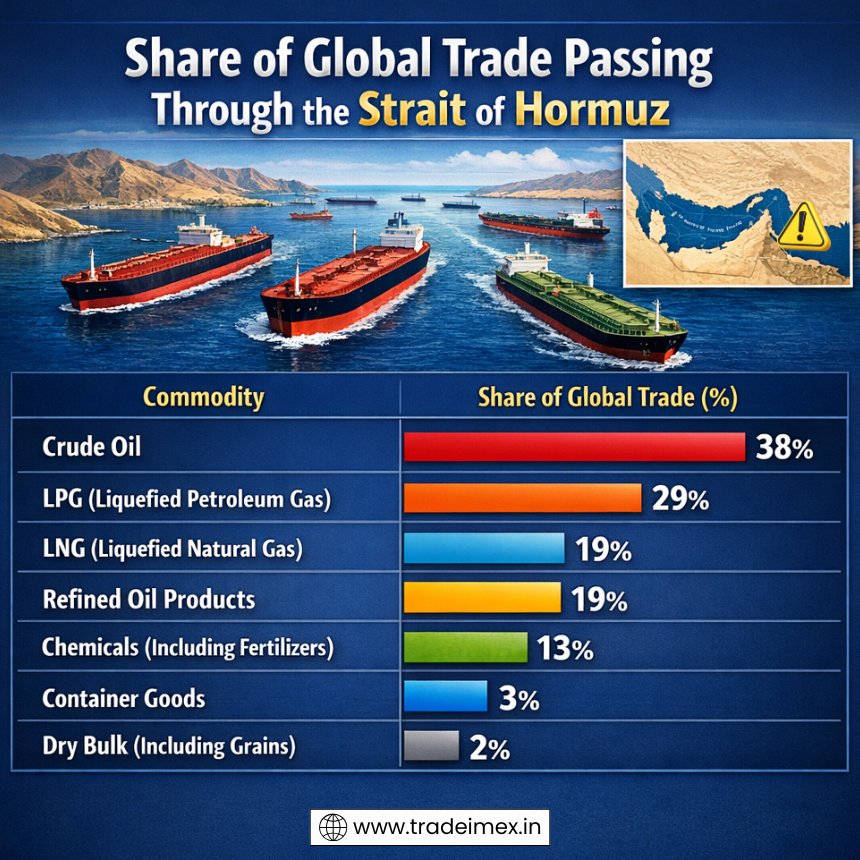
Key takeaway: Energy commodities dominate traffic through the strait, but essential goods like chemicals and fertilizers also depend heavily on this route. Even a small disruption can affect multiple sectors at once.
Fertilizer Import Dependence on the Persian Gulf Region
Some countries, especially developing & least developed ones, rely heavily on fertilizer imports that pass through the Strait of Hormuz, as per the Fertilizer import data by country. This creates a major vulnerability.
Share of Fertilizer Imports (by sea) originating from the Gulf (2025)
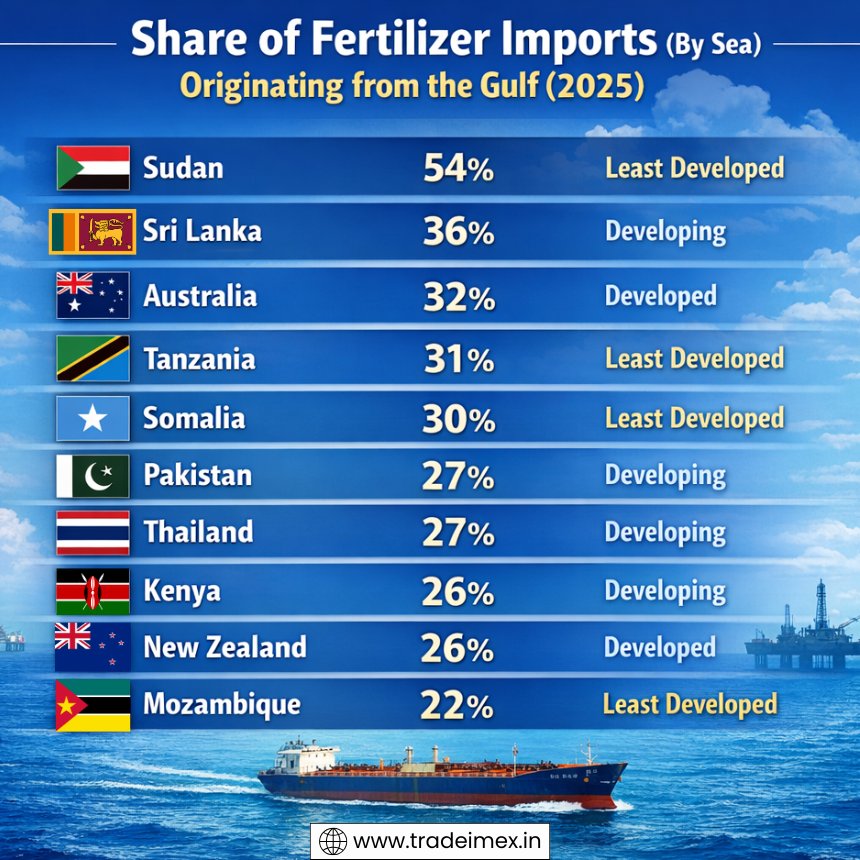
Key takeaway: Many lower-income countries depend heavily on this route for fertilizers. Any disruption can directly affect agriculture, food production, and food prices.
Rising Borrowing Costs After Escalation
Geopolitical tensions in the region have led to increased borrowing costs (bond yields) for several countries, reflecting higher financial risk.
Bond Yield Changes (1 Jan – 9 March 2026)
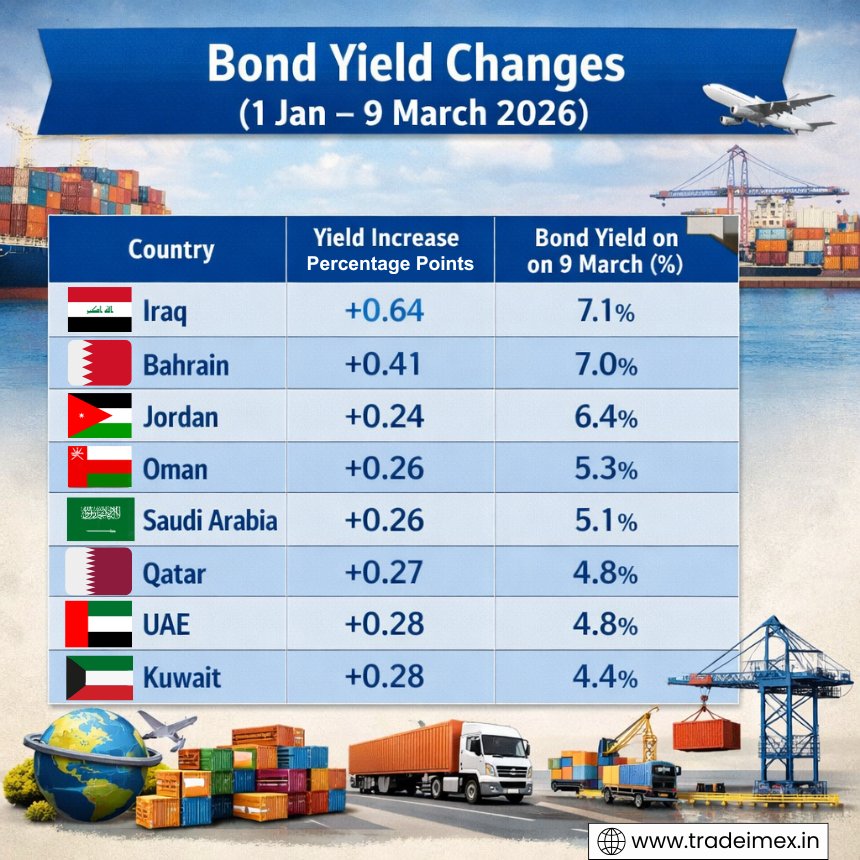
Key takeaway: Even before any long-term disruption, financial markets react quickly. Higher borrowing costs make it more expensive for governments to raise funds, adding pressure to already strained economies.
Overall Insight
Taken together, these visuals show three layers of impact:
-
Trade exposure: A large share of global energy and key goods flows through the Strait
-
Supply vulnerability: Many countries depend on it for essential imports like fertilizers
-
Financial pressure: Markets respond quickly, raising borrowing costs in affected regions
This combination makes disruptions in the Strait of Hormuz a global economic risk, not just a regional issue.
Shipping: The Hidden Multiplier
Energy is only the first layer. The shipment system amplifies the shock.
Insurance and Risk Premiums
During heightened tensions:
-
War-risk insurance premiums can rise 5–10 times
-
Some insurers withdraw coverage entirely
-
Shipowners refuse to enter high-risk zones
This leads to:
-
Fewer vessels are operating in the region
-
Higher trade rates globally
-
Longer transit times due to rerouting
Rerouting Constraints
Unlike other trade disruptions, Hormuz offers limited alternatives.
-
Pipelines (e.g., the Saudi East-West pipeline) can bypass some flows.
-
However, total alternative capacity is far below normal export volumes.
-
LNG has even fewer rerouting options.
Port Congestion and Delays
When ships reroute:
-
Nearby ports (e.g., in the UAE and Oman) face congestion.
-
Scheduling disruptions ripple across global shipping networks.
-
Container availability becomes uneven.
Key Insight: Shipping disruption acts as a force multiplier. Even goods not passing through Hormuz become more expensive due to global trade repricing.
Supply Chains: From Energy Shock to Industrial Disruption
Modern supply chains are tightly interconnected. A disruption in one node spreads quickly.
Industrial Dependencies
Key sectors affected include:
-
Automotive manufacturing
-
Electronics
-
Chemicals and plastics
-
Construction materials
These sectors depend on:
-
Energy inputs
-
Petrochemical derivatives
-
Timely shipping
Fertilizer and Food Systems
A less discussed but critical risk is fertilizer disruption.
-
Gulf countries export key fertilizer inputs
-
Reduced supply leads to higher global fertilizer prices
-
Farmers cut usage or pay more
Result:
-
Lower crop yields or higher production costs
-
Food price inflation within months
Just-in-Time Fragility
Many industries still operate on lean inventory models. This means:
-
Even short delays can halt production lines
-
Companies lack a buffer stock for prolonged disruptions
Key Insight: What begins as an energy disruption evolves into a multi-sector supply shock, affecting both production and consumption.
Regional Exposure: Why Asia Faces the Greatest Risk
Energy Dependence
Asia is the largest importer of Gulf energy, as per the Asia trade data.
-
India imports 85% of its crude oil
-
A large share comes via Hormuz
-
China, Japan, and South Korea face similar exposure
Economic Transmission Channels
For countries like India, the impact flows through:
-
Higher import bills
-
Currency depreciation pressure
-
Inflation (fuel + food)
-
Widening current account deficit
Policy Response Constraints
Governments can:
-
Use strategic reserves
-
Adjust fuel taxes
-
Subsidize key sectors
But these are temporary measures. Prolonged disruption strains fiscal balances.
Key Insight: Emerging economies face a dual shock: external vulnerability + limited policy space.
Financial Markets & Inflation: The Broader Economic Impact
Inflation Transmission
Energy price increases spread through:
-
Transportation costs
-
Manufacturing inputs
-
Food production
This creates cost-push inflation across economies.
Central Bank Dilemma
Central banks face a difficult trade-off:
-
Raise interest rates to control inflation
-
Or support growth amid slowing economic activity
Stagflation Risk
If disruption persists:
-
Growth slows due to supply constraints
-
Prices remain high due to energy and trade costs
This combination leads to stagflation, a scenario policymakers struggle to manage.
Market Volatility
-
Equity markets react negatively to uncertainty
-
Commodity markets become highly volatile
-
Safe-haven assets (gold, USD) strengthen
Key Insight
Hormuz disruptions are not just a trade issue. They become a macro-financial stability risk.
Duration Matters: Short Shock vs Structural Crisis
The severity of impact depends largely on how long disruptions last.
Short-Term Disruption (Weeks)
-
Price spikes in oil and shipping
-
Temporary supply chain delays
-
Limited long-term damage
Medium-Term Disruption (Months)
-
Sustained inflation
-
Industrial slowdown
-
Rising trade imbalances
Long-Term Disruption (6+ Months)
-
Production shutdowns in exporting countries
-
Structural shifts in supply chains
-
Global economic slowdown or recession
Production Feedback Loop
If exports remain blocked:
-
Storage fills up in producing countries
-
Oil and gas production is reduced
-
Global supply tightens further
Key Insight: Time transforms a trade disruption into a structural economic crisis.
Limited Alternatives and Strategic Constraints
Pipeline Capacity
Some Gulf countries have invested in bypass routes:
-
Saudi Arabia’s East-West pipeline
-
UAE’s Fujairah export route
However:
-
Combined capacity cannot replace Hormuz flows
-
Infrastructure constraints limit scalability
Strategic Reserves
Countries maintain emergency reserves:
-
Typically covers 30–90 days of consumption
But:
-
Not all countries have equal reserves
-
Replenishment becomes difficult during prolonged crises
Renewable Energy Buffer
While renewables reduce dependence:
-
They cannot replace oil and LNG in the short term
-
Industrial and transport sectors still rely heavily on fossil fuels
Key Insight: There is no immediate substitute for Hormuz. This makes disruptions uniquely dangerous.
Winners and Losers in a Disrupted Scenario
Potential Winners
-
Non-Gulf oil exporters (US, Brazil, Norway)
-
Shipping companies (higher import rates)
-
Commodity traders (price volatility opportunities)
Major Losers
-
Energy-importing countries
-
Manufacturing economies
-
Consumers who are facing higher prices
Sectoral Impact
Most affected sectors:
-
Aviation
-
Energy
-
Chemicals
-
Agriculture
Relatively resilient sectors:
-
Digital services
-
Domestic-focused industries
Key Insight: The disruption redistributes economic gains but reduces overall global efficiency.
Long-Term Implications for Global Trade
Supply Chain Diversification
Companies are likely to:
-
Reduce dependence on single routes
-
Build regional supply chains
-
Increase inventory buffers
Energy Security Investments
Governments may accelerate:
-
Strategic reserves
-
Alternative energy sources
-
Domestic production
Geopolitical Realignment
-
Trade routes gain strategic importance
-
Maritime security becomes a priority
-
Alliances may shift around energy access
Structural Shift
Over time, repeated disruptions could:
-
Reduce the globalization efficiency
-
Increase regionalization
-
Raise baseline costs of trade
Key Insight: Hormuz disruptions may accelerate an already ongoing shift toward a less centralized global trade system.
Major Implications and Considerations
-
Disruptions in the Strait of Hormuz show how vulnerable global trade is to geopolitical tensions, especially at critical maritime chokepoints.
-
Shocks in this region can spread quickly across global supply chains and commodity markets.
-
Reducing risks requires de-escalation and better protection of maritime systems, including ships, ports, seafarers, and civilian infrastructure.
-
It is also important to keep trade routes open and secure, in line with international law and freedom of navigation.
-
The overall economic impact will depend on how long the tensions last, how severe they are, and how widely they spread.
-
Continuous monitoring is needed to track risks and respond effectively.
-
Developing economies are particularly vulnerable due to high debt levels, limited fiscal space, and restricted access to finance.
-
Rising energy, transport, and food costs can strain government budgets and household incomes.
-
This can increase economic and social pressures and slow progress toward sustainable development, especially in countries dependent on imported energy, fertilizers, and staple foods.
Final Takeaway
The Strait of Hormuz disruptions are a clear reminder of how interconnected the global economy is.
A single chokepoint can influence:
-
Energy prices
-
Food security
-
Inflation
-
Economic stability
And the countries with the least resources are often the most affected. In short, what happens in one narrow stretch of water can reshape the global economy within days.
Conclusion and Final Verdict
In conclusion, the Strait of Hormuz is more than a narrow waterway. It is a central node in the global economic system. Disruptions in 2026 highlight a critical reality: global trade remains highly vulnerable to geographic chokepoints. The immediate impact is visible in energy prices. The deeper impact unfolds across shipping, supply chains, inflation, and economic growth. The most important variable is duration. Short disruptions create volatility. Prolonged disruptions create structural damage. For policymakers and businesses, the lesson is clear: resilience, diversification, & strategic planning are no longer optional. They are essential.
Want to access the latest global trade data or search live import-export data by country, product, or HS code? Visit TradeImeX and get access to the latest trade statistics and market intelligence. Contact us at info@tradeimex.in to get customized trade reports & market insights.
Also Read:
Top 10 Trade-Affected Countries Due to the US-Iran War
Vietnam’s Trade & Currency Under Pressure as Strait of Hormuz Crisis
Share
What's Your Reaction?
 Like
0
Like
0
 Dislike
0
Dislike
0
 Love
0
Love
0
 Funny
0
Funny
0
 Angry
0
Angry
0
 Sad
0
Sad
0
 Wow
0
Wow
0