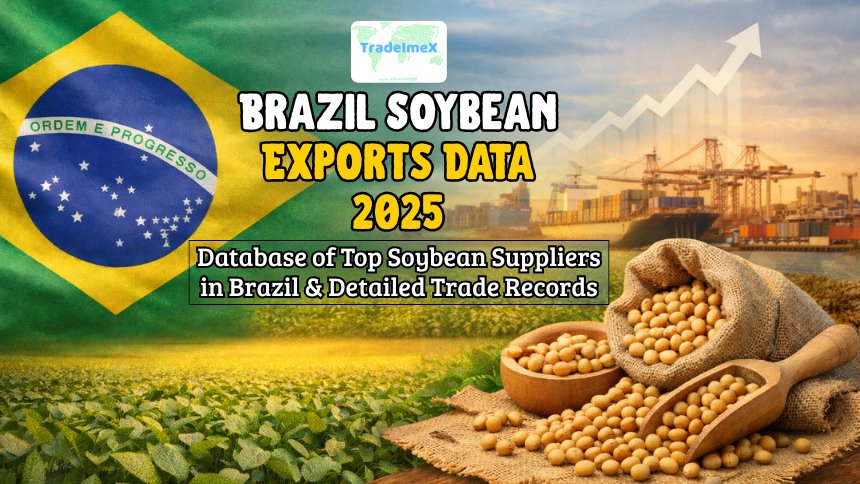
Brazil Soybean Exports Data 2025: Database of Top Soybean Suppliers in Brazil & Detailed Trade Records
Access Brazil Soybean Exports Data 2025, featuring a comprehensive database of top soybean suppliers in Brazil, detailed shipment records, export volumes, HS codes, & global trade insights for market analysis and lead generation.

Record Export Growth and Global Leadership
Brazil remains the backbone of the global soybean trade in 2025. With record-breaking production, expanding export infrastructure, and dominant market share in Asia, the country has strengthened its position as the world’s largest soybean exporter. In 2025, Brazil strengthened its position as the world’s leading soybean exporter, setting new shipment records and solidifying its role as the primary source of soybeans for global markets, especially China, which remains the dominant buyer. According to the latest Brazil export data and Soybean export data of Brazil, the total value of Brazil soybean exports reached $43.53 billion in 2025, a 1% increase from the previous year. Brazil exported a total of 108.81 million tons of soybeans in 2025.
According to Brazilian maritime and trade agencies:
-
Brazil exported a record 108.68 million tons of soybeans in 2025, surpassing previous annual totals and growing approximately 11.7 % versus 2024.
-
Exported soybean by-products, such as soybean meal, also reached historical highs, with over 23 million tons shipped in 2025.
-
Export volumes to China accounted for the largest share, with roughly 65 % of Brazilian soybeans destined for Chinese importers in the 2025 calendar year.
Brazil is the largest soybean exporter in the world, according to the global trade data. Global demand dynamics, including tariff shifts and reduced U.S. soybean participation in China’s market, helped Brazil capture an outsized share of global trade flows. This report provides a deeper, data-driven breakdown of soybeans classified under HS code 1201:
-
Brazil’s soybean production statistics (2025/26 season)
-
Export volumes, values, and price trends
-
State-wise production analysis
-
Port-wise shipment distribution
-
Detailed trade flow data by destination
-
Database of top soybean suppliers and exporters
-
HS code structure and trade record insights
-
Market outlook for 2026
Brazil Soybean Export Data 2025
Brazil exported approximately 108–112 million metric tons of soybeans in 2025, making it the largest soybean exporter globally.
According to Brazil’s Ministério da Agricultura e Pecuária:
Export Volume Overview (2025)
-
Total Soybean Exports: Around 109 MMT
-
Total Export Value: USD 43.5 Billion
-
Average FOB Price: USD 520–560 per metric ton
-
Peak Export Month: March 2025 (15 MMT)
Monthly Export Trend 2025
Brazil’s exports are highly seasonal:
-
January–April: Peak export window (post-harvest)
-
May–August: Strong shipments continue
-
September–December: Slower but steady exports
March and April together typically account for nearly 25–30% of annual exports.
Brazil Soybean Exports by Country: Where Does Brazil Export Soybeans?
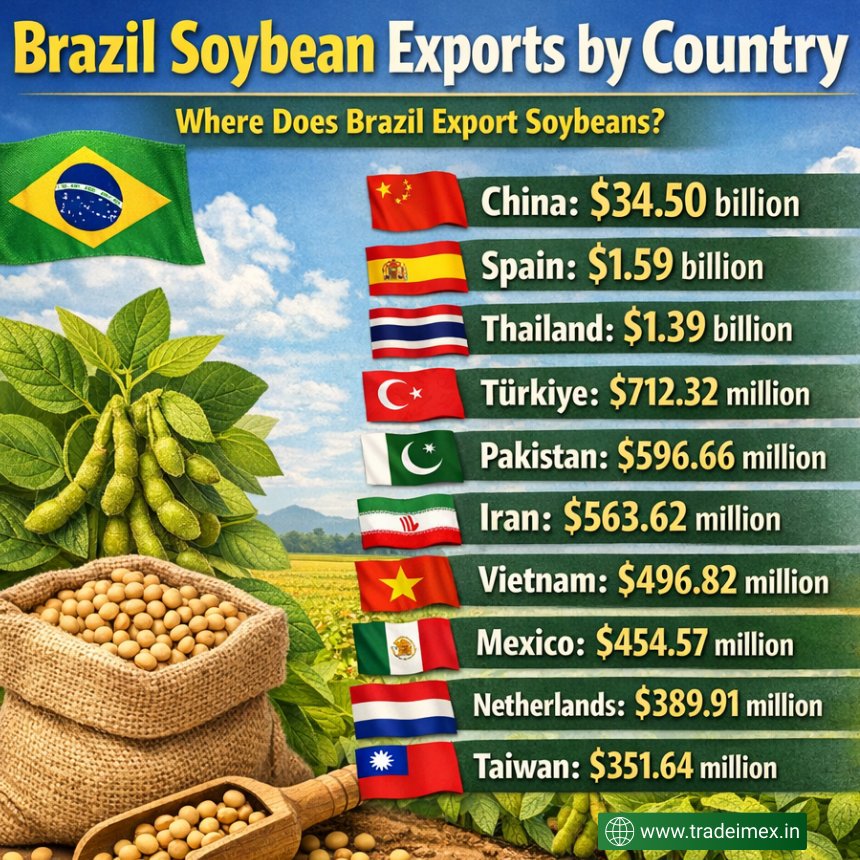
Brazil is a significant player in the global soybean market, with the country being one of the largest exporters of soybeans worldwide. Brazil exports soybeans to a variety of countries, with China being the top destination for Brazilian soybean exports. Brazil's agriculture industry plays a crucial role in supplying soybeans to meet the growing demands of countries around the world, establishing its position as a key player in the international soybean trade market. The top 10 export destinations for Brazilian soybeans, as per the Brazil shipment data for 2025, include:
1. China: $34.50 billion (79.3%)
China is the largest importer of Brazilian soybeans, accounting for a significant portion of around 80% of Brazil's soybean exports, as per the data on Brazil soybean exports to China by HS code. The demand for soybeans in China is driven by the country's growing population and its increasing use of soybeans in livestock feed and cooking oil. Brazil's proximity to China & its large-scale soybean production make it an ideal supplier for the Chinese market.
2. Spain: $1.59 billion (3.7%)
Spain is another important destination for Brazil's soybean exports, with a substantial share of Brazil's soybean shipments heading to this European country. Spain's demand for soybeans is driven by its food processing industry, which uses soybeans as a key ingredient in various food products. The close trade relations between Brazil and Spain also contribute to the significant volume of soybeans exported from Brazil to Spain.
3. Thailand: $1.39 billion (3.2%)
Thailand is a major importer of Brazilian soybeans, with a significant portion of Brazil's soybean exports finding their way to this Southeast Asian country. The demand for soybeans in Thailand is driven by the country's flourishing food and feed industries, which rely on soybeans as a key ingredient. Brazil's competitive pricing and high-quality soybeans make it a preferred supplier for the Thai market.
4. Türkiye: $712.32 million (1.6%)
Turkey is an emerging market for Brazilian soybean exports, with a growing share of Brazil's soybean shipments going to this Middle Eastern country. The demand for soybeans in Turkey is driven by its expanding livestock industry, which uses soybeans as a primary source of protein in animal feed. Brazil's strategic location and efficient export infrastructure make it a reliable source of soybeans for the Turkish market.
5. Pakistan: $596.66 million (1.4%)
This country is a key destination for Brazilian soybean exports, with a significant portion of Brazil's soybean exports being shipped to this South Asian country. The demand for soybeans in this nation is driven by the country's growing food processing industry, which relies on soybeans for the production of edible oil and food products. Brazil's reputation for high-quality soybeans and efficient supply chain management makes it a preferred supplier for the market.
6. Iran: $563.62 million (1.3%)
Iran is a significant importer of Brazilian soybeans, with a notable share of Brazil's soybean exports heading to this Middle Eastern country. The demand for soybeans in Iran is driven by the country's food processing industry, which uses soybeans in the production of cooking oil and food products. Brazil's competitive pricing and reliable supply make it a key supplier for the Iranian market.
7. Vietnam: $496.82 million (1.1%)
Vietnam is an important market for Brazilian soybean exports, with a growing share of Brazil's soybean shipments going to this Southeast Asian country, as per the data on Brazil soybean exports to Vietnam. The demand for soybeans in Vietnam is driven by its food processing industry, which uses soybeans in the production of cooking oil and food products. Brazil's efficient export infrastructure and commitment to quality make it a preferred supplier for the Vietnamese market.
8. Mexico: $454.57 million (1%)
Mexico is a key destination for Brazilian soybean exports, with a significant portion of Brazil's soybean exports being shipped to this North American country. The demand for soybeans in Mexico is driven by its food processing industry, which relies on soybeans for the production of cooking oil and food products. Brazil's competitive pricing and proximity to Mexico make it a primary source of soybeans for the Mexican market.
9. Netherlands: $389.91 million (0.9%)
The Netherlands is a significant importer of Brazilian soybeans, with a notable share of Brazil's soybean shipments finding their way to this European country. The demand for soybeans in the Netherlands is driven by its food processing industry, which uses soybeans in the production of cooking oil and food products. Brazil's commitment to sustainable farming practices and traceability in soybean production makes it a preferred supplier for the Dutch market.
10. Taiwan: $351.64 million (0.8%)
Taiwan is an emerging market for Brazilian soybean exports, with a growing share of Brazil's soybean exports being shipped to this Asian country. The demand for soybeans in Taiwan is driven by its food processing industry, which uses soybeans in the production of cooking oil and food products. Brazil's reputation for high-quality soybeans and reliable export services makes it a key supplier for the Taiwanese market.
Database of Top Soybean Suppliers in Brazil: Brazil Soybean Exporters Shipments Records
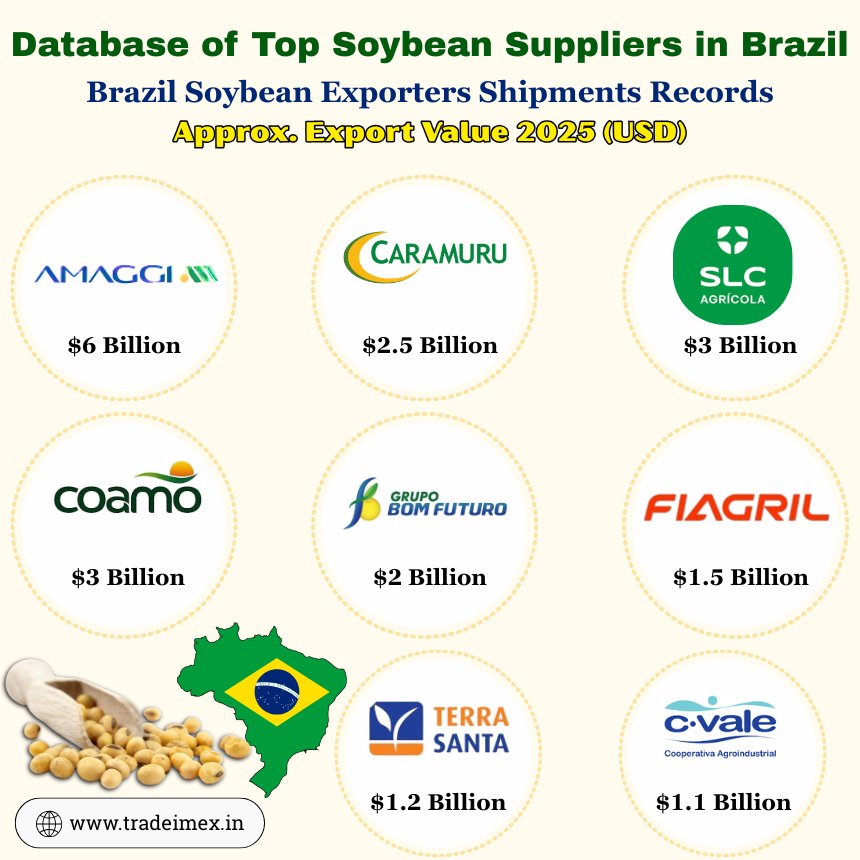
When it comes to major soybean exporting companies and supplier networks in Brazil, a combination of agribusiness giants and integrated commodity traders dominate shipments. Here’s a snapshot of key Brazilian soybean suppliers based on trade data and export activity, as per the Brazil soybean exporters & suppliers database for 2025:
|
Rank |
Company |
Approx. Export Value 2025 (USD) |
Top Export Types |
Top Export Destination |
|
1 |
Amaggi |
$6 Billion |
Raw Soybeans, Non-GMO Soy |
China |
|
2 |
Caramuru Alimentos |
$2.5 Billion |
Soybean Meal, Soybean Oil |
EU, Middle East |
|
3 |
SLC Agrícola |
$3 Billion |
Identity-Preserved Soybeans |
China, Europe |
|
4 |
Coamo Agroindustrial Cooperativa |
$3 Billion |
Soybeans, Soymeal |
China, Asia |
|
5 |
Grupo Bom Futuro |
$2 Billion |
Raw Soybeans |
China |
|
6 |
Fiagril |
$1.5 Billion |
Soybeans |
China |
|
7 |
Terra Santa Agro |
$1.2 Billion |
Soybeans |
Asia |
|
8 |
C.Vale Cooperativa Agroindustrial |
$1.1 Billion |
Soybeans, Soymeal |
China |
|
9 |
Agrícola Alvorada |
$1 Billion |
Soybeans |
China |
|
10 |
Imcopa |
$1 Billion |
Soy Protein, Soybean Oil |
Europe |
Key Observations (Brazilian Players – 2025)
-
Amaggi remains the largest Brazilian-controlled soybean exporter, with vertically integrated farming and port terminals.
-
Cooperatives like Coamo and C.Vale play a major role in aggregating soybean output from member farmers.
-
Processors such as Caramuru and Imcopa focus more on value-added exports (meal, oil, soy protein).
-
Most Brazilian exporters remain highly dependent on China, though EU markets are increasingly important for certified and traceable soy.
Additional Insights on 2025 Export Structure
1. Market Concentration
The top four global trading houses & soybean exporting companies of Brazil together account for approximately 45–55% of Brazil’s soybean export value.
2. Export Product Breakdown (Industry-wide)
-
Raw Soybeans (HS 1201): 75% of total export value
-
Soybean Meal (HS 2304): 18–20%
-
Soybean Oil (HS 1507): 5–7%
3. Destination Concentration
-
China: 65% of Brazil’s soybean exports
-
European Union: 15%
-
Southeast Asia: 10%
-
Others: 10%
Brazil Soybean Exports in the Last 10 Years: Historical Brazil Soybean Export Data
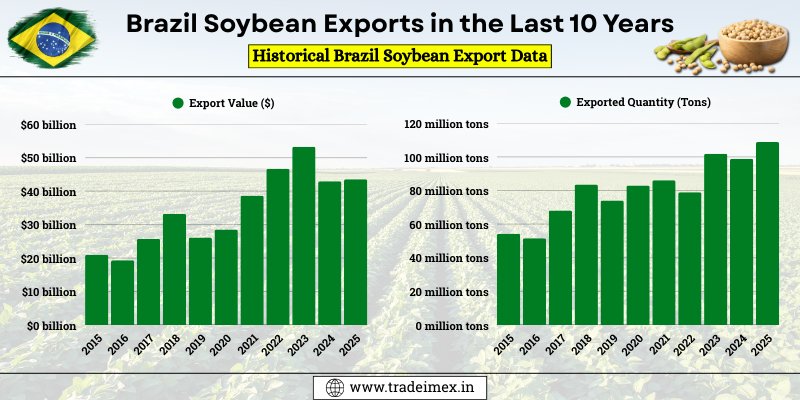
|
Year of Exports |
Export Value ($) |
Exported Quantity (Tons) |
|
2015 |
$20.98 billion |
54.32 million tons |
|
2016 |
$19.33 billion |
51.58 million tons |
|
2017 |
$25.71 billion |
68.15 million tons |
|
2018 |
$33.19 billion |
83.60 million tons |
|
2019 |
$26.11 billion |
74.03 million tons |
|
2020 |
$28.56 billion |
82.97 million tons |
|
2021 |
$38.63 billion |
86.10 million tons |
|
2022 |
$46.66 billion |
78.93 million tons |
|
2023 |
$53.24 billion |
101.86 million tons |
|
2024 |
$42.94 billion |
98.81 million tons |
|
2025 |
$43.53 billion |
108.81 million tons |
Brazil Soybean Production Data 2025
Crop Size and Output Drivers
Brazil’s soybean production growth in 2025 mirrored its export performance. Key production figures include:
-
2025/26 crop projections indicated Brazilian soybean output could reach 173–177 million tons, above the previous season’s totals, supported by expanded planted area and favorable yields.
-
Some industry analysts even forecast a potential 180 million ton production for the 2025/26 cycle, depending on weather and planting progress.
-
USDA estimates suggest Brazil accounts for roughly 40 % of global soybean production, far ahead of competitors like the United States (around 119 million tons) and Argentina (around 51 million tons).
This dominant production base allows Brazil not just to satisfy its own internal demand for animal feed and processing but also to export agricultural surpluses worldwide.
Brazil’s soybean production continues to set global benchmarks. According to estimates from the United States Department of Agriculture (USDA) and Brazil’s Companhia Nacional de Abastecimento (CONAB):
2025/26 Production Overview
-
Total Production: 172–178 million metric tons
-
Harvested Area: 46–47 million hectares
-
Average Yield: 3.7–3.9 metric tons per hectare
-
Share of Global Production: 40–41%
Brazil now produces nearly 1 out of every 2 soybeans traded globally.
Year-on-Year Growth
|
Season |
Production (MMT) |
Growth % |
|
2022/23 |
156 MMT |
— |
|
2023/24 |
163 MMT |
+4.5% |
|
2024/25 |
169 MMT |
+3.6% |
|
2025/26 |
175 MMT (est.) |
+3.5% |
Growth drivers in 2025:
-
Expansion of farmland in Mato Grosso and MATOPIBA region
-
Higher adoption of biotech seeds
-
Improved rainfall distribution
-
Better storage and export planning
State-Wise Soybean Production in Brazil (2025)
Brazil’s soybean output is geographically concentrated. Top Producing States Include:
|
Rank |
State |
Production (MMT) |
Share |
|
1 |
Mato Grosso |
47–49 MMT |
28% |
|
2 |
Paraná |
22–24 MMT |
13% |
|
3 |
Rio Grande do Sul |
20–22 MMT |
12% |
|
4 |
Goiás |
16–17 MMT |
9% |
|
5 |
Mato Grosso do Sul |
14–15 MMT |
8% |
Mato Grosso alone produces more soybeans than many entire countries.
The MATOPIBA agricultural frontier (Maranhão, Tocantins, Piauí, Bahia) continues expanding acreage at 4–6% annually.
Export Volumes and Monthly Trade Data
Looking closer at 2025 shipments:
-
In July 2025 alone, 12.3 million tons were exported, representing a 9 increase over July 2024, driven by strong shipments to China.
-
In March 2025, monthly shipments reached 14.6 million tons, the highest level in nearly a year, driven by peak harvest activity.
-
Exports through November 2025 already surpassed entire annual totals from earlier years, with 104.79 million tons by November alone.
These data imply a sustained export tempo across most of 2025, not limited to isolated months.
Brazil Soybean Export Value and Agribusiness Impact
The value of Brazil’s agricultural exports in 2025 was significant, with soybeans contributing a large share:
-
Brazil’s agribusiness exports totaled approx US$169.2 billion in 2025, with soybeans as one of the main value drivers.
-
The export value from raw soy and soy derivatives, especially soymeal, cushioned Brazil’s trade surplus and contributed meaningfully to its overall export revenues.
Despite some downward pressures on prices due to high supply levels, the volume gains helped offset price declines and boosted total export revenues.
Prices, Market Dynamics & Trends
Price Trends in 2025
Even as volumes climbed:
-
Average soybean export prices softened due to an abundant global supply.
-
Conversely, soybean oil and meal prices showed differing trends, driven by demand from biodiesel and feed sectors.
Supply Chain and Crushing Capacity
Brazil expanded crushing capacity, enhancing its ability to process soybeans domestically and feed export markets with soymeal and oil, commodities increasingly shipped abroad.
Trade Shifts and Competitive Dynamics
Trade tensions, particularly between the U.S. and China, inadvertently benefited Brazilian soybean exports, as China shifted more purchases toward Brazil, often taking volumes that U.S. suppliers did not compete for.
Challenges & Sustainability Considerations
While 2025 was strong in trade metrics, the soybean sector faces challenges:
-
Seed piracy and intellectual property issues create industry losses and impact innovation incentives.
-
Deforestation concerns linger, with pressures around land use and environmental regulation.
-
Export diversification and infrastructure bottlenecks remain areas for ongoing improvement.
Conclusion: Brazil’s Soybean Export Dominance in 2025
In conclusion, Brazil’s export performance in 2025 underscores its critical role in global soybean markets, not only in sheer volume but also in shaping trade flows, price trends, and agribusiness strategies.
Key takeaways include:
-
Record exports (108.8 mt) — confirming Brazil’s leadership in soybean shipments.
-
Strong production base (173–180 mt) — enabling sustained export growth.
-
China as dominant destination — absorbing a majority of Brazil’s soy exports.
-
Diversified supplier landscape — with major agribusiness firms driving international trade.
-
Strategic export value contribution — soybeans remain central to Brazil’s trade surplus and agribusiness economy.
As Brazil enters the 2026 crop cycle, production and market signals suggest continued prominence in soy exports, even amid evolving global trade conditions.
Note For Our Readers
We hope that you liked our insightful blog report on Brazil’s soybean export data 2025. Want deeper insights into Brazil soybean exports by country or access the latest Brazil import-export shipment data? Visit TradeImeX today and reach out to us at info@tradeimex.in to turn real trade data into real business opportunities with our customized trade database reports.
Share
What's Your Reaction?
 Like
0
Like
0
 Dislike
0
Dislike
0
 Love
0
Love
0
 Funny
0
Funny
0
 Angry
0
Angry
0
 Sad
0
Sad
0
 Wow
0
Wow
0