Everything About Mongolia’s Major Exports in 2025: Key Products, Countries & Growth Trends
Explore Mongolia's major exports in 2025, including top export destinations, market trends, & trade data. Get the latest Mongolia export data insights.
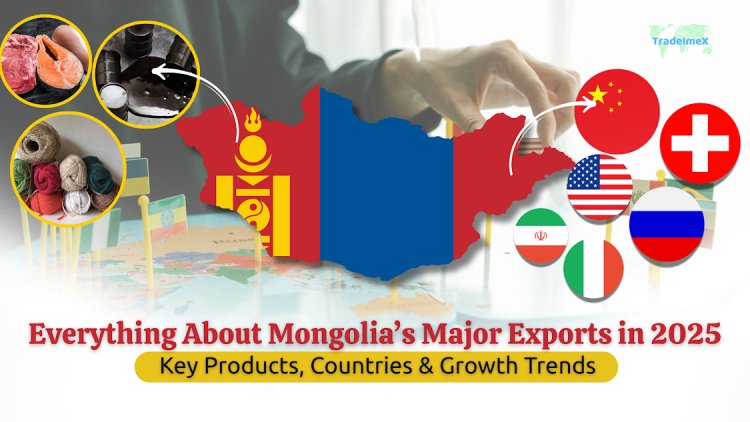
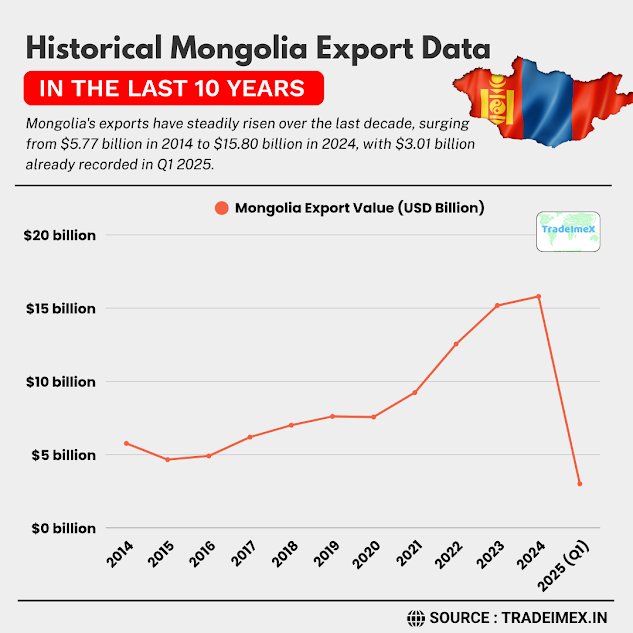
In recent years, Mongolia has emerged as a key player in the global export market. With its strategic location, rich natural resources, and growing economy, the country has seen a significant increase in the export of various products to countries around the world. According to Mongolia export data and Mongolia customs data, the total value of Mongolian exports reached $15.8 billion in 2024, a 4% increase from the previous year. As per the Mongolia export trade data, in the first quarter of 2025, Mongolia exports accounted for $3.01 billion.
Based on the records from global trade data, Mongolia is the 85th biggest exporter in the world. Mongolia is the 24th biggest exporter of goods in Asia, as per the Asia trade data. In this article, we will explore everything you need to know about Mongolia's exports in 2025, including key products, top export destinations, and growth trends.
Key Export Product Categories of Mongolia
Mongolia's export sector is diverse, encompassing a wide range of products that cater to different industries and markets. Some of the key export products from Mongolia include:
- Minerals: Mongolia is known for its vast mineral reserves, including coal, copper, gold, and uranium. These minerals are major contributors to the country's export revenue, with mining companies playing a crucial role in driving economic growth.
- Cashmere: Mongolia is a leading producer of high-quality cashmere, prized for its softness and warmth. The country's cashmere industry has flourished in recent years, with exports of cashmere products increasing steadily.
- Livestock: Mongolia is home to a large population of livestock, including sheep, goats, and horses. Livestock products such as meat, wool, and dairy are important export commodities for the country, catering to both domestic and international markets.
- Textiles: Mongolia's textile industry has been growing steadily, with a focus on producing high-quality garments and fabrics. Textile exports from Mongolia have gained popularity in international markets, contributing to the country's export earnings.
List of Top 10 Mongolian Export Products: Mongolia Exports by HS Code
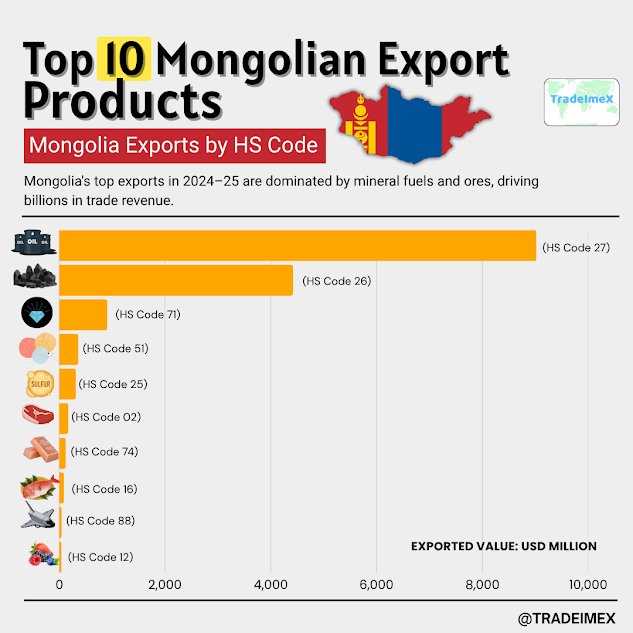
The List of Top 10 Mongolian Export Products, categorized by HS Code, provides valuable insights into Mongolia's key export commodities. These exports play a crucial role in shaping Mongolia's trade landscape and economic stability. These exports consist of a diverse range of commodities, including ores, cashmere, animal or vegetable fats, hides, and precious stones. The top 10 exports of Mongolia, as per Mongolia export statistics and Mongolia export data by HS code, in 2024-25, include:
- Mineral fuels and oils (HS Code 27): $9.02 billion
Mineral fuels and oils are the top export product of Mongolia, bringing in an impressive $9.02 billion in revenue. The country is rich in natural resources, making it a major player in the global energy market.
- Ores, slag, and ash (HS Code 26): $4.42 billion
Ores, slag, and ash are other significant export products for Mongolia, generating $4.42 billion in revenue. Mongolia is known for its abundant mineral reserves, including coal, copper, and gold, which are in high demand worldwide.
- Precious stones and metals (HS Code 71): $912.49 million
Mongolia is also a key exporter of precious stones and metals, bringing in $912.49 million in revenue. The country is renowned for its deposits of rare gemstones such as turquoise and amethyst, as well as precious metals like gold and silver.
- Wool (HS Code 51): $363.58 million
Wool is a traditional export product for Mongolia, generating $363.58 million in revenue. The country is home to a large population of sheep, whose wool is prized for its quality and warmth.
- Salt, sulfur, lime, and cement (HS Code 25): $318.81 million
Salt, sulfur, lime, and cement are essential export products for Mongolia, bringing in $318.81 million in revenue. These products are widely used in various industries, including construction and agriculture.
- Meat and edible meat offal (HS Code 02): $174.98 million
Mongolia is also a significant exporter of meat and edible meat offal, generating $174.98 million in revenue. The country's vast grasslands provide ample grazing opportunities for livestock, making it an ideal location for meat production.
- Copper and articles thereof (HS Code 74): $127.65 million
Copper and articles thereof are important export products for Mongolia, bringing in $127.65 million in revenue. The country is rich in copper deposits, which are in high demand for various industrial applications.
- Preparations of meat and fish (HS Code 16): $93.56 million
Preparations of meat and fish are another key export product for Mongolia, generating $93.56 million in revenue. These products include processed meats, canned fish, and other value-added products that cater to international markets.
- Aircraft, spacecraft, and parts thereof (HS Code 88): $51.27 million
Aircraft, spacecraft, and parts thereof are niche export products for Mongolia, bringing in $51.27 million in revenue. The country's aerospace industry is steadily growing, with a focus on manufacturing and exporting aircraft components.
- Oil seeds and oleaginous fruits (HS Code 12): $45.23 million
Oil seeds and oleaginous fruits round out the list of top 10 Mongolian export products, generating $45.23 million in revenue. These products are essential for the production of vegetable oils, which are used in cooking, cosmetics, and other industries.
Top 10 Mongolia Trade Partners: Major Export Partners of Mongolia
As a key player in the global market, Mongolia has established significant trade partnerships that play a crucial role in its export sector, as indicated by Mongolia's exports by country. The top 10 trade partners of Mongolia, also known as the major export partners, consist of countries like China, the Russian Federation, the United States, Japan, and South Korea, among others.
The continuous collaboration and trade exchanges with these countries underline Mongolia's position as a valuable player in the global trade landscape. The top 10 Mongolia export partners, as per the data on Mongolia exports by country and Mongolia shipment data for 2024-25, include:
- China: $14.40 billion (91.4%)
China has been Mongolia's largest trade partner for many years, dominating the Mongolian export market. With a trade volume of $14.40 billion, China accounts for a whopping 91.4% of Mongolia's total exports. Mongolia mainly exports minerals, livestock, and cashmere to China, making it a crucial partner for Mongolia's economy.
- Switzerland: $744.97 million (4.7%)
Switzerland holds the second position as Mongolia's major export partner, with a trade value of $744.97 million. Mongolia mainly exports precious metals and minerals to Switzerland. The trade relationship between Mongolia and Switzerland has been steadily growing, contributing significantly to Mongolia's export revenue.
- USA: $166.39 million (1.1%)
The United States is another important trade partner for Mongolia, with a trade volume of $166.39 million. Mongolia exports mainly textiles, minerals, and animal products to the USA. Despite being relatively smaller compared to China and Switzerland, the trade partnership with the USA plays a vital role in diversifying Mongolia's export market.
- Russia: $82.32 million (0.5%)
Russia has been a traditional trade partner of Mongolia, with a trade value of $82.32 million. Mongolia exports minerals, textiles, and livestock to Russia, as per the data on Russia imports from Mongolia by HS code. The trade relationship with Russia not only contributes to Mongolia's export revenue but also plays a significant role in maintaining a strong political and economic partnership between the two countries.
- Iran: $80 million (0.5%)
Iran is another emerging trade partner for Mongolia, with a trade volume of $80 million. Mongolia exports mainly minerals, textiles, and livestock to Iran. The trade relationship with Iran provides opportunities for Mongolia to diversify its export market and strengthen economic ties with the Middle East region.
- Italy: $59.63 million (0.4%)
Italy holds a significant position as one of Mongolia's major export partners, with a trade value of $59.63 million. Mongolia mainly exports textiles, minerals, and livestock to Italy. The trade partnership with Italy contributes to Mongolia's export revenue and opens up new opportunities for collaboration in various sectors.
- South Korea: $52.56 million (0.3%)
South Korea is an important trade partner for Mongolia, with a trade volume of $52.56 million. Mongolia exports mainly textiles, minerals, and animal products to South Korea. The trade relationship with South Korea helps Mongolia to tap into the East Asian market and strengthen economic cooperation with one of the leading economies in the region.
- Niger: $34.03 million (0.2%)
Niger is a relatively smaller but significant trade partner for Mongolia, with a trade value of $34.03 million. Mongolia mainly exports minerals, textiles, and livestock to Niger. The trade partnership with Niger provides opportunities for Mongolia to expand its export market and foster economic ties with countries in Africa.
- France: $20.34 million (0.1%)
France holds a minor position as one of Mongolia's export partners, with a trade volume of $20.34 million. Mongolia mainly exports textiles, minerals, and animal products to France, as per the data on France imports from Mongolia. The trade relationship with France contributes to Mongolia's export revenue and strengthens diplomatic relations between the two countries.
- Hong Kong: $14.30 million (0.1%)
Hong Kong is another minor trade partner for Mongolia, with a trade value of $14.30 million. Mongolia exports mainly minerals, textiles, and livestock to Hong Kong. The trade partnership with Hong Kong provides access to the global market and opportunities for Mongolia to diversify its export destinations.
Mongolia Exports to 61 Countries in the First 4 Months of 2025
The General Department of Customs of Mongolia reports that in the first four months of 2025, Mongolia exported commodities to 61 nations. China received 91.2% of total exports, with Switzerland receiving 5.6%, the United States receiving 1.1%, and Russia receiving 0.5%. A total of 98.3% of Mongolia's exports came from these four nations. In comparison to the same period in 2024, the overall value of exported goods and raw materials was $4.242 billion, a 14.1% reduction. According to the World Bank's most recent Mongolia Economic Update, a rise in copper production and a slow rebound in the agricultural sector would help the nation's GDP expand by 6.3% in 2025.
Mongolia Exports in the Last 10 Years: Historical Mongolia Export Data
|
Year of Exports |
Mongolia Export Value ($) |
|
2014 |
$5.77 billion |
|
2015 |
$4.66 billion |
|
2016 |
$4.91 billion |
|
2017 |
$6.20 billion |
|
2018 |
$7.01 billion |
|
2019 |
$7.61 billion |
|
2020 |
$7.57 billion |
|
2021 |
$9.24 billion |
|
2022 |
$12.55 billion |
|
2023 |
$15.18 billion |
|
2024 |
$15.80 billion |
|
2025 quarter 1 |
$3.01 billion |
Mongolia Export Trends & 2025 Outlook
- Coal: expected +10–15% growth driven by rail link and rising Chinese demand
- Copper: Oyu Tolgoi expansion increased concentrate exports by 15–20%
- Gold, iron ore: steady with global price resilience
- Value‑added exports (cashmere, meat, fruit, nuts): slow but growing via trade agreements (EU, Japan, U.S.)
Mongolia’s Trade Agreements & Policy Environment
- WTO (since 1997): MFN tariffs, liberal trade framework.
- Japan–Mongolia EPA (2016): Preferential tariffs on 5,700 Mongolian goods; low utilization (~24.6% in 2022).
- Asia–Pacific Trade Agreement (2021): Tariff reductions with China, South Korea, India, and Sri Lanka.
- EU GSP+: Tariff-free access for ~7,200 products (e.g., cashmere, leather, food).
- EAEU‑Mongolia FTA: Under negotiation; could ease exports to Russia‐led markets.
Mongolia Tariffs Snapshot
- Mongolia’s applied average MFN tariff: ~5%, max up to 40%.
- Most imports are low-tariff or duty-free; only ~4% of tariff lines are duty-free.
- U.S. tariffs on Mongolia: None specific—but as part of the broader "reciprocal tariff" policy from April 2025, the U.S. exempted “certain minerals” (copper, gold, energy).
Insights for Buyers & Suppliers
For Buyers:
- Coal & copper: prioritize long-term contracts; logistics via rail ensure reliability
- Gold: Swiss channels remain optimal; ESG and traceability certifications will add value
- Cashmere/textiles: U.S. duty-free potential (pending), EU GSP viable—focus on quality compliance
For Suppliers:
- Expand value‑adding: process gold/cashmere domestically to increase margins
- Improve quality standards: meat, fruit, and nuts must meet EU/Japan regulations for market access
- Planning: leverage new rail routes to China; explore the EAEU corridor into Russia
- Monitor U.S. legislation: Third Neighbor Act may open lucrative niche markets
Risks & Considerations
- China-U.S. trade tension: slower Chinese GDP, possible drop in raw‑materials demand and prices.
- Low usage of EPAs: current utilization of Japan/EU agreements remains under 30%; requires supplier outreach.
- Infrastructure gaps: Despite progress, logistical and processing capacity limitations persist.
Mongolia Export Growth Trends
The export sector in Mongolia is poised for continued growth in the coming years, driven by several key trends:
- Diversification: Mongolia is keen on diversifying its export base beyond traditional commodities like minerals and livestock. The country is exploring new markets and industries to expand its export portfolio, focusing on value-added products and services.
- E-commerce: The rise of e-commerce has opened up new opportunities for Mongolian exporters to reach global markets. Online platforms and digital marketing strategies are increasingly being used to promote Mongolian products and attract international buyers.
- Sustainable Practices: With a growing emphasis on sustainability and ethical production, Mongolia is adopting environmentally friendly practices in its export industry. This includes responsible mining, fair trade agreements, and eco-friendly manufacturing processes.
- Infrastructure Development: Mongolia is investing in improving its infrastructure, including transportation networks and trade facilities, to facilitate smoother export processes.
Conclusion and Final Words
In conclusion, Mongolia's export sector is on a trajectory of growth and diversification, with a focus on key products, expanding market reach, and sustainable practices. By tapping into emerging trends and leveraging its competitive advantages, Mongolia is well-positioned to further enhance its presence in the global export market in 2025 and beyond.
We hope that you liked our insightful and interactive blog report on Mongolia export data and export trends in 2025. Visit TradeImeX to access the latest Mongolia import-export data. Contact us at info@tradeimex.in to get a customized database report on Mongolia exports, along with a verified list of the top exporters in Mongolia.
Share
What's Your Reaction?
 Like
0
Like
0
 Dislike
0
Dislike
0
 Love
0
Love
0
 Funny
0
Funny
0
 Angry
0
Angry
0
 Sad
0
Sad
0
 Wow
0
Wow
0