Global Scrap Metal Trade: Aluminum Waste & Scrap Import-Export data Under HS code 7602
Explore global aluminum waste & scrap trade under HS Code 7602. Access import-export data, top countries, market trends, and price insights.


Introduction
The global scrap metal industry is undergoing a structural transformation driven by decarbonization goals, industrial reshoring, and tightening raw material supply chains. Among all recyclable metals, aluminum waste and scrap, classified under HS Code 7602, holds a uniquely strategic position. Aluminum can be recycled indefinitely without loss of properties, consumes less energy than primary aluminum production, and plays a central role in automotive, construction, packaging, and renewable energy industries. According to the latest global trade data and aluminum scrap import data, the total value of global aluminum scrap imports under HS code 7602 reached $23.82 billion in 2024, a 2% increase from the previous year. According to the aluminum scrap export data, the total value of global aluminum exports under HS code 7602 reached $23.18 billion in 2024, representing a 4% increase from the previous year.
The total aluminum scrap trade value reached $47 billion in 2024-25. During 2025, international trade in aluminum scrap has expanded in both volume & complexity. Trade flows are increasingly influenced not just by price arbitrage but by policy interventions, environmental regulations, geopolitical alignments, and domestic recycling capacity constraints. This report presents a detailed, data-driven overview of global aluminum waste and scrap trade under HS Code 7602, covering market size, regional dynamics, import-export leaders, pricing behavior, and outlook trends of the scrap metal trade.
Understanding HS Code 7602: Scope and Classification
HS Code 7602 covers aluminum waste and scrap, including:
-
New manufacturing scrap (process scrap, trimmings, turnings)
-
Old scrap (post-consumer aluminum, used beverage cans, automotive scrap)
-
Mixed and segregated aluminum scrap is suitable for remelting
It excludes aluminum slag, dross, ash, and residues with minimal recoverable aluminum content.
This classification is critical because aluminum scrap under HS 7602 is considered secondary raw material, not finished metal, which significantly affects tariff treatment, customs valuation, and trade policy in most jurisdictions.
Global Market Size and Trade Value (2024–25)
Total Trade Value
In 2024, global trade in aluminum waste and scrap under HS 7602 reached around:
-
USD 23–25 billion in total import value
-
USD 22–24 billion in total export value
The slight excess in import value reflects freight, insurance, and quality premiums applied by importing countries.
Global Trade Volume
Estimated global trade volume in 2024:
-
12.0–12.5 million metric tons of aluminum scrap traded internationally
This volume represents roughly 25–30% of total global aluminum scrap generation, with the remainder consumed domestically by recycling industries.
Aluminum Scrap Imports by Country: Top Aluminum Scrap Importing Countries

When diving into the realm of aluminum scrap imports by country, it becomes apparent that some nations take the lead in the importation of aluminum waste and scrap materials. These top aluminum waste and scrap-importing countries play a significant role in the global recycling economy by turning scrap into valuable resources. Leading the pack, countries like China, India, and Germany are key players in the importation of aluminum scraps for recycling and manufacturing purposes. The top 10 aluminum scrap importers by country, as per the aluminum scrap shipment data for 2024-25, include:
1. China: $3.69 billion (15.5%)
China stands out as the leading importer of aluminum scrap, with an import value of $3.69 billion, accounting for 15.5% of the global total. The country's robust manufacturing sector and infrastructure development drive the demand for recycled aluminum, making it a key player in the global aluminum scrap market.
2. India: $3.68 billion (15.5%)
Following closely behind China, India emerges as a significant importer of aluminum waste and scrap, with an import value of $3.68 billion, mirroring China's share of 15.5%. The country's rapid industrialization and growing automotive sector create a strong demand for recycled aluminum, making India a pivotal player in the aluminum recycling landscape.
3. Germany: $1.92 billion (8.1%)
Germany secures the third spot among the top aluminum waste and scrap importing countries, with an import value of $1.92 billion, contributing 8.1% to the global total, as per the Germany aluminum scrap import data by HS code. The country's advanced engineering and manufacturing industries drive the demand for recycled aluminum, emphasizing Germany's commitment to sustainable practices and resource efficiency.
4. South Korea: $1.74 billion (7.3%)
South Korea maintains a prominent position in the global aluminum scrap market, with an import value of $1.74 billion, accounting for 7.3% of the total imports. The country's thriving electronics and automotive sectors fuel the demand for recycled aluminum, highlighting South Korea's role as a key importer in the aluminum recycling industry.
5. USA: $1.33 billion (5.6%)
The United States ranks fifth among the top aluminum waste and scrap importing countries, with an import value of $1.33 billion, representing 5.6% of the global total, as per the US aluminum scrap import data by HS code. The country's robust aerospace and construction industries drive the demand for recycled aluminum, underscoring the significance of aluminum recycling in the USA's manufacturing sector.
6. Thailand: $1.32 billion (5.6%)
Thailand emerges as a significant importer of aluminum scrap, with an import value of $1.32 billion, mirroring the USA's share of 5.6%. The country's automotive and electronics industries create a strong demand for recycled aluminum, positioning Thailand as a key player in the global aluminum recycling landscape.
7. Italy: $1.08 billion (4.6%)
Italy secures a notable position among the top aluminum waste and scrap importing countries, with an import value of $1.08 billion, contributing 4.6% to the global total. The country's renowned fashion and automotive industries drive the demand for recycled aluminum, highlighting Italy's commitment to sustainable manufacturing practices.
8. Hong Kong: $1.02 billion (4.3%)
Hong Kong plays a pivotal role in the global aluminum scrap market, with an import value of $1.02 billion, accounting for 4.3% of the total imports. The region's strategic location and trading hub status facilitate the import and re-export of aluminum scrap, positioning Hong Kong as a key player in the aluminum recycling industry.
9. France: $563.79 million (2.4%)
France features prominently among the top aluminum waste and scrap importing countries, with an import value of $563.79 million, representing 2.4% of the global total. The country's aerospace and automotive sectors drive the demand for recycled aluminum, underscoring France's commitment to sustainable resource management.
10. Malaysia: $552.76 million (2.3%)
Malaysia rounds up the list of top aluminum waste and scrap importing countries, with an import value of $552.76 million, contributing 2.3% to the global total. The country's electronics and renewable energy industries fuel the demand for recycled aluminum, highlighting Malaysia's role in promoting aluminum recycling and sustainability.
Aluminum Scrap Exports by Country: Top Aluminum Scrap Exporting Countries
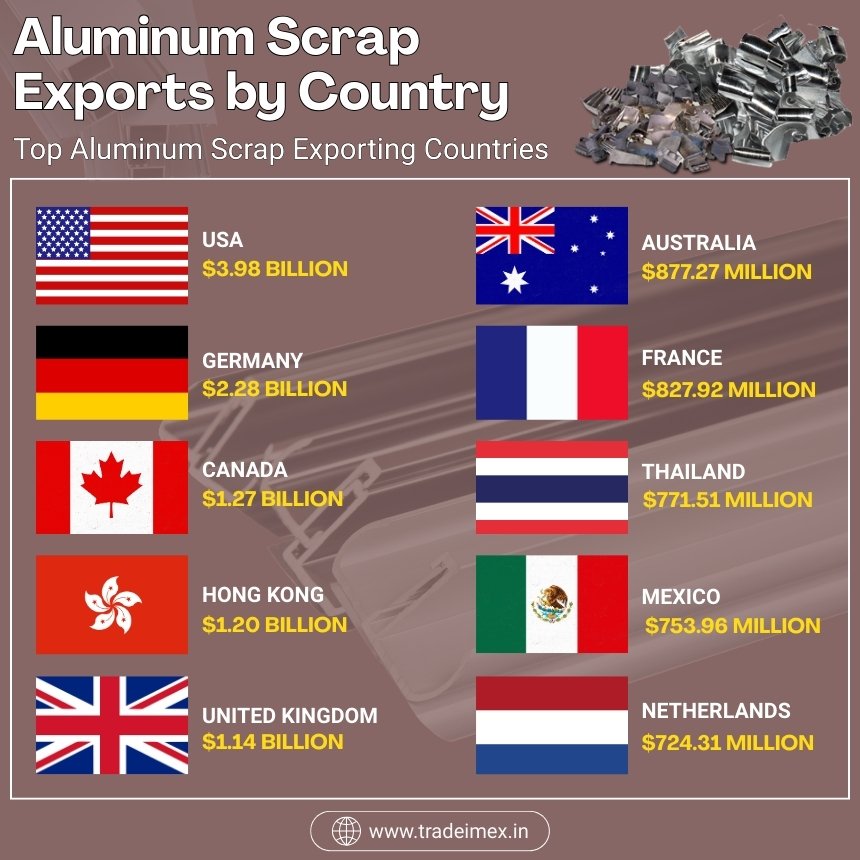
When examining the landscape of aluminum scrap exports by country, the focus turns to the top aluminum waste and scrap exporting countries globally. This data reveals the significant role these nations play in the recycling and repurposing of aluminum materials, contributing to sustainable practices within the industry. Aluminum is a highly recyclable material, and exporting aluminum waste and scrap helps to reduce the need for new aluminum production, which in turn saves energy and reduces greenhouse gas emissions. The top exporting countries include the United States, Germany, and Canada. The top 10 aluminum scrap exporting countries, as per the metal scrap & aluminum scrap trade data for 2024-25, include:
1. USA: $3.98 billion (17.2%)
The United States is the leading exporter of aluminum waste and scrap, with a total export value of $3.98 billion, accounting for 17.2% of the global market, as per the aluminum scrap export data of USA by HS code. The US has a well-established recycling infrastructure and a high demand for recycled aluminum, making it a key player in the global aluminum scrap market.
2. Germany: $2.28 billion (9.9%)
Germany is the second-largest exporter of aluminum waste and scrap, with a total export value of $2.28 billion, representing 9.9% of the global market. The country has a strong focus on sustainability and recycling, and its export of aluminum scrap contributes significantly to the circular economy.
3. Canada: $1.27 billion (5.5%)
Canada is another major player in the aluminum scrap market, with a total export value of $1.27 billion, accounting for 5.5% of global exports, as per Canada aluminum scrap export data by HS code. The country's proximity to the US market & its well-developed recycling industry make it a key exporter of aluminum waste and scrap.
4. Hong Kong: $1.20 billion (5.2%)
Hong Kong is a significant exporter of aluminum waste and scrap, with a total export value of $1.20 billion, representing 5.2% of the global market. The region's strategic location and strong trading networks make it an important hub for the export of recycled aluminum.
5. United Kingdom: $1.14 billion (4.9%)
The United Kingdom is also among the top aluminum waste and scrap exporting countries, with a total export value of $1.14 billion, accounting for 4.9% of global exports. The country's commitment to sustainability and recycling initiatives drives its export of aluminum scrap.
6. Australia: $877.27 million (3.8%)
Australia plays a significant role in the global aluminum scrap market, with a total export value of $877.27 million, representing 3.8% of global exports. The country's mining industry produces a significant amount of aluminum waste, which is recycled and exported to meet global demand.
7. France: $827.92 million (3.6%)
France is a key player in the aluminum scrap market, with a total export value of $827.92 million, accounting for 3.6% of global exports. The country's advanced recycling infrastructure and focus on circular economy principles drive its export of aluminum waste and scrap.
8. Thailand: $771.51 million (3.3%)
Thailand is a growing player in the global aluminum scrap market, with a total export value of $771.51 million, representing 3.3% of global exports. The country's booming manufacturing sector generates a significant amount of aluminum waste, which is recycled and exported to international markets.
9. Mexico: $753.96 million (3.3%)
Mexico is also a significant exporter of aluminum waste and scrap, with a total export value of $753.96 million, accounting for 3.3% of global exports. The country's proximity to the US market and its strong trading relationships make it a key player in the aluminum scrap market.
10. Netherlands: $724.31 million (3.1%)
The Netherlands rounds out the top 10 aluminum waste and scrap exporting countries, with a total export value of $724.31 million, representing 3.1% of global exports. The country's efficient trade and strong commitment to sustainability drive its export of aluminum scrap to global markets.
Global Aluminum Scrap Trade in the Last 10 Years: Yearly Aluminum Scrap Import-Export Data

|
Year of Trade |
Aluminum Scrap Imports ($) |
Aluminum Scrap Exports ($) |
|
2014 |
$13.96 billion |
$12.54 billion |
|
2015 |
$12.63 billion |
$10.98 billion |
|
2016 |
$11 billion |
$9.86 billion |
|
2017 |
$14.04 billion |
$11.86 billion |
|
2018 |
$15.97 billion |
$13.35 billion |
|
2019 |
$13.55 billion |
$11.51 billion |
|
2020 |
$11.69 billion |
$10.72 billion |
|
2021 |
$20.76 billion |
$19.60 billion |
|
2022 |
$24.91 billion |
$22.82 billion |
|
2023 |
$22.03 billion |
$21.24 billion |
|
2024 |
$23.82 billion |
$23.18 billion |
Aluminum Scrap Trade Crisis & Export Restrictions
The aluminum recycling industry has completely changed as a result of technological advancements in sorting capabilities, which have made it possible for previously unfeasible lower-quality materials to compete with high-quality feedstock. This development signifies a profound change in the way industries handle the creation of secondary aluminum, especially in light of the protracted downturns in global industry that have lowered the rates of traditional waste generation. These market dynamics have also been exacerbated by the imposition of aluminum scrap export restrictions in key economies:
-
Global supply constraint: Technological advances and declining industrial scrap generation have tightened global aluminum scrap availability just as demand for recycled material surges.
-
EU export policy shift: The European Commission is preparing export restrictions on aluminum scrap to prevent domestic shortages and support local secondary production, with measures expected by spring 2026.
-
Industry alarm: European aluminium industry leaders describe the current scrap scarcity as crisis-level, urging urgent regulatory action to retain material locally.
-
Proposed controls: Potential mechanisms include export tariffs (25-30%), licensing systems, and recycled content mandates tied to circular economy goals.
-
US strategic focus: In the United States, industry groups are pushing for export bans on high-value scrap like used beverage cans and broader controls under national security trade laws.
-
China’s model: China already uses export duties (~15%) to protect domestic scrap supply while still allowing trade flows.
-
India’s emerging stance: India is reportedly considering export limits to support its own growing secondary aluminum sector.
-
Market impacts:
-
Primary producers benefit from increased domestic feedstock.
-
Secondary processors invest more in local sorting and processing infrastructure.
-
Downstream manufacturers must adapt supply chains and design products for easier recycling.
-
Unintended consequences: Export curbs may create waste management challenges for lower-grade scrap and produce regional price volatility as markets adjust.
-
Future trends: Digital tracking (e.g., blockchain) and advanced classification tech are becoming important for compliance and efficiency in regulated scrap markets.
Pricing Trends and Trade Economics
Average Trade Prices (2024)
Global aluminum scrap trade prices average ranged between:
-
USD 1,700 – 2,400 per metric ton, depending on grade and region
Key price determinants:
-
Primary aluminum prices (LME)
-
Scrap quality and contamination levels
-
Trade and insurance costs
-
Import tariffs and compliance costs
Clean scrap grades (UBCs, extrusion scrap) commanded premiums of 15–30% over mixed scrap.
Volatility Factors
Price volatility during 2024–25 was driven by:
-
Fluctuating energy prices
-
Shipping disruptions in key maritime routes
-
Currency movements in emerging markets
-
Trade policy announcements (tariffs, export controls)
Policy and Regulatory Developments
Export Restrictions
Several regions are reconsidering aluminum scrap export policies:
-
European policymakers are evaluating export controls to support domestic decarbonization.
-
Some Central Asian and African countries have implemented temporary scrap export bans.
-
Discussions in the U.S. focus on limiting exports of high-quality scrap.
These measures may reduce global liquidity and push prices upward.
Environmental and Quality Standards
Importing countries increasingly require:
-
Radiation checks
-
Chemical composition certifications
-
Pre-shipment inspections
This trend favors organized exporters and disadvantages informal scrap traders.
Strategic Importance of Aluminum Scrap
Aluminum scrap is no longer just waste; it is a strategic industrial resource.
Key advantages:
-
95% energy savings compared to primary aluminum
-
Lower carbon footprint
-
Faster production cycles
-
Reduced dependence on bauxite mining
As countries pursue net-zero targets, access to scrap becomes a competitive advantage.
Outlook for 2026
Key Expectations
-
Continued growth in ASEAN and South Asia imports
-
Tighter export controls in Europe
-
Higher premiums for clean scrap grades
-
Increased investment in domestic recycling capacity
-
Greater price differentiation by quality and origin
Risks
-
Trade disruptions from regulatory changes
-
Trade bottlenecks
-
Currency instability in emerging markets
Conclusion and Final Thoughts
In conclusion, the global aluminum waste and scrap trade under HS Code 7602 has entered a new phase of strategic importance in 2024–25. With annual trade exceeding USD 23 billion and volumes surpassing 12 million metric tons, aluminum scrap has become a cornerstone of global manufacturing, sustainability, and trade policy. As recycling replaces mining as the primary growth driver in aluminum supply, countries that secure reliable scrap access will hold a significant industrial advantage. The coming years will be shaped not only by prices but by policy decisions, environmental compliance, and the ability to integrate scrap into advanced circular economies.
For more information on the latest global trade commodity data, or to search live aluminum scrap import-export data by country, visit TradeImeX. Contact us at info@tradeimex.in for customized trade reports and market insights.
Share
What's Your Reaction?
 Like
1
Like
1
 Dislike
0
Dislike
0
 Love
0
Love
0
 Funny
0
Funny
0
 Angry
0
Angry
0
 Sad
0
Sad
0
 Wow
0
Wow
0