Mexican Cattle Imports Data 2025 with HS Code: Complete Import Statistics & Importers Insights
Explore Mexican cattle imports data 2025 with HS code. Get detailed import statistics, key importers, trade volume, values & market insights.


The global livestock trade rarely changes overnight. But 2025 has rewritten the rulebook for Mexican cattle imports and cross-border live animal trade. For importers, exporters, feedlot operators, and agribusiness analysts, access to accurate, HS-code-level import data is no longer optional. It’s the difference between reacting late and positioning early. According to the latest Mexico import data & Mexico customs data, the total value of Mexican cattle imports reached $36.32 million in 2024, a 43% decline from the previous year. Mexico imported cattle worth around $29.4 million in 2025.
The year 2025 has been one of the most disruptive in recent memory for the cattle trade of Mexico. This disruption stems from a resurgence of the New World screwworm, a pest that prompted significant policy and border shifts during the year. The impact has been felt across both export and import channels, with implications for producers, importers, and downstream markets on both sides of the border.
To understand Mexico’s cattle import landscape in 2025, we’ll examine:
-
Trade data and volume trends
-
Policy impacts and sanitary controls
-
Historical comparisons and forecasted patterns
-
Mexican cattle importers data
-
Conclusions and strategic takeaways
Historical Context of Mexican Cattle Imports: What the Data Shows
Before analyzing 2025, it’s essential to establish a data baseline.
Mexico Live Cattle Imports – 2024 Snapshot
According to Mexico customs datasets:
-
Import Value (HS 010290): USD 36.3 million
-
Imported Quantity: approx. 15,700 head
-
Primary Supplier: United States (near-total share)
This data confirms an important structural insight:
Mexico is not a high-volume live cattle importer. It is traditionally a net exporter, sending millions of feeder cattle north each year while importing only targeted volumes.
This imbalance is exactly why any disruption to exports immediately affects import strategies. To appreciate 2025 patterns, we need a quick snapshot of recent history.
Trade Volume (Pre-2025)
-
In 2024, the international live cattle trade continued to be significant. For example, Mexico recorded imports of live bovine animals valued at approximately US$29.4 million with a quantity of around 15,746 head, mainly from the United States, as per the data on US cattle exports to Mexico.
-
Before the pandemic era and into 2023–24, Mexico typically balanced trade flows with the U.S.: Mexico exports a large number of feeder cattle to the U.S. while importing a relatively smaller volume of live cattle or specialized animals (e.g., breeding stock or dairy animals) as needed for domestic production cycles.
Border Trade Patterns
Trade in cattle between Mexico and the U.S. is heavily seasonal & volume-dependent, with livestock moving north for feedlot finishing or slaughter. In 2023 and 2024, approximately 1.25 million head of Mexican cattle were imported (into the U.S.) annually in normal years.
However, this northbound volume does not reflect what Mexico imports from other countries, which has historically been far lower and largely concentrated on genetics, dairy replacement stock, or specialized cattle.
Mexican Cattle Imports in 2025: The Statistics
Unlike export flows, Mexico’s live cattle imports are less frequently reported in real time. However, existing data and leading trends still paint a clear picture.
Early 2025 Trade Data
For the early part of 2025, the United States Agricultural Marketing Service (AMS) reported weekly livestock crossings from Mexico into the U.S. (primarily eastward), showing feeder cattle movements into American states like Arizona, New Mexico, and Texas. While these refer to cattle leaving Mexico, they correlate strongly with the overall imbalance in the cattle trade.
Weekly tallies from March and April 2025, before the disruption, showed:
-
March YTD crossings from Mexico to the U.S.: 39,487 head (compared with YTD 245,288 in 2024).
-
April YTD crossings were around 141,545 head, less than half of the prior year’s pace.
Important: This reflects the export side, but the disruption to this channel inherently flips incentives for importers, and domestic demand typically sees hiring of cattle genetics or replacements from outside Mexico if supply tightens.
Mexico’s Domestic Imports (HS 010290)
The 2025 Mexico cattle import data by HS Code gives us a recent benchmark:
-
Mexico’s imports of Live bovine animals (HS 010290) in 2024 amounted to US$29.4M with 15,746 head, entirely sourced from the United States.
With the disruptions in 2025 border controls and health concerns, it’s expected that:
-
Mexico’s imports of live cattle may remain stable or increase modestly if genetic, dairy replacement, or specialized market needs arise to balance its domestic herd (historically exported in large numbers).
-
Conversely, if border closures persist, trade may shift toward other origins or genetic solutions like bovine semen (though that’s in a different HS code category).
Data Gaps and Indicators
While detailed 2025 Mexico import data under HS 010290 isn’t yet publicly published, there are leading indicators that analysts use:
-
Trade balances for live animals show Mexico importing millions in cattle stock and related animals in certain months, pointing to ongoing domestic demand.
-
Animal genetics imports (e.g., bovine semen under HS 051110) continued into late 2025 with a US$13.15M value Jan–Sep 2025, suggesting that animal breeding support is active.
Mexico Cattle Importers Database & Shipment Records
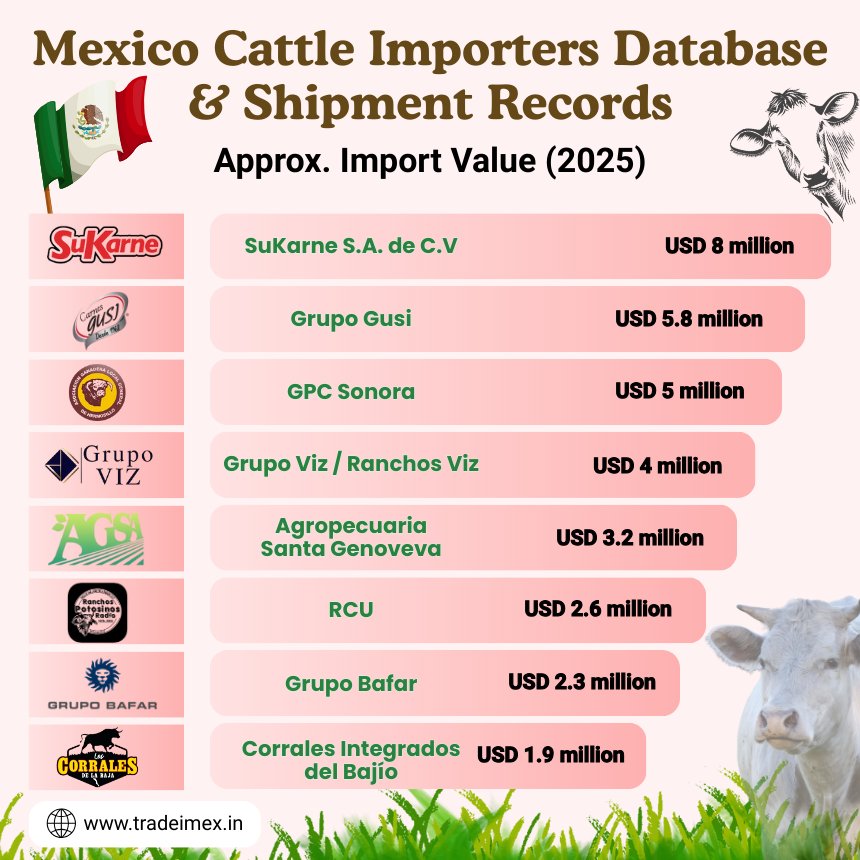
The growing demand for livestock across North America has significantly increased cattle imports from Mexico, as buyers seek high-quality and competitively priced animals to meet supply needs. In recent years, Mexican cattle imports have supported beef production, breeding programs, and feedlot operations in multiple regions. With streamlined trade policies and established supply chains, Mexican cattle importers, importing cattle from Mexico, continue to play a crucial role in maintaining stable market flow, ensuring consistent livestock availability, and strengthening cross-border agricultural trade relationships. The leading cattle importers in Mexico in 2025 include:
|
Rank |
Company Name |
Approx. Import Value (2025) |
Imported Type |
Top Import Source |
|
1 |
SuKarne S.A. de C.V. |
USD 8 million |
Feeder cattle, slaughter cattle |
United States |
|
2 |
Grupo Gusi |
USD 5.8 million |
Feeder cattle, dairy-linked stock |
United States |
|
3 |
Ganaderos Productores de Carne de Sonora (GPC Sonora) |
USD 5 million |
Feeder cattle |
United States |
|
4 |
Grupo Viz / Ranchos Viz |
USD 4 million |
Feeder & finishing cattle |
United States |
|
5 |
Agropecuaria Santa Genoveva |
USD 3.2 million |
Dairy replacement cattle |
United States |
|
6 |
Ranchos de Chihuahua Unidos (RCU) |
USD 2.6 million |
Feeder cattle |
United States |
|
7 |
Grupo Bafar (Agropecuaria División) |
USD 2.3 million |
Slaughter cattle |
United States |
|
8 |
Corrales Integrados del Bajío |
USD 1.9 million |
Feedlot cattle |
United States |
|
9 |
Ganadería Integral del Norte (GIN) |
USD 1.5 million |
Feeder cattle |
United States |
|
10 |
Productores de Leche del Centro (PLC) |
USD 1.3 million |
Dairy cattle |
United States |
Supplier Concentration: Where Mexico Imports Cattle From
Top Supplier by Data Share
-
United States: 95–100% share (historically)
Mexico’s live cattle imports are highly concentrated, which creates:
-
Strong price linkage to U.S. cattle markets
-
High exposure to U.S. regulatory decisions
-
Limited diversification during emergencies
Mexican Cattle Imports in the Last 10 Years: Historical Mexico Cattle Import Data
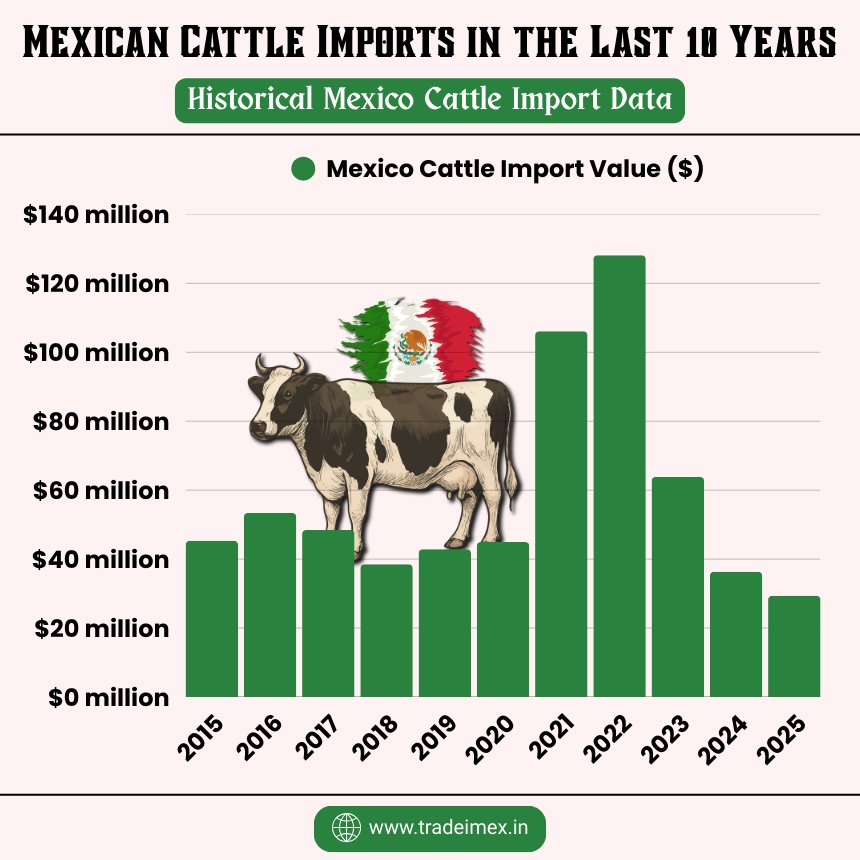
|
Year of Imports |
Mexico Cattle Import Value ($) |
|
2015 |
$45.31 million |
|
2016 |
$53.39 million |
|
2017 |
$48.43 million |
|
2018 |
$38.51 million |
|
2019 |
$42.84 million |
|
2020 |
$44.97 million |
|
2021 |
$106.08 million |
|
2022 |
$128.18 million |
|
2023 |
$63.86 million |
|
2024 |
$36.32 million |
|
2025 |
$29.40 million |

Policy Shocks & Border Controls
New World Screwworm Outbreak
The most defining trend for cross-border cattle trade in 2025 was the outbreak of New World screwworm in Mexico, prompting significant changes to both imports and exports of live animals.
-
In early 2025, the U.S. Department of Agriculture (USDA) announced the resumption of cattle and bison imports from Mexico under new pre-clearance medical protocols after a 2024 suspension due to screwworm controls.
-
However, the detection of further screwworm cases in 2025 led to phased border reopening plans and intermittent closures throughout the year.
-
Multiple enforcement actions by the U.S. slowed cattle imports dramatically, with industry reports estimating that only ~230,000 Mexican cattle crossed into the U.S. in 2025, a steep drop from the usual 1.2 million head.
Impact on Importers
For companies and ranchers in Mexico who depend on importing cattle, this volatility presents both challenges and opportunities:
-
Risk of Supply Disruptions: If screwworm controls extend into 2026, importers must diversify sources or adjust inventories.
-
Regulatory Compliance Burdens: New pre-clearance and health inspection protocols add cost and time to import processes.
-
Price Pressure: Lower cross-border supply has historically added upward price pressure on feeder markets.
Importers' Insights: Trends, Strategies, and Market Shifts
Given the context above, let’s unpack what industry participants and data tell us about import trends in 2025.
1. Shift in Import Patterns
With live cattle exports from Mexico to the U.S. sharply reduced, sellers in the United States and Canada found themselves adjusting:
-
Some cattle destined for export north remained in Mexico, increasing local inventory.
-
Importers looking for specialized cattle genetics or breeding animals have leaned more heavily on alternatives (e.g., semen or embryo import).
2. Genetic and Specialized Imports
Trade data on bovine semen imports suggests sustained activity:
-
In 2024, Mexico accounted for 3.26% of global bovine semen imports.
-
In January–September 2025, imports of bovine semen grew by 7.35% in value compared with the prior year period.
This trend suggests that Mexican producers and importers are:
-
Seeking genetic improvements
-
Adjusting to lower live cattle exports
-
Preparing for long-term herd resilience
3. Price and Feedlot Impacts
As cross-border cattle availability dwindles, the downstream effects have included:
-
Higher feeder cattle prices in U.S. markets as supply tightens.
-
Increased demand for domestically raised or newly imported replacement animals in Mexico.
4. Industry Voices on Import Strategy
Importers have publicly shared that:
-
They expect long-term border health protocols to shape sourcing decisions.
-
Diversification outside traditional U.S.–Mexico feeder cattle channels may become more common.
-
Genetic imports (and investments in domestic herd improvement) are a hedge against cross-border uncertainty.
Comparing Mexico’s Cattle Import vs. Export Balance
Trade Imbalance
Historically, Mexico’s live cattle trade is heavily export-oriented, with far larger volumes exported (predominantly to the U.S.) than imported, as per the Mexico export data.
-
Exports have been in the millions of head annually.
-
Imports are typically an order of magnitude smaller, focused on specialized needs.
Given the 2025 disruptions:
-
Export volumes dropped sharply.
-
Imports may increase slightly if producers adjust herd structures.
-
The trade balance may narrow, but exports are still the dominant flow.
Forecast and What to Watch
1. Short-Term (Next 6–12 Months)
-
Mexico’s live cattle imports under HS 010290 are likely to be modest but stable, driven by genetics and replacement needs.
-
Continued border health negotiations will dictate the pace of future cattle movements.
2. Long-Term Structural Trends
-
Importers may increasingly use genetic imports (semen or embryos) as part of herd improvement.
-
Mexico could diversify import sources beyond the U.S., depending on global trade partnerships.
3. Data Monitoring
Key indicators to watch:
-
Mexico’s HS 010290 annual imports
-
Live cattle price movements globally
-
Domestic Mexico herd expansion or contraction trends
Conclusion and Final Thoughts
In conclusion, the year 2025 was a turning point in the modern Mexican cattle trade. While historical patterns saw large volumes of live cattle flowing northward into the U.S., safety concerns over New World screwworm radically altered trade flows, leading to:
-
A sharp reduction in cross-border live cattle export volumes.
-
Increased regulatory and health-protocol attention from USDA/APHIS.
-
Strategic shifts among Mexican importers toward genetics and specialized cattle imports.
-
A complex but evolving trade landscape under HS Code 010290.
For importers, producers, and analysts, the lesson of 2025 is clear: resilience in sourcing, adaptability in protocol compliance, and a holistic view of live animal trade are essential for navigating ongoing market shifts.
FAQs: Mexican Cattle Imports Data 2025
1. How many live cattle did Mexico import in 2025 compared to previous years?
Based on available trade signals and recent customs data, Mexico’s live cattle imports in 2025 remained broadly in line with recent years, though shipment patterns changed. Import volumes were lower in number of head but higher in average value, worth $29-30 million, reflecting stricter health protocols, higher compliance costs, and more selective purchasing by importers.
2. Which countries supplied most of Mexico’s cattle imports in 2025?
Mexico’s cattle imports in 2025 were overwhelmingly sourced from the United States (95-100%), continuing a long-standing trade pattern. Supplier diversification remained minimal, meaning Mexican importers stayed highly dependent on U.S. animal health regulations, border inspections, and policy decisions throughout the year.
3. What types of cattle were most commonly imported into Mexico in 2025?
Trade data indicates that feeder cattle accounted for the majority of live cattle imports in 2025. Smaller but consistent volumes of dairy replacement cattle and specialized finishing animals were also imported, particularly by vertically integrated beef and dairy producers focused on herd stability rather than expansion.
4. Why did average cattle import values increase in 2025?
The rise in average import value per head in 2025 was driven by multiple factors, including enhanced veterinary inspections, quarantine requirements, border delays, and tighter supply conditions. Importers prioritized cattle with clear health certification, which increased per-unit costs even as overall import volumes remained controlled.
5. What insights can businesses gain from tracking Mexican cattle import data?
By analyzing cattle import data, businesses can:
-
Identify active and repeat importers
-
Track supplier dependency and risk exposure
-
Monitor price trends through per-head import values
-
Anticipate market tightening or recovery cycles
-
Plan sourcing and sales strategies ahead of regulatory changes
For traders and analysts, cattle import data functions as an early warning system for broader livestock and beef market movements.
Feel free to ask for Mexico cattle import-export data by country or HS code, or tailored insights on impacts to beef prices, regional rancher strategies, or global cattle genetics trade reports. Contact us at info@tradeimex.in for customized trade database reports and market insights.
Share
What's Your Reaction?
 Like
0
Like
0
 Dislike
0
Dislike
0
 Love
0
Love
0
 Funny
0
Funny
0
 Angry
0
Angry
0
 Sad
0
Sad
0
 Wow
0
Wow
0