EU-Australia Trade Deal Finalized: Latest Trade Data & Australia-EU Free Trade Agreement Insights
Explore the EU-Australia trade deal with the latest trade data, key benefits, & insights into the Australia-EU Free Trade Agreement. Learn how this landmark FTA impacts global trade, exports, and economic growth in 2026.

The long-awaited EU–Australia Free Trade Agreement (FTA) has finally been sealed after nearly eight years of negotiations. On March 24, 2026, Australian Prime Minister Anthony Albanese and European Union Commission President Ursula von der Leyen signed the long-awaited free trade agreement (FTA), ending a protracted dispute between them over the production and export of Australian Prosecco. Exports are permitted for the next ten years only, with some labeling changes. According to the latest Europe trade data & Australia export data, the total value of Australia-EU trade reached $51.26 billion in 2025.
For policymakers, exporters, and investors, this is more than just another trade pact. It marks a structural shift in global trade patterns at a time when supply chains are being redrawn, & geopolitical risks are rising. This in-depth blog breaks down what the trade agreement actually includes, the latest trade data behind it, and what it means for both economies and the wider global trade system.
A Deal Years in the Making: Historic Australia-EU Free Trade Agreement
Negotiations for the EU–Australia FTA or EU-Australia trade deal began in 2018, but the path was anything but smooth. Talks stalled multiple times, most notably in 2023, due to disagreements over agricultural market access and product labeling rules.
The sticking points were predictable:
-
Australia wanted better access for beef, lamb, and sugar exports
-
The EU wanted stronger protections for geographical indications (GI), such as “feta” or “prosecco.”
-
Both sides had competing interests in manufacturing, services, and environmental standards
The breakthrough in 2026 reflects a broader shift in global trade priorities. Rising tariffs in the United States and export restrictions from China pushed both sides to diversify partnerships. In short, this deal is as much about geopolitics as it is about trade.
Headline Numbers: What the Data Says
The economic scale of the agreement is substantial, even before full implementation.
Key Trade Figures
-
€1 billion annually: Estimated savings for EU exporters from tariff elimination
-
A$10 billion ($7 billion) annually: Expected boost to Australia’s economy
-
33% increase in EU exports to Australia over 10 years
-
$51.26 billion: Total two-way trade (2025 baseline)
These numbers suggest that while the EU–Australia trade corridor is already significant, the agreement aims to accelerate growth rather than create it from scratch.
GDP and Market Context
-
EU: 450 million consumers and $31 trillion GDP
-
Australia: Smaller market but resource-rich and strategically located
This imbalance explains why the EU focuses on export expansion, while Australia prioritizes market access.
Tariff Elimination: Near-Total Liberalization
One of the most important aspects of the Australia-EU trade agreement is tariff removal.
-
Almost 100% of EU exports to Australia will become tariff-free
-
Immediate tariff removal for:
-
Wine and sparkling wine
-
Chocolate and confectionery
-
Processed foods
-
Gradual tariff reductions for:
-
Dairy products like cheese
For Australia:
-
Expanded access to EU markets for:
-
Beef
-
Dairy
-
Agricultural products (with quotas)
However, this is not full liberalization of agriculture. Safeguards and quotas remain, reflecting political sensitivities on both sides.
Top Goods Australia Imports from the EU
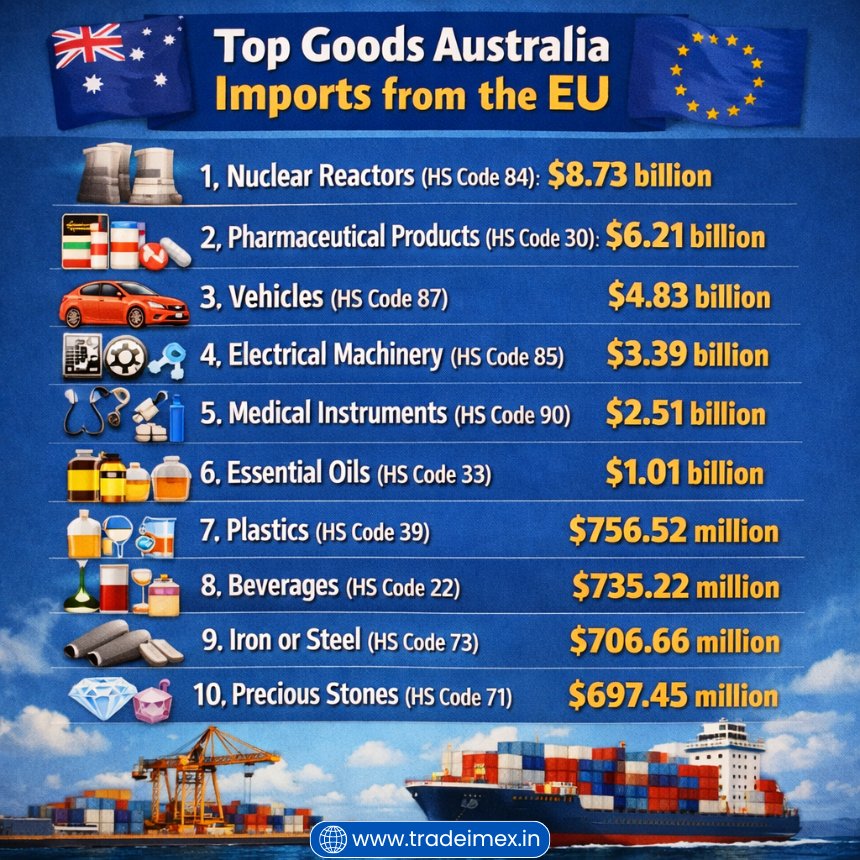
Australia's imports from the EU encompass a diverse range of top goods, reflecting the strong trade relationship between the two regions. Key products include machinery, vehicles, pharmaceuticals, and medical instruments, showcasing the high level of technology and innovation exchanged between Australia and the EU. Australia imported goods worth $41.23 billion from the EU in 2025. The top 10 products that Australia imports from the EU, according to the EU trade data & Australia import data for 2025, include:
1. Nuclear reactors & machinery (HS Code 84): $8.73 billion
Nuclear reactors and machinery are essential for Australia's industrial and energy sectors. Among the EU members, Australia imports the most machinery from Germany, as per the data on Australia imports from Germany by HS code. The EU is a leading exporter of nuclear reactors and machinery to Australia, providing high-quality products that meet the country's stringent standards.
2. Pharmaceutical products (HS code 30): $6.21 billion
Pharmaceutical products play a crucial role in Australia's healthcare system, and the EU is a key supplier of these goods. From essential medications to cutting-edge medical treatments, Australia imports a wide range of pharmaceutical products from the EU.
3. Vehicles (HS code 87): $4.83 billion
The automotive industry is a significant sector in Australia, and the country imports a substantial number of vehicles from the EU. European cars are known for their quality, performance, and innovative design, making them popular among Australian consumers.
4. Electrical machinery & equipment (HS code 85): $3.39 billion
Electrical machinery and equipment are vital for Australia's infrastructure and technological advancements. The EU provides a diverse range of electrical products, including appliances, industrial machinery, and electronic components, helping to meet Australia's growing demands.
5. Optical, medical, & surgical instruments (HS code 90): $2.51 billion
Optical, medical, and surgical instruments are essential for Australia's healthcare and research sectors. The EU supplies a wide array of advanced medical devices, diagnostic tools, and surgical equipment, contributing to Australia's healthcare innovation.
6. Essential oils, perfumery, & cosmetics (HS code 33): $1.01 billion
Beauty and personal care products are in high demand in Australia, and the EU is a major source of essential oils, perfumery, and cosmetics. European brands are renowned for their quality and innovation, attracting Australian consumers looking for premium beauty products.
7. Plastics & articles thereof (HS code 39): $756.52 million
Plastics are ubiquitous in modern society, serving a wide range of purposes in various industries. The EU supplies Australia with a diverse selection of plastic products and articles, including packaging materials, construction supplies, and consumer goods.
8. Beverages, spirits, & vinegar (HS code 22): $735.22 million
The EU offers an array of beverages, spirits, and vinegar to cater to Australia's diverse culinary preferences. From fine wines and spirits to specialty vinegars and beverages, European imports add a touch of sophistication to Australia's food and beverage market.
9. Articles of iron or steel (HS code 73): $706.66 million
Iron and steel products are essential for Australia's construction, manufacturing, and infrastructure projects. The EU supplies a range of iron and steel articles, including structural components, machinery parts, & industrial equipment, supporting Australia's development.
10. Precious stones & metals (HS code 71): $697.45 million
Precious stones and metals hold value both as investment assets and luxury goods. The EU provides Australia with a selection of high-quality gemstones, precious metals, and jewelry, catering to the demand for luxury items in the Australian market.
Top Goods Australia Exports to the EU
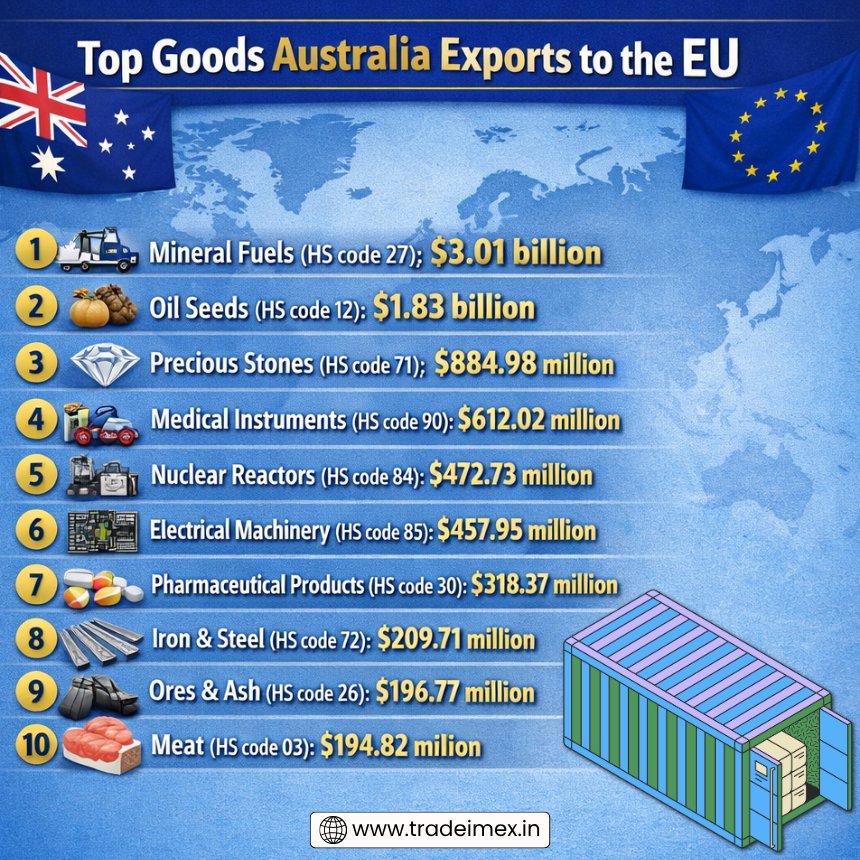
Australia exports a variety of top goods to the European Union, making significant contributions to its economy. Some of the top goods exported from Australia to the EU include agricultural products like wine, beef, and cereals, as well as raw materials such as ores and minerals. These goods undergo strict quality control measures to meet the high standards of the EU, showcasing Australia's commitment to providing top-notch products. Australia exported goods worth $10.03 billion to the EU in 2025. The top 10 goods that Australia exports to the EU, along with their respective values based on Harmonized System (HS) codes, as per the Australia shipment data for 2025, include:
1. Mineral fuels & oils (HS code 27): $3.01 billion
Mineral fuels and oils are among the top goods that Australia exports to the EU, with a substantial export value of $3.01 billion. Australia exports the most mineral fuels to the Netherlands in the EU, as per the data on Australia exports to the Netherlands by HS code. These products play a crucial role in powering various industries and vehicles in the EU, making them a significant import for the region.
2. Oil seeds & oleaginous fruits (HS code 12): $1.83 billion
Oil seeds and oleaginous fruits are another key export category for Australia, with a total export value of $1.83 billion to the EU. These products are essential for the production of cooking oils, biofuels, and various food products, contributing to the EU's agricultural and food processing industries.
3. Precious stones & metals (HS code 71): $884.98 million
Australia also exports precious stones and metals to the EU, with an export value of $884.98 million. These high-value commodities include diamonds, gold, and other precious metals used for jewelry, industry, and investment, driving trade and economic activity between Australia and the EU.
4. Optical, medical, surgical instruments (HS code 90): $612.02 million
Optical, medical, and surgical instruments are critical exports from Australia to the EU, with a total export value of $612.02 million. These high-tech, precision instruments are in demand across the EU healthcare sector, contributing to advancements in medical treatments and services.
5. Nuclear reactors & machinery (HS code 84): $472.73 million
Australia exports nuclear reactors and machinery to the EU, with an export value of $472.73 million. These advanced technological products are crucial for various industries in the EU, including energy production, manufacturing, and infrastructure development, fostering innovation and growth.
6. Electrical machinery & equipment (HS code 85): $457.95 million
Electrical machinery and equipment are the top exports from Australia to the EU, with a total export value of $457.95 million. These products include electrical appliances, components, and devices that are integral to the functioning of modern societies in the EU, supporting daily activities and industrial operations.
7. Pharmaceutical products (HS code 30): $318.37 million
Australia also exports pharmaceutical products to the EU, with an export value of $318.37 million. These medicines, vaccines, and healthcare products are essential for maintaining public health and well-being in the EU, ensuring access to quality healthcare services for its population.
8. Iron & steel (HS code 72): $209.71 million
Iron and steel products are significant exports from Australia to the EU, with a total export value of $209.71 million. These construction materials are essential for infrastructure projects, manufacturing, and various industries in the EU, driving economic development and employment opportunities.
9. Ores, slag, & ash (HS code 26): $196.77 million
Australia exports ores, slag, and ash to the EU, with an export value of $196.77 million. These raw materials are key inputs for the steel, cement, and manufacturing industries in the EU, supporting production processes and value chains across different sectors.
10. Meat & edible meat offal (HS code 02): $194.82 million
Meat and edible meat offal are significant exports from Australia to the EU, with a total export value of $194.82 million. These high-quality food products are consumed widely in the EU, contributing to the region's food security, culinary diversity, and agricultural trade.
Australia-EU Trade Data in the Last 10 Years
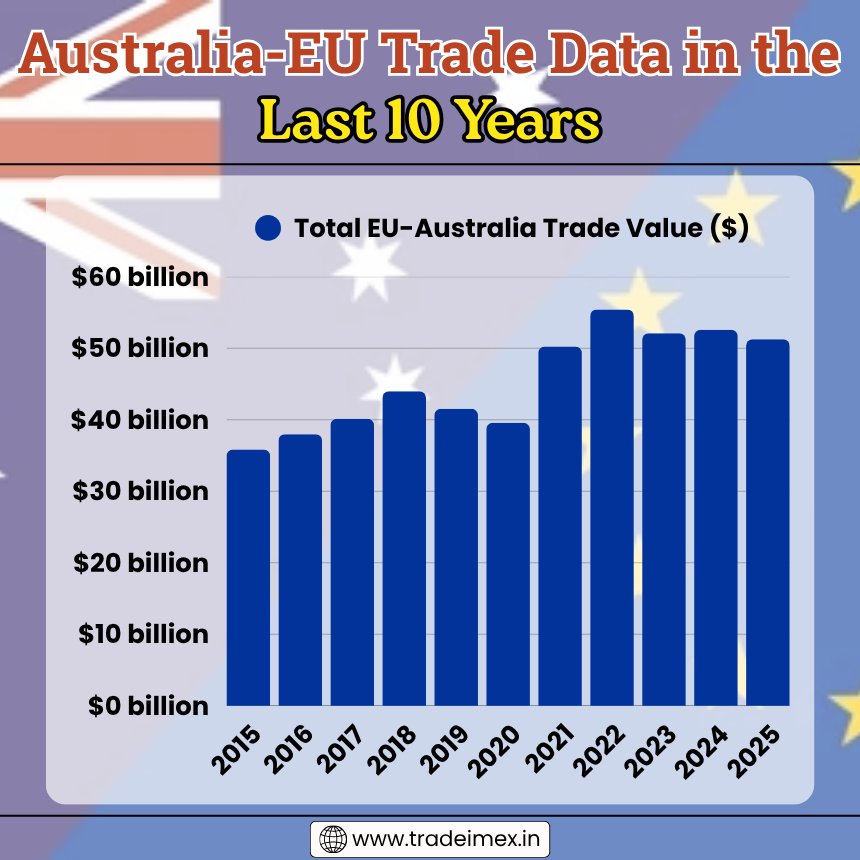
|
Year of Trade |
Total EU-Australia Trade Value ($) |
|
2015 |
$35.85 billion |
|
2016 |
$37.99 billion |
|
2017 |
$40.15 billion |
|
2018 |
$43.98 billion |
|
2019 |
$41.55 billion |
|
2020 |
$39.59 billion |
|
2021 |
$50.25 billion |
|
2022 |
$55.44 billion |
|
2023 |
$52.11 billion |
|
2024 |
$52.59 billion |
|
2025 |
$51.26 billion |
Agriculture: The Most Contested Sector
Agriculture was the hardest part of the negotiations, and it still reflects compromise rather than full agreement.
What Australia Gains
-
Limited quotas for:
-
Beef (30,000–35,000 tons)
-
Sheep meat (31,000 tons)
-
Partial duty-free access (about 55% for some red meat categories)
What the EU Protects
-
Strong protections for domestic farmers
-
Safeguard mechanisms to prevent market disruption
-
Strict geographical indication rules
This means Australian farmers gain access, but not at the scale they initially demanded. Critics in Australia argue the quotas are too small, especially compared to EU agreements with other countries.
Geographical Indications (GI): A Quiet but Major Change
One of the most overlooked yet impactful parts of the agreement is the enforcement of EU geographical indications.
What Changes
-
Australia must phase out the use of certain EU-origin names for exports:
-
“Prosecco” (10-year transition)
-
“Feta” (restricted use)
-
Over 165 agrifood and 231 spirit GIs are protected
Why It Matters
This affects branding, labeling, and marketing for Australian producers. It may force rebranding costs and changes in export strategies. At the same time, it protects the premium identity of European products globally.
Critical Minerals: The Strategic Core of the Deal
While agriculture got the headlines, the real long-term value of this agreement lies in critical minerals.
Key Developments
-
Elimination of tariffs on:
-
Lithium
-
Rare earths
-
Tungsten
-
Ban on export restrictions for critical minerals
-
Increased EU investment in Australian mining projects
Strategic Context
This is directly tied to:
-
Europe’s push for green energy (EVs, batteries)
-
Reducing reliance on China for raw materials
In effect, the FTA doubles as a supply chain security agreement.
Manufacturing and Industrial Trade
The agreement also reshapes trade in manufactured goods.
Key Highlights
-
Removal of tariffs on EU vehicles (including EVs)
-
Adjustment of Australia’s luxury car tax threshold
-
Lower costs for European industrial exports
For the EU, this strengthens its position in high-value exports such as:
-
Automobiles
-
Machinery
-
Chemicals
For Australia, the benefits are more indirect, mainly through:
-
Cheaper imports
-
Increased competition
-
Access to advanced technologies
Services and Investment Liberalization
Beyond goods, the FTA includes provisions for services and investment.
What’s Included
-
Improved market access for:
-
Financial services
-
Professional services
-
Digital trade
-
Stronger investor protections
-
Reduced regulatory barriers
This is critical because services account for a growing share of both economies.
Consumer Impact: Prices, Choice, and Competition
For consumers, the effects will be more visible than for most trade agreements.
Expected Changes
In Australia:
-
Lower prices for European goods:
-
Wine
-
Cheese
-
Processed foods
-
Greater variety of imported products
In the EU:
-
More access to Australia:
-
Meat
-
Wine
-
Seafood
However, increased competition may also pressure local producers.
Geopolitical Significance: A Trade Deal with a Strategic Purpose
This agreement is not happening in isolation. It is part of a broader shift in global trade alliances.
Key Drivers
-
U.S. tariff policies are disrupting global trade flows
-
China’s control over critical mineral exports
-
The EU’s push for “open strategic autonomy.”
The EU has recently signed or advanced trade deals with:
-
India
-
Mercosur
-
Indonesia
The Australia deal is part of what some analysts call a “trade diversification strategy.”
Winners and Losers
Winners
-
EU exporters (manufacturing, food, beverages)
-
Australian mining sector
-
Consumers (lower prices, more choice)
-
Investors in both regions
Losers or Challenged Groups
-
Australian farmers (due to limited quotas)
-
EU farmers (due to increased competition)
-
Australian producers using EU-style product names
No trade agreement is perfectly balanced, and this one reflects political compromise.
Risks and Uncertainties
Despite the optimism, several risks remain.
1. Ratification Delays
FTAs often face political hurdles before full implementation.
2. Agricultural Backlash
Farm lobbies in both regions have already raised concerns.
3. Global Trade Volatility
Changes in U.S. or China trade policy could reshape the deal’s impact.
What Happens Next?
The agreement still needs:
-
Legal finalization
-
Ratification by EU member states
-
Implementation timelines
Once in force, the impact will roll out gradually over the years, not overnight.
Final Takeaways: A Turning Point in Global Trade
The EU–Australia Free Trade Agreement is more than a bilateral deal. It reflects how global trade is evolving in response to uncertainty.
Three key takeaways stand out:
-
Trade is becoming strategic, not just economic
Critical minerals and supply chains now matter as much as tariffs -
Partial liberalization is the new normal
Sensitive sectors like agriculture remain protected -
Alliances are shifting
Countries are actively diversifying away from dependence on major powers
For businesses and investors, this agreement opens opportunities in:
-
Export expansion
-
Supply chain partnerships
-
Resource investment
For policymakers, it signals a new era where trade agreements double as geopolitical tools.
Conclusion and Final Thoughts
In conclusion, the EU–Australia FTA is a landmark agreement shaped by both economics and geopolitics. With near-total tariff elimination, strategic mineral cooperation, & expanded market access, it sets the stage for deeper trade integration between two advanced economies. But its real significance lies in timing. In a fragmented global economy, this deal shows that large-scale trade cooperation is still possible, though increasingly complex. The next decade will determine whether it delivers on its promise of growth, resilience, and strategic alignment.
Note For Our Readers
We hope you found this blog on the EU–Australia Trade Deal and its latest trade data insights useful and informative. If you’re looking for deeper analysis or need customized reports or to search live Australia import-export data by product, country, or shipment level, feel free to connect with TradeImeX.
We provide detailed and up-to-date export-import databases covering the EU and Australia, including buyer-supplier insights, shipment-level records, and evolving trade trends to support your strategic decisions. For exclusive access or tailored data solutions, reach out to us at info@tradeimex.in today.
Share
What's Your Reaction?
 Like
0
Like
0
 Dislike
0
Dislike
0
 Love
0
Love
0
 Funny
0
Funny
0
 Angry
0
Angry
0
 Sad
0
Sad
0
 Wow
0
Wow
0