How to Find Buyers and Suppliers in Indonesia Using Customs Data?
Discover how to find buyers and suppliers in Indonesia using customs data. Learn how TradeImeX helps businesses analyze Indonesia import-export data for market insights, trade trends, and potential partnerships.


In today's globalized economy, finding reliable buyers and suppliers is crucial for any business looking to expand its operations. This is especially true for companies looking to do business in Indonesia, a rapidly growing market with a diverse range of opportunities. One effective way to identify potential partners in Indonesia is by utilizing customs data. According to Indonesia import data, Indonesia's imports accounted for $233.65 billion in 2024, a 5% increase from the previous year. Indonesia's exports reached a total value of $264.70 billion in 2024, with an increase of 2% from the previous year, as per Indonesia export data. In this article, we will explore how to find buyers and suppliers in Indonesia using customs data.
Understanding the Importance of Customs Data
Customs data provides detailed information on the import and export activities of a country. By analyzing this data, businesses can gain insights into market trends, identify potential buyers and suppliers, assess the competitiveness of products, and much more. In the case of Indonesia, customs data can be particularly valuable due to the country's diverse economy and rapidly growing market. By tapping into this data source, businesses can gain a competitive edge and increase their chances of success in the Indonesian market.
Accessing Customs Data in Indonesia
To access customs data in Indonesia, businesses can utilize online customs databases such as the Indonesia Government Customs Data Platform or Indonesia customs data-providing platforms like TradeImeX. This platform provides access to a wealth of information on import and export activities, including detailed reports on products, companies, and trade volumes. By leveraging this data, businesses can gain valuable insights into market trends, identify potential buyers and suppliers, and make informed decisions about their business strategy.
Analyzing Customs Data to Identify Buyers and Suppliers
- Once businesses have access to customs data, the next step is to analyze this data to identify potential buyers and suppliers.
- One effective way to do this is by using data analysis tools, software, or trade data providers such as TradeImeX.
- By inputting specific search criteria, businesses can generate reports that highlight key players in the market, trends in product demand, and other valuable insights.
- By carefully analyzing this data, businesses can identify potential partners that align with their business goals and objectives.
Leveraging TradeImeX for Market Intelligence
TradeImeX is a powerful platform that provides access to comprehensive customs data, allowing you to analyze trade activities in Indonesia with ease. With TradeImeX, you can search for specific products, monitor competitors, track market trends, and identify potential buyers and suppliers. The platform offers advanced search functionalities and customizable reports to help you make strategic business decisions.
By acquiring the data, businesses can identify market trends, assess the competitiveness of products, and evaluate potential partners. This information can then be used to develop a targeted business strategy that maximizes opportunities and minimizes risks. By leveraging customs data in this way, businesses can increase their chances of success in the Indonesian market.
Comprehensive Trade Reports for Market Analysis with Indonesia Customs Data
Businesses can find new market prospects and make well-informed trade decisions by utilizing Indonesian customs data. TradeImeX provides a range of summary reports to assist companies in identifying possible partners and analyzing market trends:
✅ Indonesia Importer-Exporter Reports: Find Indonesian suppliers and buyers for particular products with this importer and exporter data report.
✅ Report on Indonesia's Country of Origin and Destination: Examine Indonesia's trade connections with other countries.
✅ Indonesia trade data by HS code report: Track the import-export status of a specific product in Indonesia with the Indonesia HS Code Report.
Indonesia's Top Import Products as per Customs Import Data
Indonesia's top import products cover a wide range of goods, classified by Harmonized System (HS) codes to facilitate international trade. From machinery and electrical equipment to mineral fuels and oils, the country's imports reflect its dynamic economy and diverse needs. As a key player in the global market, Indonesia continues to source a variety of products to meet the demands of its growing population and expanding industries. The top 10 goods that Indonesia imports, as per Indonesia customs import data by HS code and Indonesia trade data for 2024, are:
- Mineral fuels and oils (HS code 27): $40.66 billion (17.4%)
- Nuclear reactors and machinery (HS code 84): $33.51 billion (14.34%)
- Electrical machinery and equipment (HS code 85): $27.04 billion (11.58%)
- Iron and steel (HS code 72): $10.66 billion (4.56%)
- Plastics and articles thereof (HS code 39): $10.59 billion (4.53%)
- Vehicles (HS code 87): $9.65 billion (4.13%)
- Organic chemicals (HS code 29): $7.10 billion (3.04%)
- Cereals (HS code 10): $6.81 billion (2.92%)
- Precious stones and metals (HS code 71): $4.77 billion (2.05%)
- Optical, medical, or surgical instruments (HS code 90): $4.42 billion (1.89%)
Indonesia’s Top Export Products as per Customs Export Data
According to Indonesia Customs Export Data by HS code, the top export products of the country encompass a diverse range of commodities. Among the leading export items are palm oil, coal, natural gas, rubber, and textiles. These products play a significant role in Indonesia's economy and global trade relations. The top 10 goods that Indonesia exports, as per the Indonesia shipment data and Indonesia export data for 2024, include:
- Mineral fuels and oils (HS code 27): $55.52 billion (20.98%)
- Animal or vegetable fats and oils (HS code 15): $26.82 billion (10.13%)
- Iron and steel (HS code 72): $25.80 billion (9.75%)
- Electrical machinery and equipment (HS code 85): $15.05 billion (5.69%)
- Vehicles (HS code 87): $11.01 billion (4.16%)
- Precious stones and metals (HS code 71): $8.87 billion (3.35%)
- Ores, slag, and ash (HS code 26): $8.22 billion (3.11%)
- Nickel and articles thereof (HS code 75): $7.99 billion (3.02%)
- Footwear (HS code 64): $7.08 billion (2.68%)
- Nuclear reactors and machinery (HS code 84): $6.94 billion (2.62%)
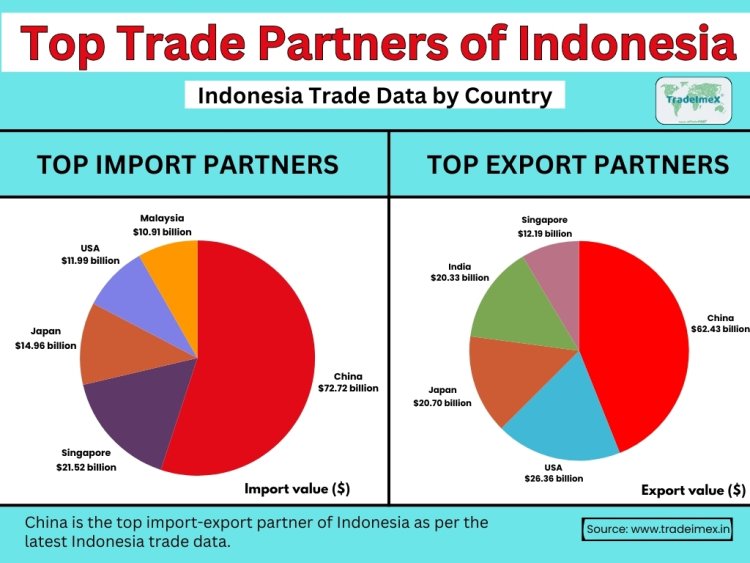
Top Trade Partners of Indonesia: Indonesia Trade Data by Country
Indonesia's top trade partners play a crucial role in the country's economy. Key Indonesia import partners include China, Japan, and Singapore, while essential Indonesia export partners consist of the United States, China, and Japan. These trade relationships highlight Indonesia's global presence and the importance of international trade for the country's economic growth. Indonesia's top trade partners as per Indonesia import-export data and Indonesia trade data for 2024 include:
|
Top import partners |
Import value ($) |
Top export partners |
Export value ($) |
|
1. China |
$72.72 billion (31%) |
1. China |
$62.43 billion (23%) |
|
2. Singapore |
$21.52 billion (9.2%) |
2. USA |
$26.36 billion (10%) |
|
3. Japan |
$14.96 billion (6.4%) |
3. Japan |
$20.70 billion (7.8%) |
|
4. USA |
$11.99 billion (5.1%) |
4. India |
$20.33 billion (7.7%) |
|
5. Malaysia |
$10.91 billion (4.7%) |
5. Singapore |
$12.19 billion (4.6%) |
Indonesia Import-Export Data in the Last 10 Years: Yearly Customs Trade Data

|
Year of Trade |
Indonesia total imports ($) |
Indonesia total exports ($) |
|
2014 |
$178.17 billion |
$176.03 billion |
|
2015 |
$142.69 billion |
$150.28 billion |
|
2016 |
$135.65 billion |
$144.49 billion |
|
2017 |
$156.92 billion |
$168.81 billion |
|
2018 |
$188.71 billion |
$180.21 billion |
|
2019 |
$171.27 billion |
$167.68 billion |
|
2020 |
$141.62 billion |
$163.30 billion |
|
2021 |
$195.69 billion |
$231.58 billion |
|
2022 |
$237.44 billion |
$291.97 billion |
|
2023 |
$221.73 billion |
$258.79 billion |
|
2024 |
$233.65 billion |
$264.70 billion |
Steps to Find Buyers and Suppliers in Indonesia
- Identify Your Target Market: Before you start searching for buyers and suppliers in Indonesia, it's important to identify your target market. Determine which products or industries you are interested in and research market trends and demand in Indonesia.
- Use Search Tools: Once you have identified your target market, you can use the TradeImeX search live data feature to find potential buyers and suppliers in Indonesia. You can search by product, company, HS code, or trade route to narrow down your results and find relevant information on Indonesia customs data.
- Analyze Import and Export Data: By analyzing import and export data, you can gain valuable insights into market trends and identify key players in the Indonesian market. Look for companies that are importing or exporting products similar to yours, as they may be potential partners for your business.
- Contact Potential Buyers and Suppliers: Once you have identified potential buyers and suppliers in Indonesia, you can use the contact information provided by TradeImeX to reach out and establish business relationships. Introduce your company, discuss potential opportunities for collaboration, and negotiate terms of trade.
- Monitor Market Trends: Finally, it's important to stay informed about market trends and developments in Indonesia. By regularly monitoring customs data and market intelligence provided by TradeImeX, you can adapt your business strategy to meet changing market conditions and stay ahead of the competition.
Using Customs Data to Find Buyers
Once you have access to customs data, you can start using it to find potential buyers in Indonesia. By analyzing the import activities of companies, you can identify businesses that are importing products similar to yours or related to your industry. You can then reach out to these companies to explore potential partnership opportunities, such as supplying them with your products or offering them distribution services.
Using Customs Data to Find Suppliers
Similarly, customs data can also help you find reliable suppliers in Indonesia. By analyzing the export activities of companies, you can identify manufacturers or wholesalers that are exporting products that you are interested in. You can then reach out to these suppliers to inquire about their products, pricing, and terms of trade. By leveraging customs data in this manner, you can streamline your supplier’s sourcing process and find trusted partners for your business.
Conclusion
In conclusion, finding buyers and suppliers in Indonesia using customs data is an effective strategy for businesses looking to expand their operations in this dynamic market. By accessing and analyzing customs data, businesses can gain valuable insights into market trends, identify key players, and make informed decisions about whom to do business with. Leveraging this data can give businesses a competitive edge and increase their chances of success in Indonesia. So, what are you waiting for? Start exploring customs data today to unlock new opportunities in the Indonesian market!
We hope that you liked our interactive report on how to find Indonesian buyers & suppliers using customs data. Visit TradeImeX to access more of these market reports and trade trends. Contact us at info@tradeimex.in and easily get a list of Indonesia’s top export companies and import companies with our Indonesia exporters data and Indonesia importers data
Share
What's Your Reaction?
 Like
0
Like
0
 Dislike
0
Dislike
0
 Love
0
Love
0
 Funny
0
Funny
0
 Angry
0
Angry
0
 Sad
0
Sad
0
 Wow
0
Wow
0