Exploring the Potential of India-EU Free Trade Agreement: Europe-India Trade Corridor
Explore the potential of the India-EU Free Trade Agreement and its impact on the Europe-India Trade Corridor. Get insights into trade trends, key exports & imports, and growth projections.


The potential of the India-EU Free Trade Agreement holds significant promise for both regions, particularly in the context of the Europe-India Trade Corridor. The most recent round of free trade agreement negotiations between India and the EU, which lasted from March 10 to 14, has recently concluded. Before this, India's Commerce Minister continued trade talks in the United States on March 4–6. By agreeing to complete their Free Trade Agreement by the end of 2025, India and the EU have taken a significant step forward.
Through this agreement, the EU-India trade relations will be strengthened in several areas, such as investment, trade, mobility, and technology. According to global trade data, the total value of India's imports from the EU reached $65.12 billion, while India's exports to the EU accounted for $93.08 billion in 2024. The total bilateral trade volume between the EU and India reached $158.2 billion in 2024, a substantial 6.73% increase from the previous year. This article will delve into the opportunities and challenges presented by this agreement and explore how it can shape the future of trade between India and the European Union.
- Over the years, discussions have stalled, with industries like cars, pharmaceuticals, and agriculture becoming obstacles.
- The EU and India have the potential to be one of the key partnerships of this century," stated Ursula von der Leyen, president of the European Commission.
- By the end of the year, India and the EU hope to have a free trade agreement finalized.
Understanding the India-EU Free Trade Agreement
The India-EU Free Trade Agreement has been under negotiation since 2007, to strengthen economic ties between the two regions. This agreement seeks to eliminate tariffs and non-tariff barriers to trade, facilitate market access for goods and services, and promote investment flows between India and the EU. By fostering greater economic integration, the agreement aims to create a more conducive environment for businesses in both regions to thrive.
List of top Commodities India Imports from EU: India-EU Import Products
The top 10 Indian imports from the European Union cover a wide range of products that contribute significantly to the bilateral trade between the two regions. Some key India-EU import products include machinery, automobiles, pharmaceuticals, chemicals, electronic equipment, and precious metals. These imports not only support various industries in India but also reflect the strong economic ties between India and the EU. The top 10 goods that India imports from the EU, as per the global shipment data and Europe trade data for 2024 include:
- Nuclear reactors and machinery (HS code 84): $13.31 billion
- Electrical machinery and equipment (HS code 85): $4.79 billion
- Aircraft, spacecraft, and parts thereof (HS code 88): $4.12 billion
- Optical, medical, or surgical instruments (HS code 90): $3.68 billion
- Iron and steel (HS code 72): $3.12 billion
- Precious stones and metals (HS code 71): $2.78 billion
- Plastics and articles thereof (HS code 39): $2.46 billion
- Vehicles (HS code 87): $2.22 billion
- Organic chemicals (HS code 29): $2.22 billion
- Miscellaneous chemical products (HS code 38): $1.77 billion
List of top Commodities India Exports to EU: India-EU Export Products
India's exports to the European Union encompass a diverse range of commodities that foster bilateral trade relations and economic growth. Some of India's top exports to the EU include textiles, pharmaceuticals, machinery, organic chemicals, and vehicles. These products not only showcase India's rich manufacturing capabilities but also highlight its significance as a key trading partner for the EU. The top 10 goods that India exports to the EU, as per the global trade records and EU trade statistics for 2024 are:
- Mineral fuels and oils (HS code 27): $21.49 billion
- Electrical machinery and equipment (HS code 85): $9.26 billion
- Nuclear reactors and machinery (HS code 84): $6.80 billion
- Organic chemicals (HS code 29): $5.39 billion
- Iron and steel (HS code 72): $4.64 billion
- Precious stones and metals (HS code 71): $3.70 billion
- Pharmaceutical products (HS code 30): $3.54 billion
- Articles of apparel and clothing, not knitted (HS code 62): $2.91 billion
- Vehicles (HS code 87): $2.53 billion
- Articles of apparel and clothing, knitted (HS code 61): $2.48 billion
India-EU Trade in the Last 10 Years: Yearly India-EU Trade Data
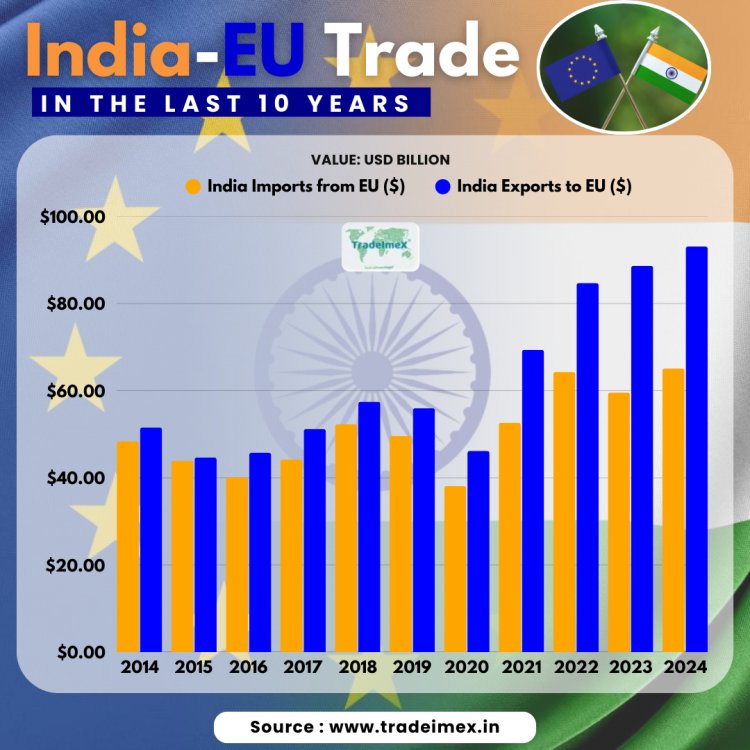
|
Year of Trade |
India Imports from EU ($) |
India Exports to EU ($) |
|
2014 |
$48.37 billion |
$51.56 billion |
|
2015 |
$43.91 billion |
$44.69 billion |
|
2016 |
$40.13 billion |
$45.74 billion |
|
2017 |
$44.21 billion |
$51.19 billion |
|
2018 |
$52.29 billion |
$57.47 billion |
|
2019 |
$49.60 billion |
$56 billion |
|
2020 |
$38.10 billion |
$46.20 billion |
|
2021 |
$52.64 billion |
$69.36 billion |
|
2022 |
$64.31 billion |
$84.69 billion |
|
2023 |
$59.56 billion |
$88.66 billion |
|
2024 |
$65.12 billion |
$93.08 billion |
India's Top Import Partners in the EU: India-EU Trade Data by Country
India's top import partners in the EU play a significant role in shaping the India-EU trade landscape. The trade data by country points towards a strong economic relationship between India and key EU nations. Germany, Belgium, and the United Kingdom emerged as prominent import partners, highlighting the diversified trade avenues between India and the European Union. Germany is India's largest import partner in the EU, as per Germany export data and the export data of Germany exports to India. India's top EU import partners in 2024, include:
- Germany: $17.15 billion
- United Kingdom: $8.40 billion
- France: $7.10 billion
- Belgium: $6.68 billion
- Italy: $5.74 billion
India's Top Export Partners in the EU: India-EU Trade Data by Country
India's top export partners in the EU play a crucial role in shaping the trade landscape between the two regions. Analyzing India-EU trade data by country provides valuable insights into the economic relations that drive these partnerships. Countries like Germany, the United Kingdom, and the Netherlands have emerged as key players in India's export ventures within the European Union. The Netherlands is India's biggest export partner in the EU, as per Netherlands import data. The top 10 export partners of India amongst the European Union members in 2024, include:
- Netherlands: $24.63 billion
- United Kingdom: $14.29 billion
- Germany: $10.40 billion
- Italy: $8.46 billion
- France: $7.87 billion
What does India-EU trade look like?
With €124 billion in goods traded or 12.2% of all Indian trade in 2023, the EU is India's biggest trading partner. In 2023, the value of services traded between the EU and India was close to €60 billion, about double that of 2020. Of that, digital services accounted for one-third.
Around 10.8% and 10.5% of India's overall trade is with the US and China, respectively. With 2.2% of the bloc's total commerce, India is the ninth-largest commercial partner of the EU. Although commerce between India and the EU has increased by around 90% in the last ten years, negotiations for a free trade agreement have stalled over time because of notable differences between the two nations, particularly in the areas of pharmaceuticals, cars, and agriculture.
What would the India-EU trade agreement include?
Von der Leyen emphasized artificial intelligence, clean technology, and semiconductors as important sectors that would gain from a trade deal in her speech in India. Achieving an agreement will be complicated, however, with considerable adjustments expected on both sides in fields spanning vehicles and alcohol to medical pharmaceuticals and textiles.
The EU wants India to reduce tariffs of over 100 percent on cars, wine and whiskey. India, meanwhile, seeks reduced tariffs and increased market access for important exports, such as clothing, textiles, and pharmaceuticals. India has also raised objections to several environmental regulations from the EU, such as border carbon taxes on cement, steel, and aluminum.
Opportunities for Growth in the Europe-India Trade Corridor
The Europe-India Trade Corridor presents a wealth of opportunities for businesses looking to expand their market reach. With the India-EU Free Trade Agreement in place, companies in both regions stand to benefit from increased access to each other's markets, reduced trade barriers, and enhanced regulatory cooperation. This could lead to a boost in bilateral trade and investment flows, driving economic growth and job creation in both regions.
Addressing Challenges and Roadblocks
While the India-EU Free Trade Agreement holds immense potential, some challenges and roadblocks need to be addressed. Issues such as differences in regulatory standards, intellectual property rights protection, and market access barriers can hinder the smooth implementation of the agreement. By addressing these challenges through dialogue, negotiation, and cooperation, both regions can unlock the full potential of their trade relationship.
Negotiation Focus Areas of India-EU FTA
The FTA negotiations, relaunched in June 2022 after an eight-year hiatus, encompass several critical areas:
- Tariffs on Automobiles and Alcoholic Beverages: The EU is advocating for reductions in India's high tariffs, which range between 100% and 150%, on imported cars, whiskey, and wine.
- Carbon Tax and Environmental Regulations: India has expressed concerns over the EU's proposed Carbon Border Adjustment Mechanism (CBAM), which plans to impose tariffs of 20% to 35% from January 2026 on high-carbon goods, including steel, aluminum, and cement. India perceives these measures as potential trade barriers that could affect its exports.
- Investment Protection: The EU seeks provisions for easier profit repatriation and expedited dispute resolution for its companies operating in India. India, however, insists that disputes should initially go through local courts before international arbitration.
- Data Security and Movement of Professionals: India is pushing for recognition as a data-secure country to facilitate digital trade and seeks easier temporary work access for its skilled professionals in the EU, benefiting sectors like IT. The EU, in return, demands India liberalize its accountancy, architecture, and legal services, a move opposed by local industry groups.
Trade and Pricing Trends
The implementation of the FTA is anticipated to influence trade and pricing dynamics:
- Automobiles: Reducing tariffs on EU automobiles could lead to increased imports of European cars into India, potentially intensifying competition in the domestic market and influencing pricing strategies.
- Agricultural Products: The EU's demand for lower tariffs on agricultural goods, currently between 35% and 60%, could result in increased imports of European agricultural products, affecting domestic prices and the livelihoods of local farmers.
- Environmental Compliance Costs: The EU's environmental regulations, such as the CBAM, could impose additional costs on Indian exporters of high-carbon goods, potentially affecting their competitiveness in the EU market.
Key Takeaways and Overview
- India-EU Trade Volume (2024): $155.2 billion
- India's Exports to EU: $93.08 billion
- India's Imports from EU: $65.12 billion
- Key Industries Benefiting from FTA: Automobiles, Pharmaceuticals, IT Services, Textiles, Steel, Alcoholic Beverages
Tariff Reductions & Market Access
- EU demands lower tariffs on automobiles and alcoholic beverages, currently:
- Luxury Cars: 100%-150%
- Whiskey & Wine: 100%-150%
- India seeks greater market access for IT services, textiles, and pharmaceuticals in the EU.
Carbon Border Tax (CBAM) Impact
- CBAM Tariffs (from 2026): 20%-35% on steel, aluminum, and cement.
- Indian exporters face increased compliance costs for high-carbon goods.
Investment & Dispute Resolution
- EU Proposal: Fast-track dispute settlement, easier profit repatriation.
- India's Stand: Local legal channels before international arbitration.
Movement of Skilled Professionals
- India demands easier visa regulations for IT & engineering professionals.
- EU seeks liberalization of the Indian legal & accounting services market.
Projected Trade & Pricing Trends Post-FTA
|
Sector |
Expected Impact Post-FTA |
|
Automobiles |
Lower tariffs → Increased EU car imports → Higher competition for Indian brands |
|
Alcoholic Beverages |
Lower tariffs → More European wines & whiskeys in India |
|
Pharmaceuticals |
Increased market access → Boost in Indian generic drug exports |
|
Textiles & Apparel |
Enhanced duty-free access → More Indian garment exports to the EU |
|
Steel & Cement |
CBAM tax impact → Higher production costs for Indian exporters |
|
IT & Digital Trade |
Easier movement of professionals → Increased Indian IT exports to the EU |
Expected Growth Post India-EU Free Trade Agreement (2026 Projection)
|
Parameter |
2024 (Pre-FTA) |
2026 (Post-FTA Projection) |
|
Total Trade Volume |
$155.2 billion |
$180 billion |
|
India’s Exports to EU |
$93.08 billion |
$100 billion |
|
India’s Imports from EU |
$65.12 billion |
$80 billion |
Conclusion
In conclusion, the India-EU Free Trade Agreement has the potential to reshape the economic landscape of both regions and create new opportunities for growth and collaboration. With the Europe-India Trade Corridor as a conduit for enhanced trade and investment flows, the agreement has the potential to unlock new opportunities for businesses in both regions and pave the way for a more prosperous future. As both regions work towards finalizing the agreement, it is imperative to address challenges and foster cooperation to ensure a mutually beneficial outcome for all stakeholders involved.
We hope that you liked our interactive blog on India-EU trade and the potential of their free trade agreement. To get more insights on global trade trends, trading bloc insights, and import-export data, visit TradeImeX. Contact us at info@tradeimex.in.
Share
What's Your Reaction?
 Like
0
Like
0
 Dislike
0
Dislike
0
 Love
0
Love
0
 Funny
0
Funny
0
 Angry
0
Angry
0
 Sad
0
Sad
0
 Wow
0
Wow
0