Brazil-Russia Trade Relations Ahead of BRICS 2026: Bilateral Trade Data & Top Traded Products
Explore Brazil–Russia trade relations ahead of BRICS 2026, including bilateral trade data, top traded products, key trade trends, and market insights.


The evolving economic relationship between Brazil and Russia is gaining strategic and commercial prominence as the two countries prepare to engage within an expanded and increasingly influential BRICS framework heading into 2026. Once peripheral partners in each other’s foreign trade matrices, Russia and Brazil have steadily deepened commercial ties, a trend driven by complementary economic structures, shared geopolitical outlooks, and the search for resilient markets amid global trade tensions. According to the latest Brazil export data & Russia import data, the total value of Brazil-Russia trade accounted for $10.91 billion in 2025.
Brazil is the 4th largest trading partner of Russia, according to global trade data. With the upcoming BRICS summit in 2026, all eyes are on the bilateral trade data for 2025 to gauge the progress made and identify opportunities for further expansion. In this article, we will delve into the trade data for 2025 and highlight the top traded products between Brazil and Russia.
Russia-Brazil Trade: Historical Context & Strategic Importance
Brazil and Russia officially established diplomatic relations in 1945, but commercial ties remained modest for decades. In the early 2000s, bilateral trade hovered at lower levels, marked by agricultural and basic commodities exchanges. Over the last decade and particularly following global geopolitical realignments, such as heightened Western sanctions on Russia, the commerce between Russia & Brazil increased significantly in both volume and complexity.
A turning point came in 2024, when bilateral trade reached a record high of around US$12.4 billion. Russia’s exports comprised about US$11 billion of that figure, while Brazil’s exports were roughly US$1.4–1.5 billion, crystallizing the historically heavily imbalanced trade relationship.
This imbalance reflects structural economic patterns: Russia is a significant exporter of energy and agricultural inputs, while Brazil is a global agricultural powerhouse exporting meat, coffee, and grains, products increasingly sought by Russian markets.
2025: Trade Data and Statistical Picture
Bilateral Trade Flows in 2025
According to the latest Brazil-Russia trade database and national reporting:
-
Brazil’s exports to Russia in 2025 were approximately US$1.52 billion. This figure represents sustained expansion over previous years, even as it remains modest relative to Brazil’s total exports.
-
Russia’s exports to Brazil continued robustly, with detailed monthly data showing, for example, in December 2025, Brazil exported US$140 million worth of goods to Russia, up sharply from the same month in 2024.
Trade data confirms that in late 2025, the monthly figures remained positive on the export side, showing emerging diversification of goods and markets. While official data for Russian exports to Brazil in the full-year 2025 lags behind total consolidated figures, national institutions reported that Russia remained one of Brazil’s leading sources of imports for key input goods such as fertilizers and refined energy products.
Notably, Brazil’s trade balance with Russia continues to be strongly in deficit, a reflection of its much larger import intake from Russia. The volume of trade, however, underscores growth: intermediated reports from 2025 place the six-month trade turnover at approximately US$ 5.8 billion, with strong year-on-year increases (e.g., 32 % growth in Russian exports to Brazil in this period alone).
Top Goods Brazil Imports from Russia: What Does Brazil Import from Russia?
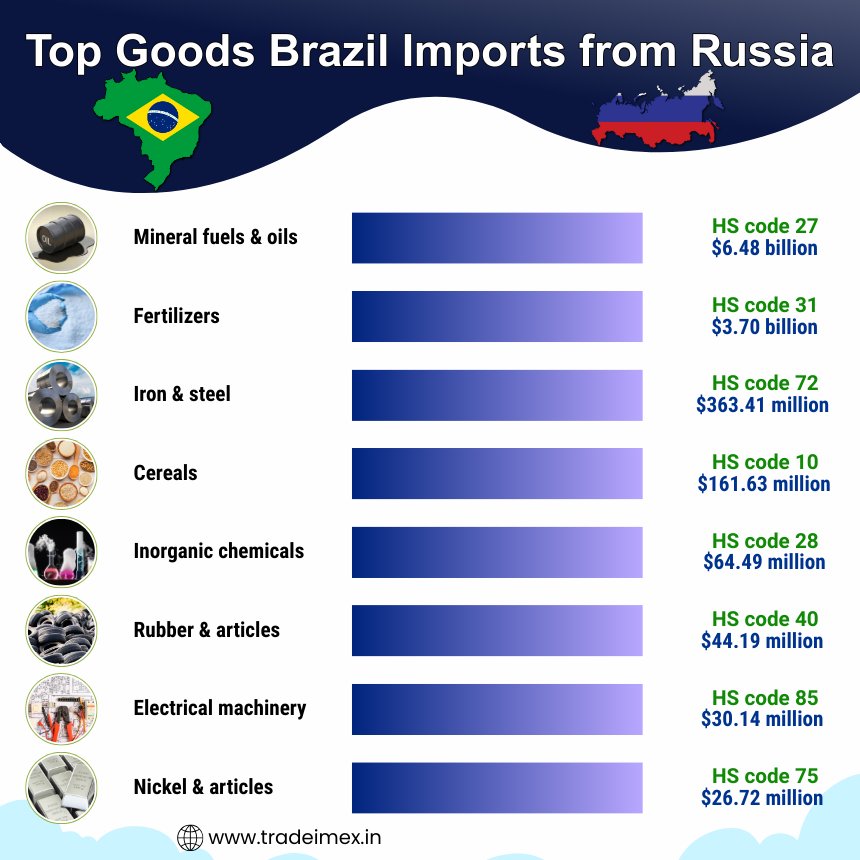
Brazil ranks as one of the significant importers of goods from Russia, with the top products being mainly commodities such as grain, oil, iron, and metal products. These imports strengthen the economic relationship between the two countries and contribute to their respective industrial sectors. Brazil imported goods worth $9.39 billion in 2025. The top 10 goods that Brazil imports from Russia, as per the Brazil import data & Russia export data for 2025, include:
1. Mineral fuels & oils (HS code 27): $6.48 billion
One of the top goods that Brazil imports from Russia is mineral fuels and oils. This includes products such as petroleum, natural gas, and other fossil fuels. These resources are essential for Brazil's energy needs, as well as for its industrial sector. Brazil relies on Russia to supply a significant portion of its fuel requirements, making this one of the most important imports from the country.
2. Fertilizers (HS code 31): $3.70 billion
Another essential import for Brazil from Russia is fertilizers. These products are crucial for Brazil's agricultural sector, as they help improve soil fertility and crop yields. With a large agricultural industry, Brazil depends on imports of fertilizers to sustain its agricultural production. Russia is a key supplier of fertilizers to Brazil, providing the country with the necessary resources to support its farming activities, as per the data on Russia fertilizer exports to Brazil.
3. Iron & steel (HS code 72): $363.41 million
Iron and steel are vital materials for Brazil's construction and manufacturing industries. These products are used in the production of various goods, including vehicles, machinery, and infrastructure projects. Brazil imports a significant amount of iron and steel from Russia to meet its domestic demand for these materials. The country relies on these imports to support its construction projects and industrial activities.
4. Cereals (HS code 10): $161.63 million
Cereals are another important import for Brazil from Russia. These products include grains such as wheat, barley, and corn, which are essential for Brazil's food and livestock industries. Brazil imports cereals from Russia to supplement its domestic production and ensure food security for its population, as per the data on Brazil cereals imports from Russia by HS code. These imports play a crucial role in supporting Brazil's agricultural sector and ensuring a stable food supply for the country.
5. Inorganic chemicals (HS code 28): $64.49 million
Inorganic chemicals are essential for various industries in Brazil, including pharmaceuticals, textiles, and manufacturing. These products are used in the production of a wide range of goods, from medicines to consumer products. Brazil imports inorganic chemicals from Russia to meet its industrial needs and support its manufacturing sector. These imports contribute to the growth of Brazil's economy and help sustain its industrial activities.
6. Rubber & articles thereof (HS code 40): $44.19 million
Rubber and rubber products are critical for Brazil's automotive, construction, and manufacturing sectors. These materials are used in the production of tires, conveyor belts, and other industrial products. Brazil imports rubber and articles thereof from Russia to support its manufacturing activities and ensure a steady supply of these essential materials. These imports play a vital role in sustaining Brazil's industrial growth and supporting its economic development.
7. Electrical machinery & equipment (HS code 85): $30.14 million
Electrical machinery and equipment are essential for Brazil's electronics, telecommunications, and energy sectors. These products include items such as generators, transformers, and electrical appliances. Brazil imports electrical machinery and equipment from Russia to support its technological advancement and infrastructure development. These imports are crucial for Brazil's energy security and economic growth, as they help meet the country's increasing demand for electrical products.
8. Nickel & articles thereof (HS code 75): $26.72 million
Nickel is a vital material for Brazil's steel, automotive, and aerospace industries. This metal is used in the production of stainless steel, alloys, and other high-performance materials. Brazil imports nickel and articles thereof from Russia to support its industrial activities and ensure a stable supply of this essential material. These imports contribute to the growth of Brazil's manufacturing sector and help enhance the country's competitiveness in the global market.
9. Nuclear reactors & machinery (HS code 84): $25.71 million
Nuclear reactors and machinery are crucial for Brazil's energy production and infrastructure development. These products are used in the generation of electricity, as well as in various industrial applications. Brazil imports nuclear reactors and machinery from Russia to support its energy needs and ensure a reliable supply of these technologies. These imports play a vital role in Brazil's energy security and help drive the country's infrastructure projects.
10. Salt, sulfur, lime, & cement (HS code 25): $17.57 million
Salt, sulfur, lime, and cement are fundamental materials for Brazil's construction, agriculture, and manufacturing sectors. These products are used in a wide range of applications, from building materials to fertilizers. Brazil imports salt, sulfur, lime, and cement from Russia to meet its domestic demand for these materials and support its industrial activities. These imports contribute to Brazil's economic growth and help sustain its construction projects and agricultural production.
Energy Imports Lead the Way
Russian fertilizers have been particularly significant. In 2024, fertilizer shipments accounted for approximately 34% of Brazilian imports from Russia, underscoring Brazil’s reliance on these inputs to sustain its global agricultural output. While Russia’s export volume to Brazil surpasses Brazil’s exports by a significant margin, the core categories have centered on inputs essential to Brazilian production and energy.
Recent trade coverage indicates that Russia’s prominence as a diesel supplier has faced dynamic shifts due to changes in global sanctions regimes, diversified supply sources, and evolving trade costs, leading Brazil to gradually diversify diesel imports among suppliers.
Top Goods Brazil Exports to Russia: What Does Brazil Export to Russia?
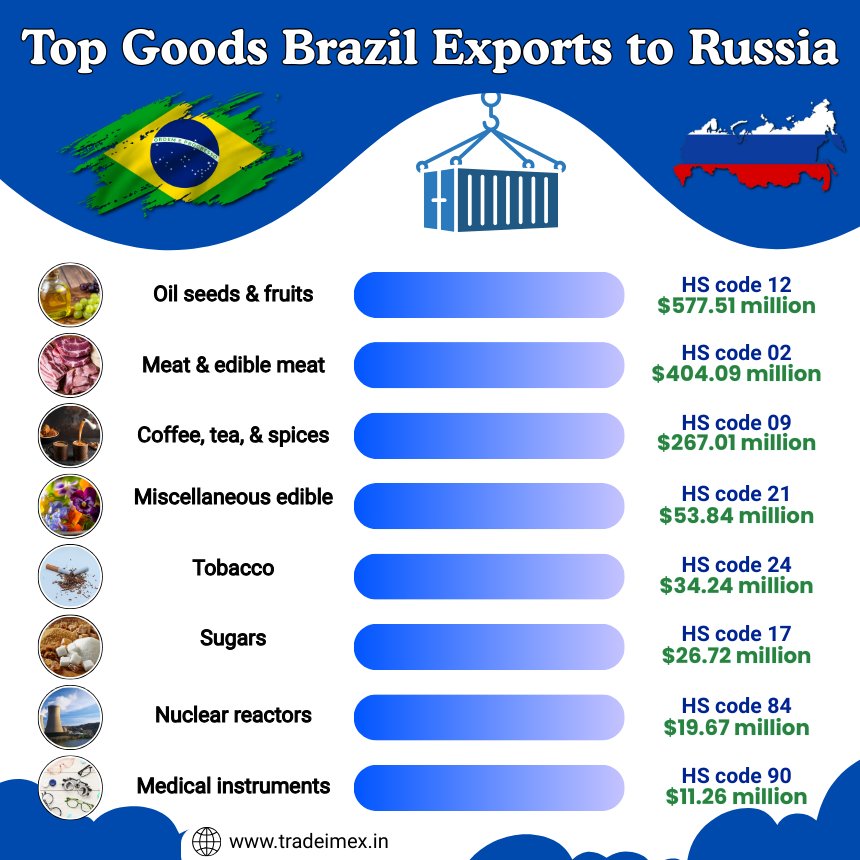
Brazil's export market to Russia thrives on a variety of top goods, making it an essential trade relationship. The key products that Brazil exports to Russia include agricultural goods like soybeans, meat products, and coffee, which highlight Brazil's strength in the agribusiness sector. Furthermore, Brazil also exports machinery, chemicals, and iron ore to meet Russia's industrial demand. According to the latest Brazil shipment data and Russia customs data, the total value of Brazil exports to Russia reached $1.52 billion in 2025. The major goods that Brazil exports to Russia include:
1. Oil seeds & oleaginous fruits (HS code 12): $577.51 million
One of the top goods that Brazil exports to Russia is oilseeds and oleaginous fruits. This category includes soybeans, sunflower seeds, and other oil-producing crops, as per the data on Brazil exports to Russia by HS code. Russia is a major importer of these products from Brazil, as they are used in various industries such as food processing and animal feed production. The value of exports in this category amounts to $577.51 million, making it a significant part of the trade relationship between Brazil and Russia.
2. Meat & edible meat offal (HS code 02): $404.09 million
Another major export category from Brazil to Russia is meat and edible meat offal. This includes products such as beef, poultry, and pork, which are in high demand in the Russian market. The value of exports in this category totals $404.09 million, showcasing the importance of the meat industry in Brazil's exports to Russia.
3. Coffee, tea, & spices (HS code 09): $267.01 million
Brazil is famous for its coffee production, and it is no surprise that coffee is one of the top goods exported to Russia. In addition to coffee, Brazil also exports tea and spices to the Russian market. The value of exports in this category amounts to $267.01 million, highlighting the popularity of Brazilian coffee and other products in Russia.
4. Miscellaneous edible preparations (HS code 21): $53.84 million
This category includes various edible preparations such as sauces, condiments, and food preparations. Brazil exports a range of these products to Russia, with a total value of $53.84 million. While not as large as other export categories, miscellaneous edible preparations still play a role in Brazil's trade with Russia.
5. Tobacco (HS code 24): $34.24 million
Tobacco is another significant export from Brazil to Russia, with a value of $34.24 million. Brazilian tobacco is known for its quality, making it a sought-after product in the Russian market. The tobacco industry contributes to the overall trade relationship between the two countries.
6. Sugars & sugar confectionery (HS code 17): $26.72 million
Brazil is a major producer of sugar, and this is reflected in its exports to Russia. Sugars and sugar confectionery products have a total export value of $26.72 million. These products are used in various industries, including food production and confectionery.
7. Nuclear reactors & machinery (HS code 84): $19.67 million
Brazil also exports nuclear reactors and machinery to Russia, with a total value of $19.67 million. These products are crucial for various industrial sectors and contribute to the technology exchange between the two countries.
8. Optical, medical, surgical instruments (HS code 90): $11.26 million
Optical, medical, and surgical instruments are another category of goods exported from Brazil to Russia. These products have a total export value of $11.26 million and play a role in the healthcare industry in Russia.
9. Products of animal origin (HS code 05): $10.23 million
Brazil exports products of animal origin to Russia, including dairy products and eggs. The total value of exports in this category is $10.23 million, underscoring the importance of these goods in the trade relationship between the two countries.
10. Pharmaceutical products (HS code 30): $6.19 million
Lastly, Brazil exports pharmaceutical products to Russia, with a total export value of $6.19 million. These products are essential for the healthcare industry and contribute to the overall trade balance between Brazil and Russia.
Agricultural Exports Lead
The dominance of meat, coffee, and oilseeds reinforces Brazil’s role as a global agricultural exporter. Although these products are relatively low in value compared to manufactured goods, they form a consistent and resilient trade pillar with Russia. Data from Brazil’s trade authorities confirms that soybeans, coffee, bovine meat, and poultry account for the vast majority of export revenues to Russia. In 2024–25, these products collectively accounted for nearly 80% of Brazil’s export revenue to the Russian market.
The strong demand for Brazilian agricultural products in Russia has also catalyzed technical cooperation, including agreements to simplify sanitary inspections and certifications, which are crucial for commodities such as beef and poultry, as well as to open new markets for products like eggs and cocoa beans.
Brazil-Russia Trade in the Last 10 Years: Yearly Bilateral Trade Data
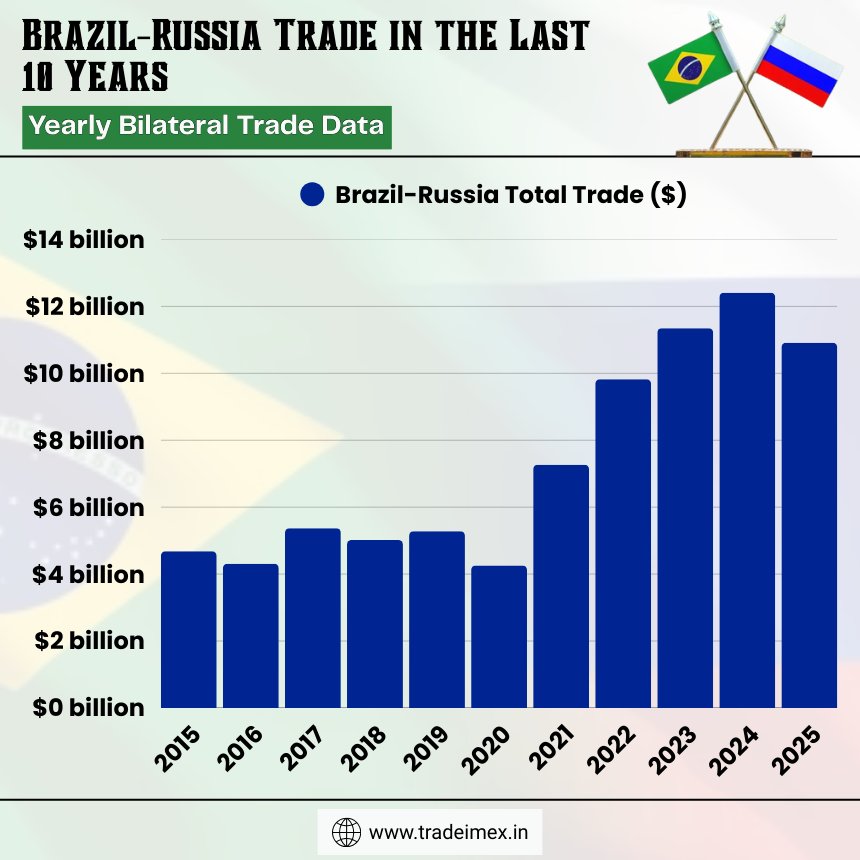
|
Year of Trade |
Brazil-Russia Total Trade ($) |
|
2015 |
$4.68 billion |
|
2016 |
$4.31 billion |
|
2017 |
$5.37 billion |
|
2018 |
$5.02 billion |
|
2019 |
$5.28 billion |
|
2020 |
$4.26 billion |
|
2021 |
$7.27 billion |
|
2022 |
$9.82 billion |
|
2023 |
$11.35 billion |
|
2024 |
$12.41 billion |
|
2025 |
$10.91 billion |
Drivers of Bilateral Trade Growth
Several structural and strategic factors underlie the deepening Brazil–Russia trade relationship:
1. Complementary Economic Structures: Brazil’s export strengths in agriculture mesh with Russia’s export capabilities in energy and industrial inputs. The agricultural sector in Brazil is one of the world’s most productive, while Russia’s fertilizers, refined fuels, and energy commodities are competitively priced and globally significant.
2. Geopolitical Realignment: Russia’s pivot toward non-Western markets, in part due to sanctions from the United States and EU after 2022, has accelerated trade with emerging markets. Brazil, under a foreign policy that seeks diversification and greater South-South cooperation, has reinforced this trend through BRICS and bilateral engagement.
3. BRICS Framework and Shared Goals: BRICS serves as a political and economic forum for Brazil and Russia to coordinate trade policy, currency cooperation, and multidimensional economic dialogue. The grouping’s effort to reduce dependency on Western financial and trade systems further aligns Brasília and Moscow toward long-term economic collaboration.
4. Diversification Strategy: Brazil is actively promoting diversification of its Russian trade beyond commodities into energy, mining, technology, and strategic minerals. Conversely, Russia sees Brazil as a gateway to larger Latin American markets, offering avenues for technologies, industrial products, and agricultural cooperation.
Challenges and Trade Imbalances
Despite growth, several challenges persist:
-
Trade Imbalance: Brazil’s trade balance with Russia is significantly negative, reflecting a structural reliance on Russian imports for key inputs.
-
Sanctions and Political Risk: Global geopolitical tensions, including potential secondary sanctions from Western entities, create uncertainties around Russia-linked trade flows, though both countries reaffirm their commitment to sovereign trade relations.
-
Trade and Diversification: Distance, costs, and trade bottlenecks limit more rapid expansion into manufacturing and high-value products.
Looking Ahead to BRICS 2026
The BRICS Summit in 2026 will provide a platform for Brazil and Russia to further anchor their economic cooperation within a broader geopolitical context. Expectations include:
-
Enhanced trade policy frameworks aimed at reducing barriers and incentivizing value-added goods.
-
Coordination on currency use and financial instruments to diminish reliance on external currencies, potentially facilitating trade in rubles and reais.
-
Expanded collaboration in energy transition, technology, and agritech, leveraging Russian expertise in nuclear energy and Brazil’s agricultural science.
As BRICS expands its membership and influence, the Brazil–Russia bilateral economic relationship is poised to become a cornerstone of not just their own national strategies, but of broader South-South cooperation in global trade.
Conclusion and Final Thoughts
Brazil–Russia trade relations in 2025 reflect a dynamic, increasingly strategic partnership. While dominated by agricultural exports from Brazil & energy/agricultural inputs from Russia, the volume and sophistication of commercial exchanges are rising. With trade volumes in the billions of dollars annually and mutual interest in diversifying into new sectors, the relationship is likely to solidify further as both countries approach BRICS 2026, navigating geopolitical tensions and market challenges alike.
This evolving partnership underscores a broader shift in global trade architecture toward multipolar cooperation and reflects the utility of BRICS as both an economic and geopolitical forum for emerging market economies.
Want to know more about the latest global trade database and skyrocket your business? Visit TradeImeX and search live import-export data by country, product, HS code, & company. Contact us at info@tradeimex.in for customized trade data reports & market insights.
Share
What's Your Reaction?
 Like
0
Like
0
 Dislike
0
Dislike
0
 Love
0
Love
0
 Funny
0
Funny
0
 Angry
0
Angry
0
 Sad
0
Sad
0
 Wow
0
Wow
0