
US-China Trade Deal 2025 Explained: Impact on Exports, Imports & Tariffs
Discover the highlights of the US-China Trade Deal 2025, including changes in exports, imports, & tariffs. Explore how this deal reshapes global trade.

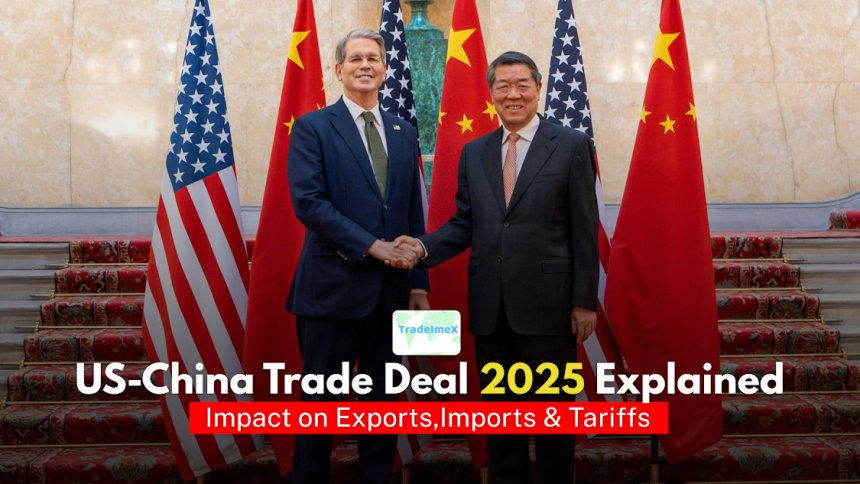
In recent years, the trade relationship between the United States and China has been a topic of great importance and contention. The two largest economies in the world have been engaged in a trade war, with tariffs and other barriers being put in place that have had significant impacts on both countries’ economies. However, in June 2025, a new trade deal was reached between the US and China that has the potential to reshape the global trade data and international trade landscape. As far as the US-China bilateral trade is concerned, the total value of US imports from China reached $108.47 billion in the first quarter of 2025, as per the US import data. According to China trade data, the total value of US exports to China accounted for $31.82 billion in the first quarter of 2025. In this article, we will explore the impact of the US-China Trade Deal on exports, imports, and tariffs.
U.S. and China Strike Another Trade Deal, But Big Issues Remain
The United States and China have once again reached a tentative agreement to ease their ongoing trade conflict. However, the agreement lacks clarity, and key points of contention between the two economic powerhouses remain unsettled. President Donald Trump revealed late Thursday that a US-China trade deal had been finalized. China’s Ministry of Commerce later confirmed the development but refrained from disclosing specifics.
This announcement followed trade negotiations between American and Chinese officials held in London, building on previous discussions in Geneva, Switzerland. Since returning to the presidency, Trump has sought to dismantle what he views as a global trade structure that disadvantages the U.S. His administration’s trade strategy has been characterized by abrupt policy shifts and limited transparency. For several months, the U.S. and China have been engaged in a tit-for-tat trade war, exposing the economic damage each nation can inflict on the other.
Trump is also facing pressure to finalize trade agreements with other major partners before the July 8 deadline. Meanwhile, the unpredictability of U.S. trade actions and the burden of tariffs, paid by U.S. importers and often passed along to consumers, have raised concerns about the stability of the U.S. economy. Although the recent thaw in tensions was viewed positively by analysts, they remain skeptical that the deep-rooted disagreements between Washington and Beijing will be resolved anytime soon.
Highlights of the US-China Trade Agreement
-
A key component of the latest agreement is China’s commitment to provide rare earth minerals critical to major American industries, such as automotive, semiconductors, and smartphones.
-
President Trump mentioned that these resources would be delivered upfront, although the specifics of that provision remain unclear.
-
China dominates the global rare earth sector, producing approximately 60% of the world’s supply and processing nearly 90%. The United States has long regarded this dependency as a national security risk, a concern that persisted during President Joe Biden’s tenure.
-
In February 2024, then-Energy Secretary Jennifer Granholm expressed the U.S.’s unease with China’s control over strategic minerals.
-
These worries have intensified during Trump’s second term, especially following his implementation of sweeping tariffs, including a 145% levy on Chinese goods, and new export restrictions targeting China’s semiconductor industry.
-
In retaliation, China’s Ministry of Commerce introduced its curbs on rare earth exports in April.
-
As part of the new deal, the U.S. will reduce its tariffs on Chinese imports to a flat rate of 55%, down from 145%. In exchange, China will lower its tariffs on American goods to 10%, a steep cut from the previous 125%.
-
The revised U.S. tariff rate includes several components: a 10% base tariff, currently under legal challenge after being ruled unlawful by a trade court, though a higher court has paused the decision, a 25% tariff originating from Trump’s first term, and an additional 20% related to alleged fentanyl trafficking.
Background of the US-China Trade Relationship
Before delving into the specifics of the US-China Trade Deal 2025, it is important to understand the context of the trade relationship between these two economic giants. The US and China have long been major trading partners, with billions of dollars’ worth of goods and services flowing between the two countries each year. However, tensions began to rise in the early 2010s as the US accused China of unfair trade practices, including intellectual property theft and currency manipulation. This eventually led to the imposition of tariffs on billions of dollars’ worth of goods from both countries, creating a trade war that had far-reaching consequences.
US-China Trade Trends in the Last 10 Years: Yearly US-China Bilateral Trade Data

|
Year of Trade |
US Imports from China ($) |
US Exports to China ($) |
|
2014 |
$486.29 billion |
$123.67 billion |
|
2015 |
$504.04 billion |
$115.87 billion |
|
2016 |
$481.36 billion |
$115.59 billion |
|
2017 |
$525.74 billion |
$129.99 billion |
|
2018 |
$562.70 billion |
$120.28 billion |
|
2019 |
$470.95 billion |
$106.44 billion |
|
2020 |
$456.44 billion |
$124.48 billion |
|
2021 |
$540.07 billion |
$151.44 billion |
|
2022 |
$575.71 billion |
$153.83 billion |
|
2023 |
$448.03 billion |
$147.80 billion |
|
2024 |
$462.63 billion |
$143.54 billion |
|
2025 Quarter 1 |
$108.47 billion |
$31.82 billion |
The US-China Trade Deal 2025 Explained
In 2025, after years of negotiations and escalating tensions, the US and China finally reached a new trade deal that aimed to address many of the issues that had been plaguing their relationship. The deal included provisions for greater market access, intellectual property protection, and the removal of many of the tariffs that had been imposed during the trade war. While the specifics of the deal are complex and multifaceted, several key points are worth highlighting.
Impact on Exports
One of the primary goals of the US-China Trade Deal 2025 was to increase exports between the two countries. Both the US and China have a strong export-driven economy, and the removal of tariffs and other barriers to trade was expected to have a positive impact on the flow of goods between the two countries. As a result, many American companies saw an increase in demand for their products in the Chinese market, leading to a boost in exports and economic growth.
Impact on Imports
In addition to the impact on exports, the US-China Trade Deal 2025 also had significant implications for imports. With the removal of tariffs and other trade barriers, Chinese goods became more competitive in the US market, leading to an increase in imports from China. While this was good news for American consumers, who saw lower prices on a wide range of goods, it also raised concerns about the impact on domestic industries that were unable to compete with cheap Chinese imports.
Impact on Tariffs
Perhaps the most significant aspect of the US-China Trade Deal 2025 was the reduction of tariffs between the two countries. The US-China trade war has led to the imposition of billions of dollars’ worth of tariffs on goods from both the US and China, which has raised prices for consumers and put a strain on many industries. With the signing of the new trade deal, many of these tariffs were removed, leading to lower prices for consumers and a more stable economic environment for businesses.
Setting the Stage: Context & Timeline of the US-China Trade Deal

-
January 20, 2025: Donald Trump takes office, reviving trade tensions.
-
Feb 1: Imposes an extra 10% tariff on all Chinese imports targeting fentanyl precursor chemicals.
-
Feb 4–Mar 4: China retaliates with tariffs on U.S. products (energy, agriculture) rising to 15%, triggering a U.S. counter-tariff escalation to 20%.
-
Apr 2 (“Liberation Day”): Trump declares a national emergency; enacts a 10% baseline tariff and country-specific reciprocal tariffs surging U.S. tariffs on Chinese goods to a cumulative 145% (China hits back with up to 125%).
-
May 12: In Geneva, a 90-day truce kicks in, U.S. tariffs reset to 30%, China’s to 10%, with deeper talks planned.
-
Late June: A rare-earth agreement formalizes China’s expedited exports and ends some U.S. tech/visa restrictions.
-
U.S. average effective tariff now 22.5%, highest since 1909.
Tariff Regime Snapshot
|
Category |
Pre–May Truce |
May–Aug 2025 Truce |
|
Chinese goods imported to the US |
Up to 145% |
30% |
|
U.S. exports to China |
Up to 125% |
10% |
|
Steel & aluminum |
25%+ (Section 232) |
Remains |
|
Auto parts |
25% |
Remains |
|
Fentanyl-related items |
20% (Feb) |
Remains |
Trade Flows & Economic Effects
US-China Bilateral Trade
-
US exports to China: $143.54 billion in 2024, down 2.8% from peak, 531,000 U.S. jobs supported. Jan–Apr 2025 dropped 12% to $40 billion
-
US Imports from China: $462.63 billion in 2024; Jan–Apr 2025 fell 7% to $128 billion, the first dip in years.
-
U.S. trade deficit narrowed: from $95 billion (Jan–Apr 2024) to $88 billion (same 2025 period).
Macro & Household Impacts
-
Price pressure: April tariffs alone drove a +1.3% CPI hike; broader 2025 tariffs +2.3%, costing average households $3,800 and low-income earners $1,700 in lost purchasing power.
-
Growth drag: GDP growth hit by 0.5pp from April measures, 0.9pp across all 2025 tariffs; U.S. economy 0.6% smaller long-term ($160 b/year).
-
State impact: Agriculture and service-heavy states saw deeper adverse effects; manufacturing saw temporary job boosts followed by adjustment pains.
The Rare‑Earths Breakthrough
-
Strategic minerals: China halted exports of rare-earth elements (magnets, dysprosium, terbium), choking U.S. industrial lines (EVs, defense tech) after April.
-
June 27 Agreement: China will begin expediting rare-earth export permits; the U.S. will rescind some technology and visa restrictions.
-
Lingering friction: Chinese licensing remains slow, opaque, and favors big state firms; Western businesses report delayed approvals and IP concerns.
Winners & Losers from the US-China Trade Agreement
Winners
-
U.S. tech & defense industries: eased rare-earth access to restore supply chains.
-
Chinese rare-earth miners/exporters: secured partial market recovery.
-
U.S. services (travel, education): increased Chinese engagement as some tech tensions cooled.
Losers
-
U.S. consumers & manufacturers: higher tariffs increased costs; CPI spiked, and margins were squeezed.
-
U.S. agricultural exporters: Chinese retaliation on soybeans, pork, and grains persisted.
-
Small businesses in trade-sensitive states faced reduced order volumes and disrupted supply chains.
China Cancels US Pork Imports: Impact on US-China Trade Relations
In April 2025, China officially halted significant imports of U.S. pork, marking a sharp decline in trade that had previously been robust. The suspension was primarily attributed to ongoing geopolitical tensions and stricter sanitary regulations following rising concerns over animal disease control. According to customs data, U.S. pork exports to China dropped by over 70% in the first half of 2025 compared to the same period in 2024. This steep fall comes after the U.S. had shipped more than $1.1 billion worth of pork to China in 2023, making it one of the top destinations. The void left by U.S. suppliers has largely been filled by Brazil, Spain, and Denmark, whose pork exports to China surged by double digits in 2025. This shift not only impacts American pork producers but also reshapes global pork trade routes as China diversifies away from U.S. meat sources.
Looking Ahead: Risks & Realities
-
Truce ends mid-Aug 2025: conditional extension possible, but without a permanent agreement, tariffs could snap back.
-
Next negotiations: focus on structural issues such as IP norms, subsidies, tech export controls, and standards.
-
Supply‑chain shifts: firms diversifying away from China (Vietnam, Mexico, India) to hedge risk; domestic rare-earth capacity investments are underway but remain long-term.
-
Broader trade diplomacy: U.S. pursuing deals with India, UK, Vietnam; global strategy in flux as economic alliances evolve.
Market Reaction
Global financial markets generally welcomed the news. In London, the FTSE closed slightly higher, gaining 0.1%. Japan’s Nikkei climbed by 0.6%, while Hong Kong’s Hang Seng Index advanced 0.8%. Meanwhile, markets in Shanghai ended the day up by 0.5%. U.S. markets were more subdued, with investors weighing the trade developments against fresh economic data.
New inflation figures showed consumer prices rose just 0.1%, under expectations, suggesting both muted inflation and consumer caution amid trade uncertainty. The S&P 500 declined by 0.3%, breaking a four-day winning streak. The Dow Jones Industrial Average was mostly unchanged, slipping by just one point. The Nasdaq, heavily weighted with tech stocks, fell 0.5%.
Conclusion and Final Verdict
The 2025 US–China Trade Agreement, particularly the rare-earth accord, offers tactical relief to U.S. technology sectors. However, tariffs remain significantly high and broad, with meaningful consumer and agricultural pain. The upcoming months (July-August) are make-or-break. Whether the truce solidifies into a lasting agreement or reverts to protectionist escalation will shape the global trade and economic landscapes for years ahead.
In conclusion, the US-China Trade Deal 2025 has had a significant impact on exports, imports, and tariffs between the two countries. By removing barriers to trade and increasing market access, the deal has created new opportunities for American and Chinese companies alike. While there are still challenges to be overcome and issues to be addressed, the signing of the trade deal represents a positive step forward in the relationship between the US and China.
We hope that you liked our insightful blog report on the US-China trade deal 2025. If you want to access more global trade trends or search global import-export data by country, visit TradeImeX. Contact us at info@tradeimex.in and get the latest, exclusive, and customized database report as per your business needs.
Share
What's Your Reaction?
 Like
0
Like
0
 Dislike
0
Dislike
0
 Love
0
Love
0
 Funny
0
Funny
0
 Angry
0
Angry
0
 Sad
0
Sad
0
 Wow
0
Wow
0