Top 10 Vietnam Trading Partners in 2025: Explore Vietnam Import and Export Data Insights
Explore the top Vietnam trading partners in 2025 with detailed Vietnam trade statistics. Discover Vietnam’s biggest trade partners with data insights.

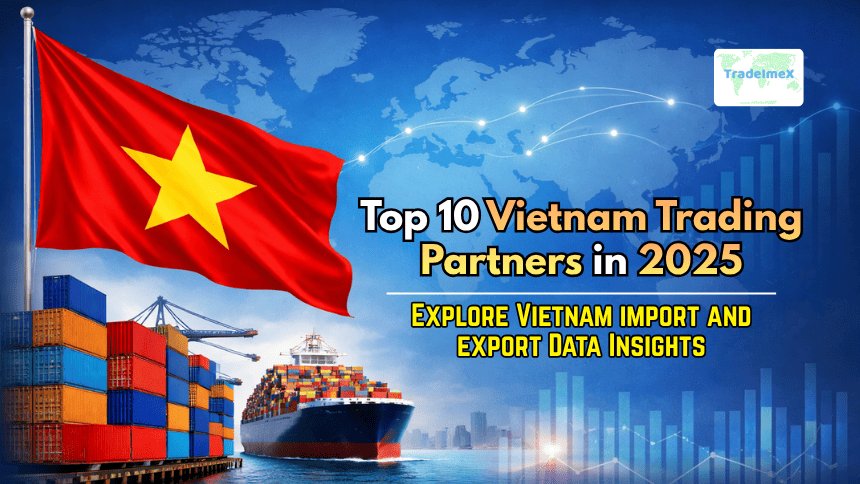
One of the most important economic developments of the last 20 years has been Vietnam's ascent to prominence in international trade. Vietnam's economy is one of the most export-oriented & trade-dependent in the world in 2025, thanks to its location, skilled labor force, and wide structure of free trade agreements. According to the latest Vietnam import data, the total value of Vietnam imports accounted for $455.01 billion in 2025, a 19.4% increase from the previous year. According to Vietnam export data, Vietnam's exports totaled $475.04 billion in 2025, an increase of 17% from the previous year.
Vietnam has become an important beneficiary as global supply chains continue to restructure in the face of geopolitical concerns, increased manufacturing costs, and diversification plans. Vietnam is one of the top 15 trade nations and has one of the most rapidly expanding economies in the world, according to the Vietnam customs data and global trade data.
In-depth, data-driven analysis of Vietnam's top 10 trading partners in 2025 is provided by this blog, which also looks at sector-wise dependencies, total trade values, top export and import partners, and the strategic insights influencing Vietnam's place in international trade.
Overview of Vietnam's Trade in 2025
Vietnam's overall trade turnover (exports plus imports) hit USD 930.05 billion in 2025, solidifying its place among the world's most open countries. Vietnam is heavily dependent on global trade, as evidenced by the fact that trade value accounts for more than 170% of the country's GDP.
-
$475.04 billion in total exports in 2025
-
$455.01 billion in total imports in 2025
-
Trade Balance: $20 billion in moderate surplus
With the help of exports of electronics, machinery, textiles, and agricultural products, Vietnam was able to maintain a stable trade momentum in spite of the uncertainties surrounding the world economy and the slower development of demand in major markets.
The Significance of Vietnam's Trade Partner Network
Understanding Vietnam's trading partners is essential to analyzing the country’s global trade performance, as Vietnam's biggest trade partners play a crucial role in shaping both supply chains and demand, as per the data on Vietnam trade partners. A detailed look at Vietnam exports by country and Vietnam imports by country highlights how key markets influence growth, while Vietnam export partners continue to drive strong outbound trade.
With rising Vietnam imports and exports, businesses rely heavily on accurate Vietnam trade statistics to identify trends and opportunities. China remains a leading Vietnam largest trading partner on the import side, while the US dominates exports, together forming Vietnam's main trading partners. Overall, these relationships define Vietnam top trading partners and underscore Vietnam’s strategic position in global trade. Vietnam's diversity of trading partners sheds light on:
-
Realignment of the global supply chain
-
Reliance on imported materials for production
-
Risks associated with tariffs and geopolitics
-
Industrial competitiveness over the long run
Vietnam functions mainly as a manufacturing and assembly nexus, which means that its imports & exports are closely linked, in contrast to resource-based exporters, according to the Trade Statistics of Vietnam Customs.
Vietnam’s Top Import Partners in 2025: Vietnam Imports by Country

Vietnam's commercial landscape is significantly shaped by its main import partners. China, South Korea, Japan, and the United States are some of Vietnam's major import partners. One of the biggest suppliers of goods to Vietnam is China, which is closely followed by South Korea and Japan. Additionally, the United States is a significant import partner of Vietnam. Through trade partnerships, these nations support Vietnam's economic growth in addition to facilitating the flow of commodities into the country. According to Vietnam's shipment data for 2025, the country's main import trading partners are:
1. China: $186 Billion (39.6%)
China continued to dominate Vietnam’s import landscape in 2025, accounting for nearly 40% of total imports, based on the database of Vietnam imports from China by HS code.
Top Imports:
-
Electronic components and semiconductors
-
Machinery and manufacturing equipment
-
Textile fabrics and accessories
-
Chemicals, plastics, and steel
Vietnam’s major export sectors, electronics, textiles, and machinery, remain strongly reliant on Chinese upstream supplies.
2. South Korea: $58 Billion (12.3%)
South Korea secured the second position, largely supported by FDI-driven supply chains, particularly in electronics manufacturing.
Top Imports:
-
Semiconductor chips
-
Display panels
-
Precision machinery
-
Industrial chemicals
Large corporations like Samsung play a central role in sustaining this trade relationship.
3. Japan: $24 Billion (5.1%)
Japan remained a vital source of high-value capital goods for Vietnam.
Top Imports:
-
Industrial machinery
-
Automotive components
-
Electrical and robotic systems
These imports contribute significantly to Vietnam’s shift toward advanced manufacturing capabilities.
4. Taiwan: $22 Billion (4.7%)
Taiwan maintained a crucial position in Vietnam’s electronics supply chain.
Top Imports:
-
Printed circuit boards
-
Semiconductor components
-
Precision electronic parts
Taiwanese inputs are key to supporting Vietnam’s export-oriented electronics industry.
5. Singapore: $20 Billion (4.3%)
Singapore primarily acted as a regional trade and re-export hub for Vietnam.
Top Imports:
-
Refined petroleum products
-
Chemicals
-
Re-exported electronics and machinery
A significant portion of these goods originates from third countries but is routed through Singapore.
6. Thailand: $18 Billion (3.8%)
Thailand’s trade with Vietnam reflects strong regional integration within ASEAN supply chains.
Top Imports:
-
Automotive parts
-
Petrochemicals
-
Plastics and resins
-
Processed food inputs
7. Malaysia: $15 Billion (3.2% Share)
Malaysia supplied a mix of energy resources and electronics-related inputs.
Top Imports:
-
LNG and petroleum products
-
Semiconductor components
-
Electrical machinery
8. Indonesia: $12 Billion (2.6%)
Indonesia’s exports to Vietnam were largely resource-driven.
Top Imports:
-
Coal
-
Petroleum products
-
Palm oil
-
Basic industrial materials
These imports play a key role in power generation and food processing industries.
9. United States: $11 Billion (2.3%)
Although the United States is Vietnam’s largest export destination, its role as an import partner is comparatively smaller.
Top Imports:
-
Aircraft and aerospace components
-
Agricultural commodities such as soybeans and cotton
-
High-tech machinery
While lower in volume, US imports tend to have a higher unit value.
10. Germany: $9 Billion (1.9%)
Germany remained Vietnam’s top import partner from Europe.
Top Imports:
-
Industrial machinery
-
Automotive systems
-
Electrical equipment
-
Specialty chemicals

Key Observations from the Distribution of Shares
-
Nearly 40% of Vietnam's imports come from China alone, demonstrating the country's strong upstream reliance.
-
More than 61% of all imports come from East Asia, which includes China, Korea, Japan, and Taiwan.
-
Stability and resilience in the region are contributed to by ASEAN partners.
-
Western suppliers (US, Germany) prioritize specialized, high-value products over quantity.
-
Vietnam's position as a production and assembly hub within international value chains is seen in its import structure.
Vietnam’s Top Export Partners in 2025: Vietnam Exports by Country

Vietnam's export environment is significantly shaped by its main export partners. Vietnam's top export markets include the US, China, Japan, South Korea, and Germany. Through trade ties in a variety of industries, including electronics, textiles, and agriculture, these alliances considerably contribute to Vietnam's economic progress. According to Vietnam trade data for 2025, the top 10 export or trading partners for exports are as follows:
1. United States: $153.2 Billion (37.4%)
With almost one-third of Vietnam's total exports going to the US, the US continued to be the country's biggest export market, according to the database on Vietnam exports to the US by HS code.
Top exports:
-
Electronics and smartphones
-
Computers and electrical equipment
-
Apparel, footwear, and textiles
-
Furniture and wood products
-
Machinery and mechanical appliances
Demand-driven and customer-focused, Vietnam's export partnership with the US is essential to its trade surplus.
2. China: $67.5 Billion (16.5%)
China ranked second among Vietnam’s export destinations, serving as both a major buyer and supplier.
Top Exports:
-
Electronics and components
-
Agricultural products (fruits, rubber, seafood)
-
Machinery and intermediate goods
Exports to China are closely integrated with regional supply chains and cross-border manufacturing networks.
3. European Union (EU): $57.8 Billion (14.1%)
The European Union collectively held its position as Vietnam’s third-largest export market.
Top Exports:
-
Apparel and textiles
-
Footwear
-
Furniture
-
Consumer electronics
Free trade agreements have enabled Vietnam to expand its presence across European markets.
4. South Korea: $31.4 Billion (7.7%)
South Korea’s ranking reflects strong FDI-led and intra-company trade flows.
Top Exports:
-
Electronic components
-
Machinery
-
Textiles
-
Processed industrial goods
Much of this trade supports Korean manufacturing operations within Vietnam.
5. Japan: $25.6 Billion (6.2%)
Japan remained a consistent and high-value export destination for Vietnam.
Top Exports:
-
Machinery and equipment
-
Electronics
-
Textiles and garments
-
Seafood and agricultural products
Strict quality standards in Japan have helped Vietnam upgrade its export capabilities.
6. Netherlands: $23.1 Billion (5.6%)
Trade between Vietnam and the Netherlands continued to expand steadily.
Top Exports:
-
Electronics
-
Petroleum products
-
Agricultural and food products
-
Construction materials
Favorable trade policies and logistics advantages have supported this growth.
7. Hong Kong: $18.2 Billion (4.4%)
Hong Kong primarily acted as a re-export and logistics hub for Vietnamese goods.
Top Exports:
-
Electronics and components
-
High-value consumer goods
A large share of exports passing through Hong Kong are ultimately shipped to other global markets.
8. India: $12.4 Billion (3%)
India emerged as a growing export destination for Vietnam in South Asia.
Top Exports:
-
Electronics
-
Machinery
-
Chemicals
-
Agricultural products
Diversification efforts have strengthened bilateral trade between the two countries.
9. Australia: $11.3 Billion (2.8%)
Australia remained a stable market for both industrial and consumer-oriented exports.
Top Exports:
-
Electronics
-
Textiles and garments
-
Seafood and food products
10. Canada: $10.3 Billion (2.5%)
Canada is one of Vietnam’s top 10 export markets, supported by trade agreements like CPTPP.
Top Exports:
-
Apparel and footwear
-
Furniture
-
Consumer electronics
Key Takeaways from Vietnam's Export Partner Market (2025)
-
The United States is Vietnam's most important demand market, accounting for roughly 38% of its exports.
-
Over 30% came from China and the EU combined, demonstrating a balanced distribution between Asia and the West.
-
Trade between Japan and South Korea, which is driven by FDI, is still substantially significant.
-
Although they are secondary in scale, the ASEAN and CPTPP markets encourage variety.
-
Due to its highly concentrated export profile, Vietnam poses a risk to policy and efficiency.
Sector-Wise Trade Dependency
1. Electronics and Electrical Equipment
Electronics dominate Vietnam’s export basket, contributing more than 35% of total exports. The sector is highly dependent on imports from China and South Korea, while its primary export destinations include the United States, the European Union, and China. Overall, this industry serves as the backbone of Vietnam’s trade structure.
2. Textiles and Apparel
The textile and apparel sector continues to be a key pillar of Vietnam’s exports, with shipments exceeding USD 40 billion. However, the industry relies heavily on imported fabrics from China, South Korea, and Taiwan. Meeting rules of origin requirements under free trade agreements remains a major strategic hurdle.
3. Machinery and Mechanical Appliances
Vietnam’s machinery exports surpass USD 45 billion, while imports exceed USD 60 billion. This imbalance highlights the country’s role as a manufacturing hub that imports components, assembles products, and exports finished or semi-finished goods.
4. Agriculture and Seafood
Agricultural and seafood exports generate around USD 55 billion annually. Major export markets include China, the United States, Japan, and the European Union. Vietnam is a leading global exporter of products such as rice, coffee, seafood, and fresh fruits.
Trade Agreements and Their Impact on Partner Dynamics
Vietnam participates in over 15 free trade agreements, including the CPTPP, RCEP, EU-Vietnam FTA, and various ASEAN agreements. These frameworks have helped lower tariffs, diversify export markets, and attract foreign investment. At the same time, they continue to reshape trade partner dynamics by influencing shifts in market share over time.
Major Insights From Vietnam’s Trading Partners Data
1. High Import Concentration Risk: Vietnam’s strong dependence on imports from China and South Korea increases its exposure to supply chain disruptions and price fluctuations.
2. Strong Export Market Concentration: Around 45% of Vietnam’s exports are directed to the United States and China, making the economy sensitive to policy or demand changes in these markets.
3. Rising Value Addition: There is a gradual shift from low-value assembly toward higher-value manufacturing, particularly in electronics and machinery.
4. Strategic Role in the “China+1” Strategy: Vietnam continues to benefit significantly from global supply chain diversification as companies look beyond China for manufacturing bases.
Challenges Facing Vietnam’s Trade Model
Despite its rapid growth, Vietnam faces several structural challenges, including limited domestic production of key components, infrastructure constraints at ports and logistics hubs, rising labor and land costs, and increasing scrutiny from trade partners regarding compliance and origin standards. Addressing these issues will be essential for long-term sustainability.
Outlook: Vietnam’s Trade Partners Beyond 2025
Looking ahead, trade with the United States and the European Union is expected to remain driven by consumer demand, while regional integration across Asia will deepen under RCEP. Emerging markets such as India, the Middle East, and Africa are likely to offer new growth opportunities. Strengthening domestic supplier networks will also become a key policy focus. Overall, Vietnam is projected to sustain annual trade growth of around 6–7% in the coming decade.
Conclusion and Final Analysis
In conclusion, Vietnam stands at the forefront of global trade realignment. Its leading trade partners, China, the United States, South Korea, the European Union, and Japan, highlight a well-balanced mix of supply-side and demand-driven relationships. Vietnam’s trade data reflects a nation that has successfully established itself as a global manufacturing hub, while still navigating challenges related to dependency, market concentration, and value addition.
For businesses, policymakers, and investors, understanding these trade dynamics is crucial to capitalizing on opportunities within Asia’s evolving economic landscape. Vietnam’s journey is not just about growth; it is about strategic integration into the global economy, clearly reflected in the data.
Note For Our Readers
We hope that you liked our data-driven and insightful blog report on the Top 10 Vietnam Trading Partners in 2025. To access the latest Vietnam trade data, or to search live Vietnam import-export shipment data by country, visit TradeImeX. Contact us at info@tradeimex.in for customized Vietnam trade reports & market insights to skyrocket your business!
Also read about:
Share
What's Your Reaction?
 Like
0
Like
0
 Dislike
0
Dislike
0
 Love
0
Love
0
 Funny
0
Funny
0
 Angry
0
Angry
0
 Sad
0
Sad
0
 Wow
0
Wow
0