Dominican Republic Imports by Country & Category 2024-25 | Key Import Trends & Statistics
Explore Dominican Republic Imports by Country & Category for 2024-25. Get key import trends, top trading partners, and detailed statistics to boost your market insights and business strategy.


The Dominican Republic, one of the largest economies in the Caribbean and Central America, has a trade structure that relies heavily on imports to meet domestic demand for energy, consumer goods, industrial machinery, and raw materials. According to the Dominican Republic import data, the total value of the Dominican Republic imports reached $32.70 billion in 2024, a 4% increase from the previous year. According to Dominican Republic customs data and import statistics, the country imported goods worth $15.88 billion in the first two quarters of 2025. Imports account for more than 21 percent of the nation’s GDP, a clear sign that its growth, production, and consumption cycles are closely tied to international supply chains.
While this strong import dependency supports the nation’s consumption and industrial development, it also creates challenges: exposure to global price fluctuations, reliance on a few key partners (especially the United States and China), and persistent trade deficits. In 2024, the Dominican Republic trade deficit was close to 19.8 billion US dollars, reflecting the imbalance between imports (over 32 billion) and exports (around 13 billion). The Dominican Republic is the 71st largest importer in the world, as per the global trade data. This article breaks down the Dominican Republic’s import performance by partner countries, commodity categories, and sectoral trends for 2024, while also projecting where things may head in 2025, with a key focus on the Dominican Republic import data.
Dominican Republic Imports by Country: Where Does the Dominican Republic Import From?
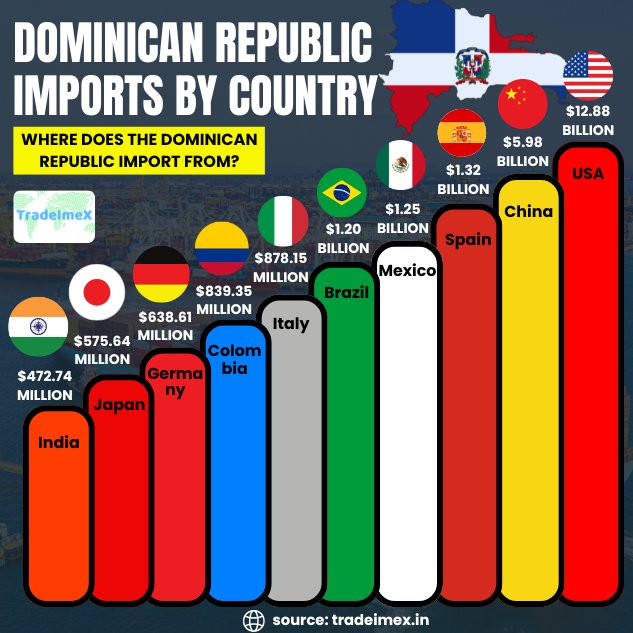
The Dominican Republic imports goods from various countries worldwide to meet its diverse economic needs. Some of the major trading partners include the United States, China, and Mexico. The United States holds a significant share of the Dominican Republic's imports, particularly in machinery, chemicals, and petroleum products. China stands out as a key source of electronics and textiles for the country, while Mexico plays a crucial role in supplying vehicles and refined petroleum.
These import partnerships play a vital role in sustaining the Dominican Republic's economy and fostering international trade relations. The top 10 import partners for the Dominican Republic imports by country, as per the Dominican Republic shipment data for 2024-25, include:
1. USA: $12.88 billion (39.4%)
The United States is the largest trading partner of the Dominican Republic, accounting for a significant portion of the country's imports, as per the data on US exports to Dominican Republic. With a strong economy and diverse range of products, the USA provides the Dominican Republic with a variety of goods, from machinery and equipment to consumer products and food items.
The United States is by far the most important supplier, accounting for over 39 percent of total imports in 2024. This dominance stems from geographic proximity, deep economic ties under the CAFTA-DR free trade agreement, and the country’s reliance on U.S. energy products, vehicles, food items, and machinery.
2. China: $5.98 billion (18.3%)
China is another major player in the Dominican Republic's import market, providing the country with a wide range of affordable goods and products. From electronics and textiles to machinery and raw materials, China offers competitive prices and large quantities, making it a popular choice for Dominican importers.
3. Spain: $1.32 billion (4.1%)
Spain has historical ties with the Dominican Republic, and this relationship is reflected in the significant amount of imports that the Dominican Republic receives from Spain. With a focus on luxury goods, technology, and automotive products, Spain is a key player in the Dominican Republic's import market.
4. Mexico: $1.25 billion (3.8%)
Mexico is another important trading partner for the Dominican Republic, offering a variety of goods and products at competitive prices. From agricultural products and food items to machinery and electronics, Mexico provides the Dominican Republic with a diverse range of imports.
5. Brazil: $1.20 billion (3.7%)
Brazil is known for its agricultural products, and this is reflected in the significant amount of imports that the Dominican Republic receives from the country, as per the data on Brazil exports to Dominican Republic by HS code. With a focus on food items, raw materials, and energy products, Brazil plays a vital role in meeting the Dominican Republic's import needs.
6. Italy: $878.15 million (2.7%)
Italy is a key player in the Dominican Republic's import market, offering a variety of high-quality products, from fashion and luxury goods to machinery and automotive parts. With a focus on design and innovation, Italy is a popular choice for Dominican importers looking for unique and premium products.
7. Colombia: $839.35 million (2.6%)
Colombia is a growing player in the Dominican Republic's import market, providing the country with a range of goods, from agricultural products and textiles to machinery and electronics. With a focus on quality and affordability, Colombia is becoming an increasingly popular choice for Dominican importers.
8. Germany: $638.61 million (2%)
Germany is known for its high-quality engineering and technology products, and this is reflected in the imports that the Dominican Republic receives from the country. With a focus on machinery, automotive parts, and electronics, Germany plays a vital role in meeting the Dominican Republic's import needs.
9. Japan: $575.64 million (1.8%)
Japan is a key player in the Dominican Republic's import market, offering a variety of high-tech and innovative products, from electronics and automotive parts to machinery and consumer goods. With a focus on quality and technology, Japan is a popular choice for Dominican importers.
10. India: $472.74 million (1.4%)
India is a key player in the Dominican Republic's import market, providing the country with a variety of affordable goods and products, from textiles and food items to machinery and raw materials. With a focus on affordability and diversity, India is a popular choice for Dominican importers looking to expand their product offerings. Dominican Republic and India bilateral trade reached a record high in 2024.
Key takeaway: The Dominican Republic is highly dependent on the U.S. and China, which together supply more than 60 percent of its imports. Any geopolitical or economic disruptions involving these two countries could create major vulnerabilities for the Dominican market.
Dominican Republic Imports by Category: Top 10 Imported Products of the Dominican Republic
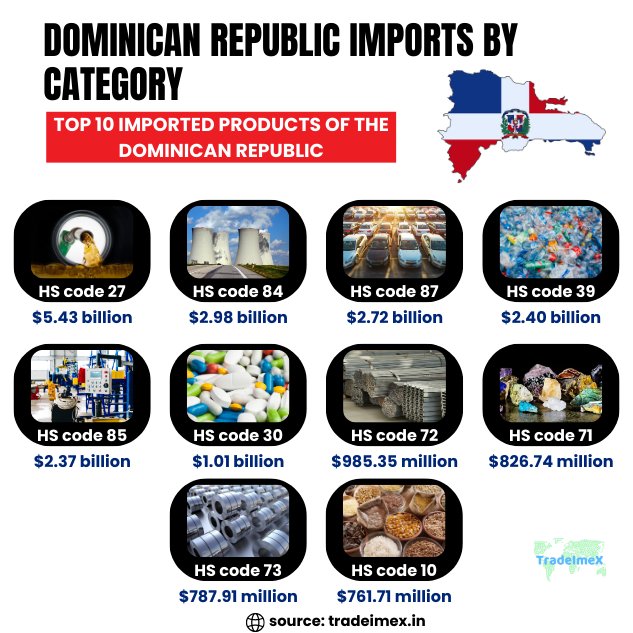
The Dominican Republic imports a variety of products across different categories, with the top 10 imported products being a crucial part of its trade landscape. From machinery and electronics to mineral fuels, vehicles, and plastics, these items dominate the country's import market. This diverse range of imports reflects the country's dependence on a variety of goods to support its economy and meet the needs of its population. The major imports of the Dominican Republic in 2024-25 include:
1. Mineral fuels and oils (HS code 27): $5.43 billion
Mineral fuels and oils are among the top imported products of the Dominican Republic. With a value of $5.43 billion, these products are essential for the country's energy needs and industrial development.
2. Nuclear reactors and machinery (HS code 84): $2.98 billion
Nuclear reactors and machinery are another significant category of imports for the Dominican Republic. With a value of $2.98 billion, these products play a crucial role in the country's infrastructure and technological advancement.
3. Vehicles (HS code 87): $2.72 billion
Vehicles, including cars, trucks, and buses, are essential imports for the Dominican Republic. With a value of $2.72 billion, these products are crucial for transportation and mobility within the country.
4. Plastics and articles thereof (HS code 39): $2.40 billion
Plastics and articles made from plastic are important imports for the Dominican Republic, with a value of $2.40 billion. These products are used in various industries, including packaging, construction, and consumer goods.
5. Electrical machinery and equipment (HS code 85): $2.37 billion
Electrical machinery and equipment are crucial imports for the Dominican Republic, with a value of $2.37 billion. These products are essential for the country's infrastructure, telecommunications, and manufacturing sectors.
6. Pharmaceutical products (HS code 30): $1.01 billion
Pharmaceutical products are vital imports for the Dominican Republic, with a value of $1.01 billion. These products play a crucial role in the country's healthcare system and public health programs.
7. Iron and steel (HS code 72): $985.35 million
Iron and steel are essential imports for the Dominican Republic, with a value of $985.35 million. These products are used in construction, manufacturing, and infrastructure projects throughout the country.
8. Precious stones and metals (HS code 71): $826.74 million
Precious stones and metals are valuable imports for the Dominican Republic, with a value of $826.74 million. These products are used in jewelry, electronics, and the luxury goods industries.
9. Articles of iron or steel (HS code 73): $787.91 million
Articles made of iron or steel are important imports for the Dominican Republic, with a value of $787.91 million. These products are used in construction, machinery, and automotive industries.
10. Cereals (HS code 10): $761.71 million
Cereals are essential imports for the Dominican Republic, with a value of $761.71 million. These products are crucial for the country's food security and agricultural industry.
Dominican Republic Imports in the Last 10 Years: Historical Dominican Republic Import Data
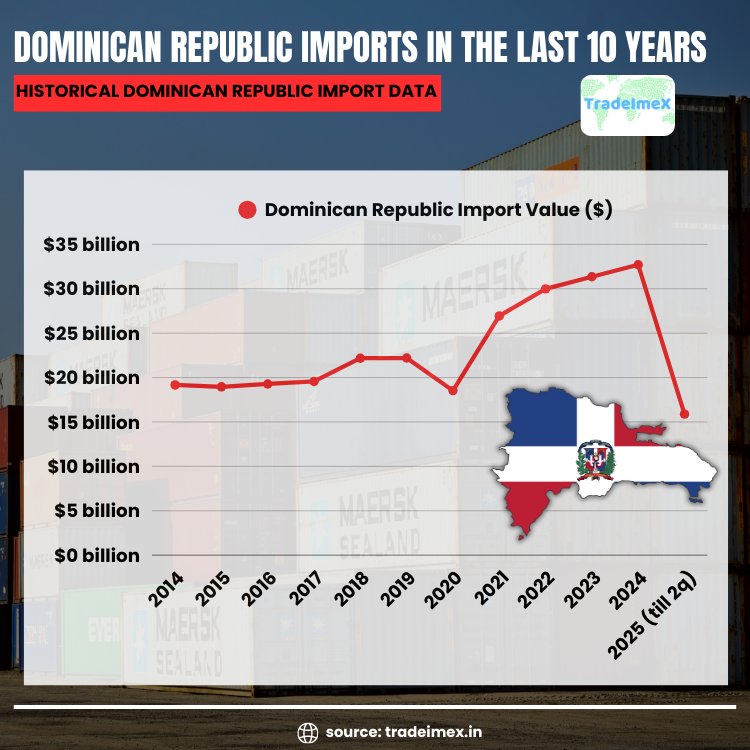
|
Year of Imports |
Dominican Republic Import Value ($) |
|
2014 |
$19.17 billion |
|
2015 |
$18.96 billion |
|
2016 |
$19.28 billion |
|
2017 |
$19.56 billion |
|
2018 |
$22.18 billion |
|
2019 |
$22.20 billion |
|
2020 |
$18.53 billion |
|
2021 |
$26.94 billion |
|
2022 |
$29.99 billion |
|
2023 |
$31.35 billion |
|
2024 |
$32.70 billion |
|
2025 (till quarter 2) |
$15.88 billion |
Dominican Republic Imports Mid-2024 Snapshot (January–July)
In the first seven months of 2024, the Dominican Republic's imports exceeded 17 billion US dollars, with the U.S. and China maintaining their dominance. Key products included:
-
Medical and surgical equipment
-
Petroleum and fuels
-
Cereals and agricultural commodities
This mid-year trend confirms the continuation of patterns observed in 2023 and previous years.
Sectoral Insights
Energy & Fuel Dependency
The largest import expense by far, fuels, highlight the Dominican Republic’s vulnerability to international oil markets. While the government has encouraged renewable energy projects (solar, wind, and hydro), fossil fuel dependency will remain significant through 2025.
Infrastructure and Industrial Growth
Machinery and vehicle imports indicate that both private and public sectors are investing in infrastructure, logistics, and industrial modernization. This aligns with tourism-driven urban development and government-backed construction initiatives.
Technology & Digital Demand
Electronics imports are expanding as the country experiences rapid digitization in banking, retail, and government services. The demand for mobile devices, networking equipment, and IT hardware is expected to grow steadily.
Healthcare Reliance
With pharmaceuticals exceeding 1 billion US dollars annually, the Dominican Republic remains dependent on foreign suppliers for essential medicines and medical technology. This reliance could be mitigated through regional partnerships or local pharmaceutical investment.
Consumer Goods & Food Security
Cereals, dairy, beverages, and meat imports point to limited domestic agricultural productivity relative to population needs. Enhancing agricultural output could reduce reliance on food imports.
Dominican Republic Import Outlook for 2025
Several key trends are expected to shape the Dominican Republic’s import dynamics in 2025:
-
Continued U.S. and China Dominance: The U.S. will remain the top supplier due to CAFTA-DR benefits and geographic ties, while China’s share is expected to expand further in machinery, electronics, and consumer goods.
-
Rising Energy Costs: If global oil prices remain high, fuel imports will put pressure on the trade deficit. Renewable investments may ease some dependency but not eliminate it in the short term.
-
Increased Industrial Inputs: Imports of iron, steel, and plastics will rise in tandem with construction and manufacturing growth, especially in urban areas and free trade zones.
-
Healthcare Imports Expansion: The pharmaceutical market will continue to expand with population growth and increased healthcare spending. Strategic sourcing from India and Latin America may diversify supply.
-
Food Imports vs. Local Production: Food imports will remain high unless domestic agricultural modernization efforts scale up. Wheat and corn imports will continue to dominate the cereals segment.
-
Diversification Efforts: Policymakers are aware of the risks of overdependence on two partners. Diversifying suppliers, particularly within Latin America and Europe, will be a priority.
Conclusion and Final Thoughts
In conclusion, the Dominican Republic’s import structure in 2024–25 highlights both its strengths and vulnerabilities. The economy relies heavily on imports for fuel, industrial equipment, vehicles, and healthcare products, with the U.S. and China together supplying more than 60 percent of total needs. On the one hand, this import dependency supports industrial growth, infrastructure development, and consumer demand. On the other hand, it exposes the country to trade deficits, external shocks, and supply chain risks.
Looking ahead, the Dominican Republic must focus on:
-
Diversifying its import partners
-
Expanding renewable energy to reduce fuel dependency
-
Developing domestic manufacturing capacity
-
Modernizing agriculture to cut down on food imports
-
Strengthening regional pharmaceutical supply chains
By strategically addressing these issues, the Dominican Republic can transform its import reliance from a vulnerability into an engine for sustainable, resilient growth.
For more insights into the latest Dominican Republic export-import data, visit TradeImeX. Contact us at info@tradeimex.in for customized trade reports, market insights, and search live import-export data by country, product, or HS code, as per your business needs.
Share
What's Your Reaction?
 Like
0
Like
0
 Dislike
0
Dislike
0
 Love
0
Love
0
 Funny
0
Funny
0
 Angry
0
Angry
0
 Sad
0
Sad
0
 Wow
0
Wow
0