Mongolian Cashmere Export Data 2025: Mongolia Exports of Cashmere Wool
Explore Mongolian cashmere export data for 2025: key export markets, trends, economic impact, & future outlook for this luxury "white gold" fiber.


Introduction: “White Gold” on the World Stage
In recent years, Mongolia's cashmere industry has been flourishing, with a significant increase in the export of cashmere wool to various countries around the world. With the demand for high-quality cashmere products on the rise, Mongolia has become a key player in the global cashmere export market. According to the Mongolia export data and Mongolia customs data, the total value of Mongolian cashmere exports reached $70.56 million in 2024, a major decline of 28% from the previous year. As per the Mongolia cashmere export data for 2025, the total value of Mongolia’s cashmere exports accounted for over $8 million in the first quarter of 2025.
Mongolia produces some of the world’s finest cashmere, an industry prized as "white gold." Mongolia is the 6th largest cashmere exporter in the world, as per the global trade data. As the second-largest producer globally, just behind China, Mongolian cashmere is both a cultural heritage and economic lifeline for nomadic communities, as per Mongolia’s cashmere production. But the industry sits at a crossroads in 2024–25, with climate shocks, policy pivots, and bold ambitions reshaping its trajectory. This blog uncovers export volumes, value trends, shocks hitting supply, industrial responses, and future forecasts for Mongolian cashmere export data in 2024-25. Let’s break it all down by the numbers.
Overview of Mongolia's Cashmere Industry
Mongolia is known for producing some of the finest cashmere wool in the world, and Cashmere is among Mongolia’s major exports. The country's harsh climate and rugged terrain have created the perfect conditions for raising cashmere goats, whose fine, soft undercoat is harvested to produce luxurious cashmere yarn. The cashmere industry plays a crucial role in Mongolia's economy, providing employment opportunities for thousands of herders and contributing to the country's GDP. Mongolia's cashmere exports have been steadily increasing over the years, with a growing demand for Mongolian cashmere in international markets.
Detailed Insights into the Exports of Mongolian Cashmere
-
Diminished Exports in Q1 2024: The Mongolian Customs General Administration reports that the country's combed cashmere exports fell by 55% in the first quarter of 2024 as compared to the same time in 2023.
-
Volume and Value of Exports: Mongolia exported 72.3 tons of combed cashmere worth 8.5 million USD in the first quarter of 2024.
-
Government Initiatives: To increase cashmere processing capacity, the Mongolian government has allocated 198 billion tugriks (57.5 million USD) as part of the "White Gold" campaign.
-
Future Objectives: By 2028, the domestic cashmere market is expected to have 40% deep processing and 100% primary processing.
-
Economic Importance: Trailing only behind gold and copper in terms of exports, cashmere is a vital source of income for many Mongolians and a substantial contributor to the nation's GDP.
-
Global Market: According to the World Bank, Mongolia is the second-biggest producer of raw cashmere, with a market share that has been steadily rising to 40%.
-
Sustainable Practices: With an emphasis on community development, environmental preservation, and animal care, programs such as the "Good Cashmere Standard" are encouraging ecological cashmere production in Mongolia and elsewhere.
Mongolia’s Cashmere Exports by Country in 2024
Overview and Key Highlights
-
Italy is the dominant market, taking around 80% of all combed cashmere exported from Mongolia in 2024.
-
China remains the leading importer of washed goat cashmere, accounting for 99.0% of those exports.
-
In 2024, Mongolia exported wool, animal hair, horsehair yarn, and fabric (which includes raw and semi-processed cashmere) to China worth USD 164.82 million.
-
Italy imported USD 56.20 million worth of wool and related textiles from Mongolia in 2024.
Top 10 Mongolian Cashmere Export Destinations: Mongolia Cashmere Exports by Country
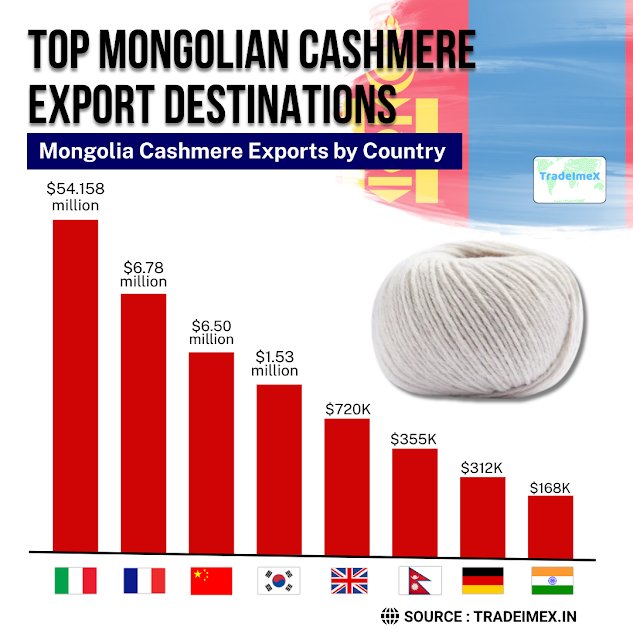
Mongolia's cashmere industry has witnessed significant growth in recent years, with the country emerging as a key player in the global market. The top 10 Mongolian cashmere export destinations include countries such as China, Italy, the United States, Germany, Japan, and South Korea, as per Mongolia customs data. Mongolia's high-quality cashmere products have garnered international acclaim, attracting buyers from around the world. The top 10 export destinations for Mongolian cashmere, as per Mongolia cashmere exports by country and Mongolia shipment data for 2024-25, include:
1. Italy: $54.158 million (76.8%)
Italy stands out as the biggest export destination for Mongolian cashmere exports, accounting for a whopping 76.8% of the total cashmere exported, as per the data on Italy cashmere imports from Mongolia. Italian consumers appreciate the superior quality of Mongolian cashmere and are willing to pay a premium for it.
2. France: $6.78 million
France is another significant market for Mongolia's cashmere, with exports totaling $6.78 million. French fashion houses and luxury brands often source their cashmere from Mongolia due to its reputation for producing some of the finest cashmere in the world.
3. China: $6.50 million
Despite being a major producer of cashmere itself, China also imports cashmere from Mongolia. Chinese consumers value the softness and warmth of Mongolian cashmere, making it a popular choice in the Chinese market.
4. South Korea: $1.53 million
South Korea is an emerging market for Mongolian cashmere, with exports reaching $1.53 million in 2024-25. The demand for luxury cashmere products in South Korea has been on the rise, further fueling the growth of Mongolian cashmere exports to the country.
5. United Kingdom: $720K
The United Kingdom is also a significant importer of Mongolian cashmere, with exports totaling $720K. British consumers appreciate the quality and craftsmanship of Mongolian cashmere, making it a sought-after luxury item in the UK market.
6. Nepal: $355K
Nepal may be a smaller market compared to some of the other countries on this list, but it still plays a role in the demand for Mongolian cashmere. With exports amounting to $355K, Nepal demonstrates a growing interest in high-quality cashmere products from Mongolia.
7. Germany: $312K
Germany is another European country that imports Mongolian cashmere, with exports totaling $312K. German consumers value the sustainability and ethical practices of Mongolian cashmere producers, making it a popular choice in the German market.
8. India: $168K
India may be better known for its textile industry, but it also imports Mongolian cashmere. With exports of $168K, India demonstrates a growing interest in luxury cashmere products from Mongolia.
9. Japan: $16K
Japan, known for its appreciation of high-quality fabrics, is a growing market for Mongolian cashmere. Despite relatively lower exports of $16K, Japan's demand for Mongolian cashmere is on the rise.
10. USA: $8K
Rounding out the top 10 list is the USA, with exports of Mongolian cashmere totaling $8K. While the US may not be among the largest importers of Mongolian cashmere, there is a niche market for luxury cashmere products in the country.
Mongolia Cashmere Exports in the Last 10 Years: Yearly Mongolian Cashmere Export Data
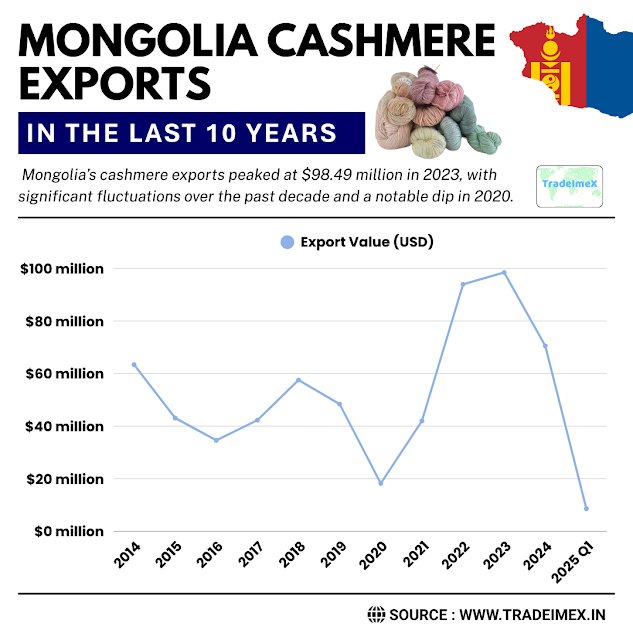
|
Year of Exports |
Mongolia Cashmere Export Value ($) |
|
2014 |
$63.40 million |
|
2015 |
$43.08 million |
|
2016 |
$34.61 million |
|
2017 |
$42.27 million |
|
2018 |
$57.56 million |
|
2019 |
$48.38 million |
|
2020 |
$18.20 million |
|
2021 |
$41.98 million |
|
2022 |
$93.97 million |
|
2023 |
$98.49 million |
|
2024 |
$70.56 million |
|
2025 quarter 1 |
$8.57 million |
Sample Report of Mongolia Cashmere Export Data 2025
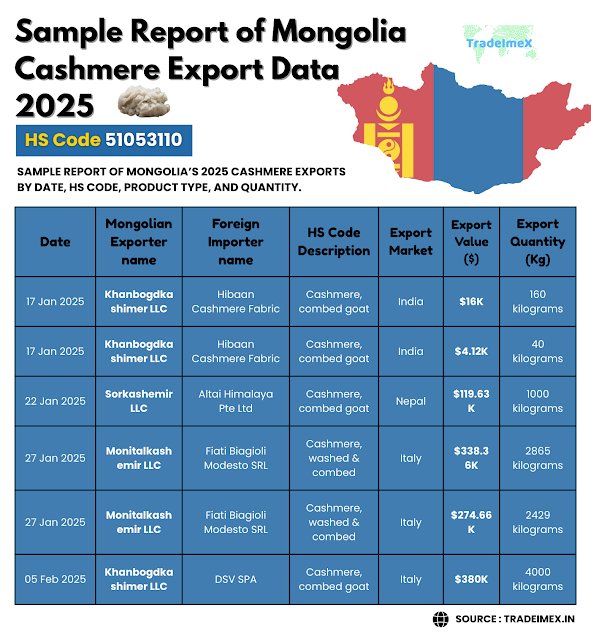
|
Date |
Mongolian Exporter name |
Foreign Importer name |
HS Code |
HS Code Description |
Export Market |
Export Value ($) |
Quantity (Kg) |
|
17 Jan 2025 |
Khanbogdkashimer LLC |
Hibaan Cashmere Fabric |
51053110 |
Cashmere, combed goat |
India |
$16K |
160 kilograms |
|
17 Jan 2025 |
Khanbogdkashimer LLC |
Hibaan Cashmere Fabric |
51053110 |
Cashmere, combed goat |
India |
$4.12K |
40 kilograms |
|
22 Jan 2025 |
Sorkashemir LLC |
Altai Himalaya Pte Ltd |
51053110 |
Cashmere, combed goat |
Nepal |
$119.63K |
1000 kilograms |
|
27 Jan 2025 |
Monitalkashemir LLC |
Fiati Biagioli Modesto SRL |
51053110 |
Cashmere, washed & combed |
Italy |
$338.36K |
2865 kilograms |
|
27 Jan 2025 |
Monitalkashemir LLC |
Fiati Biagioli Modesto SRL |
51053110 |
Cashmere, washed & combed |
Italy |
$274.66K |
2429 kilograms |
|
05 Feb 2025 |
Khanbogdkashimer LLC |
DSV SPA |
51053110 |
Cashmere, combed goat |
Italy |
$380K |
4000 kilograms |
Note: If you want more such exclusive and detailed database reports or import-export data on Mongolian Cashmere, contact us at info@tradeimex.in.
Export Value: From Raw to Washed & Beyond
2024 Snapshot
-
In 2024, Mongolia exported cashmere and cashmere products worth USD 441.2 million, of which USD 263.6 million was from washed cashmere. The exported washed cashmere volume stood at 5,449 tons, making up 74% of the country’s washed output.
Growth Outlook to 2024–25
-
Exports accounted for 3% of Mongolia’s total exports in that period, reaching USD 444.4 million, a 33.4% increase over the previous year.
-
The government projects export receipts to climb to USD 660 million by the end of 2024, under a strategic shift whereby only combed cashmere is exported from 2023 forward.
Early 2025 Trends
-
However, Q1 of 2025 saw a sharp downturn: Mongolia exported just 72.3 tons of combed cashmere worth USD 8.5 million, a 55% drop compared to Q1 2024.
Volume Data & Processing Figures
Raw & Washed Production
-
Annually, Mongolia collects 10,000 tons of raw cashmere, which after washing drops to 7,000 tons and further to 5,000 tons after combing.
-
Consistent with historical data, Mongolia supplies around 9,600 tons of raw cashmere annually to the global market.
Processing Strategy
-
The shift to export only combed cashmere is designed to add value domestically, with estimates showing combed cashmere could fetch USD 500 million. If further spun into finished products like sweaters or scarves, the value jumps to around USD 1.5 billion, on par with revenue from the Oyu Tolgoi mine (USD 1.4 billion in 2022).
-
Presently, about 50 enterprises with installed capacity to process 119,000 tons of combed cashmere are operational.
Climate Shock: The 2024 Dzud Disaster & Crisis Impact
Dzud’s Toll
-
In early 2024, an extreme Dzud (harsh winter) devastated Mongolia’s livestock, causing over 11.5% loss in national livestock, over 7.44 million animals, including around 2.5 million goats.
Supply Consequences
-
SFA-certified cashmere volume plunged from 1,322 tons in 2023 to just 600 tons in 2024, with an upper bound estimate around 800 tons.
-
Delayed shedding due to severe cold also degraded fiber quality, increasing coarse hair contamination and reducing clean yield.
Price Response
-
The price of raw cashmere soared to 185,000 MNT/kg (£40–£45), up from 165,000 MNT/kg (£36–£38) the year prior.
Policy Delay on Export Ban
-
A government ban on non-dehaired cashmere exports, slated for July 2024, was postponed to July 2025, a relief that allowed continuity for SFA-certified processors.
Industrial and Government Response: Building Domestic Processing
“White Gold” Campaign
-
Mongolia launched the "White Gold" campaign, pledging 198 billion MNT (USD 57.5 million) in investments to expand cashmere processing capacity.
-
Ambitions include 100% primary processing domestically and 40% deep (finished-product) processing by 2028.
Strategic Goals
-
The shift from raw exports to value-added goods has the potential to elevate cashmere’s export revenue from USD 500 million (combed) to USD 1.5 billion (finished goods).
-
It also signals a strategic attempt to diversify an export base still heavily dependent on mining (coal and copper account for 94% of exports).
Challenges: Supply, Infrastructure, Sustainability
Supply Constraints Remain
-
The Dzud-induced collapse in goat numbers and raw fiber availability continues to constrain the supply chain and capacity for processing.
-
Q1 2025’s 55% export drop underscores vulnerability even as processing capacity grows.
Sustainability Risks
-
Overgrazing impacts, especially from cashmere goat herding, are degrading pasture ecosystems, contributing to desertification in Mongolia.
Infrastructure & Trade Hubs
-
Weak transport infrastructure, limited processing units, and reliance on external markets constrain export potential.
-
85% of the cashmere wool produced in Mongolia is exported to Inner Mongolia because Mongolia cannot process most of the wool directly due to the lack of a high-end textile and dyeing industry.
Key Players in the Industry: Top Cashmere Exporters in Mongolia
Gobi Cashmere (Gobi JSC)
-
Gobi Cashmere is one of the world’s five largest vertically integrated luxury cashmere producers. Processes 1,200 tons of raw cashmere annually, producing 500,000 knitwear pieces, 250,000 m of textiles, and 25,000 custom garments. Approximately 80% of its output comprises sweaters and coats.
Tavan Bogd Group
-
A diversified Mongolian conglomerate owning Gobi and other key brands. A critical actor in promoting domestic processing and export of value-added cashmere products.
SMEs and New Entrants
-
Other players, such as Evseg, Buyan, Bodios, Goyo, etc., contribute significantly to the export of cleaned or yarn cashmere. Smalls are emerging as important nodes in the supply chain.
Putting It All Together: Export Data at a Glance
|
Period |
Raw / Washed (Value) |
Processed (Combed/Finished) |
Key Notes |
|
2023 |
$441.2 million total, $263.6 million washed |
– |
Washed = 74% of washed output |
|
2023–2024 Trend |
$444.4 million - 3% of exports |
Forecast $660M by the end of 2024 |
Strategy: Export only combed cashmere |
|
Q1 2025 |
72.3 t, $8.5 M |
– |
55% decrease vs Q1 2024 |
|
Future Goal (2028) |
– |
100% primary, 40% deep processing target |
$500M combed → $1.5B if finished |
Forward Outlook: Prospects & Considerations
What Needs to Happen
-
Scale domestic processing: Meet capacity targets, build finished-product production, and train a skilled workforce.
-
Stabilize supply: Address climate resilience, livestock restocking, grazing management, insurance, and infrastructure.
-
Ensure sustainability: Pasture rehabilitation, ecosystem-aware grazing regulations, and possibly transitioning some herders to yak or camel alternatives.
-
Diversify export markets: Lean into the EU, the U.S., and Japan as buyers of higher-end Mongolian cashmere goods.
Why This Matters
-
Potential export income could match Mongolia’s largest mining operation (USD 1.4 billion) if fully realized.
-
It would shrink Mongolia’s extreme export dependence on mining (coal, copper 94%).
-
Building processing capability fosters rural employment, adds value domestically, and promotes more equitable distribution of gains.
Future Outlook
Looking ahead, Mongolia's cashmere industry is poised for further growth and expansion. With the increasing global demand for sustainable and ethically produced cashmere products, Mongolia is well-positioned to capitalize on this trend and solidify its position as a leading exporter of cashmere wool. By continuing to uphold its commitment to sustainability and ethical practices, Mongolia can attract more discerning consumers who value the quality and authenticity of Mongolian cashmere. With a focus on quality, sustainability, and ethical production, Mongolia's cashmere industry is set to thrive in the years to come.
Conclusion: Between Opportunity and Vulnerability
Mongolia’s cashmere sector stands at a pivotal intersection:
-
Momentum: Exports rising, policy encouraging value addition, and serious industrial investment underway.
-
Vulnerability: Climate-induced livestock loss, supply bottlenecks, environmental degradation, and infrastructure gaps.
-
Vision: Transform from exporter of just raw and washed fiber to a global brand in luxury finished products, sweaters, scarves, and beyond.
If supply stabilizes and domestic processing matures, cashmere could become the lifeblood of diversification, bringing in USD 1.5 billion in exports, matching the mining powerhouse.
In conclusion, Mongolia's cashmere export data for 2025 is indicative of the country's growing prominence in the global cashmere market. With its high-quality cashmere wool, sustainable practices, and ethical production methods, Mongolia is well-positioned to meet the increasing demand for premium cashmere products worldwide.
We hope that you liked our data-driven interactive blog report on Mongolia's cashmere export data for 2025. For more database insights into the latest Mongolia import-export data or to search live data by country, product, or HS code, visit TradeImeX. Contact us at info@tradeimex.in for customized trade data reports, verified exporter lists, and market insights.
Share
What's Your Reaction?
 Like
0
Like
0
 Dislike
0
Dislike
0
 Love
0
Love
0
 Funny
0
Funny
0
 Angry
0
Angry
0
 Sad
0
Sad
0
 Wow
0
Wow
0