Jordan Import Data
Jordan, a strategically located country in the Middle East, plays a vital role in regional trade due to its proximity to markets in Asia, Africa, and Europe. Despite being resource-constrained, Jordan relies heavily on imports to meet domestic demand and sustain its growing industries. The nation’s economy is diversified, with key sectors such as manufacturing, pharmaceuticals, agriculture, and services shaping its trade dynamics. Given its dependence on energy and raw materials, Jordan’s import profile is crucial for understanding its economy. Jordan import data provides valuable insights into its trade activities, key partners, and consumer preferences.
Petroleum goods, machinery, automobiles, medicines, and food items are among Jordan's main import categories. The nation's energy requirements, industrial base, healthcare system, and consumer market all depend on these imports. Jordan's advantageous Middle Eastern location makes it a desirable destination for international exporters, particularly in high-demand industries like technology, healthcare, and energy. With imports making up a considerable amount of GDP, Jordan is mostly dependent on them to meet its internal needs.
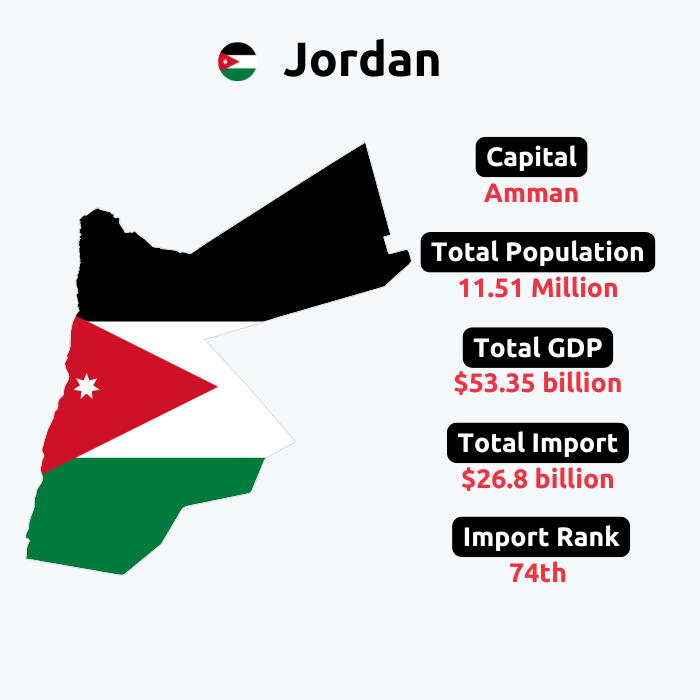
According to Jordan Import Data and Customs data, Jordan imported goods worth $26.8 billion in 2024, a 3% increase from the previous year. As per Jordan import statistics, Jordan is ranked the 74th biggest importer in the world. The total GDP of Jordan stands at $53.35 billion, with imports accounting for 57.07% of GDP. Jordan is a member of trading blocs such as the WTO and the Greater Arab Free Trade Area (GAFTA). According to Jordan Customs Data, mineral fuels and oils ($6.7 billion) are the largest import category of the country, while China ($4.8 billion) is Jordan’s biggest import partner. Let us explore the Jordan import data for 2024–25, with a focus on its top imports, leading import partners, and major trade trends.