WTO vs Reality: Is the Global Trade System Collapsing Due to the Middle-East War?
Discover how the Middle East war & Strait of Hormuz disruption could trigger a global trade collapse. Analyze the global trade slowdown in 2026.

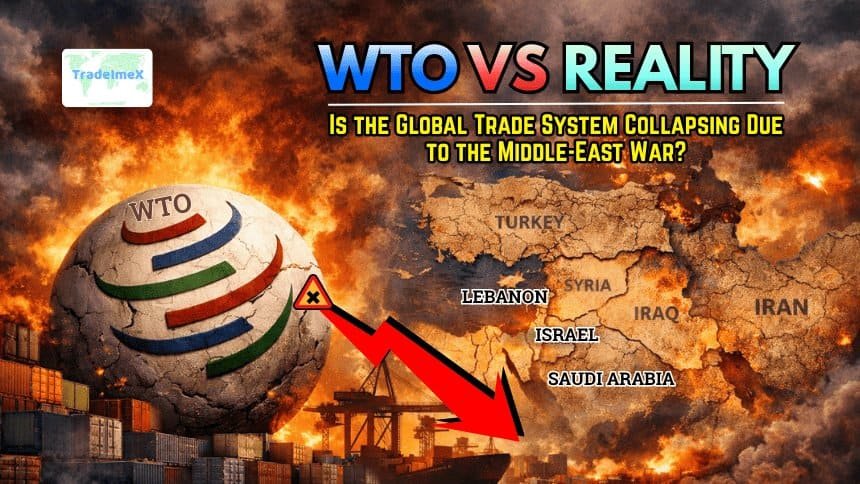
The global trading system has always been fragile beneath its polished surface. Built on cooperation, rules, and predictability, institutions like the World Trade Organization (WTO) were meant to prevent exactly the kind of economic disruption the world is witnessing today. But 2026 is testing that promise. The escalating Middle-East war, particularly the Iran-centred conflict and the disruption of the Strait of Hormuz, has triggered one of the largest supply shocks in modern economic history. The total global trade value reached $35 trillion in 2025, a 7% increase from the previous year, according to the global trade data. Oil flows have stalled, shipping routes are under threat, and countries are increasingly acting in self-interest rather than cooperation. So the big question is no longer theoretical: Is the WTO-led global trade system still functioning, or are we watching it fracture in real time? Let’s find out about the global trade slowdown & disruption in 2026 with this article.
The WTO Promise vs Ground Reality
According to reports from March and April of 2026, the global trade system is seeing its worst disruption in eight decades, marked by a dramatic slowdown, structural changes in supply networks, and escalating geopolitical tensions, mostly due to the Middle East conflict. The former "world order" has irreversibly shifted, according to WTO Director-General Ngozi Okonjo-Iweala. The WTO was designed to stabilize global trade through three key principles:
- Rules-based trade
- Dispute resolution mechanisms
- Reduction of tariffs and barriers
In theory, even during geopolitical tensions, trade should continue with minimal disruption & global trade slowdown. But reality looks very different. The WTO (World Trade Organization) itself has warned that global trade growth could slow to just 1.9% in 2026, with risks of falling even lower if the Middle-East conflict continues. Even more concerning, economists suggest growth could drop to 1.4%, alongside weaker global GDP. This is not a collapse yet, but it is a clear slowdown in a system built on expansion. At the same time, the WTO has been struggling internally:
-
Dispute settlement mechanisms are weakened
-
Negotiations are stalled
-
Consensus-based decision-making is increasingly ineffective
The result is a system that exists, but struggles to respond when it matters most.
WTO Projected vs. Reality (2026 Outlook)
-
Sharp Slowdown: According to WTO projections, global merchandise trade volume growth will drop from 4.6% in 2025 to 1.9% in 2026.
-
High-Energy Scenario: Trade growth may drop to 1.4% if oil and gas prices stay high as a result of the conflict.
-
Resilience through AI: 42% of trade growth in 2025 came from a boom in AI-enabling items. Although this momentum is still present in 2026, the conflict's effects on energy and shipping prices pose a threat.
The Shock: Middle-East War and Trade Disruption
The Middle East war is not just a regional conflict. It is a global economic shock.
1. The Strait of Hormuz Bottleneck
-
Around 20% of global oil and gas flows through the Strait of Hormuz
-
The 2026 conflict disrupted shipments by up to 90% at peak levels
The Strait of Hormuz disruption is arguably the most critical chokepoint in global trade.
When it closed:
-
Oil prices surged past $120 per barrel
-
LNG supplies stalled
-
Shipping insurance costs skyrocketed
-
Thousands of vessels were stranded
This single disruption shows how vulnerable globalization really is.
2. Energy Shock = Trade Shock
Energy is the backbone of trade. When energy prices spike:
-
Manufacturing costs rise
-
Transport becomes expensive
-
Inflation spreads globally
The IMF and World Bank warned that the war is:
-
Driving up oil, gas, and fertilizer prices
-
Increasing global food insecurity
-
Hitting import-dependent economies hardest
This is not just about trade volumes. It is about economic stability itself.
3. Supply Chain Collapse in Real Time
Take Germany as an example.
Exports to key Asian and Middle Eastern markets have faced significant disruption, as per the Asia trade data & global supply chain crisis:
-
Transit times increased from 12–18 days to over 30 days due to rerouting around conflict zones.
-
Industrial orders, especially in machinery and automotive components, have slowed noticeably.
-
Temperature-sensitive pharmaceutical shipments have faced higher risks and rising trade costs.
This is what trade disruption looks like on the ground:
-
Not abstract statistics
-
But businesses are losing orders
-
Farmers losing income
-
Consumers paying more
Impact of the Middle East Conflict
-
Blockade of the Strait of Hormuz: In February 2026, there were about 130 vessels per day in the Strait of Hormuz, a crucial chokepoint for energy, but by March 2026, there were almost none.
-
Shipping: Due to the war, there has been considerable rerouting via the Red Sea/Suez Canal, which has increased insurance costs and added 10–14 days to transit times.
-
Food and Fertilizer Security: Global agriculture is seriously threatened by disruptions to fertilizer exports from the Gulf, particularly affecting producers in Brazil, Thailand, and India.
Global Trade in The Last 10 Years: Yearly Global Trade Data

|
Year of Trade |
Total Global Trade Value ($) |
|
2015 |
$16.5 trillion |
|
2016 |
$20.2 trillion |
|
2017 |
$23.4 trillion |
|
2018 |
$24.9 trillion |
|
2019 |
$25 trillion |
|
2020 |
$22 trillion |
|
2021 |
$28.5 trillion |
|
2022 |
$32 trillion |
|
2023 |
$31 trillion |
|
2024 |
$33 trillion |
|
2025 |
$35 trillion |
|
2026 (Projected) |
$33 trillion |

WTO vs Geopolitics: Who Really Controls Trade?
The WTO assumes that rules override politics. But modern trade tells a different story.
1. Geopolitical Alignment Drives Trade
Recent research shows that:
-
A strong geopolitical alignment can increase trade by 20% over time
-
Global trade has already fallen due to political fragmentation
In simple terms:
Countries trade more with allies, less with rivals.
That means:
-
Trade is no longer neutral
-
It is political
2. Rise of Economic Nationalism
Countries are reacting to the crisis by protecting themselves:
-
Russia is expanding exports to fill gaps
-
But also restricting domestic supply to control prices
Meanwhile:
-
Tariffs are rising
-
Strategic industries are being protected
-
Trade blocs are strengthening
The WTO has little power to stop this shift.
3. The Collapse of Multilateralism
The WTO’s biggest challenge is its structure:
-
It requires consensus among all members
-
Even one country can block decisions
In a world of rising conflict, this becomes a major weakness.
As a result:
-
Agreements stall
-
Reforms fail
-
Enforcement weakens
Is Globalization Reversing?
Not entirely. But it is changing shape.
1. From Globalization to “Fragmentation.”
Instead of one global system, we are seeing:
-
Regional trade blocs
-
“Friend-shoring” (trading with allies)
-
Strategic decoupling
The Middle East war accelerates this trend.
2. Winners and Losers
Interestingly, not everyone is losing.
Winners:
-
Energy exporters (short-term gains)
-
Countries filling supply gaps (e.g., Russia)
-
AI-related trade sectors (still growing strongly)
Losers:
-
Import-dependent economies
-
Small exporters
-
Consumers (via inflation)
This uneven impact shows that the system is not collapsing uniformly. It is rebalancing.
3. Trade Still Continues
Despite all the disruption:
-
83% of German exporters still expect growth in 2026
This highlights an important point:
Trade does not stop. It adapts.
The Energy Crisis: A Structural Turning Point
According to an IMF report on the war in the Middle East, the 2026 conflict has been described as:
-
The largest supply disruption in global oil history & global supply chain crisis.
This has long-term consequences.
1. Persistent High Prices
Even after temporary ceasefires:
-
Oil prices remain elevated
-
Infrastructure damage may take years to repair
2. Inflation and Stagflation Risks
High energy prices lead to:
-
Rising inflation
-
Slower growth
-
Potential stagflation
This is exactly what the global economy fears most.
3. Food and Fertilizer Crisis
Energy shocks spill into agriculture:
-
Fertilizer prices rise
-
Food production costs increase
-
Hunger risks grow
WTO’s Diminishing Relevance?
The WTO is not collapsing, but its influence is shrinking.
1. What the WTO Can Still Do
-
Provide data and forecasts
-
Offer a platform for dialogue
-
Maintain basic trade norms
2. What It Cannot Do (Right Now)
-
Prevent wars
-
Stop energy shocks
-
Enforce compliance among major powers
In other words:
The WTO works best in stable times, not crises.
The Bigger Picture: System Collapse or System Evolution?
So, is the global trade system collapsing? The answer is more nuanced.
1. Not a Collapse, But a Transition
What we are seeing is:
-
A shift from rules-based globalization
-
To power-based trade networks
2. The New Trade Reality
The emerging system looks like this:
-
Trade influenced by geopolitics
-
Supply chains redesigned for resilience
-
Regionalization over global integration
3. The Role of Crisis
Historically, crises reshape trade systems:
-
The 1970s oil shock and energy diversification
-
The 2008 crisis and financial reforms
-
COVID-19 to supply chain rethinking
The 2026 Middle East war may do the same for trade.
Final Verdict: WTO vs Reality
The WTO represents how global trade is supposed to work. The Middle East war shows how it actually works under stress.
Key Takeaways:
-
Global trade is slowing, not collapsing
-
The WTO is weakening but still relevant
-
Geopolitics now drives trade more than rules
-
The energy crisis is reshaping global supply chains
-
The system is fragmenting, not disappearing
Is the Global Trade System Collapsing?
-
Unorganized Collapse Risk: According to reports, the WTO cautions that the system could "disorderly collapse" in the absence of a new, effective agreement on international regulations.
-
Shifting Rules: Although Most-Favoured-Nation (MFN) rules still govern 72% of trade, their use has declined, and the WTO's dispute resolution procedure is stalled.
-
Reshaped Patterns: Trade patterns are moving away from global, multilateral flows & toward aligned blocs as a result of the war's acceleration of a decoupling or fragmentation.
Conclusion and Bottom Line
In conclusion, the idea of a smooth, rules-based global trade system is being challenged like never before. The Middle-East war has exposed:
-
The fragility of supply chains
-
The dominance of geopolitics
-
The limits of institutions like the WTO
But it has also revealed something equally important: Trade is resilient. Even in a crisis, it does not stop. It reroutes, reorganizes, and reinvents itself. So no, the global trade system is not collapsing. But it is no longer what it used to be. And the WTO, once the backbone of globalization, is now just one player in a much more complex and unpredictable game of global trade data.
Note For Our Readers
We hope this blog helps you better understand the growing gap between WTO expectations and the on-the-ground reality of global trade, especially in the context of the ongoing Middle East conflict, also impacting the Iran trade data. As trade patterns shift, supply chains realign, and geopolitical risks intensify, access to reliable and timely trade data becomes more important than ever.
If you’re looking to move beyond broad trends and need deeper, data-backed insights, TradeImeX can support you. We offer detailed, shipment-level import-export data by country, product, and HS codes, along with real-time updates that reflect current market disruptions. Whether you are a business seeking alternative suppliers, an analyst tracking the impact of geopolitical events, or a trader looking to stay ahead of market shifts, our customized reports and live data tools can give you a clear edge.
For tailored insights or to explore our data solutions, feel free to reach out to us at info@tradeimex.in today.
Read also about:
Top 10 Trade-Affected Countries Due to the US-Iran War
Share
What's Your Reaction?
 Like
0
Like
0
 Dislike
0
Dislike
0
 Love
0
Love
0
 Funny
0
Funny
0
 Angry
0
Angry
0
 Sad
0
Sad
0
 Wow
0
Wow
0