
Kenya Car Imports Report 2025: Database of Car Importers in Kenya Under HS Code 8703
Explore the Kenya Car Imports report 2025 with detailed Kenya car import data under HS Code 8703, top car importers in Kenya, leading supplier countries, & market insights.


Introduction
Kenya remains one of Africa's largest automotive markets and a major hub for vehicle imports in East Africa. Driven by a growing middle class, urbanization, expanding transport infrastructure, and rising demand for personal mobility, the country's automotive sector continues to experience significant growth. Since local vehicle manufacturing remains relatively limited, car imports continue to dominate Kenya's passenger vehicle market. According to Kenya import data and Kenya customs import data of cars, the total value of Kenya car imports reached a record $1.25 billion in 2025, a 20% increase from the previous year, making automobiles one of the country's most valuable import categories. According to the Kenya car import data under HS code 8703, Kenya imported 97.10 thousand metric tons of cars in 2025.
Kenya is the 93rd largest importer of cars and 12th largest importer of used vehicles in the world, according to global trade data. Passenger vehicles accounted for a significant share of Kenya's total automotive imports as consumers, businesses, and government agencies increased car purchases. Do you know why? This blog on Kenya Car Import Report 2025 explores the latest trends in vehicle imports, top source countries, major imported vehicle categories, leading car importers in Kenya, market drivers, challenges, and opportunities within Kenya's automotive sector.
What Is HS Code 8703?
HS Code 8703 covers: "Motor cars and other motor vehicles principally designed for the transport of persons." The category includes:
-
Passenger cars
-
Sedans
-
SUVs
-
Crossovers
-
Station wagons
-
Hybrid vehicles
-
Electric vehicles
-
Luxury vehicles
-
Multi-purpose passenger vehicles
It excludes commercial trucks, buses, motorcycles, and special-purpose vehicles.
For businesses looking to enter the East African automotive market, understanding car importers in Kenya and car buyers in Kenya is essential. A reliable List of car importers in Kenya helps exporters connect with potential partners and distributors. Many dealers import cars from Japan to Kenya due to the popularity of Japanese vehicles and their competitive pricing.
Kenya Car Import Statistics 2025
Kenya remains heavily dependent on imported vehicles due to limited domestic production capacity, as per the Africa Trade Data. Recent trends in Car imports in Kenya and Cars imports to Kenya indicate steady demand for both new and used vehicles. Companies planning to import car to Kenya can benefit from analyzing detailed Kenya car import data to identify market opportunities. The Best car importers in Kenya often source vehicles from multiple international markets, while leading car importing companies in Kenya continue to expand their networks to meet growing consumer demand.
Key Import Statistics (2025)
-
Total vehicle imports under HS Code 8703: $1.25 billion
-
Annual growth rate: 8.7%
-
Total imported passenger vehicles: Around 118,000 units
-
Used vehicles share: 78%
-
New vehicles share: 22%
-
Average vehicle import value: $10,600 per unit
Passenger vehicle imports continue to represent one of Kenya's largest consumer goods import categories. When importing a motor vehicle into Kenya, one should always consider the latest trade statistics & market analysis.
Kenya Car Imports by Country: Where Does Kenya Import Cars From?
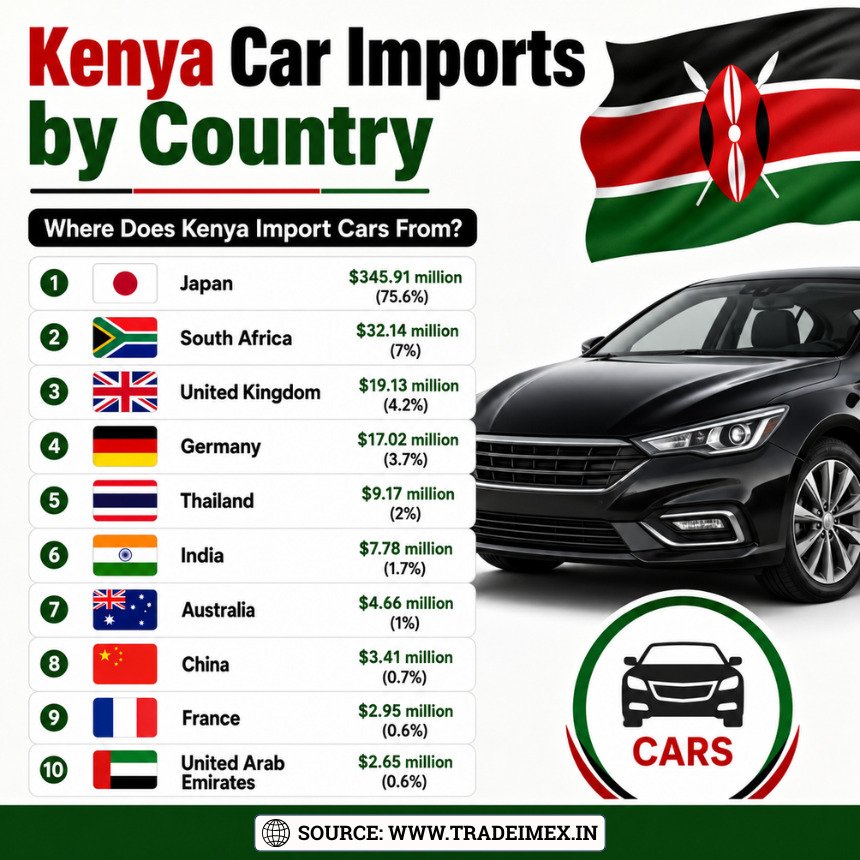
Kenya car imports by country show that Kenya sources cars from various countries around the world. The primary countries where Kenya imports cars from include Japan, South Africa, the United Kingdom, and Germany. These nations serve as major suppliers due to a combination of factors such as vehicle availability, pricing, quality, and proximity to Kenya. With a diverse range of options available, Kenya's import market continues to thrive, offering consumers a wide selection when it comes to purchasing vehicles from overseas. The top 10 car suppliers to Kenya, as per the Kenya car shipment data for 2025, include:
1. Japan: $345.91 million (75.6%)
Japan is the leading country from which Kenya imports cars, accounting for a staggering 75.6% of the total imports, as per the data on Kenya car imports from Japan. Japanese cars are renowned for their quality, reliability, and advanced technology, making them a popular choice among Kenyan consumers to import cars from Japan to Kenya. From fuel-efficient compact cars to high-performance sports cars, Japan offers a wide range of vehicles to suit every need and budget.
2. South Africa: $32.14 million (7%)
South Africa is another significant source of car imports for Kenya, accounting for 7% of the total imports. South African cars are known for their ruggedness and durability, making them well-suited for the rough terrain and harsh conditions often found in Kenya. Additionally, importing cars from South Africa can be more cost-effective due to lower transportation costs and proximity to Kenya.
3. United Kingdom: $19.13 million (4.2%)
The United Kingdom is a popular destination for Kenyan car imports, accounting for 4.2% of the total imports. British cars are known for their luxury, elegance, and sophisticated design, making them a preferred choice for those looking for a touch of class. With iconic brands such as Jaguar, Land Rover, and Aston Martin, the UK offers a range of premium vehicles that appeal to discerning Kenyan buyers.
4. Germany: $17.02 million (3.7%)
Germany is renowned for its engineering prowess and automotive innovation, making German cars highly sought after in Kenya, as per the data on Kenya car imports from Germany. With famous brands like Mercedes-Benz, BMW, and Audi, Germany offers a wide range of luxury vehicles that combine performance, comfort, and cutting-edge technology. Kenyan consumers value German cars for their reliability, safety features, and driving dynamics.
5. Thailand: $9.17 million (2%)
Thailand has emerged as a key player in the global automotive industry, with a growing reputation for producing affordable and reliable cars. Thai cars are known for their fuel efficiency, low maintenance costs, and value for money, making them a popular choice for budget-conscious Kenyan buyers. With brands such as Toyota, Honda, and Mitsubishi, Thailand offers a diverse range of vehicles to suit various preferences.
6. India: $7.78 million (1.7%)
India is becoming an increasingly important source of car imports for Kenya, accounting for 1.7% of the total imports. Indian cars are known for their affordability, practicality, and ease of maintenance, making them a popular choice for first-time car buyers & families. With brands such as Tata, Mahindra, and Maruti Suzuki, India offers a range of compact cars, SUVs, and sedans that cater to different needs and lifestyles.
7. Australia: $4.66 million (1%)
Australia may not be a major exporter of cars to Kenya, but it still plays a significant role in Kenya's automotive market. Australian cars are known for their ruggedness, off-road capability, and reliability, making them popular choices for outdoor enthusiasts and adventure seekers in Kenya. Brands such as Holden and Ford offer a range of utility vehicles and pickup trucks well-suited to the Kenyan terrain.
8. China: $3.41 million (0.7%)
China is a rising star in the global automotive industry, with a growing presence in the Kenyan car market. Chinese cars are known for their affordability, innovative features, and modern design, making them attractive options for budget-conscious consumers. With brands such as Geely, Chery, and BYD, China offers a range of electric cars, compact cars, and SUVs that appeal to a wide range of customers.
9. France: $2.95 million (0.6%)
France may not be a top exporter of cars to Kenya, but French cars are known for their style, sophistication, and technological innovation. With iconic brands such as Peugeot, Renault, and Citroën, France offers a range of compact cars, hatchbacks, and SUVs that appeal to fashion-conscious Kenyan buyers. French cars are valued for their distinctive design, comfortable interiors, and eco-friendly features.
10. United Arab Emirates: $2.65 million (0.6%)
The United Arab Emirates may be better known for its luxury cars than for its mass-market vehicles, but it still plays a role in Kenya's car import market. UAE cars are known for their opulence, exclusivity, & prestige, making them sought after by high-end buyers in Kenya. With brands such as Rolls-Royce, Bentley, and Lamborghini, the UAE offers a range of luxury cars & sports cars that cater to customers with selective tastes.
Kenya Car Importers Database: Top Car Buyers in Kenya With Shipment Records
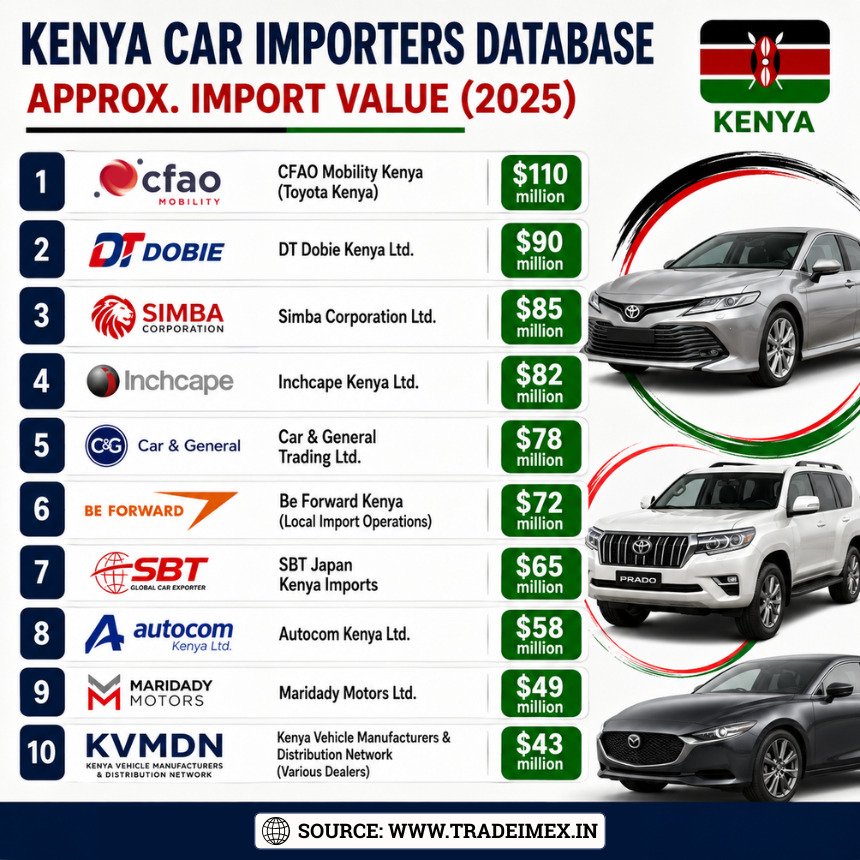
Kenya's automotive import sector includes hundreds of vehicle importers, dealerships, distributors, and automobile trading companies. Major categories of car buyers or the leading car importers in Kenya, according to the Kenya car importers & Kenya car buyers database for 2025, include:
1. CFAO Mobility Kenya (Toyota Kenya)
-
Approx. Import Value (2025): $110 million
-
Top Imported Cars: Toyota Prado, Toyota Hilux, Toyota Corolla Cross, Toyota RAV4
-
Top Import Source: Japan
2. DT Dobie Kenya Ltd.
-
Approx. Import Value (2025): $90 million
-
Top Imported Cars: Mercedes-Benz C-Class, E-Class, GLE, Actros passenger variants
-
Top Import Source: Germany
3. Simba Corporation Ltd.
-
Approx. Import Value (2025): $85 million
-
Top Imported Cars: Mitsubishi Outlander, Mitsubishi Pajero Sport, Proton X70
-
Top Import Sources: Japan, Malaysia
4. Inchcape Kenya Ltd.
-
Approx. Import Value (2025): $82 million
-
Top Imported Cars: BMW X5, BMW 3 Series, Land Rover Discovery, Range Rover Sport
-
Top Import Sources: Germany, United Kingdom
5. Car & General Trading Ltd.
-
Approx. Import Value (2025): $78 million
-
Top Imported Cars: Suzuki Swift, Suzuki Vitara, Mazda Demio, Mazda CX-5
-
Top Import Source: Japan
6. Be Forward Kenya (Local Import Operations)
-
Approx. Import Value (2025): $72 million
-
Top Imported Cars: Toyota Vitz, Nissan Note, Honda Fit, Subaru Forester
-
Top Import Source: Japan
7. SBT Japan Kenya Imports
-
Approx. Import Value (2025): $65 million
-
Top Imported Cars: Toyota Aqua, Nissan X-Trail, Mazda Axela, Honda Vezel
-
Top Import Source: Japan
8. Autocom Kenya Ltd.
-
Approx. Import Value (2025): $58 million
-
Top Imported Cars: Toyota Harrier, Subaru XV, Nissan Dualis, Mazda CX-3
-
Top Import Source: Japan
9. Maridady Motors Ltd.
-
Approx. Import Value (2025): $49 million
-
Top Imported Cars: Toyota Land Cruiser Prado, Toyota Premio, Honda Fit Hybrid
-
Top Import Sources: Japan, UAE
10. Kenya Vehicle Manufacturers & Distribution Network (Various Dealers)
-
Approx. Import Value (2025): $43 million
-
Top Imported Cars: Hyundai Tucson, Kia Sportage, Hyundai Elantra
-
Top Import Source: South Korea
Authorized Vehicle Distributors
Examples:
-
CFAO Motors Kenya
-
DT Dobie Kenya
-
Simba Corporation
-
Isuzu East Africa
-
Inchcape Kenya
These firms primarily import new vehicles.
Get verified & customized Kenya Car Importers Database today to leave an impression in the automotive & car industry and skyrocket your business. Contact us today at info@tradeimex.in.
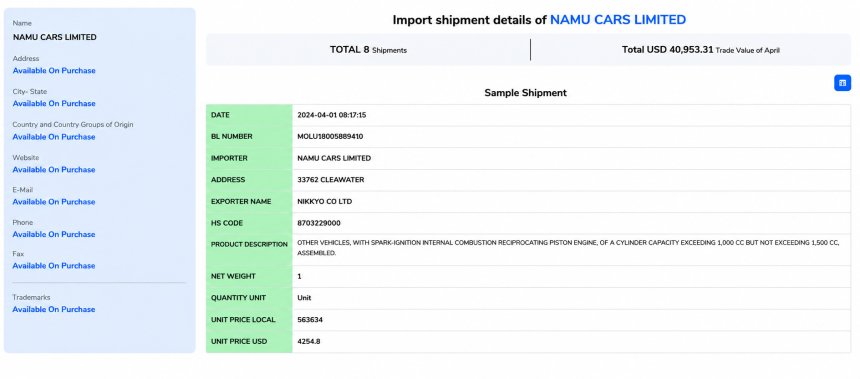

Kenya Car Import Data in the Last 10 Years
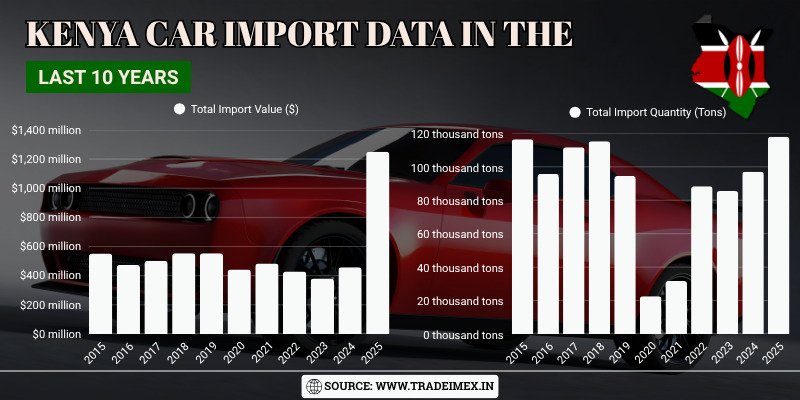
|
Year of Imports |
Total Import Value ($) |
Total Import Quantity (Tons) |
|
2015 |
$552.58 million |
116.48 thousand tons |
|
2016 |
$473.52 million |
95.76 thousand tons |
|
2017 |
$502.58 million |
111.68 thousand tons |
|
2018 |
$553.68 million |
115.26 thousand tons |
|
2019 |
$553.53 million |
94.56 thousand tons |
|
2020 |
$442.53 million |
22.52 thousand tons |
|
2021 |
$484.37 million |
31.63 thousand tons |
|
2022 |
$429.61 million |
88.34 thousand tons |
|
2023 |
$381.39 million |
85.50 thousand tons |
|
2024 |
$457.16 million |
97.10 thousand tons |
|
2025 |
$1.25 billion |
118 thousand tons |
Despite temporary disruptions during the pandemic period, Kenyan car imports have steadily increased due to strong domestic demand.
Why Kenya Imports So Many Cars
Several factors continue driving vehicle imports into Kenya.
Growing Middle-Class Population
Increasing household incomes have expanded demand for:
-
Personal vehicles
-
Family SUVs
-
Compact sedans
-
Hybrid vehicles
Urban Expansion
Cities such as:
-
Nairobi
-
Mombasa
-
Kisumu
-
Nakuru
-
Eldoret
have experienced rapid population growth and increasing transportation needs.
Limited Domestic Production
Although local assembly operations exist, they cannot fully satisfy market demand, leading to continued dependence on imported vehicles.
Growth of Ride-Hailing Services
Platforms such as Uber, Bolt, and local mobility providers have significantly increased demand for affordable passenger vehicles.
Kenya's Automobile Industry: Trends and Prospects
The Kenyan car market is rebounding in 2025 following a three-year losing streak. Following an outstanding increase in Q1 that continued in the subsequent months, full-year numbers increased by 21.8%. In terms of brands, Isuzu continued to lead this year with a 47.8% market share and a 25.5% growth in sales, then came Toyota with a market share of 23% and a 5.9% decline. Mitsubishi came in third with an astounding gain of 75.9% and a share of 6.7%. Ford dropped to fifth place (+21.2%), while Tata came in fourth, up 737.9%. Regarding vehicles, the Isuzu D-Max topped the list with a 35.2% increase, followed by the Toyota Hilux with a 3-spot increase and an 81.8% increase.
Market Trend for the Medium Term
Before 2015, when yearly sales reached a peak of 13,840 units, the Kenyan car market experienced a period of expansion. A severe decline ensued, with sales dropping by 47% in 2016 and an additional 8% in 2017 to reach 8,614 units. Sales increased to 15,825 units in 2019 (+83.7%) as a result of a recovery in the next years, which was fueled by robust private consumption and improvements in the global macroeconomy. The COVID-19 pandemic, however, upset this trend, resulting in a 19.6% decline in sales to 12,731 units in 2020.
Sales increased by 26.4% to 16,095 units in 2021 as a result of growing consumer confidence and rebounding economic activity. But the market fell 5.1% in 2022, 18.7% in 2023, and a further 10.6% in 2024 to conclude at 11,100 units as a result of a prolonged recession that began in 2022. High inflation, high interest rates, and declining currency all contributed to this downturn by reducing consumer spending power and raising the cost of financing and car imports. As a result of this, demand for new cars fell precipitously, especially for more expensive models and foreign brands.
Top Imported Vehicle Types in Kenya
1. SUVs and Crossovers
-
Import Value: $420 million
-
Market Share: 33.6%
Popular models include:
-
Toyota Prado
-
Toyota Harrier
-
Nissan X-Trail
-
Mazda CX-5
2. Compact Sedans
-
Import Value: $275 million
-
Market Share: 22%
3. Hybrid Vehicles
-
Import Value: $180 million
-
Market Share: 14.4%
Kenyan consumers increasingly prefer hybrid vehicles because of rising fuel prices.
4. Hatchbacks
-
Import Value: $145 million
-
Market Share: 11.6%
5. Pickup Vehicles
-
Import Value: $110 million
-
Market Share: 8.8%
6. Luxury Vehicles
-
Import Value: $70 million
-
Market Share: 5.6%
7. Electric Vehicles
Import Value: $50 million
Market Share: 4%
Most Imported Car Brands in Kenya
The Kenyan automotive market remains heavily dominated by Japanese manufacturers to import cars from Japan to Kenya. Toyota is the largest manufacturer & supplier of cars to Kenya.
1. Toyota
Approx. import value in 2025: $430 million
Popular models:
-
Prado
-
Harrier
-
Corolla
-
Vitz
-
RAV4
2. Nissan
Approx. import value in 2025: $160 million
Popular Models:
-
Nissan Note
-
Nissan X-Trail
-
Nissan Hardbody & Patrol
-
Nissan Dualis
-
Nissan Tiida
3. Mazda
Approx. import value in 2025: $120 million
Popular Models:
-
Mazda Demio
-
Mazda CX-5
-
Mazda Axela
-
Mazda CX-3
-
Mazda CX-30
4. Honda
Approx. import value in 2025: $95 million
Popular Models:
-
Honda Fit
-
Honda CR-V
-
Honda Stream
-
Honda Civic
-
Honda Accord
5. Subaru
Approx. import value in 2025: $90 million
Popular Models:
-
Subaru Forester
-
Subaru Impreza
-
Subaru Legacy
-
Subaru XV
-
Subaru Outback
6. Suzuki
Approx. import value in 2025: $70 million
Popular Models:
-
Suzuki Alto
-
Suzuki Swift
-
Suzuki Vitara
-
Suzuki Jimy
-
Suzuki Ciaz
7. Mitsubishi
Approx. import value in 2025: $65 million
Popular Models:
-
Mitsubishi Lancer
-
Mitsubishi Outlander
-
Mitsubishi Canter
-
Mitsubishi Pajero
-
Mitsubishi RVR
8. Isuzu
Approx. import value in 2025: $50 million
Popular Models:
-
Isuzu D-Max
-
Isuzu F-Series
-
Isuzu N- Series
-
Isuzu MU-X
-
Isuzu Trooper
9. BMW
Approx. import value in 2025: $40 million
Popular Models:
-
BMW M340i
-
BMW X5
-
BMW M5
-
BMW X7
-
BMW i7
10. Mercedes-Benz
Approx. import value in 2025: $35 million
Popular Models:
-
E-Class
-
C-Class
-
GLC
-
S-Class
-
G-Class
Emerging Trend: Growth of Hybrid Vehicle Imports
Hybrid vehicles are rapidly gaining popularity across Kenya. Reasons include:
1. Rising Fuel Costs
Consumers seek vehicles with better fuel efficiency.
2. Environmental Awareness
Interest in lower-emission vehicles is increasing.
3. Government Support
Kenya continues encouraging cleaner transportation solutions. Popular hybrid imports include:
-
Toyota Prius
-
Toyota Aqua
-
Honda Fit Hybrid
-
Nissan Note e-Power
Hybrid imports grew by nearly 24% in 2025 compared to the previous year.
Kenya’s Electric Vehicle Market Growth
Although EV adoption remains in its early stages, growth is accelerating. Factors supporting EV imports include:
-
Expansion of charging infrastructure
-
Reduced operating costs
-
Government sustainability initiatives
Popular imported EV brands include:
-
BYD
-
Tesla
-
Nissan
-
Hyundai
-
Volkswagen
Industry estimates suggest EV imports could double over the next five years.
Future Outlook for Kenya Car Imports
Industry analysts expect continued growth through 2030. Key forecasts include:
-
Passenger vehicle imports are expected to exceed $1.6 billion by 2030
-
The hybrid vehicle market share is reaching 25%
-
EV market share exceeding 10%
-
Growth in dealership networks
-
Increased demand for SUVs and crossovers
Kenya is expected to remain East Africa's leading vehicle import market.
Conclusion and Final Thoughts
Kenya's passenger vehicle import market continues to expand, with imports under HS Code 8703 reaching approximately $1.25 billion in 2025. Strong consumer demand, urbanization, economic growth, and expanding transportation needs continue driving vehicle imports into the country.
Japan remains the dominant supplier, accounting for more than half of Kenya's imported vehicles, while hybrid and electric vehicles are emerging as important growth segments. SUVs, sedans, and fuel-efficient passenger cars continue dominating import demand.
As Kenya's economy expands and vehicle ownership rates rise, the country is expected to remain one of Africa's most attractive automotive markets. For exporters, manufacturers, dealers, and investors, access to a comprehensive Kenya Car Importers Database can provide crucial insights into buyers, import trends, and emerging opportunities across the automotive supply chain.
Frequently Asked Questions (FAQs)
1. Which is the most imported car in Kenya in 2025?
The Toyota brand, particularly models such as the Toyota Prado, Toyota Harrier, Toyota Corolla, Toyota Vitz, and Toyota RAV4, remains the most imported and widely purchased vehicle category in Kenya, followed by the Isuzu D-Max, which is Kenya's best-selling car in 2025. Toyota continues to dominate the Kenyan market due to its reliability, fuel efficiency, affordable spare parts, and strong resale value. Japan remains Kenya's largest source of imported passenger vehicles, as per the database on Japan car exports to Kenya.
2. How many cars are imported in Kenya every year?
Kenya imports between 100,000 and 120,000 passenger vehicles annually, with the majority being used vehicles sourced from Japan, the United Kingdom, South Africa, and other international markets. Import volumes vary depending on economic conditions, exchange rates, and government regulations affecting vehicle imports.
3. How many car imports are there in Kenya in 2025?
According to the 2025 Kenya car import statistics under HS Code 8703, Kenya imported around 118,000 passenger vehicles, valued at around $1.25 billion. Used vehicles accounted for roughly 78% of total imports, while new vehicles represented about 22% of the market, as per the Kenya car import database.
4. Which car is mostly used in Kenya?
The Toyota Corolla is widely regarded as the most commonly used car in Kenya, followed by popular models such as the Toyota Vitz, Toyota Premio, Toyota Harrier, Isuzu D-Max, Nissan Note, Mazda Demio, and Honda Fit. Toyota vehicles dominate Kenyan roads because they are durable, fuel-efficient, and relatively inexpensive to maintain.
5. How much will it cost to import a car from Japan to Kenya?
The cost of importing a car from Japan to Kenya depends on the vehicle's purchase price, age, engine size, shipping charges, insurance, and applicable taxes. For a typical used Japanese vehicle valued at $8,000–$12,000, the total landed cost after import duty, excise duty, VAT, IDF, RDL, inspection, and clearance charges often ranges between $12,000 and $20,000 (KES 1.5–2.6 million). Kenya applies import duty, VAT, excise duty, and other levies based on the vehicle's Customs Value (CIF), as per Kenya customs data.
Note For Our Readers
We hope this blog on Kenya Car Imports Report 2025, Car Importers in Kenya, HS Code 8703, and Kenya's passenger vehicle trade trends provides valuable insights into one of Africa's fastest-growing automotive markets.
For more information on the Kenya import database, Kenya vehicle import shipment records, importer databases, customs statistics, buyer details, and customized trade reports by company, product, or HS code, contact TradeImeX at info@tradeimex.in and gain access to comprehensive database reports & global trade intelligence solutions.
Share
What's Your Reaction?
 Like
0
Like
0
 Dislike
0
Dislike
0
 Love
0
Love
0
 Funny
0
Funny
0
 Angry
0
Angry
0
 Sad
0
Sad
0
 Wow
0
Wow
0