
Global Auto Parts Exports Data 2025: Auto Parts Exporters & Suppliers Database
Explore Global Auto Parts Exports Data 2025 with database insights on auto parts suppliers & exporters in the international automotive industry.


The global automotive industry is no longer just about finished vehicles. Today, the real backbone of international automotive trade lies in auto parts and components, which move across borders in massive volumes to support manufacturing, assembly, and aftermarket demand. According to the latest global trade data and auto parts export data, the total value of auto parts exports reached $453.72 billion in 2025, a 2% increase from the previous year. Motor parts & auto parts are the 10th most exported commodity worldwide, as per the global commodity export data under HS code 8708.
In 2025, the auto parts trade has become more data-driven, more fragmented, & more competitive than ever. This blog breaks down global auto parts export data, key exporters, supplier databases, trade trends, and actionable insights for businesses looking to enter or expand in this space.
Global Auto Parts Trade Overview (2025)
The global auto parts market continues to operate at a massive scale. According to recent trade datasets:
-
Global automotive parts exports reached over $453 billion in 2025, forming the baseline for 2025 trade activity.
-
Over 1 million shipments of auto parts were recorded globally between mid-2024 and mid-2025.
-
The number of global exporters ranges between 16,000 and 42,000 companies, depending on the dataset scope.
-
Trade spans 135–160+ exporting countries and nearly 190 importing markets.
In simple terms, auto parts exports are not controlled by a few players. Instead, they operate through a highly distributed global supply chain, where thousands of suppliers compete and collaborate simultaneously.
Export Growth Trends and Market Momentum
Strong but Uneven Growth
The auto parts export sector is growing, but not uniformly:
-
Shipment volumes grew 19% year-over-year in recent databases.
-
Some datasets report up to 79% YoY growth in specific segments.
-
Monthly shipments alone can exceed 90,000 transactions globally.
However, value growth has been more stable:
-
Global export value slightly declined by -1.9% from 2023 to 2024, reflecting pricing pressure and macroeconomic factors.
What This Means
-
Volume growth indicates strong demand and supply chain activity
-
Value stagnation suggests price competition and cost pressure
-
Margins are tightening, especially in commoditized parts
Auto Parts Exports by Country: Top Auto Parts Exporting Countries
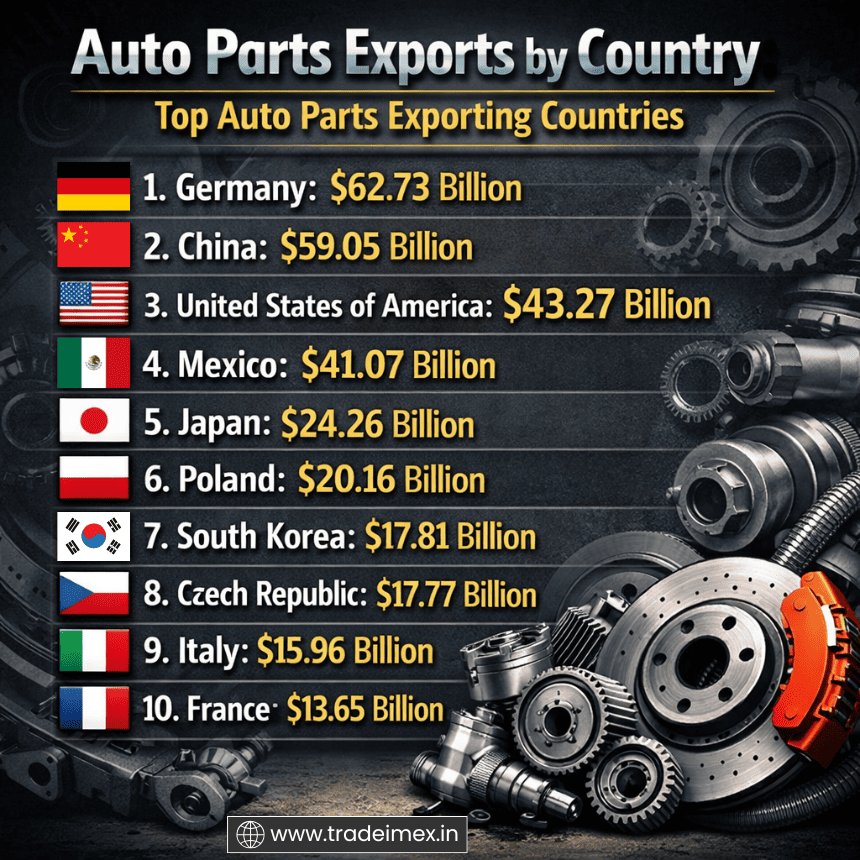
When examining auto parts exports by country, several nations emerge as the top auto parts exporting countries. These countries play a significant role in the global automotive industry by supplying a wide range of auto components to various markets worldwide. Their expertise in manufacturing and exporting auto parts showcases their competitive edge and contribution to the automotive supply chain. The top 10 automotive parts exporting countries, as per the auto parts shipment data for 2025, include:
1. Germany: $62.73 billion (14.2%)
Germany is known for its high-quality engineering and advanced manufacturing capabilities, making it a powerhouse in the auto parts export market, as per the Germany auto parts export data by HS code. German auto parts manufacturers are revered for their precision and innovation, producing a wide range of products that are in high demand worldwide. From complex components to cutting-edge technology, Germany's auto parts industry continues to lead the way in innovation and reliability.
2. China: $59.05 billion (12.5%)
As the world's largest automobile market, China plays a vital role in auto parts exports. The country's robust manufacturing sector and competitive pricing have made it a top choice for auto parts buyers globally for China auto parts suppliers. Chinese auto parts manufacturers produce a diverse range of products, from basic components to advanced systems, catering to the needs of various vehicle models and manufacturers. With its vast production capacity and growing expertise, China is poised to maintain its position as a key player in the auto parts export market.
3. United States of America: $43.27 billion (9.9%)
The United States has a long history of automotive manufacturing and innovation, making it a significant player in the auto parts export market, as per the US auto parts export data. American auto parts manufacturers & auto parts suppliers in USA are known for their technological prowess and high-quality products, ranging from engines and transmissions to electronic systems and sensors. With a strong focus on research and development, the US auto parts exports continue to drive innovation in the auto parts industry, creating cutting-edge solutions for the vehicles of tomorrow.
4. Mexico: $41.07 billion (9.1%)
Mexico has emerged as a key player in the auto parts export market, thanks to its strategic location and skilled workforce. The country's proximity to major automotive markets, such as the United States and Canada, has made it an attractive destination for auto parts manufacturers looking to expand their global reach. Mexican auto parts companies are known for their cost-effective production processes and efficient supply chains, ensuring the timely delivery of high-quality products to customers worldwide.
5. Japan: $24.26 billion (5.7%)
Japan has a strong reputation for quality and reliability in the auto parts export market, with its products being sought after for their precision engineering and advanced technology. Japanese auto parts manufacturers are known for their focus on sustainability and eco-friendliness, producing environmentally friendly products that meet the highest standards of performance and durability. With a rich heritage of automotive innovation, Japan continues to be a major player in the global auto parts industry.
6. Poland: $20.16 billion (4.2%)
Poland has emerged as a leading auto parts exporter in Europe, with its skilled workforce and competitive production costs attracting buyers from around the world. Polish auto parts manufacturers are known for their craftsmanship and attention to detail, producing a wide range of products that meet the diverse needs of customers. With a focus on quality and efficiency, Poland has established itself as a key player in the auto parts export market, offering reliable solutions for a wide range of vehicles.
7. South Korea: $17.81 billion (4.1%)
South Korea is known for its technological prowess and innovation in the auto parts export market, producing high-quality products that are in demand globally. Korean auto parts manufacturers & Korean auto parts suppliers are known for their focus on research and development, creating cutting-edge solutions for the automotive industry. With a strong emphasis on quality and performance, South Korea continues to be a major player in the global auto parts market, supplying products that meet the highest standards of excellence.
8. Czech Republic: $17.77 billion (3.6%)
The Czech Republic has emerged as a key player in the auto parts export market, thanks to its skilled workforce and advanced manufacturing capabilities. Czech auto parts manufacturers are known for their precision engineering and attention to detail, producing a diverse range of products that cater to the needs of various vehicle manufacturers. With a strong focus on quality and innovation, the Czech Republic continues to be a preferred destination for auto parts buyers looking for reliable and high-quality products.
9. Italy: $15.96 billion (3.4%)
Italy has a long-standing tradition of craftsmanship and innovation in the auto parts export market, with its products being acclaimed for their style and performance. Italian auto parts manufacturers are known for their focus on design and aesthetics, creating products that combine form & function seamlessly. With a strong heritage of automotive excellence, Italy continues to be a major player in the global auto parts industry, offering products that exude style and sophistication.
10. France: $13.65 billion (3%)
France is known for its expertise in automotive design and engineering, making it a key player in the auto parts export market. French auto parts manufacturers are revered for their creativity and innovation, producing products that embody the country's rich heritage of automotive excellence. With a focus on sustainability and energy efficiency, France continues to be a preferred destination for auto parts buyers looking for environmentally friendly solutions.
Together, these countries account for over 50% of global exports
Regional Breakdown
-
Europe: 45% of global exports
-
Asia: 30%
-
North America: 22%
Key Insight
-
Europe leads in high-value precision components
-
Asia dominates volume and cost competitiveness
-
North America remains strong in OEM-linked exports
Global Auto Parts Exporters & Suppliers Database (2025)
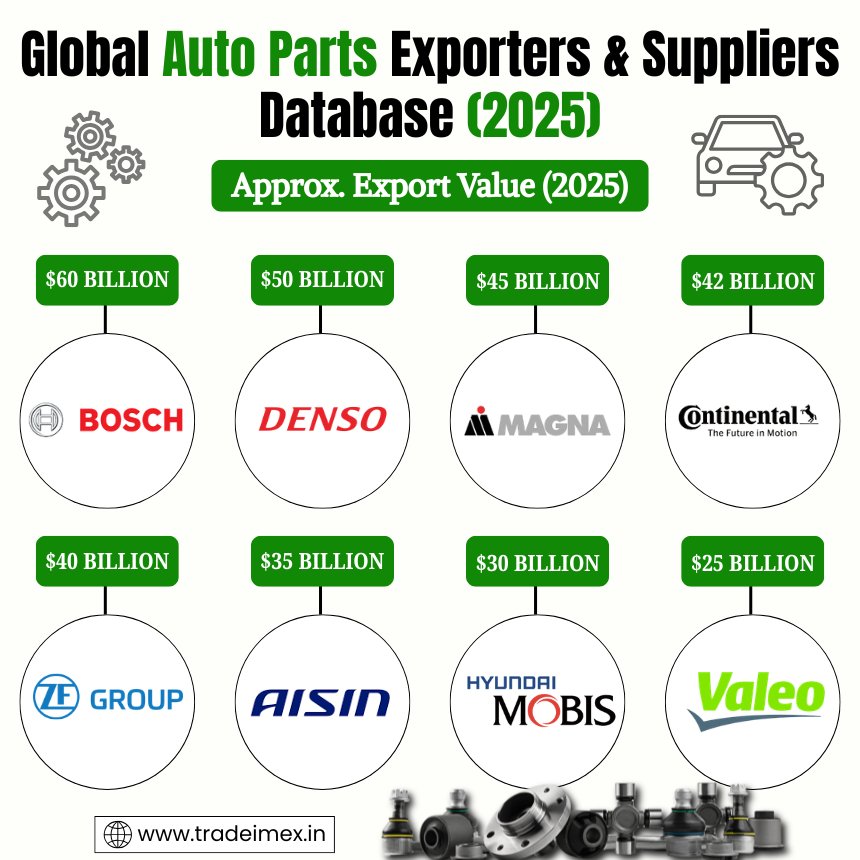
A major shift in 2025 is the growing importance of structured supplier databases. The Auto Parts Exporters & Suppliers Database is a comprehensive resource for businesses in the automotive industry seeking to expand their global reach. This dataset contains a vast collection of information for auto parts exporters and suppliers, making it a valuable tool for companies seeking to establish partnerships and streamline their supply chain processes. Robert Bosch GmbH and Denso Corporation are the largest auto parts suppliers globally. The leading auto parts exporters & automotive parts exporting companies, as per the auto parts suppliers database for 2025, include:
1. Robert Bosch GmbH (Germany)
-
Approx. Export Value (2025): $60 billion
-
Top Export Types:
-
Engine components
-
Fuel systems
-
Automotive electronics
-
Sensors
2. Denso Corporation (Japan)
-
Approx. Export Value (2025): $50 billion
-
Top Export Types:
-
Thermal systems
-
Powertrain components
-
EV systems
3. Magna International Inc. (Canada)
-
Approx. Export Value (2025): $45 billion
-
Top Export Types:
-
Body systems
-
ADAS (driver assistance systems)
-
EV platforms
-
Seating systems
4. Continental AG (Germany)
-
Approx. Export Value (2025): $42 billion
-
Top Export Types:
-
Tires
-
Braking systems
-
Automotive electronics
-
Sensors
5. ZF Friedrichshafen AG (Germany)
-
Approx. Export Value (2025): $40 billion
-
Top Export Types:
-
Transmissions
-
Driveline systems
-
Chassis components
6. Aisin Corporation (Japan)
-
Approx. Export Value (2025): $35 billion
-
Top Export Types:
-
Transmission systems
-
Drivetrain components
-
Body parts
7. Hyundai Mobis (South Korea)
-
Approx. Export Value (2025): $30 billion
-
Top Export Types:
-
Automotive modules
-
EV components
-
Infotainment systems
8. Valeo (France)
-
Approx. Export Value (2025): $25 billion
-
Top Export Types:
-
Lighting systems
-
ADAS technologies
-
Thermal systems
9. Lear Corporation (United States)
-
Approx. Export Value (2025): $23 billion
-
Top Export Types:
-
Seating systems
-
Electrical distribution systems
10. Faurecia (FORVIA) (France)
-
Approx. Export Value (2025): $22 billion
-
Top Export Types:
-
Interior systems
-
Emissions control technologies
-
Hydrogen mobility solutions
Key Insights
-
Germany leads with multiple top exporters (Bosch, Continental, ZF)
-
Japan excels in electronics and hybrid/EV systems
-
EV and ADAS components are the fastest-growing export categories
-
Most companies are Tier-1 suppliers, directly serving global automakers
Global Database Scale
-
37,000+ suppliers/exporters identified globally
-
26,000+ buyers/importers tracked
-
Coverage across 200+ countries
What These Databases Contain
A modern auto parts exporters database typically includes:
-
Company name and location
-
Product categories (HS codes)
-
Shipment history
-
Buyer relationships
-
Pricing trends
-
Trade volumes
Why It Matters
Instead of guessing markets, businesses now:
-
Identify active buyers already importing similar products
-
Analyze competitor shipments
-
Target high-demand regions with real data
This reduces risk and improves conversion rates in export sales.
Global Auto Parts Exports in The Last 10 Years: Historical Export Data
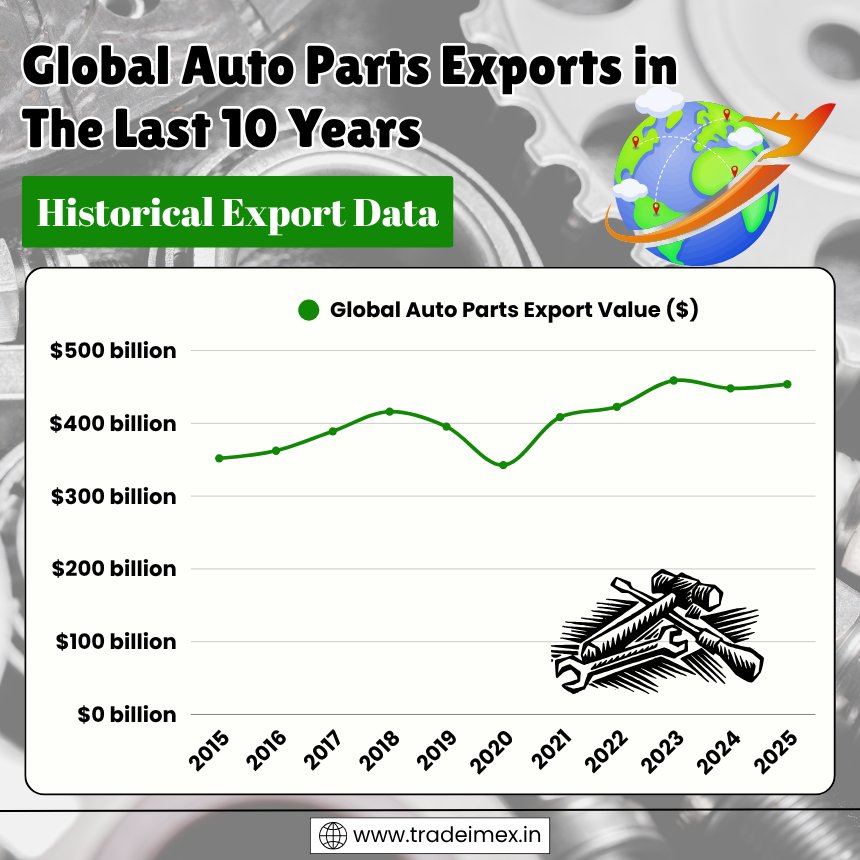
|
Year of Exports |
Global Auto Parts Export Value ($) |
|
2015 |
$351.87 billion |
|
2016 |
$362.28 billion |
|
2017 |
$389.01 billion |
|
2018 |
$416.08 billion |
|
2019 |
$395.49 billion |
|
2020 |
$342.58 billion |
|
2021 |
$408.48 billion |
|
2022 |
$422.72 billion |
|
2023 |
$458.82 billion |
|
2024 |
$448.01 billion |
|
2025 |
$453.72 billion |

Major Import Markets Driving Demand
Auto parts exports exist because of strong importing countries.
Top Importers
-
United States (the largest importer globally)
-
India
-
Vietnam
Key Demand Drivers
-
Vehicle production hubs
-
Aftermarket repair ecosystems
-
EV transition and component upgrades
Example: India’s Rising Role
India is both:
-
A top exporter
-
A major importer
In FY2025:
-
Auto parts exports reached $23 billion
-
Trade surplus hit $453 million
This dual role reflects how modern supply chains work: countries both import and export different components.
Product Categories in Auto Parts Exports
Auto parts exports are not uniform. The market is segmented into multiple categories:
High-Volume Categories
-
Engine components
-
Transmission systems
-
Brake systems
-
Suspension parts
-
Electrical components
High-Growth Segments (2025)
-
EV components (battery systems, controllers)
-
Sensors and electronics
-
Lightweight materials
Example Insight
Germany’s export growth is driven heavily by:
-
Engine components
-
Drive transmission parts
Supply Chain Transformation in 2025
The auto parts export ecosystem is undergoing structural change.
1. Automation in Manufacturing
Automation is reshaping exports by:
-
Increasing production efficiency
-
Enabling customization
-
Reducing labor dependency
Manufacturers are investing in robotics and AI to remain competitive
2. Supply Chain Diversification
Companies are reducing reliance on single-country sourcing.
Example:
-
Major automakers are shifting away from China-centric supply chains
This opens opportunities for:
-
India
-
Vietnam
-
Mexico
-
Eastern Europe
3. Rise of Regional Trade Hubs
Instead of global-only supply chains, companies are building regional clusters:
-
North America (US–Mexico)
-
Europe (Germany–Eastern Europe)
-
Asia (China–ASEAN–India)
Challenges in the Global Auto Parts Export Market
Despite growth, the industry faces real constraints.
1. Price Pressure
-
Increasing competition
-
Lower margins
-
Commodity-driven pricing
2. Trade Barriers
-
Tariffs (e.g., US auto tariffs impacting exports)
-
Regulatory compliance
-
Localization requirements
3. EV Transition Complexity
The shift to electric vehicles is changing demand:
-
Decline in traditional engine components
-
Rise in electronics and battery systems
4. Supply Chain Volatility
-
Geopolitical tensions
-
Raw material shortages
-
Trade disruptions
Opportunities for Exporters in 2025
Despite challenges, the opportunities are substantial.
High-Potential Regions
-
Africa (rapid growth)
-
Latin America
-
Middle East
-
Southeast Asia
China, for example, saw export growth across:
-
CIS & Baltics: +35%
-
Latin America: +21%
-
Africa: +17%
High-Potential Strategies
-
Focus on niche components
-
Invest in quality certifications
-
Use export databases for targeting buyers
-
Build long-term OEM partnerships
-
Adapt to EV component demand
Future Outlook (2025–2030)
The next five years will reshape the auto parts export industry.
Key Trends Ahead
-
EV components will dominate growth
-
Digital supply chains will replace manual sourcing
-
Regionalization will continue
-
Supplier consolidation will increase
Market Direction
The industry is moving toward:
-
Fewer but stronger suppliers
-
More data-driven decisions
-
Faster, more flexible production systems
Conclusion and Final Thoughts
In conclusion, the global auto parts export market in 2025 is vast, complex, and highly competitive. With hundreds of billions in trade value, tens of thousands of suppliers, and millions of shipments, it represents one of the most dynamic sectors in global trade. What sets successful exporters apart today is not just manufacturing capability, but access to data and the ability to act on it. An effective auto parts exporters and suppliers database is no longer optional. It is a core tool for:
-
Identifying buyers
-
Understanding market demand
-
Tracking competitors
-
Expanding globally with precision
For businesses looking to grow in this space, the opportunity is clear. The challenge is execution. And in 2025, execution is powered by data.
Note For Our Readers
We hope this blog gives you a clear, data-driven understanding of the global auto parts export landscape in 2025, from the dominance of Tier-1 suppliers and shifting supply chains to the rise of EV components, regional trade hubs, and increasing competition across international markets. As the automotive industry continues to evolve, driven by electrification, automation, and geopolitical shifts, having access to accurate and detailed auto parts import-export data is becoming more important than ever.
If you’re looking to move beyond surface-level insights and need deeper, data-backed intelligence, TradeImeX can support your business goals. You can global search live auto parts export data by country, company, and HS codes, along with real-time updates that reflect current market dynamics. Whether you are searching for verified buyers, identifying reliable suppliers, tracking competitor activity, or analyzing demand and pricing trends, our customized datasets and analytics solutions can help you make smarter, faster decisions. Contact info@tradeimex.in today to accelerate your global trade growth.
Share
What's Your Reaction?
 Like
0
Like
0
 Dislike
0
Dislike
0
 Love
0
Love
0
 Funny
0
Funny
0
 Angry
0
Angry
0
 Sad
0
Sad
0
 Wow
0
Wow
0