UK-India Free Trade Agreement Explained: A New Chapter in Bilateral Trade
Discover key highlights of the UK-India Free Trade Agreement 2025, including tariff cuts, trade statistics, sectoral benefits, and its impact on global trade. Learn how this historic FTA is set to reshape bilateral trade and boost economic ties.


Introduction
After three years of negotiations, the UK and India have agreed on a ‘landmark’ trade deal on Tuesday, 6th May, 2025. The deal could assist UK industries affected by Trump tariffs, with ministers stating it will contribute £4.8bn annually to the economy by 2040. The UK and India have reached a trade agreement that simplifies the process for UK companies to export whisky, cars, and other goods to India, while reducing taxes on clothing and footwear exports from India. The UK-India free trade deal has long been promoted as one of the biggest prizes of Brexit. After a conversation with Indian Prime Minister Narendra Modi, Keir Starmer stated that the “landmark deal” with India will increase the economy and provide benefits for British citizens and businesses. This deal will also have an impact on the overall global trade data in 2025.
The UK-India free trade agreement promises to benefit the UK’s car and alcohol sectors, which have been affected by the consequences of Donald Trump’s US tariffs. It has sparked controversy, though, regarding the choice to exempt both Indian workers briefly joined to the UK and their patrons from national insurance contributions (NICs) for three years. In 2024, UK-India trade amounted to £42.6bn and was projected to increase. However, the government claimed that the India-UK trade deal would enhance this trade by an extra £25.5bn annually by 2040. Let's delve deeper into the details of this landmark India-UK free trade deal and its implications on global trade.
India-UK Bilateral Trade Statistics (2024-25): Free trade Agreement between India and UK
In the fiscal year 2024–25, the bilateral trade between India and the United Kingdom reached a total of $22.69 billion, highlighting the robust economic partnership between the two nations. As per the United Kingdom import data, India's exports to the UK amounted to $14.29 billion, while India’s imports from the UK stood at $8.40 billion, resulting in a trade surplus of $5.89 billion in India's favor, as per the United Kingdom export data. This substantial trade volume underscores the deepening economic ties and mutual dependence in various sectors.
The recent UK-India Free Trade Agreement (FTA), signed in May 2025, is poised to further enhance this relationship. The agreement is expected to increase bilateral trade by £25.5 billion ($34.13 billion) annually by 2040. Key provisions include India's commitment to reduce tariffs on 90% of British goods, such as whisky, medical devices, and automobiles. Notably, whisky tariffs will decrease from 150% to 40% over a decade, and car tariffs will drop to 10% from over 100%. Conversely, 99% of Indian exports to the UK will become duty-free, benefiting sectors like textiles, marine products, leather, and auto parts.
India-UK Bilateral Trade in the Last 10 Years: Historical Bilateral Trade Data
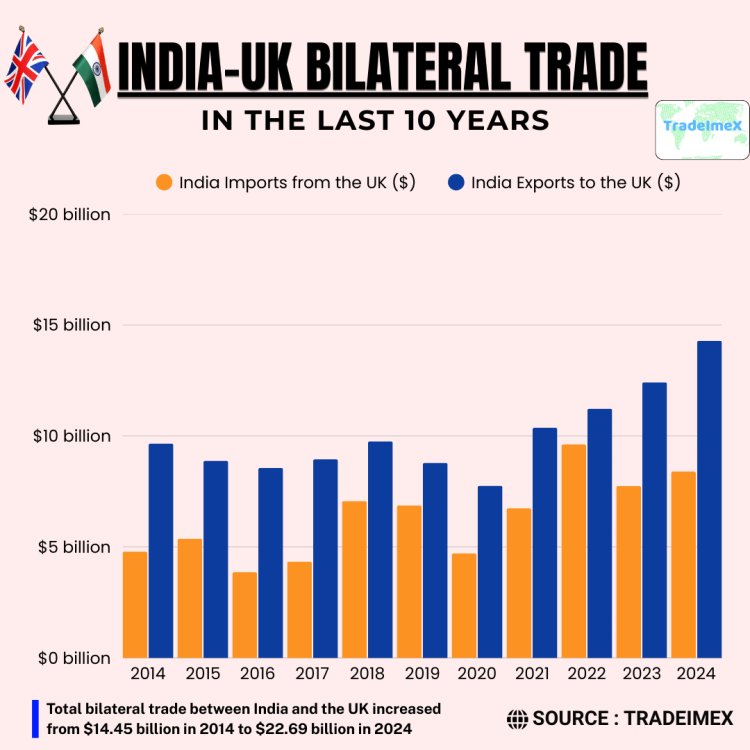
The India-UK free trade agreement has been established for the betterment of both economies. These historical figures from our exclusive database reports underscore the deepening economic ties between the two nations and highlight areas for potential growth and balance in trade relations:
|
Year of Trade |
India Imports from the UK ($) |
India Exports to the UK ($) |
UK-India Trade Balance ($) |
|
2014 |
$4.79 billion |
$9.66 billion |
$4.87 billion |
|
2015 |
$5.37 billion |
$8.88 billion |
$3.51 billion |
|
2016 |
$3.86 billion |
$8.56 billion |
$4.70 billion |
|
2017 |
$4.34 billion |
$8.95 billion |
$4.61 billion |
|
2018 |
$7.07 billion |
$9.76 billion |
$2.69 billion |
|
2019 |
$6.87 billion |
$8.79 billion |
$1.91 billion |
|
2020 |
$4.71 billion |
$7.76 billion |
$3.05 billion |
|
2021 |
$6.74 billion |
$10.37 billion |
$3.62 billion |
|
2022 |
$9.62 billion |
$11.23 billion |
$1.61 billion |
|
2023 |
$7.75 billion |
$12.42 billion |
$4.66 billion |
|
2024 |
$8.40 billion |
$14.29 billion |
$5.88 billion |
Key Insights:
- Trade Growth: Total bilateral trade between India and the UK increased from $14.45 billion in 2014 to $22.69 billion in 2024, nearly doubling over the decade.
- Trade Balance: India consistently ran a trade surplus with the UK throughout this period, with the balance widening from $4.87 billion in 2014 to $5.88 billion in 2024.
- Imports and Exports: India's imports from the UK grew from $4.79 billion in 2014 to $8.40 billion in 2024. India's exports to the UK increased from $9.66 billion to $14.29 billion over the same period.
UK-India Bilateral Trade Snapshot (2024)
|
Metric |
Value (USD) |
|
Total Bilateral Trade |
$22.69 billion |
|
India's Exports to the UK |
$14.29 billion |
|
India's Imports from the UK |
$8.40 billion |
|
UK FDI into India (2022–23) |
$1.74 billion |
|
Cumulative UK FDI (2000–23) |
$33.9 billion |
Key Features of the India–UK Free Trade Agreement (FTA)
- Tariff Reductions:
- India will eliminate tariffs on 99% of UK exports, including whisky, cars, and aerospace products.
- The UK will remove tariffs on 85% of Indian exports, such as textiles, food, and jewelry.
- Services and Mobility:
- Enhanced access for UK services in Indian markets, including telecommunications, legal, and financial services.
- Visa provisions for Indian professionals, including musicians, chefs, and yoga instructors.
- Economic Impact:
- Projected to boost bilateral trade by $34 billion annually by 2040.
- Expected to increase UK GDP by £4.8 billion over 15 years.
- Implementation Timeline:
- The agreement is set to take effect within 12 months, pending ratification by both governments.
Major Highlights of the India-UK Free Trade Agreement
Tariff Reductions and Elimination
One of the key aspects of the UK-India free trade agreement is the reduction and elimination of tariffs on a wide range of goods and services. This move is expected to benefit exporters from both countries by making their products more competitive in the respective markets. Industries such as textiles, automotive, and pharmaceuticals are likely to see a significant boost from these tariff reductions.
Market Access
The agreement also focuses on improving market access for businesses in both countries. This includes streamlining customs procedures, reducing non-tariff barriers, and promoting trade facilitation measures. As a result, businesses will find it easier to access each other's markets, leading to increased trade volumes and business opportunities.
Investment Promotion
In addition to trade in goods and services, the UK-India free trade agreement also emphasizes the promotion of investment between the two countries. This will create a conducive environment for businesses to invest in each other's markets, fostering economic growth and job creation. The agreement includes provisions for investor protection and dispute resolution mechanisms to ensure a fair and transparent investment climate.
Intellectual Property Rights
Protecting intellectual property rights is crucial for fostering innovation and creativity in both economies. The free trade agreement includes provisions for the protection of intellectual property rights, ensuring that businesses and individuals can safeguard their innovations and creations. This will encourage investment in research and development activities, leading to the growth of innovative industries in both countries.
Benefits of the UK-India Free Trade Deal
Enhanced Trade Flows
The free trade agreement is expected to enhance trade flows between the United Kingdom and India, benefiting businesses and consumers in both countries. By reducing trade barriers and improving market access, businesses will be able to expand their export opportunities and reach new customers. This will result in increased competition, lower prices, and a wider variety of goods and services for consumers.
Economic Growth
The agreement is set to boost economic growth in both countries, creating jobs and increasing productivity. By promoting trade and investment, businesses will be able to capitalize on new opportunities and expand their operations. This will contribute to overall economic development and prosperity, benefiting the people of both nations.
Strengthened Bilateral Relations
Beyond the economic benefits, the India-UK free trade agreement benefits will also strengthen the bilateral relations between the United Kingdom and India. By deepening their economic ties, the two countries will further solidify their partnership and collaboration in various areas. This will pave the way for enhanced cooperation in fields such as education, technology, and research.
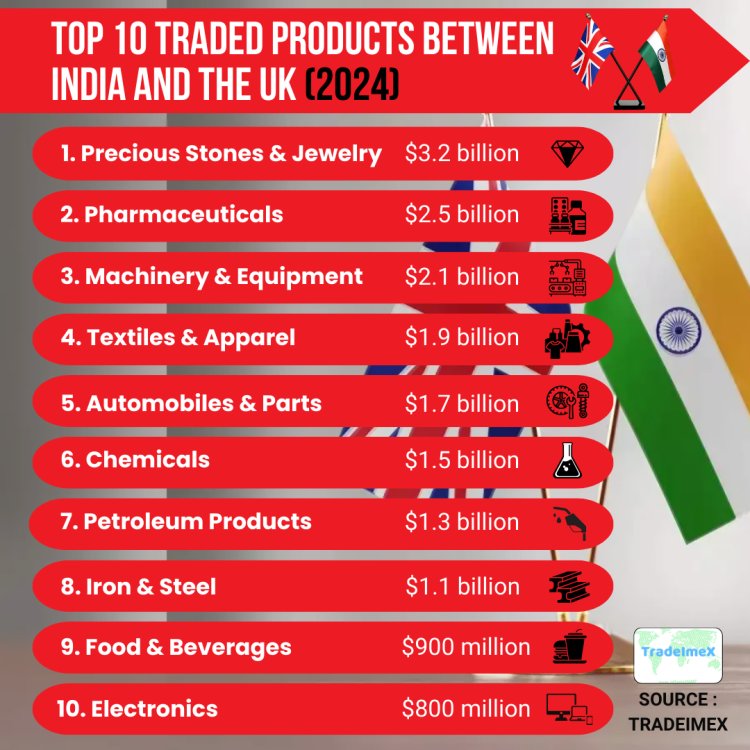
Top 10 Traded Products Between India and the UK (2024)
|
Rank |
Product Category |
Trade Value (USD) |
|
1 |
Precious Stones & Jewelry |
$3.2 billion |
|
2 |
Pharmaceuticals |
$2.5 billion |
|
3 |
Machinery & Equipment |
$2.1 billion |
|
4 |
Textiles & Apparel |
$1.9 billion |
|
5 |
Automobiles & Parts |
$1.7 billion |
|
6 |
Chemicals |
$1.5 billion |
|
7 |
Petroleum Products |
$1.3 billion |
|
8 |
Iron & Steel |
$1.1 billion |
|
9 |
Food & Beverages |
$900 million |
|
10 |
Electronics |
$800 million |
Key Sectors Set to Benefit from the India–UK Free Trade Agreement
The recently signed India–UK Free Trade Agreement (FTA) is poised to significantly enhance bilateral trade, aiming to elevate it to $120 billion by 2030. This landmark deal is expected to catalyze growth across various industries in both nations. These major sectors are set to reap substantial benefits from this agreement:
8 Sectors Poised for Growth due to the UK-INDIA FTA
- Textiles: Indian textile manufacturers will gain improved access to the UK market, benefiting from reduced tariffs and streamlined export processes. This category already constitutes one of India’s top exports to the UK, and the deal aims to remove tariffs of up to 12% on these products.
- Auto Parts: The agreement facilitates easier export of Indian auto components to the UK, potentially boosting India's automotive supply chain.
- Information Technology (IT) Services: Indian IT firms are expected to see increased opportunities in the UK, with the FTA promoting smoother cross-border service delivery.
- Pharmaceuticals: The deal is anticipated to enhance the export of Indian pharmaceutical products to the UK, supporting India's role as a global pharma hub.
- Gems & Jewelry: Indian exporters in this sector will benefit from reduced duties, making their products more competitive in the UK market.
- Leather: The FTA is set to open up new avenues for Indian leather goods in the UK, with tariff reductions making exports more viable.
- Engineering Goods: Indian engineering products are likely to gain a stronger foothold in the UK, aided by the elimination of trade barriers.
- Agricultural Products: The agreement is expected to facilitate the export of Indian agricultural commodities to the UK, promoting diversity in the UK's food supply.
Here's a detailed look at them, along with the Harmonised System (HS) codes used for international trade classification:
|
Sector |
Benefits of FTA |
Key HS Codes |
|
Textiles & Apparel |
Tariff cuts for Indian garments and fabrics in the UK retail markets. |
HS Code 61 (Knitwear), HS Code 62 (Woven garments), HS Code 52 (Cotton) |
|
Auto Components |
Easier access for Indian parts makers in the UK’s EV and auto supply chain. |
HS Code 8708 (Parts and accessories of vehicles) |
|
IT Services |
Liberalisation of cross-border digital and consultancy services. |
HS Code 9983 (IT and software services under GST in India) |
|
Pharmaceuticals |
Lower regulatory barriers and faster approvals for generics. |
HS Code 3004 (Medicaments), HS Code 3002 (Vaccines and biologics) |
|
Gems & Jewellery |
Duty cuts on polished diamonds, gold jewellery, and silver articles. |
HS Code 7102 (Diamonds), HS Code 7113 (Jewellery) |
|
Leather Goods |
Improved market access for leather footwear and bags. |
HS Code 4202 (Leather bags), HS Code 6403 (Leather footwear) |
|
Engineering Goods |
Boost to India’s machinery and industrial exports. |
HS Code 84 (Machinery), HS Code 85 (Electrical equipment) |
|
Agricultural Products |
Access for basmati rice, marine goods, tea, and spices. |
HS Code 1006 (Rice), HS Code 0306 (Shrimp), HS Code 0902 (Tea), HS Code 0904 (Spices) |
Future Outlook for the United Kingdom-India FTA
- Trade Growth: India aims to increase exports to the UK to $30 billion by 2029–30.
- Investment Opportunities: The FTA is expected to attract more UK investments in India's infrastructure, technology, and renewable energy sectors.
- Strategic Partnership: The agreement strengthens the Comprehensive Strategic Partnership between India and the UK, fostering deeper economic and cultural ties.
Conclusion and Final Thoughts
The UK-India free trade agreement or the India-UK free trade deal marks a significant milestone in the UK-India trade relations. By fostering trade, investment, and innovation, this agreement promises to bring about mutual benefits and opportunities for businesses and individuals in both nations. As the two countries embark on this new chapter in their bilateral trade relations, the future looks promising for cooperation and growth with the start of the India-UK trade deal.
Remember, free trade agreements (FTAs) are negotiated and signed by countries to facilitate trade and boost economic growth. These agreements aim to eliminate or reduce trade barriers such as tariffs, quotas, and non-tariff barriers, thereby enhancing market access and promoting economic integration. FTAs provide significant benefits for businesses, consumers, and economies, fostering innovation, growth, and prosperity.
We hope that you liked our insightful blog report on the UK-India free trade agreement 2025. Visit TradeImeX to get exclusive global trade records & search live data, along with our latest import-export database reports for the first quarter of 2025. Contact us at info@tradeimex.in to get the import-export database of 100+ countries, including the UK.
Share
What's Your Reaction?
 Like
3
Like
3
 Dislike
0
Dislike
0
 Love
0
Love
0
 Funny
0
Funny
0
 Angry
0
Angry
0
 Sad
0
Sad
0
 Wow
0
Wow
0